


Aug 29, 2018 11:00 PM
Updated Mar 8, 2024 4:36 PM
Walter G. Moss: By the end of July 2018, The Washington Post concluded that “President Trump has made 4229 false or misleading claims in 558 days;” or as CNN summarized it an average of 7.6 mistruths a day.
About a half century ago, as an employee of the Defense Intelligence Agency, I entered the CIA building for a meeting and was surprised to see on one of its walls a Biblical quote. It read: “And ye shall know the truth and the truth shall make you free.” (John 8:32) How appropriate it is then that John Brennan, former head of the CIA, has recently written, “Mr. Trump, however, has shown highly abnormal behavior by lying routinely to the American people without compunction, intentionally fueling divisions in our country and actively working to degrade the imperfect but critical institutions that serve us.”
Many months earlier, Sen. Jeff Flake (R-Ariz) had summed up Trump’s approach to truth in 2017:
2017 was a year which saw the truth—objective, empirical, evidence-based truth—more battered and abused than any other in the history of our country, at the hands of the most powerful figure in our government. It was a year which saw the White House enshrine “alternative facts” into the American lexicon, as justification for what used to be known simply as good old-fashioned falsehoods. It was the year in which an unrelenting daily assault on the constitutionally protected free press was launched by that same White House, an assault that is as unprecedented as it is unwarranted. “The enemy of the people,” was what the president of the United States called the free press in 2017.
By the end of July 2018, The Washington Post concluded that “President Trump has made 4229 false or misleading claims in 558 days;” or as CNN summarized it an average of 7.6 mistruths a day.
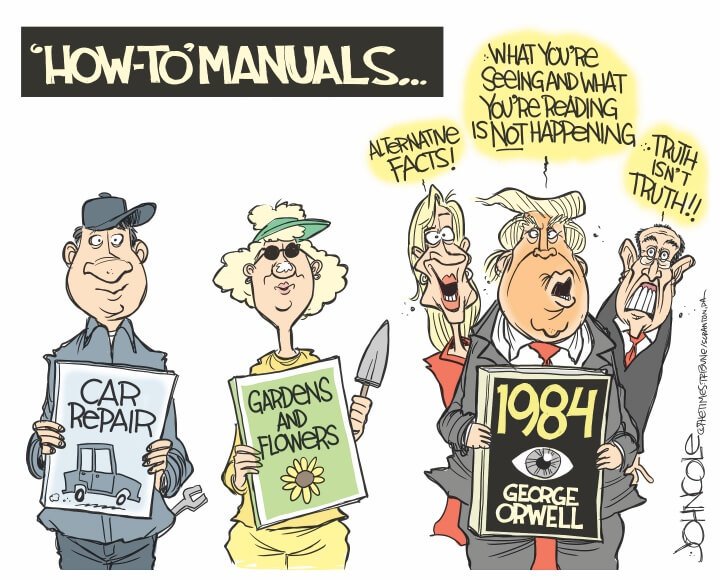
By the end of July 2018, The Washington Postconcluded that “President Trump has made 4229 false or misleading claims in 558 days;” or as CNN summarized it an average of “7.6 mistruths a day.” Some Trump administration statements about truth have already become legendary: Trump counsellor Kellyanne Conway’s claim that a “White House press secretary gave “alternative facts” when he incorrectly stated that Trump’s inauguration crowd was “the largest ever”; and, most recently, Trump lawyer Rudy Giuliani’s statement on Meet the Press that “truth isn’t truth.” (In fairness to Mr. Giuliani, he later clarified that his “statement was not meant as a pontification on moral theology but one referring to the situation where two people make precisely contradictory statements, the classic ‘he said, she said’ puzzle.”)
Related stories
In late August 2018 Trump’s personal attorney, Michael Cohen, pleaded guilty to violating campaign law by paying off two women who claimed that they had affairs with Trump. Cohen stated that the payments were made “in coordination with and at the direction of a candidate for federal office” undefined.This was just the latest revelation to indicate that the president has consistently lied about his knowledge of payments since just days before he was elected when his spokesperson said, “We have no knowledge of any of this.” (See here for a detailed list of Trump administration lies regarding the payments.)
In a July 2018 speech in South Africa, former President Obama alluded to earlier Trumpian falsehoods without mentioning the chief encourager of them.
Unfortunately, too much of politics today seems to reject the very concept of objective truth. People just make stuff up. . . . We see it in state-sponsored propaganda; we see it in internet driven fabrications, we see it in the blurring of lines between news and entertainment, we see the utter loss of shame among political leaders where they're caught in a lie and they just double down and they lie some more. Politicians have always lied, but it used to be if you caught them lying they'd be like, "Oh man." Now they just keep on lying.
. . . We see it in the promotion of anti-intellectualism and the rejection of science from leaders who find critical thinking and data somehow politically inconvenient. And, as with the denial of rights, the denial of facts runs counter to democracy, it could be its undoing, which is why we must zealously protect independent media; and we have to guard against the tendency for social media to become purely a platform for spectacle, outrage, or disinformation; and we have to insist that our schools teach critical thinking to our young people, not just blind obedience.
Obama’s words on politicians rejecting science reminds us that the Trumpian truth-trampling that we now see has been fostered in recent decades by Republican denials of scientific climate-change science. According to a 2013 source, there were then 135 climate-change deniers in Congress, overwhelmingly, if not unanimously, Republicans. One of the most influential deniers has been Republican Senator James Inhofe (Okla.), who served as chairman of the Senate committee overseeing climate change from 2003 to 2007 and then again from 2015 to 2017. Already in 2003 he indicated his belief that global warming was “the greatest hoax ever perpetrated on the American people.” In 2012, he devoted some 300 pages to the subject in his The Greatest Hoax: How the Global Warming Conspiracy Threatens Your Future.
Yet, already in 2009 a statement by the Academies of Science of the USA, other G-8 countries, and the five leading emerging economies (Brazil, China, India, Mexico and South Africa) proclaimed that “the need for urgent action to address climate change is now indisputable.” In that same year, 84 percent of U.S. scientists said that “the earth is getting warmer because of human activity such as burning fossil fuels.”
As with scientists, so too with the intelligence community—despite all its faults—truth is important because wise decision-making depends on an accurate (i.e., truthful) portrayal of reality. (For example, the Rand Corporation, which is part of that community, recently issued a report (and book) entitled “Truth Decay.” It identified four trends that characterize this decay:
- increasing disagreement about facts and analytical interpretations of facts and data
- a blurring of the line between opinion and fact
- the increasing relative volume and resulting influence of opinion and personal experience over fact
- declining trust in formerly respected sources of facts.
In June 2018, former President Obama indicated that the book was on his reading list and wrote, “The title is self-explanatory, but the findings are very interesting. A look at how a selective sorting of facts and evidence isn’t just dishonest, but self-defeating to a society that has always worked best when reasoned debate and practical problem-solving thrive.”
In her The Death of Truth: Notes on Falsehood in the Age of Trump (2018), Michiko Kakutani writes: “Two of the most monstrous regimes in human history came to power in [Russia and Germany in] the twentieth century, and both were predicated upon the violation and despoiling of truth, upon the knowledge that cynicism and weariness and fear can make people susceptible to the lies and false promises of leaders bent on unconditional power.” She then quotes Hannah Arendt’s The Origins of Totalitarianism (1951): “The ideal subject of totalitarian rule is not the convinced Nazi or the convinced Communist, but people for whom the distinction between fact and fiction (i.e., the reality of experience) and the distinction between true and false (i.e., the standards of thought) no longer exist.”
In her later essay “Truth and Politics” (1967), Arendt broadened her criticism beyond totalitarian regimes: “No one has ever doubted that truth and politics are on rather bad terms with each other,” and she suspected that politics may “be at war with truth in all its forms.” But by 1967 [amidst the Vietnam War], she thought matters were getting worse: “Factual truth, if it happens to oppose a given group’s profit or pleasure, is greeted today with greater hostility than ever before.” She also feared that the growing difficulty of distinguishing between truth and lies was fostering a “peculiar kind of cynicism—an absolute refusal to believe in the truth of anything.”
What Arendt indicated in 1967 is even truer today: truth is not highly valued in our society. Not so by most politicians. Not so by Fox News. Not so by Madison Avenue. Not so by various salespersons trying to sell us what we don’t need.
We also have to admit that truth is a complex subject. Look, for example, at the long article and bibliography on Truth at the Stanford Encyclopedia of Philosophy. Moreover, even if we honestly seek the truth (and try to put aside our biases), we are like the blind men and an elephant in the old Buddhist story where they all define an elephant differently depending on which part of it they touched. They quarrel, shout, and come to blows. Buddha's point was that reality is much larger than most of us can grasp, and like the blind men who only felt a tusk, a trunk, or a tail, we are wrong to think that reality is limited to the small portion we think it is. At best, we each grasp part of the truth. We must all be humble enough to realize that the best we can do is be truth-seekers.
Despite these caveats, however, there were other words in Arendt’s essay that can give us hope. She noted that truth possesses a stubborn staying power that lies lack. “This is the reason that consistent lying, metaphorically speaking, pulls the ground from under our feet and provides no other ground on which to stand.” In addition, she believed that in democratic societies there were certain groups that often fought for truth. Among them were philosophers, scientists, artists, historians, judges, and reporters.
Recent events involving these groups and some of the individuals and publications mentioned above—like the court cases of Michael Cohen and Paul Manafort, the criticisms of Brennan and former President Obama, the Rand report on Truth Decay and Kakutani's book, and all the honest media reporting (like that of The Washington Post)—give us hope. (Web sites like that of the LA Progressive have also contributed to unmasking Trump’s lies.)
In our whole national trauma battling Trump’s falsehoods, I am reminded of the Dreyfus Affair in France more than a century ago. In 1894, Captain Alfred Dreyfus, a French officer of Jewish descent, was convicted of treason and imprisoned on Devil’s Island, where he remained until 1899, when he returned to France for a new trial. Although convicted again, he was pardoned but not fully exonerated until 1906.
Dreyfus’s convictions and imprisonment were due to military and government dishonesty and buttressed up by French antisemitism. The case split French society into pro- and anti-Dreyfus factions—just as today in the USA we are split between pro- and anti-Trump groupings. That Dreyfus was eventually exonerated was due mainly to those elements of the press and individuals like the author Émile Zola who spoke out for justice and against government dishonesty and antisemitism.
The battle of Zola and the defenders of Dreyfus should encourage us and give us hope that the stubborn seeking of truth and the courageous defense of it will erode the ground from under Trump's tower of lies and lead to its collapse.
Walter G. Moss
Comments

Powered by RoundtableAn AI/DeFi-powered Enterprise Media Operating System. Learn more at Roundtable.io.© Roundtable 2026. By using this site you agree to the Terms of Use and Privacy Policy