
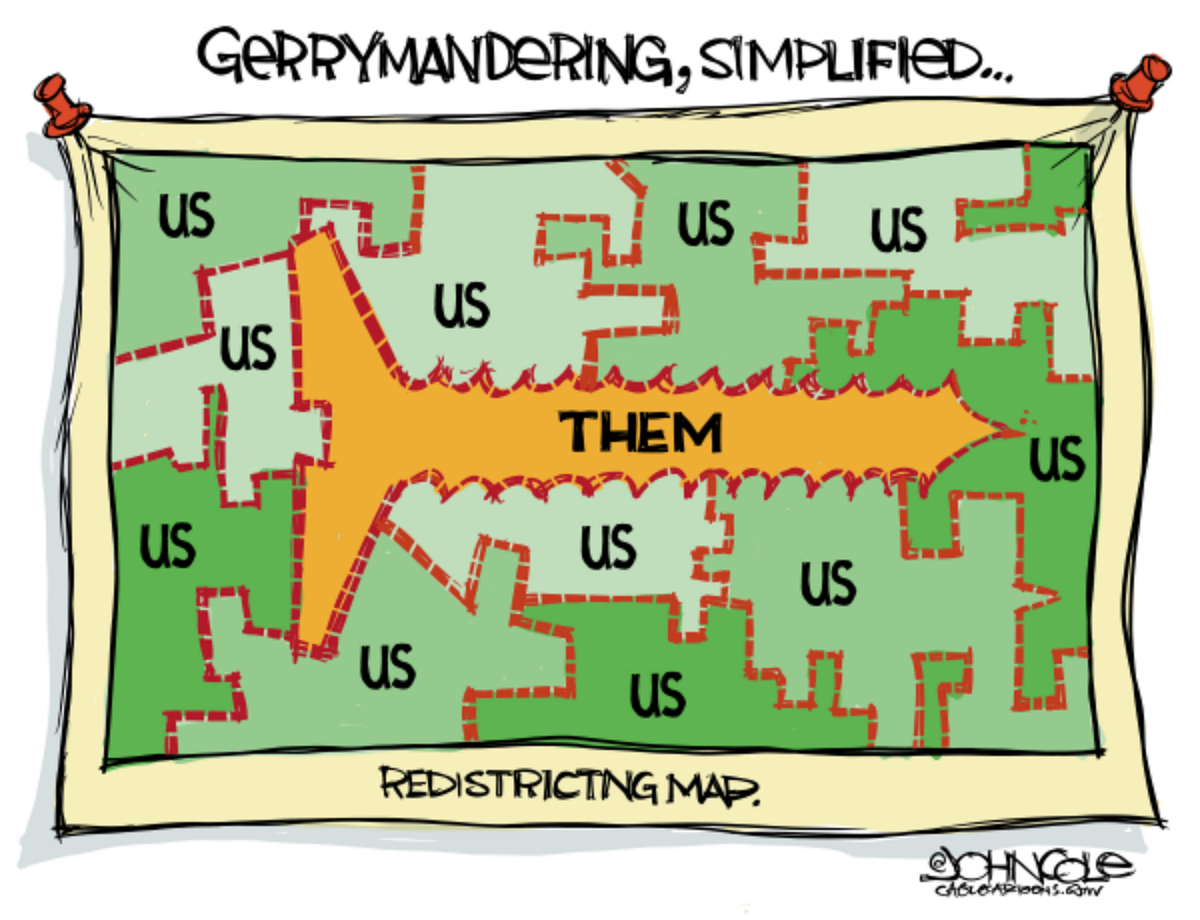
Cagle Cartoons: John Cole


Nov 28, 2025 4:05 AM
Federal court recently bars Texas from using Trump’s map in midterms due to it being an illegal racial gerrymander
In Shakespeare’s Hamlet, the prince of Denmark utters a memorable quip about an enemy being “hoisted with his own petard.” A petard was a medieval instrument of war consisting of a bell-shaped metal container filled with explosives, used to blow in a door or a gate or breach a wall. Premature explosion in your own face was an ever-present danger, and being hoisted by your own petard morphed into a popular expression implying an ironic reversal where one’s own actions backfire and cause you harm.
And now, in the wake of Tuesday’s federal court ruling, how bracingly it can be applied to Donald Trump’s malicious and destructive mid-decade redistricting gambit. Trump and his MAGA congressional cohorts were willing to greedily blow up American democracy in order to squeeze more House seats out of the Texas delegation in order to save MAGA’s three-vote majority. To lock in what MAGA Texas Attorney General Ken Paxton called their One Big Beautiful Map, they were willing to deploy Vietnam war era logic: “We had to bomb the village to save it.”
But now a three-member panel of federal judges has, at least temporarily, saved the village and stopped the bomb squad by ruling that the new Texas map is unconstitutional. Trump and Republican’s tawdry strategy has gotten hoisted by their own petard in three different ways.
First, Trump and MAGA have, as a matter of policy and ideology, always attacked every form of race-based interventions. Whether the policy is over admission to college, banning the use of DEI (diversity, equity and inclusion) initiatives as illegal discrimination, ending federal contractor affirmative action requirements, or using the power of the presidency and the federal government to censor discussions on historical or systemic racism, Trump’s version of a so-called “colorblind society” has always meant a white dominant reich. Racial considerations, present or past, have been banished from government policy.
Related stories
Except when it benefits Republicans. Not only has the federal court blocking Texas’s plan ruled it unconstitutional, but it has also decided that it is an unconstitutional racialgerrymander. It turns out Harmeet Dhillon, the anti-civil rights attorney who heads the civil rights division in Trump’s Department of Justice, inadvertently revealed the administration’s race-based strategy for Texas’s mid-decade redistricting in a letter to Texas Governor Greg Abbott, who then cited Dhillon’s letter when he added redistricting to a special session he’d scheduled for the Texas legislature.
US District Judge Jeffrey Brown, who was actually appointed by Trump in 2019, wrote in the court’s opinion that “the Governor explicitly directed the Legislature to redistrict based on race.” The White House apparently didn’t realize they were stoking their petard full of explosives that were going to blow up in their face. In the 2-1 decision, Judge Brown and his fellow judge not only overturned the Texas map as an unconstitutional racial gerrymander, but he skewered Dhillon’s letter in his decision, writing that it is “challenging to unpack the DOJ Letter because it contains so many factual, legal, and typographical errors.”
What this means is that, for his redistricting attack, Trump tried to use a race-based policy even though he had banned such policies. The evidence just keeps piling up, as Republican-drawn mid-decade maps across four states have targeted a total of nine Democratic-held seats, and six of those seats have been held by Black or Latino lawmakers.
“The state of Texas is only 40 percent white, but white voters control over 73 percentof the state’s congressional seats,” NAACP President Derrick Johnson said in a statement. “It’s quite obvious that Texas’s effort to redistrict mid-decade, before next year’s midterm elections, is racially motivated.”
Here’s where it gets even more Shakespearean. Unashamed by its hypocrisy, Trump’s Department of Justice used the opposite rationale when it sued California over its new voter-approved redistricting plan, which is meant to give Democrats in the Golden State an edge next year. DOJ attorneys are arguing that California’s redistricting plan was sold as a purely partisan gerrymander when in fact “the focus was not partisanship, but race,” according to the DOJ, which they say is impermissible under the US Constitution.
So the White House would ask everyone to believe that in conservative Texas the mid-decade redistricting is partisan-based, not racial, which is constitutionally permissible; but in Democratic stronghold California, it’s just the opposite. Unfortunately for Trump, his own-appointed federal judge is not buying it.
Petard number two, ready for hoisting
The second petard blowing up in Republican’s face is the judge himself. Not only was he appointed to the federal court by Trump in 2019, but Judge Brown served before that on the Texas Supreme Court. Texas Governor Abbott celebrated Brown’s appointment, noting that the judge had started his career as a law clerk for the governor himself when he was serving on the state Supreme Court. Abbott released a statement at that time saying, “I applaud President Trump for nominating Jeff Brown…I have had the privilege to work with [Jeff]…and have witnessed firsthand” Brown’s and another nominee’s “sharp legal minds and commitment to the Constitution and the rule of law.”
Jeff Brown was their man on the federal court, ready to provide judicial cover for whatever outrage stampeded out of the White House. But now he’s their judicial petard, plumped up like a Mexican piñata that also has exploded in their faces.
Petard number three – California’s revenge
Trump’s greedy demands for more GOP seats in Texas was the centerpiece of a national campaign to redraw maps ahead of the midterms. The new Texas map was focused on turning five Democratic-held House seats into GOP seats next year, and it kicked off a number of redistricting efforts from both parties across the country. That dubious process culminated in California Democrats winning voters’ overwhelming approval to launch their own favorable map trying to flip five Republican-held seats.
Now Judge Brown has ordered Texas to use its previous map enacted after the 2020 census. But California’s plan will still march forward. Not surprisingly, Texas has announced it will appeal the federal court ruling to the US Supreme Court but if the ruling stands, Republicans might well end up on the losing end of this mid-decade redistricting battle that they started. Ka-boom, petard number three could blow up in their faces as well.
Drawing racialized districts was a temporary solution that eventually backfired
If Shakespeare were alive today, writing and commenting on the ridiculous foibles of political intrigue coming from the Trump White House, he might well call this poetic justice for the unjust.
But it’s also yet another ridiculous episode in American politics. These are the bitter games of a representative democracy in freefall. When the public discourse has degenerated into, “Which is better, a partisan or a racial gerrymander,” you’ve entered a Hall of Mirrors inside of which reality has lost track of itself. What’s “legal” and what is not has become a game of gotcha from which one party will eventually win, but the nation as a whole cannot possibly emerge victorious. “E Pluribus Unum” takes another hit.
It doesn’t have to be this way. But truth be told, neither Republicans nor Democrats seem to want to enact the deep-rooted changes necessary to end these destructive shenanigans. Because to do so, they would have to overhaul the most basic architecture of all – winner-take-all, single-seat districts that are used to elect all members of Congress, most members of the 50 state legislatures, and most city councils in major cities.
As this whole sordid episode of mid-decade redistricting shows, there is perhaps no better illustration of the deep dilemmas of representation associated with winner-take-all districts than the 60 year effort to manipulate the district lines in legislatures in order to effectuate racial minority representation. Following the passage of the Voting Rights Act (VRA) in 1965, a full court press of legal actions to enforce the drawing of black-majority districts was unleashed. A measure of long-overdue electoral justice was finally achieved, with the number of elected black House members tripling in 15 years, from 6 to 18, and continuing to climb, with fits and starts, for six decades to today’s record of 61 blacks (along with 46 Hispanics, 18 Asian Americans and 3 Native American members out of 435). Yet, despite 60 years of the VRA, whites are still vastly overrepresented, with 72% of House members despite being only 59% of the US population.
While the Voting Rights Act (VRA) has been an enormous and gratifying triumph, at the same time, it has now badly stalled before full and fair representation has been achieved. With the careful gerrymandering of legislative district lines to capture the right pockets of racially-minded voters, with districts infamously shaped like “smashed mosquitos” and the Zorro district shaped like a giant Z and other Picasso painting-like districts, the winner-take-all electoral system has been literally twisted, contorted and forced to do something that it was never meant to do – elect representatives from a minority constituency. Winner-take-all districts are meant to be majoritarian = minorities need not apply.
But the VRA achievement has become an increasingly pyrrhic victory. As the US Supreme Court has turned more right-wing (due to the constitutional bias that gives overweighted influence to nominee-confirming Senators from low-population conservative states), the federal courts have begun turning against the goals of racial representation. Supreme Court decisions like Shaw vs Reno (1993), Shelby County v. Holder (2013), Brnovich v. DNC (2021) and others have made Swiss cheese of voting rights jurisprudence. The only arrow left in the VRA quiver is Section 2, but the US Supreme Court heard arguments in October on whether Section 2 is still constitutional. Longtime VRA advocates fear that, by next summer, there will be nothing left to voting rights jurisprudence and that will be followed by a gradual loss of diversity in legislatures.
As VRA advocates understandably circle the wagons, it is important to recognize that decades of successful voting rights actions have served to perpetuate the continued use of winner-take-all districts and their racially-tinged context. It has unintentionally reinforced the same racialized culture that has fed into the current MAGA white backlash. It is understandable why voting rights leaders have continued down this loaded path, since it has led to levels of electoral success that had not been seen since pre-Jim Crow Reconstruction. But it has always contained the seeds of its own undoing.
In a very real sense, the goals of the Voting Rights Act itself have also been hoisted by their own petard.
Innovation through Proportional Ranked Choice Voting
At this point in the nation’s political evolution, we have no choice but to enact new and innovative approaches that do not depend on the Courts to engineer racial representation and political equality. The most beneficial arrangement for the Democrats and racial minorities would be for the electoral system to evolve from the current single-seat, winner-take-all blueprint to a multi-seat system elected by Proportional Ranked Choice Voting (PRCV). That would allow racial minorities, as well as other minority constituencies, to win their fair share of representation without having to gerrymander any district lines. In the South, such a plan likely would elect more black and white Democrats, as well as some black and moderate Republicans, instead of today’s macabre Southern gallery of nearly all white, right-wing MAGA Republicans. Under a PRCV plan, representatives in the South would reflect the actual demographics of the diverse southern electorate, instead of the MAGA white Congress members that have the largest plurality and dominate there today.
Despite ample opportunity in recent years, there has been little discussion by the national punditry or most Democratic or GOP leaders about how the political mechanics and calculations of the winner-take-all system substantially drives pointlessly adversarial, race-tinged politics (another example of how, as I have previously written, the Democrats are often their own worst enemy). The logic of winner-take-all dictates a singular ambition: that you beat the other side. It is instinctual to the “us against them” knee-jerk DNA of the winner-take-all system.
Nothing in the US Constitution requires single-seat districts for the US House or the 50 state legislatures, and support is building for trying proportional voting options. As has been true throughout US history, the states and cities would be exciting laboratories for trying out this new innovation. We need new tools in the democratic toolbox. Proportional ranked choice voting should be at the top of the list.
Comments

Powered by RoundtableAn AI/DeFi-powered Enterprise Media Operating System. Learn more at Roundtable.io.© Roundtable 2026. By using this site you agree to the Terms of Use and Privacy Policy