
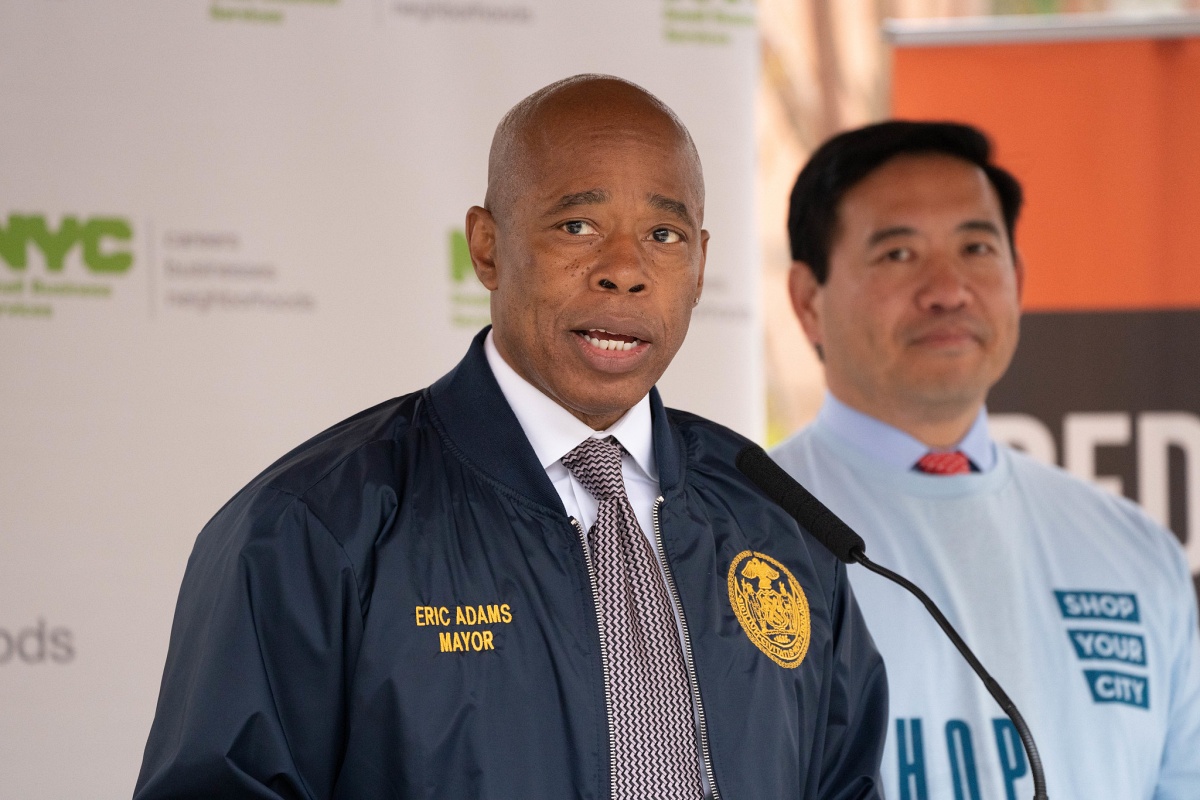
Anthony Quintano • Attribution (CC BY 2.0) • Flickr


Sep 30, 2025 4:25 PM
Updated Sep 30, 2025 6:50 PM
The downfall of Mayor Adams foreshadows a larger problem for the Black political class of New York and the community they presume to represent.
New York Mayor Eric Adams has abandoned his campaign for a second term in recognition that voters want a leadership change in City Hall. His rapid rise and fall sets a dispiriting benchmark in the history of political leadership of the Black community. Moreover, the episode should serve as a wake-up call to the recently empowered Black political class in the city.
Mayor Adams represents a last gasp of political empowerment for the working class Black neighborhoods of New York City. His administration buckled under the weight of gross character flaws, administrative dysfunction, lack of political vision, kowtowing to the police and President Trump, federal charges of bribery and fraud, and utter failure to seize a crucial moment in the city’s Black political history to advance an agenda for the 21st century.
Yet, the downfall of Mayor Adams foreshadows a larger problem for the Black political class of New York and the community they presume to represent. They are being squeezed out by demographic trends and changes in the municipal election system. As such, it appears that a historic period of representation will be short lived and squandered.
The city’s Black political class holds more offices than at any time in history. In recent years, the voting bloc has propelled representatives to the highest levels of executive, legislative, and judicial offices. Yet, their leaders are proving to be incapable of using the positions in a coordinated fashion to advance the concerns of the community.
Related stories
Besides Mayor Adams, there are the high-profiled figures of Manhattan District Attorney Alvin Bragg, State Assembly Leader Carl Heastie (Bronx), State Attorney General Letitia James (Brooklyn), Public Advocate Jumaane Williams (Brooklyn), Bronx DA Darcel Clark, Queens Borough President Donovan Richards, and City Council President Adrienne Adams (Queens). In Congress, there are Gregory Meeks, Yvette Clarke, Jamaal Bowman, and Hakeem Jeffries, the Democratic Minority Leader in the House of Representatives.
But Mayor Eric Leroy Adams was arguably the most important of them all. As the city’s 110th mayor, and second Black mayor, he oversees the machinery of municipal governance. As such, he is in the best position to organize a unity summit around an equity agenda for his base. As well, to establish an independent think-tank to research and develop strategies for how government and self-help approaches can foster economic progress for a hard-pressed constituency.
The truth, however, is that Mayor Adams and the “new Black political class” of the city seem content with simply holding office. There has been little movement to translate individual achievements into a broader agenda for the city’s Black community. As such, Adams and the political class are failing to rise to the historic moment.
To understand the tragedy of Mayor Adams, one must understand the history of New York’s racial politics. It is a story of marginalization with roots in the mass migration to Harlem during World War I. The population expanded rapidly and fostered enclaves in northern Manhattan. It grew to about 328,000 Black residents, or 6 percent of the city’s population, by 1930 and spread to Brooklyn, Queens, and the Bronx in later years.
But the community lacked authentic political representation. Instead, they relied on the Tammany Hall Democratic club under Carmine DeSapio, the old Harlem ward boss and reputed gangster. It took decades for J. Raymond Jones, known as the “Harlem Fox,” to develop as a true community voice. From the 1940s to the 1960s, he challenged the power of Tammany Hall and won election to the City Council. Under his guidance, the Black community nurtured a political class of its own.
Jones mentored a young generation of Black leaders such as Adam Clayton Powell Jr., Percy Sutton, Basil Paterson, Charlie Rangel, and David Dinkins. All would rise to prominent positions in city, state and federal governance. Most notable was Harlem’s famous “Gang of Four” - Sutton, Paterson, Rangel and Dinkins, who became the city's first Black mayor in 1989. Former congressman Charles Rangel, who passed away in May at the age of 94.
Mayor Adams and the current political class are the inheritors of a period of political evolution. The unprecedented office holding of today, however, rests on a shrinking powerbase of about 20 percent of the voting population. An estimated 200,000 Black residents – or about 10 percent of the group population – fled the city over the last 20 years citing housing and economic woes. Left unaddressed, the exodus will have a profound impact on the future of the Black political leadership.
Nonetheless, as a mobilized bloc, Black New Yorkers can remain competitive with the city’s 31 percent white population, 28 percent Hispanic population and 15 percent Asian population, according to the 2020 Census. An advantage is their tendency to vote at higher rates than the non-white voting groups – but they suffer from deficits of money and education in comparison with the white voting bloc.
In addition to a shrinking base, the ascendant Black political class must deal with the change to rank choice voting for the mayoral primary. It requires a high level of information and tends to favor better educated and affluent Democrats like the current mayoral nominee, state assemblyman Zohran Mamdani.
While the political career of Mayor Adams is on the brink, there may still be time for the city’s Black political class to extend its reign. However, to do so will require a concerted campaign to promote the economic development of their constituents. New York suffers from persistent disproportionate levels of Black unemployment even in the best of times. As well, there are concerns over the displacement of Black labor by immigrants in fields like construction and a sizable racial wealth gap, among other challenges.
Amos Wilson, a former historian and social psychologist at the City University of New York, once cautioned an earlier class of the city’s Black political leadership, “as long as the African American community is relatively weak so will be its representatives, no matter how high their offices.”
Comments

Powered by RoundtableAn AI/DeFi-powered Enterprise Media Operating System. Learn more at Roundtable.io.© Roundtable 2026. By using this site you agree to the Terms of Use and Privacy Policy