


May 12, 2026 8:05 PM
Updated May 14, 2026 1:31 AM
How California’s gubernatorial race exposes a political system that rewards wealth extraction, privatized power, and purchased visibility while marginalizing candidates rooted in public contribution and democratic accountability.
There is a legal doctrine in American constitutional law, rooted in Fourth Amendment criminal procedure, known as the “fruit of the poisonous tree.”
The principle is straightforward: when the source is corrupted, the outcomes flowing from that source are also corrupted. Evidence obtained through illegal or unconstitutional means contaminates everything derived from it.
The poisoned tree produces poisoned fruit. Here’s a simple example that makes the principle very clear:
- Imagine a town’s water supply becomes contaminated with poison.
- The town uses that poisoned water to irrigate an apple orchard.
- The apples growing on the trees may look beautiful. They may even taste sweet.
- But the apples are still contaminated because the source feeding them was contaminated.
- The poisoned tree produces poisoned fruit.
Related stories
What if that doctrine applies not only to criminal law, but to American democracy itself? In the same way, when a political system is rooted in concentrated wealth, inequality, and the ability of money (regardless of its source) to dominate visibility, the outcomes produced by that system — the candidates, policies, priorities, and public debates — will also carry the contamination of that unequal system.
The poisoned tree produces poisoned fruit.
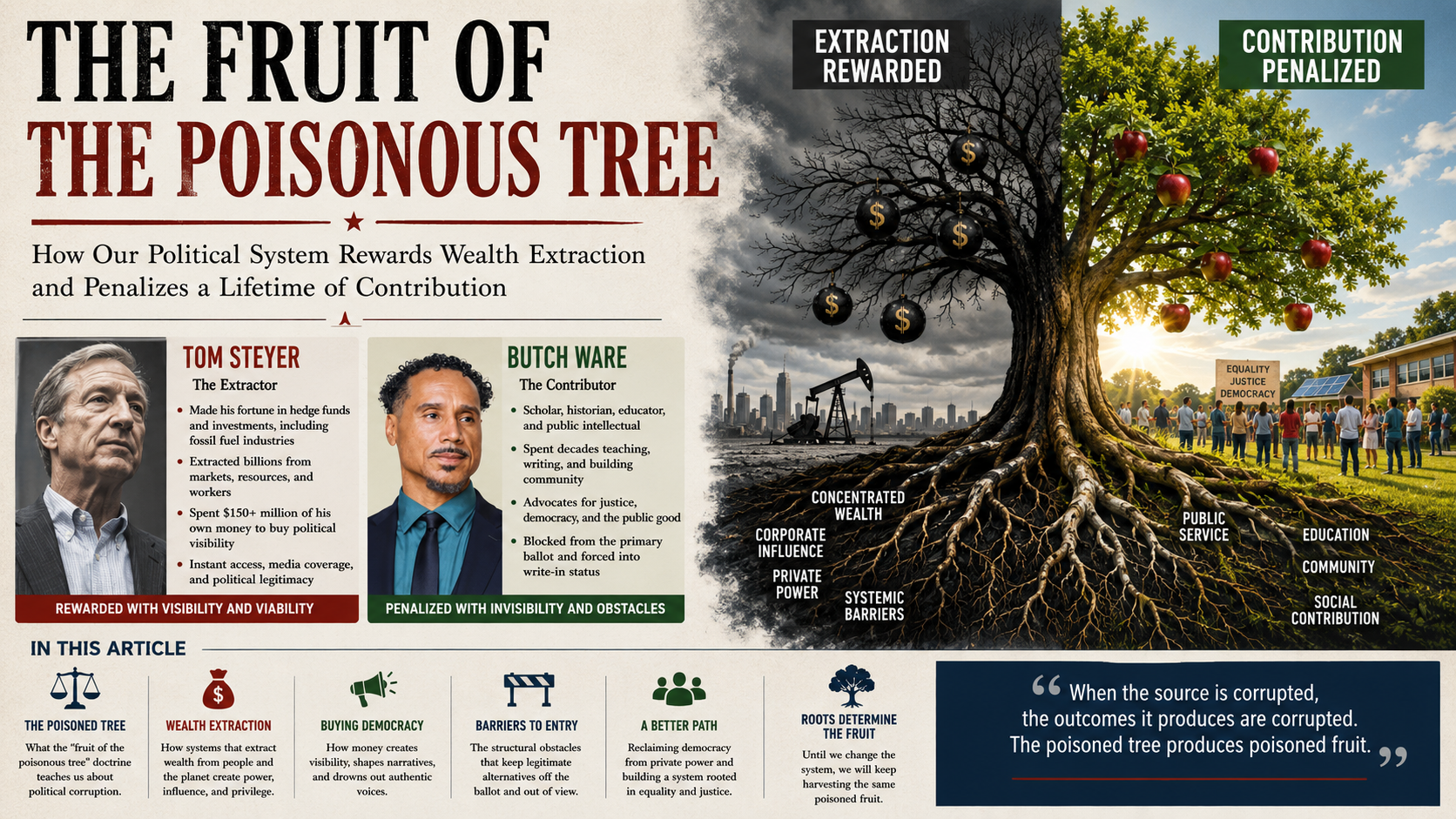
When you compare billionaire gubernatorial candidate Tom Steyer with Green Party gubernatorial candidate Butch Ware, what emerges is not merely a contrast between two men. It is a portrait of a political system that rewards wealth extraction while penalizing social contribution.
One candidate became politically viable through the accumulation of immense private wealth generated inside extractive economic systems.
The other became politically invisible despite years spent contributing intellectually, educationally, and socially to the public good.
That is the fruit.
And concentrated wealth operating as political power is the poisonous tree.
We Would Not Even Be Talking About Tom Steyer
We would not even know who Tom Steyer is politically if he had not spent millions of his personal fortune to make himself impossible to ignore. (this train of thought was injected into this thread by LA Progressive reader, LouThomas. Thank you LouThomas. See the comments section on this article)
This is not a personal attack on Tom Steyer. It is an observation about how our political system and election apparatus operates and who it disadvantages.
Steyer did not emerge through years of grassroots political organizing. He did not become nationally visible because communities organically elevated him into leadership. He did not rise through labor organizing, neighborhood coalitions, tenant movements, or local democratic accountability systems.
He purchased visibility.
His political viability was heavily subsidized by wealth accumulated through decades in the world of private equity, hedge funds, and global finance capital.
That distinction matters.
Because there is a tendency in American culture to treat extreme wealth as morally neutral or even inherently admirable. But the process through which billionaires accumulate wealth is rarely interrogated - honestly.
Steyer made his fortune through Farallon Capital Management, a hedge fund deeply tied to global investment markets, including investments connected to fossil fuel industries and carbon-intensive sectors. Like many financial firms operating at that scale, the model was not primarily about producing goods for communities or directly improving democratic life. It was about maximizing returns on capital.
That is what modern extraction often looks like.
Extraction does not necessarily involve someone physically taking resources by force. It operates through ownership structures, investment systems, speculative finance, and industries whose profitability frequently depends on environmental degradation, labor exploitation, privatization, housing inflation, or social instability that produces precarity by design.
Even Steyer’s later climate activism exists in tension with the reality that the wealth enabling his political rise emerged from systems deeply implicated in ecological extraction.
And now that extracted wealth has been converted into political amplification.
That is the key point.
The system rewards the accumulation of wealth first — regardless of how socially destructive the underlying economic structures may be — and then allows that wealth to be transformed into political legitimacy.
Meanwhile, Butch Ware Struggles for Visibility
Contrast this with Butch Ware.
Ware is a scholar, historian, educator, public intellectual, and political organizer. His work has centered on history, racial justice, political systems, religion, colonialism, democratic critique, and public education. He has spent years contributing knowledge, teaching students, engaging ideas, and participating in civic discourse.
Whatever one thinks of his politics, his orientation toward society has largely been contributive rather than extractive.
Yet most Californians have never heard of him.
Why?
Because contribution and visibility are no longer tightly connected in American democracy.
Capital and visibility are.
Ware’s campaign itself became an illustration of structural exclusion when he faced barriers to appearing on California’s gubernatorial primary ballot and was ultimately forced into write-in status after disputes surrounding ballot qualification requirements and tax-return documentation.
The details matter less than the pattern.
A billionaire candidate can flood the political ecosystem with advertising, consultants, polling, media exposure, and institutional amplification almost instantly.
A candidate rooted in scholarship, organizing, and public contribution can struggle simply to be seen.
That is not democratic equality.
That is political filtration based heavily on access to wealth and institutional infrastructure.
The Two-Party System as Gatekeeper
This problem extends beyond individual candidates.
Americans are encouraged to think of the Democratic and Republican parties as natural expressions of democracy itself. But these are not public institutions. They are private political organizations that have acquired enormous control over American public political life.
That distinction is critical.
These private entities influence ballot access, debate participation, donor legitimacy, consultant ecosystems, media recognition, and the broader definition of “viability.”
As a result, citizens are often choosing not from the full range of political possibility, but from a heavily pre-filtered menu.
And that filtration process overwhelmingly advantages:
- candidates with enormous personal wealth,
- candidates backed by wealthy donors,
- candidates tied to institutional party structures,
- or candidates acceptable to existing power arrangements.
This is precisely why someone like Butch Ware remains politically marginal despite contributing intellectually and socially to public discourse, while someone like Tom Steyer can become instantly “serious” largely through financial saturation.
The system does not reward social contribution equally.
It rewards concentrated capital.
System at Work: Extraction Becomes Leadership
One of the most dangerous myths in American political culture is the idea that immense wealth signals governing competence.
It does not.
Markets reward accumulation. Democracies are supposed to distribute power - not allow it to be hoarded by a concentrated wealthy few.
Those are fundamentally different systems of value.
A hedge fund manager may be highly skilled at generating returns within financial markets. That does not automatically translate into democratic wisdom, public accountability, or moral legitimacy.
Yet modern American politics increasingly treats wealth itself as evidence of leadership capacity.
This is how oligarchy normalizes itself.
The billionaire becomes seen not merely as wealthy, but as naturally qualified to govern.
Meanwhile, teachers, scholars, organizers, social workers, labor leaders, and community builders — people whose work often contributes directly to social cohesion — struggle for political visibility unless backed by major capital.
This inversion is not accidental.
It is structural.
And it reveals what the political system truly values.
The Poisoned Tree
The comparison between Steyer and Ware exposes something deeply troubling about American so-called "democracy".
One man extracted enormous wealth from systems tied to finance capital and fossil fuel investment and was rewarded with political amplification, media legitimacy, and gubernatorial viability.
Another man contributed through education, historical scholarship, civic discourse, and democratic critique and was rewarded with near invisibility.
That is not merely an unfortunate coincidence.
It is the logical outcome of a political system increasingly shaped by concentrated wealth.
The poisonous tree is not Tom Steyer himself.
The poisonous tree is a system where wealth extraction can be converted into political dominance while public contribution struggles even to obtain visibility.
And until that underlying structure changes, the fruit will continue looking exactly like this:
- billionaire candidates treated as inevitable,
- grassroots candidates treated as unrealistic,
- extraction rewarded,
- contribution marginalized,
- and democracy slowly hollowed out from within.
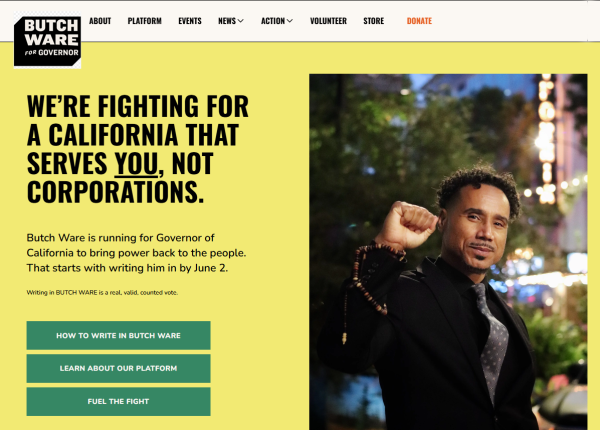
If you've been following this thread, your next question will likely be, "Why didn't the LA Progressive endorse Butch Ware in its voter guide". That answer follows in the next article that will be published shortly. In the meantime, click the image below to learn more about Butch Ware.
Comments

Powered by RoundtableAn AI/DeFi-powered Enterprise Media Operating System. Learn more at Roundtable.io.© Roundtable 2026. By using this site you agree to the Terms of Use and Privacy Policy