


Oct 21, 2020 9:00 PM
Updated Mar 8, 2024 4:31 PM
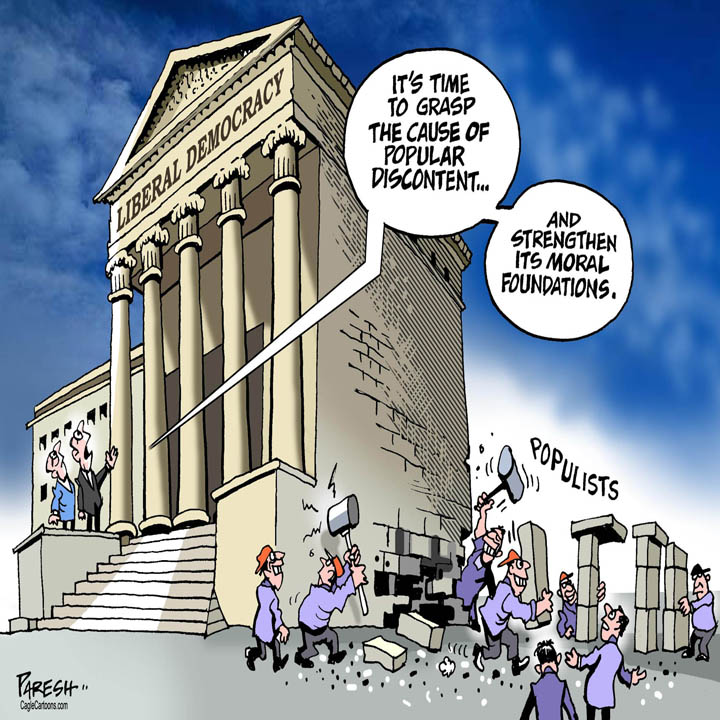
Populists are often dismissed because they are perceived to be reactionary, if not extreme. But lurking at the core are beliefs worth noting.
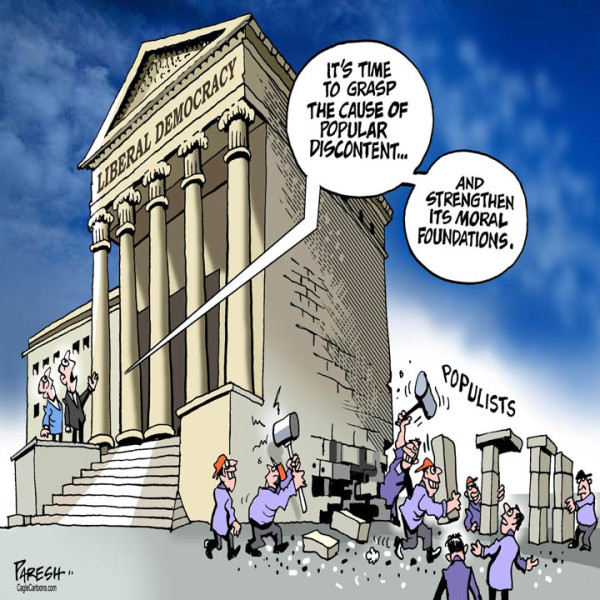
Populism and Populist are words that come trippingly off the tongue these days. One reason is the global rise in populist activity. What does it mean to use those words? Let’s answer that question using everyday-speak and, then, discuss why we should pay close attention to what John B. Judis calls ‘the Populist explosion.’
For starters, Populism isn’t an ‘it’ to be understood as a monolith. Populists occupy a variety of political locations—from Left to Right--across the political spectrum. A way to remember that dictum is by listening to Scottish folk-rock groupStealers Wheel’s early-70’s pop hit,Stuck in the Middle with You (music video if you click). Wheel’s intent is political, so says Diane Smith, who co-wrote the second edition (copyrighted version) of the song’s lyrics.
[Chorus]
Related stories
Here I am
Stuck in the middle with you.
Clowns to the left refers to Liberals, while Jokers to the right symbolizes Conservatives. “Trying to make some sense of it all,” the group lamented, “but I can see it makes no sense at all. I don't think that I can take (it) anymore.”
Second, Wheel’s lyrics aren’t just, well, ‘lyrical.’ The pejorative language—of “clowns and jokers”—is relevant in a discussion of Populism and Populists. Regardless of political stripe, populists share a disdain for ‘the establishment’ and ‘elites’—even though they don’t share a unilateral definition of either term.
But what they do share (based on their idiosyncratic interpretations) is this: the problems they see, and the outrage they feel, is the result of what they believe to be self-serving establishment/elite actions.
For example, ‘open borders’—seen as promulgated by political liberals—is a major concern for America’s Right-leaning populists. ‘Plutocratic control’ (and all that goes with it) is a major concern for America’s Left-leaning populists.
Third, not all Conservatives are Populists, and not all Progressives are Populists—even though each tandem shares commonalities. Populists are a group apart, propelled by angst and antagonism about those who ‘call the shots’ in society and how ‘elites’ are impinging on their everyday life. That includes the institutions and expressions tightly associated with the establishment and elites.
For example, science and scientists are under attack today from the Right. In all cases, though, Populists are primarily reactionaries, which is different from saying that they are largely drawn to a political ethic grounded in values and vision.
While it’s a bit hyperbolic to say that Populists are best known for what they are against, it’s also impossible to understand Populism and Populists without focusing on the issues, institutions, and figures that give rise to their ire.
Fourth, I concur with John B. Judis’s interpretation (in his book,The Populist Explosion) that the rise of populism in any country and at any time is “a warning sign.”Judis believes that Populism becomes accentuated at times and in countries “only under special circumstances…when people see the prevailing political norms—put forward, preserved, and defended by the leading segments in a country—as being at odds with their own hopes, fears, and concerns.”
In America, a recent ‘warning sign’ came in conjunction with the 2016 presidential election and Trump’s election. Not all Trump-supporting Americans (then and today) are populists, but it’s not a stretch to assert that many ‘all-in Trumper’s’ are.
Populists are often dismissed because they are perceived to be reactionary, if not extreme. But lurking at the core are beliefs worth noting.
In 2016, many American voters viewed Hillary Clinton as the candidate who embodied Establishment policies/preferences. She—and not billionaire, corporatist Donald Trump—was the target of widespread disdain.
Fifth, what happened in 2016 (and what has continued since) came as a surprise (even a shock) to many Americans. I’m referring to things like the rise in the number/activity of hate groups and militias on the Right and the emergence of the “Black Lives Matter’ Movement and Antifa activity on the Left.
But if more Americans were familiar with history—in America and abroad—they might view the current ‘Populist explosion’ as nothing surprising or new.
America’s history is replete with Populist initiatives. George Wallace’s 1968 presidential run was a Populist response to politics/circumstances of the day. So, too, wasRoss Perot and the Reform Party’srise twenty-five years later, as was Jesse Ventura’s election as Minnesota’s governor, which also happened in the same decade.
More recent examples include The Tea Party (2008) on the Right, and Occupy Wall Street (2011) on the Left. While it would be a mistake to label these examples exclusively as Populist, excluding them from Populist nomenclature would be an error, too.
Indeed, a national Populist political party emerged in the very late 19th century, and it had widespread influence for decades. It began in reaction to the perceived excesses of billionaire corporatists of the day—the Carnegie’s, Rockefeller’s, Morgan’s, and the like—whose devotion to profits and significant/widespread political influence were viewed by the public (especially by factory laborers and farmers) as self-serving, intrusive forces.
There were many notable Populist figures in that era, and Henry George is one I’ll highlight here. George ran for mayor of New York City as a labor candidate in 1886. He finished second to the Democrat candidate but outpolled Republican candidate and future U.S. president, Teddy Roosevelt. George, who was the Bernie Sanders of his era (in my opinion), is probably best known for his book,Progress and Poverty(1879). In it, George wrote a passage that applies as much today as it did nearly 150 years ago: “Material progress does not merely fail to relieve poverty; it actually produces it. This association of progress with poverty is the great enigma of our times.”
And what I’ve just described isn’t exclusively America’s story. Populism and Populists aren’t strangers globally—either historically or now. One reason is sociopolitical. Parliamentary governmental systems make it easier for populist parties/candidates to gain seats (with voice/influence) in national parliaments.
And the dictum expressed earlier—populists to the Right and Left—definitely applies in Europe, both in good times economically (often from the Left in Northern Europe) and during economic downturns (frequently from the Right in Southern Europe). But we also need to recognize something else that’s happening across Europe these days, namely, concerns/fears about immigration/terrorism, which has precipitated a Right-leaning, Populist presence across the continent and in Great Britain. Highly publicized episodes, such as the beheading of a French school teacher just a few days ago, add fuel to a burning fire.
When coupled with the contemporary urge for Nationalism (akin to Trump’s ‘America First’ emphasis), we see results like Britain’s withdrawal from the European Union. Populist figures Nigel Farage and Boris Johnson led the withdrawal campaign, the latter of whom is serving currently as Britain’s prime minister. The outcome shows that a Populist platform can become government policy, and that a Populist can rise to national prominence—not just in England, but elsewhere. Marine Le Pen and the rise of The National Front in France is an example.
Finally, Populism and Populists share traits with other isms and ists. It’s no stretch to conclude that too much of an ‘ism’ or an ‘ist’ is problematic (think of a socioemotional condition, such as Narcissism, for example). In politics, though, the interesting twist is that ‘too much’ draws adherents and naysayers—and that assertion certainly applies to Populism.
That said, a case can be made that Populism’s broadest social value may reside not at the extremes (supporters/opponents), but, per Stealers Wheel’s interpretation, ‘somewhere in the middle.’ The problem? That’s more easily said than done. Political proclivities don’t always enable people to accept ‘somewhere in the middle’ assertions, a settling place that I call both-and. Instead, many people prefer either/or, that is, A or B not A + B.
Here are two examples of both-and beliefs. As a Progressive Independent, I do not support Trump’s ‘America First’ campaign. That said, I agree with Trump’s insistence that partner countries should pay their fair share to support international collaborations, such as NATO. Or, as John Judis writes: “George Wallace’s call for ‘segregation forever’ was clearly racist, but he was right about the pitfalls of busing children of different races from one urban neighborhood to another. It did result in white flight to the suburbs.” (The Populist Explosion, p. 159, italics added)
Because today’s political worldviews tend to be largely one-sided—either/or … for/against—there’s often little room for expressing boundary-spanning beliefs. If you think I’m hyperbolic, try this experiment (you have to be a Biden-supporter to try it). Approach another Biden-supporter and say you support him, but also view him as a flawed person. Use as an example the multiple instances of Biden plagiarizing others’ speeches during his 1988 presidential election run (find visual evidence here from The Washington Post). Odds are you’ll get excuses, like “That was a long time ago.” “He’s a different person now.” “Trump’s far worse.” Less likely is a response about how Biden—like all of us—is a combination of many features, not one.
How does both-and thinking apply to Populism? For starters, I’d contend that relatively few people reading this essay consider themselves as Populists. At the same time, I’ll bet that many readers find value in any number of Populist-held views (e.g., capitalism, in its optimal form, needs to serve Americans broadly).
Populists are often dismissed because they are perceived to be reactionary, if not extreme. But lurking at the core are beliefs worth noting. Those points of view are always grounded in the words Stealers Wheel sang decades ago: “I got the feeling that something ain't right.”

Populists specialize in telling us what, why, and how ‘something ain’t right.’ Many of us may not buy-into how that thinking gets embellished and put into action—especially when it comes in extreme form—but not paying attention to it and figuring out how to respond both personally and collectively is ... well … a mistake.
Frank Fear
Comments

Powered by RoundtableAn AI/DeFi-powered Enterprise Media Operating System. Learn more at Roundtable.io.© Roundtable 2026. By using this site you agree to the Terms of Use and Privacy Policy