
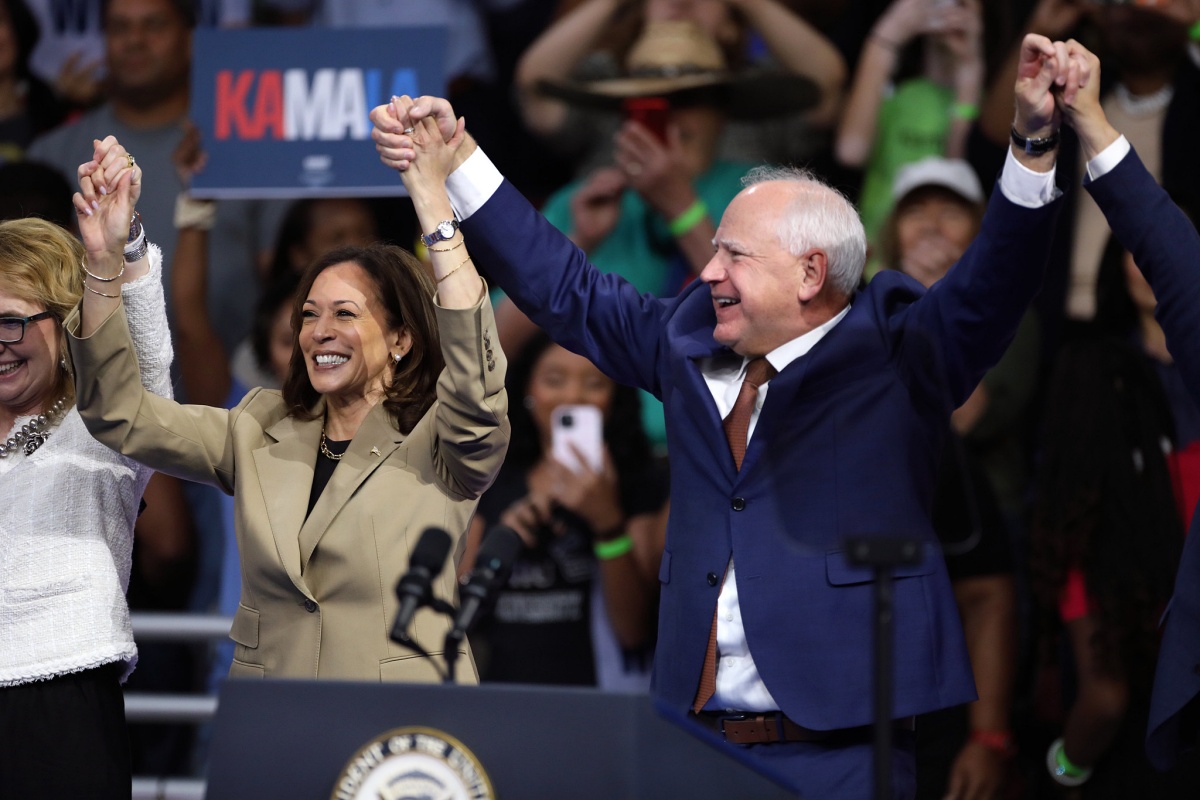
Gage Smidmore •. Attribution-ShareAlike (CC BY-SA 2.0)• Flickr


Restore Working-Class Trust
Oct 17, 2024 3:52 PM
Updated Oct 17, 2024 5:27 PM
The party has not managed to launch a social program of sweeping import since Obamacare was passed 14 years ago.
Donald Trump’s fawning praise for Elon Musk for allegedly firing employees if they grouse about working conditions may be ringing like a bad case of tinnitus for voters who depend on a paycheck.
“I love it,” Trump enthused when the tech billionaire interviewed him on his X social-media platform a week before the Democratic National Convention. “You’re the greatest,” he continued. “I mean, I look at what you do. You just walk in and you just say, ‘You wanna quit?’ They go on strike, I won't mention the name of the company, but they go on strike and you say, ‘That's OK, you’re all gone ... Every one of you is gone.’ ”
That the former “Apprentice” TV personality who made “You’re fired!” a popular salvo after a decade of corporate downsizing would voice contempt for hard-fought union rights isn’t surprising. It fits with his party’s, and his own, aversion to using regulatory or tax policies to reverse nearly a half-century of dislocation and distress endured by working-class communities and Rust Belt states. That many working people still favor him represents a significant problem for the Democratic Party and its standard-bearer Kamala Harris.
While Trump, as president, did strengthen job protections within NAFTA, his nonstop braggadocio centers conversely on the $1.9 trillion tax cut with his name on it for multinational corporations and the wealthiest Americans. He refused in office to commit himself to vetoing right-to-work legislation that would ban mandatory union dues payments.
Related stories
These and other aspects of Trump’s corporatism help explain why Harris has racked up endorsements from Teamsters locals in Michigan, Ohio and New York in defiance of the traditionally Democratic-leaning national union’s decision to remain neutral in the Nov. 5 election. When Trump’s assets are included, he is one of America’s hundreds of billionaires, a private club with a combined portfolio of $4.45 trillion, or about 50% greater than before the COVID pandemic. That the top 1 percent have as much wealth as the bottom 90 percent, a concentration no economist would call a sign of economic vitality, accounts for his penchant for courting attention with anti-everything distractions.
As the Washington Post just reported, Trump continues to test the patience of his union-member supporters, such as Teamsters, with anti-labor comments. As if vying for donations from billionaires, he has in recent days emphasized the idea of firing striking workers, something that is in fact illegal, and he told an Erie, PA, audience Oct. 13 that he’d “get other people in” rather than pay employees’ overtime.
“I know a lot about overtime. I’ve hated to give overtime,” he brayed, seemingly reinforcing a distaste for fringe benefits. “I get other people—I shouldn’t say this, but I’d get other people in. I wouldn’t pay.”
Yet Harris has a problem appealing to many working people and unions in class terms because it’s legitimate to ask, “What have Democrats done for you, and what will you do differently to counter the power of the elite and Big Business, if elected?” Any hesitancy on her part to answer this with concrete actions—as she began to do recently, however, with a pledge to expand Medicare to cover at-home senior healthcare costs and another to give first-time home buyers $25,000 in down payment support—could make the difference between her success or failure in a nip-and-tuck election.
Historically, her difficulty is hardly Harris’s making. In the years since then-President Bill Clinton pushed through the NAFTA agreement 30 years ago, accelerating American deindustrialization on a broad scale, there’s been no obvious answer to that question. There’s been instead an erosion of trust of the Democratic Party’s professed commitment to helping those struggling without substantial real estate or Wall Street investments who are scraping by in once-vibrant smokestack cities.
This loss of confidence cries out for the party’s leaders to push, loud and clear, for new social legislation to make community colleges and state universities more affordable, stem outsourcing without the heavy protectionist tariffs that would drive inflation, and assist working families with child-care expenses and access to mental health and dental clinics. Households and distressed communities need government investment.
But the party has not managed to launch a social program of sweeping import since Obamacare was passed 14 years ago (an initiative that Trump, as president, attempted to derail dozens of times, though JD Vance has given it backhanded credit by ludicrously calling him the legislation’s “father.”).
Perhaps Bill Clinton was right when he lamented to his White House aides that “we’re all Eisenhower Republicans,” in reference to his fellow Democrats. But that observation, made when the former anti-government Republican House member Newt Gingrich was ascending, no longer holds. The present era is different, with many Democratic voters appearing receptive to government programs, especially in the wake of the 2008 economic collapse, the pandemic, and intensifying floods, wildfires, and hurricanes on a heating planet. Joe Biden’s emergency stimulus packages, infrastructure renewal and emissions-cutting agenda can help his party set the course, not to mention Bernie Sanders’s politically astute economic populism of 2020.
Even Missouri Senator Josh Hawley got on board, criticizing fellow GOP congress members who “sang the praises of global integration while Wall Street bet against American industry and bought up single-family homes—so that after the banks took the workingman’s job, he couldn’t afford a house for his family to live in.”
The challenge for Kamala Harris and Tim Walz in the final three weeks before the election is to remind working people of how, even in an economy where investment in Wall Street securities and bonds supersedes the bygone security of traditional pensions, government can help low- and middle-income wage earners in relatable ways. Social Security, the GI Bill, Medicaid and Medicare helped to build the American middle class, after all, as did the higher effective tax rates that the wealthiest Americans faced in boom-times past. New labor-oriented measures of a similar boldness, such as increasing the $7.50 federal minimum wage, guaranteeing family leave as well as, yes, overtime pay, and government-backed medical insurance plans for the elderly and property insurance for people in flood zones would help send the right message to a skeptical yet pragmatic electorate.
The subject of the recent biography I cowrote—the late 20th century lawyer and activist Paul O’Dwyer—demonstrated that the understood the importance for the Democratic Party to hold onto working class support in 1964 (the last year in which a majority of white voters pulled the lever for a Democratic presidential candidate). The then New York City Council president promoted a bill intended to raise the minimum wage in his city that year to $1.50 an hour.
An unapologetic progressive, the Irish-born O’Dwyer scolded that bill’s chief opponent, the Commerce and Industry Association, saying America’s most populated city should never be a “non-competitive, high-wage island” on which the dishwasher, launderer and bakery worker are forced to supplement “starvation wages” with a welfare check.
Nor should the United States.
Trump’s typically glib belittlement of wage earners may make it easier for Harris to set herself off from him, stylistically. But she and her now more diverse party need to work harder to restore working-class trust.
The clock is ticking.
Comments

Powered by RoundtableAn AI/DeFi-powered Enterprise Media Operating System. Learn more at Roundtable.io.© Roundtable 2026. By using this site you agree to the Terms of Use and Privacy Policy