


Reasoned Hope
Nov 6, 2024 7:46 PM
Trump’s words did not merely graze the political sphere; they reshaped it, normalizing a language of hate that now flows freely across the landscape, seeping into every corner.
It’s the day after election day, USA 2024, and Michael Gold of The New York Times has unfurled a chilling narrative, casting light on the pervasive misogyny coloring the current political landscape—a hue that now stains even the nation’s highest offices. He has highlighted the unapologetic, gendered vitriol aimed at prominent figures like Vice President Kamala Harris, former Speaker Nancy Pelosi, and former Congresswoman Liz Cheney. Gold notes that insults, which in a bygone political era might have provoked scandalized gasps and swift reprimands, are now met with uneasy acceptance or, worse, raucous applause.
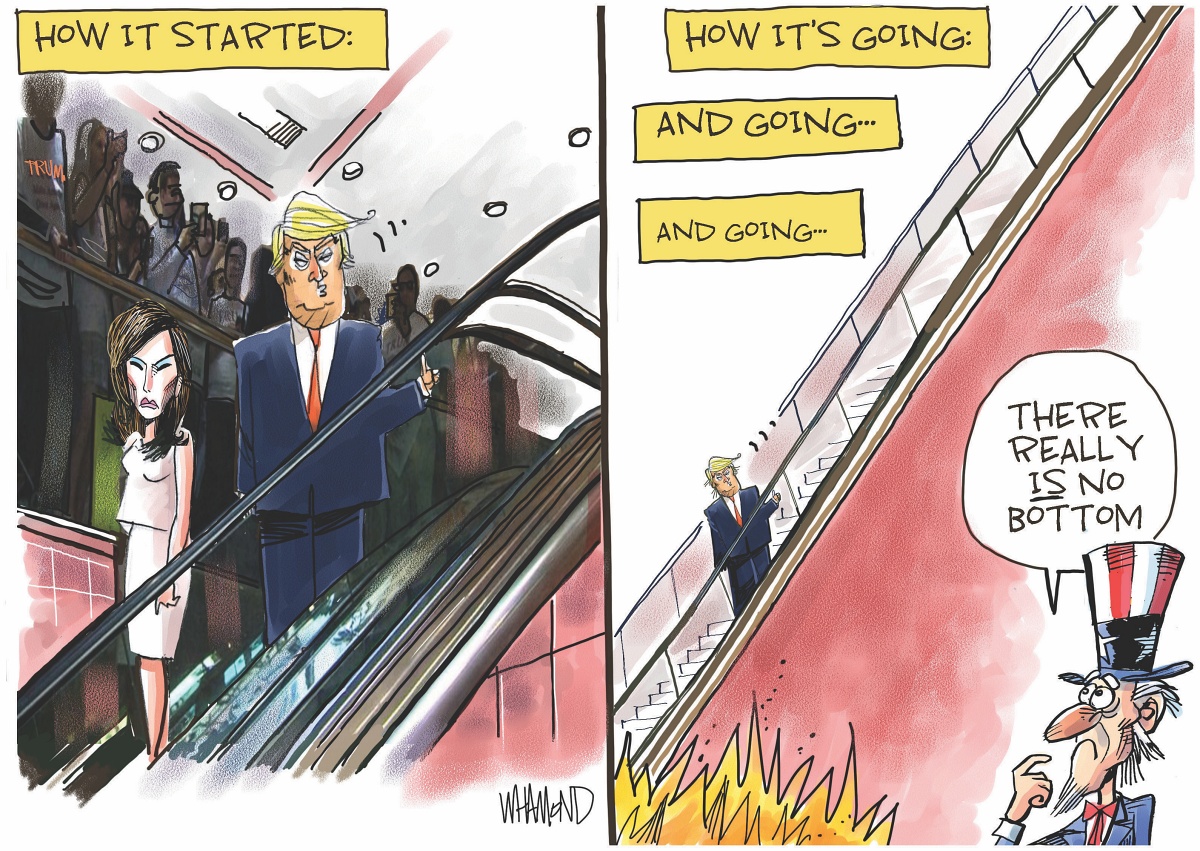
But this is only the surface of a deeper moral erosion. When Donald Trump rode that gleaming golden escalator down from his Fifth Avenue tower, he descended not just into a lobby but into the heart of the American psyche, igniting a raw, polarized discourse that still smolders today. The world witnessed, in those brief moments, a bizarre theatrical transformation—Trump, the self-cast hero, surrounded by orchestrated fanfare: Neil Young's defiant "Rockin' in the Free World" rang out, an anthem almost too ironic, as he waved to a mix of paid supporters, reporters, and tourists caught in his orbit, all draped in hastily handed-out MAGA caps and banners. The scene was unmistakably stage-managed yet electric, marking a pivot in political theater—a visceral plunge into what would become a cascading era of spectacle and vitriol.
With his descent, he invited long-buried animosities to rise, his words like a spark in dry tinder. The speech that followed, laced with xenophobia and fiery claims, was shocking in its bluntness, awakening currents of resentment and grievance, as though peeling back a veneer of civility that had always barely masked a rawer national temperament. This was no ordinary campaign launch but a watershed, a foreboding signal of how far political discourse was about to veer from norms. Here was the pivot: Trump’s words were not the guarded sound bites of polished politicians but a cascade of incendiary statements that captivated some, repulsed others, and divided most.
Little did Americans realize that a new era was upon them in which outrage and spectacle would eclipse the tempered discourse of yesteryear. And as he descended, the nation’s political discourse would descend alongside him, trailing down through a series of ever-sharpening divisions, bitterness deepening into the foundations of the American psyche.
Related stories
Trump’s words did not merely graze the political sphere; they reshaped it, normalizing a language of hate that now flows freely across the landscape, seeping into every corner. This rhetorical slide, punctuated by strategic misinformation, recalls a sinister historical tactic: the “big lie” that Joseph Goebbels mastered in Nazi Germany—untruths repeated until they masquerade as truths, facts diluted until falsehood feels familiar. In this setting, the American public has become inured to tones and terms once deemed abhorrent, as though venom in their veins has finally grown benign. The press, once a sentinel of integrity, too often falters, swept into the tide, either by design or weariness, under the weight of this collective deception.
As Election Day unfolded, Gold’s observation served not merely as reportage but as a clarion call, an urging for self-reflection. The question lingers: in embracing this new vernacular, have we already given away what’s left of a more civil political era, its remnants lost like echoes stretched to oblivion down a fading marbled corridor in Trump Tower?
In one of his more caustic barbs, reports Gold, Trump directed his unbridled ire toward Nancy Pelosi, the long-serving House Speaker and one of his most enduring political adversaries. Referring to her as a “bad person” and “evil,” he escalated, leaving little to the imagination as he called her “an evil, sick crazy bi—” and paused, almost theatrically, letting the eager crowd complete his thought in a raucous shout of “Bitch!” The moment was as calculated as it was inflammatory, a carefully staged crescendo designed to stoke the fires of anger and derision among his supporters.
This scene—a leader weaponizing words with gleeful abandon—echoes the disconcerting transformation of public rhetoric, now often thick with vitriol and devoid of restraint. It was more than just an insult; it was a signal, a release of tension that invited supporters to revel openly in contempt and rage, reflecting an emboldened discourse where aggression has come to supplant persuasion. With each sharp epithet, Trump’s words serve to blur the boundaries between political adversary and personal enemy, creating a sense of animosity that feels more visceral, more personal, and—alarmingly—more permissible.
What was once the realm of whispered slurs or private grievances has leapt like Tolkien’s Gollum to the podium, carried on the cheers of a crowd conditioned to relish in a raw, unfettered disdain. The social and political consequence is stark: norms once held as pillars of civil discourse now lay in rubble, replaced by a rhetoric that celebrates scorn as strength and fosters a climate of unapologetic hostility. And as the crowd roared, it was a reminder that words, once unleashed, can transform, corrupt, and animate a collective, leaving us all to grapple with the reverberations long after the applause has faded.
The imagery Trump conjures in his denunciations is visceral, even brutal—a dark tableau as he disparages Liz Cheney with chilling references to guns and the barrel of a rifle pointed at her face.
The imagery Trump conjures in his denunciations is visceral, even brutal—a dark tableau as he disparages Liz Cheney with chilling references to guns and the barrel of a rifle pointed at her face. His words strike with deliberate force, drawing from a lexicon more suited to warfare than the democratic arena, painting political rivalry as literal combat. Cheney, a former Republican congresswoman and now a prominent surrogate for Vice President Harris, has become, in his rhetoric, a target for scorn that verges on violent fantasy. “Let’s put her with a rifle,” he suggested during a recent interview with Tucker Carlson, “standing there with nine barrels shooting at her, OK? Let’s see how she feels about it.” The words lingered, sharpened to cut through the decorum of public speech, leaving the shadow of a threat cloaked in Trump’s favorite guise: bravado.
But if Trump’s words are fetid with venom, Harris’s rebuttal stands firm, a steady hand against a rising tide of disdain. Speaking at a rally in Phoenix, she addressed his remarks directly: “He simply does not respect the freedom of women or the intelligence of women to know what’s in their own best interest and make decisions accordingly,” she declared, resolute. “But we trust women.” Her words were a lifeline to a segment of the electorate wearied by the relentless barrage of demeaning rhetoric, a reminder that in an era of ruthless politics, there still exists an abiding respect for women’s agency and autonomy.
And yet, as Gold points out, Trump’s remarks have set a new standard for his allies, who seize this permissive climate to launch their own crude invectives. At a rally in Madison Square Garden (that has been compared to an infamous 1939 Nazi rally held at the same venue), speakers took to the stage, leveling unfiltered insults with a startling lack of restraint, even for a Trump rally. One likened Harris to a prostitute “directed by pimp handlers”—a slur cloaked in the language of misogyny, dehumanizing and dismissive. Another referred to Hillary Clinton, Trump’s opponent in 2016, as a “sick son of a bitch.” It is rhetoric designed to shock, to break the boundaries of what was once unthinkable, recasting public discourse as a stage for taunts and slurs. It is political rhetoric dipped in the bloodthirsty culture of combat sports where the sole purpose of the violence is to knock one’s opponent unconscious, or in the words of Khabib Nurmagomedov to Conor McGregor: "I want to change his face" "Not only smash him, but change his face... this is what I want."
Even outside the rally, Trump’s influence seeps into the language of his supporters. Elon Musk’s pro-Trump super PAC recently aired an ad teasing an expletive-loaded epithet for Vice President Harris. “Kamala Harris is a C Word,” it read provocatively, before revealing that “C” stood for “communist”—an implication that lingered with the weight of the slur it toyed with. In this new era, language has been twisted, vulgarity now a tool of the powerful, deployed with precision to degrade and provoke. Words, wielded like weapons, are reshaping the political landscape, inviting a collective desensitization that leaves the nation’s discourse both bruised and perilously embittered.
Senator JD Vance, Trump’s chosen running mate, echoed his campaign's aggressive tone, intensifying the rhetoric with each rally appearance. Seizing on President Biden’s comment, where Biden allegedly suggested Trump supporters were “garbage,” Vance mirrored the insult, redirecting it toward Vice President Kamala Harris with a pointed swipe. "We’re going to take out the trash, and the trash’s name is Kamala Harris," he told a fervent Atlanta crowd. The crowd's cheers, loud and unabashed, marked a new low in the political theater, where opponents are reduced to refuse, rhetoric once reserved for private bitterness now shouted openly from the podium.
But Vance’s remarks don’t stop there; they stretch further, sweeping broadly across liberal women leaders with a scornful eye. In previous statements, he has derisively dismissed them as “a bunch of childless cat ladies who are miserable at their own lives and the choices that they’ve made,” a caricature laced with deep-rooted gender stereotypes, painting liberal women as lonely and discontented, defined by their lack of traditional family structures.
This rhetoric, stark and bitter, cuts to the heart of a polarized America, where language has evolved from disagreement to debasement, and where opponents are portrayed not as equals with differing visions but as embodiments of resentment and failure. Vance’s words hold up a cracked mirror, reflecting a new form of public discourse where empathy is sacrificed at the altar of derision. The language he wields is both a rallying cry and a dividing line, inviting his audience not just to oppose but to belittle, not simply to debate but to denounce. And in doing so, the public arena inches further away from the respectful discourse that once bridged the ideological divide, drifting instead toward a realm where words are sharpened to wound, and crowds are primed to revel in the spectacle.
Gold notes how the scene in Pittsburgh the day before the election held a surreal irony, as Megyn Kelly, a onetime adversary of Trump, took the stage in support of him—a man with whom she once sparred publicly over his scornful comments about women. It was in 2016 that Kelly, then a Fox News anchor, had confronted him about his pattern of calling women “fat pigs, dogs, slobs.” Trump’s response was swift and vitriolic, escalating from online attacks to an infamous remark during an interview where he suggested she had “blood coming out of her eyes, blood coming out of her wherever.” Yet now, amid the fevered crowd in a critical battleground state, Kelly stood as an advocate, casting her lot with Trump and defending his rhetoric as somehow protective of women.
This display of allegiance was as much a reflection of the tightrope Trump walks as it was of Kelly’s own complex positioning. On one hand, he crafts a muscular, defiant appeal to men, trading on traditional notions of “strength” and the allure of an unapologetic masculinity. Yet, he must simultaneously avoid alienating women who might recoil at his comments or view his ethos as hostile. And here was Kelly, rhetorically bridging the gap for him, dismissing critiques of his masculinity and turning, curiously, to voice her concern for men.
“I’m not into their version of toxic masculinity or new masculinity,” she said of the Democrats. “I prefer the old version.” With these words, Gold notes, Kelly evoked a nostalgia for a bygone masculinity—an era of swagger and stoicism untempered by today’s emphasis on vulnerability and emotional intelligence. Her message to the women in the crowd was subtly but unmistakably clear: Trump embodies a “strength” that she believes women should rally behind, even if that strength sometimes bruises the sensibilities of the present.
This carefully curated appeal underscored the ideological gymnastics at play, revealing a deep-rooted double standard. Kelly, in her support, lent credibility to the very ethos she once questioned, inviting women to embrace a vision of masculinity that champions assertiveness even at the cost of empathy. In the end, the rally captured the contradictions that define Trump’s rhetoric: the fusion of aggression with appeal, the oscillation between confrontation and charm—a balancing act that reveals the hypocrisy at its core. And as Kelly left the stage, one couldn’t help but wonder: how much of her stance was conviction, and how much was calculated allegiance in the high-stakes theater of modern American politics?
As an educator, I have seen firsthand the attacks on Critical Race Theory and Critical Pedagogy—fields that hold the potential to ground us in an honest, multifaceted understanding of history and society.
Indeed, we, the voters, the press, and especially the educators, must confront our complicity in allowing this corrosive climate to fester. As an educator, I have seen firsthand the attacks on Critical Race Theory and Critical Pedagogy—fields that hold the potential to ground us in an honest, multifaceted understanding of history and society. These fields could serve as lifelines, challenging the reductive narratives that leave students ill-equipped to engage with complex truths. Instead, they have been met with fierce resistance, condemned as sinister attempts to “reengineer the souls of our children.” Anti-woke legislators across the country are restricting discussions of race in schools and workplaces, as though by silencing these dialogues, they are able to will into existence a more sanitized version of history.
Anti-woke legislators have embarked on a crusade so blatantly hostile to any nuanced examination of race that it borders on absurdity and reveals an agenda devoid of historical insight, rejecting critical reflexivity for a mythology that merely comforts the privileged. Policymakers have historicized history itself through the lens of denial, have reduced education to a selective narrative. The curriculum champions “disinterested modes” of knowledge that are anything but neutral. They systemically erase the voices of those who have been historically oppressed—an erasure intended to shield white students from discomfort at the expense of truth. Students are groomed to interpret history through a politically sanitized, pre-existing lens, which these policies reinforce by offering only a narrow, reassuring narrative.
This ideological maneuvering accomplishes more than just simplifying history; it reshapes education to reflect a particular worldview, one with a motivated amnesia that masks systemic injustices under a veneer of civility and captures history in what we might call a “crucible of irrationality,” where only certain interpretations—those that bolster the socio-political hegemony of the dominant class of billionaires such as Elon and his fellow Musketeers—are permitted. This is the ultimate act of domestication: history is not allowed to challenge or unsettle but is instead groomed to confirm and comfort. Within such a framework, “justice” itself becomes a suspect term, buried beneath layers of rhetoric that deny any serious engagement with the inequalities that shaped, and continue to shape our world. Any critical pedagogy that dares to undress historical narratives—whether on the right or the left of the political spectrum—and critically interrogate their historical accuracy, is shunned. Only one narrative is allowed to carry the mantle of “truth.” In legitimizing only selective accounts of history, this new curriculum does more than deny history. It fosters a form of cultural amnesia, replacing inquiry with indoctrination, and creating a generation of students who cannot recognize the shadows of the past cast upon the present. In this landscape, truth is neither accidental nor inherent; it is crafted, revised, and, when necessary, buried in a mausoleum of lies. This helps to create a cultural environment where the cult of MAGA can thrive as its adherents can hide from accountability in their isolated algorithmic fiefdoms ruled by neo-feudal lords, uncontested by oppositional narratives.
The new generation of voters are facing a structured refusal by educational authorities to permit the critical interrogation of political narratives from a variety of perspectives, isolating rational, critical discourse from the realm of everyday politics, reducing their grasp of politics to name-calling. This is a callous abandonment of critical discourse. Policial allegiances to MAGA pride themselves in abandoning facts for baseless opinions, the most lurid and obscene the better, reducing voters to mobs of guttural grievance-minded antagonists. What we need is not antagonists but protagonists who act with civic-minded courage.
The new generation of voters stands at a precipice, confronted by an educational system that seems intent on stripping away the very tools necessary for critical engagement. Through an orchestrated refusal to allow multiple perspectives in the classroom, educational authorities are cultivating a generation whose understanding of politics has been hollowed out, reduced to slogans, sound bites, and name-calling. This, in essence, is a betrayal of our democratic promise, where rational discourse and critical inquiry should form the foundation of public life. But instead of empowering young citizens to dissect the issues of their time with nuance and reason, we are abandoning them to a world where discourse is shallow, reactionary, and sensational.
Political allegiance to the cult of MAGA has accelerated this descent into anti-intellectualism, where facts are willingly sacrificed in favor of conspiratorial rhetoric and unfiltered opinion. The more lurid, the more obscene, the better—a sentiment that has reduced voters to crowds animated less by principle than by grievance, unmoored from rational analysis and whipped up by visceral antagonism. This is not the electorate of a healthy democracy; it is a gathering storm of collective resentment, individuals transformed into a mob bent on reinforcing their own beliefs rather than engaging in dialogue or pursuing truth.
What our political landscape urgently requires is not antagonists but protagonists. Protagonists who act not out of spite but, as Henry Giroux maintains, with civic-minded courage, who understand that true patriotism lies in the dedication to a democratic discourse, rooted in respect and fortified by the willingness to confront uncomfortable truths. We need citizens who, like those we idealize in the great democratic movements of history, value critical inquiry and possess the courage to challenge even their own assumptions.
To foster such an electorate, we must rekindle a spirit of critical engagement, one that invites young minds to navigate the labyrinth of political narratives with skepticism and discernment. The callous abandonment of critical discourse is an act of betrayal, but it is not irreversible. By reclaiming education as a domain of inquiry rather than indoctrination, we can help the next generation grow into citizens capable of discerning truth from fiction, fact from opinion, and progress from regression. Only then can we hope to cultivate a society where citizens act not as antagonists tearing each other down, but as protagonists building a future together.
The Pandora’s Box of our era has been unlatched, releasing forces that slither and coil through our political landscape, shaping it in unsettling ways. From its depths, Trump emerged—a figure embodying ambitions and grievances long stifled yet ever-present in the American psyche. His ascent is not merely an aberration but a sign of broader societal fractures that had lain dormant, whispering in the corners of history.
Above the heads of generations to come, the Sword of Damocles now hangs, a reminder of the delicate balance upon which democracy rests. One reckless shift, one miscalculated tilt or maneuver, and it threatens to fall, cutting through the fragile fabric of civic trust. It is a reminder that the struggles of this moment are bound to shape not only our own era but the future we bequeath. Which is why we need a generation of leadership that works from the premise of a reasoned hope for the future—a hope that doesn’t rest on wishful thinking or blind optimism, but on the careful recognition of the political forces at play and the belief that thoughtful, collective action can change the tide. Hope, when grounded in reason, doesn’t deny the reality of our challenges; it confronts them, sees their depth, and yet dares to believe in the possibility of renewal.
It’s a tempered hope that we seek, one that understands democracy’s fragility and chooses, despite everything, to believe in its resilience. Like an ancient oak that bends in a storm, democracy, too, can endure if we nurture it with vigilance and commitment. Through the weight of history, we’ve witnessed humanity rise from its darkest days, each resurgence a testament to resilience and the indomitable spirit of the human experience.
Today, even as we navigate the complex and relentless trials of our time, reasoned hope shines as a beacon, illuminating possible paths forward. It is a call for clarity and resolve, urging us to seek leaders who embody this hope—a hope not steeped in poisonous sloganeering, jingoistic jocksniffery, or chauvinistic narcissism, but fortified by an empathy and understanding of our shared challenges and how they intersect with the wider world. This hope demands a steadfast commitment not only to acknowledge the complexities of our times but also to confront them with courage, civility and integrity. It calls for leaders who will listen to the diverse voices of our nation, who will champion inclusivity over exclusion, and loyalty over convenience or expediency when it comes to our geopolitical alliances; who, for instance, will not abandon Ukraine to Russia’s imperial stormtroopers (now fortified by troops from North Korea) and who will harness the strength of our collective experiences to forge a path toward a more just and equitable future.
The pressing question before us, then, is who among us possesses the capacity for such reasoned hope to guide America through the next four years. Who will rise to the occasion, harnessing wisdom over rhetoric, collaboration over division, and vision over fear? As we ponder this, we must consider not only the rhetoric of our leaders but also their ability to unite disparate voices, forge common ground, and inspire a renewed faith in our democratic ideals. The future beckons for leaders who can prevent America from sliding into authoritarianism, state repression, or even fascism, and translate hope into action, navigating the stormy waters of our present with integrity and purpose.
We stand at a crossroads in our history, yearning for leaders untainted by the adrenaline rush of brute aggression directed at others. In a time when the instinct for confrontation often overshadows the call for understanding, we seek those who can navigate the turbulent waters of our social fabric with grace rather than force. These leaders must rise above the primal urge to dominate, choosing instead the path of empathy and dialogue.
We long for figures who understand that true strength is not measured by the ferocity of their words or actions, but by their ability to inspire unity and foster collaboration among diverse voices.
We long for figures who understand that true strength is not measured by the ferocity of their words or actions, but by their ability to inspire unity and foster collaboration among diverse voices. Leaders who can quell the rising tide of hostility, wielding instead the gentle yet unwavering power of compassion to bridge divides and heal wounds. In this pivotal moment, we must cultivate a vision of leadership that prioritizes respect and understanding, steering our collective journey toward a future where harmony prevails over discord.
We seek individuals who will neither slander nor deride as “vermin” the most vulnerable among us with wild lies about poisoning the blood of our nation and eating pets, nor wield their power as a weapon to diminish others from what they call “shithole countries.” In our quest for stewardship, we seek figures steadfast against the siren call of flattery, anchored in unwavering principles rather than the shifting sands of self-interest. Ideally, they would remain impervious to the intoxicating allure of authority, refusing to be lured into the shadows of betrayal where the ideals of our nation are sacrificed on the altar of personal ambition and power. Nor would we accept leaders who would encourage Russia to do “whatever the hell they want” to any NATO member country that doesn’t meet spending guidelines on defense. Any leader who refuses to abide by the collective-defense clause that defines our historical alliance does not deserve to lead our nation.
We need leaders untainted by the corrosive lexicon of hatred, unyielding in their rejection of the crude and brutish language that seeks to divide rather than unite. Leaders who are not prisoners to the shackles of toxic masculinity, which distorts strength into dominance and compassion into weakness. We require those who do not indulge in the vile poison of racism, whose words and actions transcend the ugly boundaries of prejudice, seeking instead to elevate the dignity of all people, regardless of their origin or skin.
These are the leaders who understand that true power lies not in the degradation of others, but in lifting them up, that the strength of a nation is measured not by the depth of its divisions but by the breadth of its compassion. In their hands, we might find the clarity to move beyond the murk of our current turmoil toward a future where the ideals of justice, equity, and humanity prevail. This means
We require guardians of our nation who will not capitulate to the lure of imperial grandeur or the interests of rogue regimes but will rise as defenders of democracy and integrity upon the global stage. Their actions must resonate with the highest ideals of our collective spirit, reflecting a commitment to justice and truth.
In this era, fraught with division and distrust, we long for leaders who can transform the political language of our society into discourse of unity and resilience, embodying a respect for the democratic principles that bind us together, nurturing a vision that embraces our shared humanity.
In the glittering maelstrom of innovation, Americans are swept along by currents of the latest technology, courtesy of Elon Musk and AI engineers, yet their political discernment lingers in a cold, dim recess, barely stirring. So many flatly refused to be led by a woman, let alone a woman of color, selecting instead a leader whose style of leadership, though draped in the mantle of democracy, often takes on the character of a swamp creature emerging from the quagmire of some barren hinterland. Here, in the murky underbelly of politics, one finds barnyard calculations proposed as federal policy, and a form of rule that cloaks itself in the familiar cadence of law but is as hollow as an echo in a remote Neanderthal cave.
A shadow of democracy will persist—its shape barely recognizable and its substance eroded—leaving behind only the faintest outline of what could have been. History will judge Americans for their actions on this day, for a viral moment when they wrapped democracy in a burial shroud, and left it ensepulchered in some damp catacomb along with a document known as the Constitution of the United States of America, a place where tourists from fellow authoritarian regimes can one day gather and read with amusement about this odd form of governance that went under the name of democracy.
Comments

Powered by RoundtableAn AI/DeFi-powered Enterprise Media Operating System. Learn more at Roundtable.io.© Roundtable 2026. By using this site you agree to the Terms of Use and Privacy Policy