


This Kind of Racial Discrimination is Generally Ignored by White People
Sep 14, 2024 10:39 PM
Updated Sep 25, 2024 8:33 PM
The California Voting Rights Act is settled law? So what! Unless we get a demand letter, we can just maintain the status quo.
Democracy, according to Websters Dictionary, is a form of government where the supreme power is vested in the people through a system of representation that usually involves free elections. In other words, a government of the people, by the people, and for the people. We are all taught this in primary school. But do we really believe it?
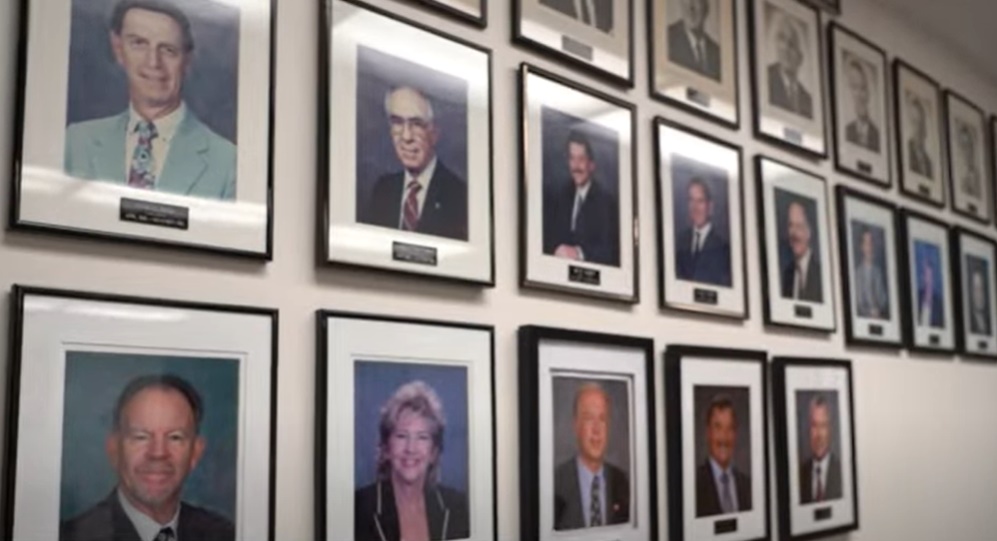
I don't believe it. Never have. The image at the top of this article gives me reason to not believe it. It's a snapshot of a wall of leaders in a community in Los Angeles County. A community with a 37% white population yet an almost 100% white city council. Please keep reading.
In 1965, President Lyndon B. Johnson signed the Voting Rights Act specifically to address a major barrier to democracy: restricted access to the ballot. Before the 1965 Voting Rights Act, Black people and other minorities had to overcome barriers that were impossible to overcome—by design! They were constructed to keep certain people from exercising their right to vote for whomever they felt would best represent them.
After the enactment of the 1965 Voting Rights Act, there was an immediate expansive shift in Black voter participation. In less than a year, a quarter of a million new Black voters registered to vote. This was a significant improvement, but it wasn’t the panacea or magic wand that it was touted to be. In my public school, for example, the 1965 Voting Rights Act was taught as if it were manna from heaven—the key that brought democracy to Black people—never was it mentioned that there was a backdoor maneuver that would help to maintain the old status quo. What we were not taught was that the Voting Rights Act applied to federal elections, not state elections. And, as we all know, states have their own elections and their own election laws.
Related stories
Fast forward a few decades and we find ourselves dealing with the ramifications of a Supreme Court decision that effectively struck down the Voting Rights Act by removing the preclearance requirement. Please bear with me—I'm getting to the point.
The LA Progressive has covered Shelby v Holder, the Supreme Court decision that rendered the Voting Rights Act toothless. Supreme Court Justice Roberts justified the gutting of the Voting Rights Act by claiming that racism is a thing of the past. Apparently, he's blind to the kind of racism that exists today. It's invisible to him and a lot of other people. But somehow, just taking a look at the wall in the city hall of Lomita reminds me that it is very much still alive.
The reason I’m writing this article is because of something the late Supreme Court Justice Ruth Bader Ginsburg said in her dissent to Shelby v. Holder 11 years ago.
In response to Chief Justice Roberts’ assertion that there isn’t enough racism in America to justify the Voting Rights Act, Justice Ginsburg famously said, “[t]hrowing out preclearance when it has worked and is continuing to work to stop discriminatory changes is like throwing away your umbrella in a rainstorm because you are not getting wet.“ That was a drop-the-mic moment that went viral. It was an unforgettable truism. But what I missed, and probably a lot of others missed as well, is what she said about at-large elections.
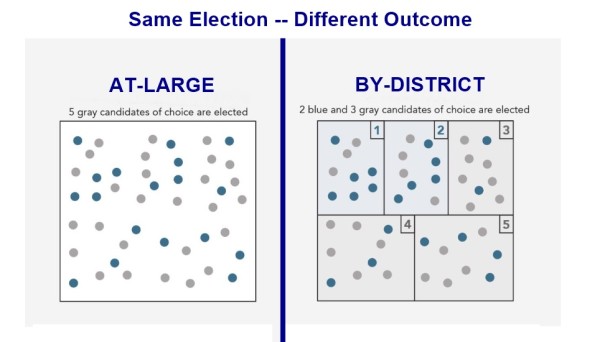
At-large elections? you ask. Yes, at-large elections are the opposite of district elections. If you are unfamiliar with the distinction and live in a large metropolitan area, think of your city council. Most likely, it is divided by city council districts. When you vote for your city council member, you are likely to be voting as a resident of a particular district within your city council, voting for a particular candidate who is running for a district seat, as opposed to the entire city voting for a single person on the city council. Election experts say that under certain circumstances, at-large elections are more likely to produce racially discriminatory outcomes.
Check out the image below. It illustrates how at-large voting systems can produce entirely different results than by-district voting systems. The experts at the Campaign Legal Center, a non-profit in Washington, DC say, "There are many varieties of election systems that incorporate at-large seats, but an at-large system generally refers to a system where every candidate on a governing body is elected by a plurality of all voters in the jurisdiction. In other words, the candidates who get the most votes from the entire city win." So, a citywide vote rather than an individual district-by-district vote is more likely to keep Black and Latino/Hispanic candidates out of office.
Justice Ginsburg’s lengthy 36-page dissent to the Shelby decision covered a lot of territory, including the racial discriminatory outcomes that are produced by at-large voting. Speaking of the variety of barriers, some of which she characterized as “second-generation barriers to minority voting”, Ginsburg said,
“Another is adoption of a system of at-large voting in lieu of district-by-district voting in a city with a sizable black minority. By switching to at-large voting, the overall majority could control the election of each city council member, effectively eliminating the potency of the minority's votes.”
The legislators of the state of California addressed this second-generation barrier to minority voting when they enacted the California Voting Rights Act of 2001 (CVRA). CVRA is a state law that makes it easier for minority groups in California to prove that their votes are being diluted in "at-large" elections by expanding on the federal Voting Rights Act of 1965.
It is settled law and has been in place for more than 20 years. So, why do so many cities in California still conduct at-large elections?—especially cities with a large minority population?
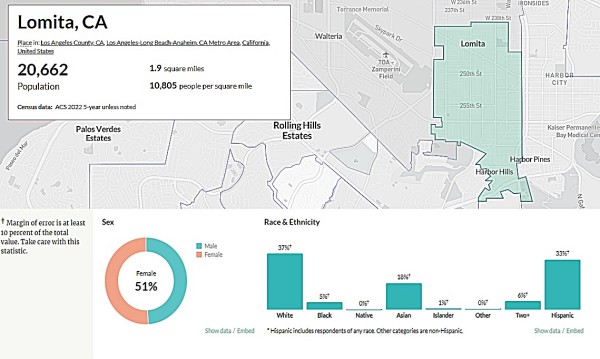
For example, Lomita, California—a small bedroom community south of Los Angeles
The population of Lomita, as of the 2020 census, is approximately 37% white and 63% people of color and/or Latino or Hispanic. The population is 51% female, yet this is not reflected in the leadership. Historically, the city has never conducted district elections—that is, until this year.
Here is a 3-minute video celebrating the 60th anniversary of Lomita. Take a look at the images hung on the wall of Lomita City Hall at about 12 seconds into the video.
If the CRVA was enacted in 2001, why does a city with a 37% white and 51% female population have a city council that appears to be almost entirely white and male? Well, it goes to the fact that laws are not self-enforcing—they must be challenged. And that is what happened in Lomita in 2022.
On January 18, 2022, the city of Lomita received a demand letter challenging their at-large election system and asserting that it violated the California Voting Rights Act (CVRA). Because they received that letter, the City of Lomita City Council adopted an ordinance to implement a by-district election system. The Lomita district-by-district election system is now in place and will be used for the first time in the November 2024 election.
Lomita has posted information that speaks to this on their website. To summarize, the city of Lomita says that it is not clear that their at-large voting system ran afoul of the CVRA law. They state that their primary reason for changing their voting system is to avoid an expensive law suit.
In full disclosure, I wouldn't know anything about this had it not been for the fact that my son, Wade Kyle, lives in Lomita and is running to be the city’s first District 2 city council member and first Black city council member. This is an uphill battle. My son is running against the current mayor, who has lots of name recognition. Check out Wade's campaign website.
As his mother, I have conflicted feelings. I am willing to fight to have this country be all of the things it holds itself up to be, but as a mother, I don't want my kids in the fight. On the other hand, my son is a man, and an extraordinary one at that. I raised him and his sister to be civically engaged and to do more than just vote. They are both doing that, and I couldn't be prouder.
Comments

Powered by RoundtableAn AI/DeFi-powered Enterprise Media Operating System. Learn more at Roundtable.io.© Roundtable 2026. By using this site you agree to the Terms of Use and Privacy Policy