
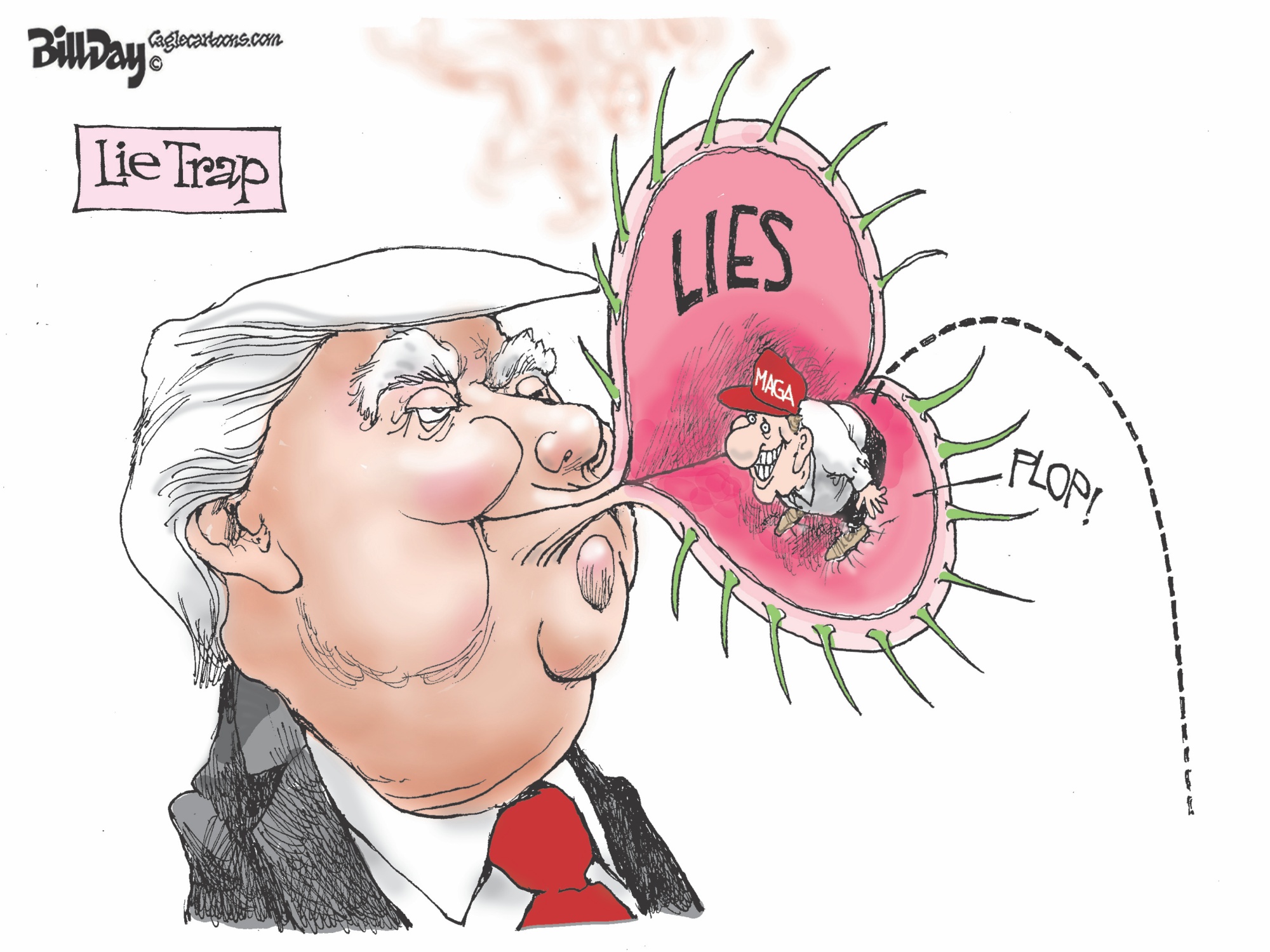
Illustration by Bill Day on Cagle Cartoons


Preventing another Trump presidency is certainly a necessary goal. Remember that Trump voters are fellow human beings - with all the imperfections of our species.
Sep 10, 2024 7:58 PM
Updated Sep 11, 2024 5:32 PM
Preventing another Trump presidency is certainly a necessary goal. Remember that Trump voters are fellow human beings - with all the imperfections of our species.
Since I first voted for John Kennedy in 1960, I can't think of any other presidential candidate worse than Donald Trump - both as a person and as a president. Regarding the latter, most other historians seem to agree. But that doesn’t mean that most of the people who might vote for him in November are bad people. Among my friends and acquaintances are some who will probably choose him, and I would not describe them as such.
I have believed in this way ever since Trump first ran for the presidency (and was elected) in 2016. In 2017, on this site, I quoted George Saunders’ 2016 article “Who Are All These Trump Supporters?”
In his essay, Saunders emphasizes an empathetic approach, one that former President Obama also often stressed. The writer found that the Trumpites were less patient than traditional conservatives, “less influenced by Goldwater and Reagan than by Fox News and reality TV,” more willing to tolerate “Trump’s racist and misogynist excesses.”
Saunders admitted that “there are bigots in the Trump movement, and wackos, and dummies,” but he reminded himself “that the important constituency is the persuadable middle segment of his supporters, who are not finding in Trump a suitable vessel for their hate but are misunderstanding him or overestimating him, and moving in his direction out of a misplaced form of hope.”
Related stories
He also found that many Trump followers were,
“friendly, generous with their time, flattered to be asked their opinion, willing to give it . . . They loved their country, seemed genuinely panicked at its perceived demise, felt urgently that we were, right now, in the process of losing something precious. They were, generally, in favor of order. . . . Some (far from all) had been touched by financial hardship.”
Many believed “they’d been let down by their government. They were anti-regulation, pro small business,” and sensitive to “any infringement whatsoever on their freedom. . . . They were adamantly for law enforcement and veterans’ rights.”
Saunders believed that many Trump supporters suffered from what he called “usurpation anxiety syndrome,” which he defined as “the feeling that one is, or is about to be, scooped, overrun, or taken advantage of by some Other with questionable intentions.”
Like many of us today, eight years ago Saunders bemoaned the division of our nation into “two separate ideological countries, LeftLand and RightLand, speaking different languages. . . . Not only do our two subcountries reason differently; they draw upon non-intersecting data sets and access entirely different mythological systems.”
His points about Trumpites being influenced by “Fox News and reality TV,” and by drawing “upon non-intersecting data sets and access entirely different mythological systems,” reminds me of a comment that one of my friends recently made about all the information presently being blasted our way: “Who or what is one to believe?”
Who indeed?
As a historian I have some training in how to determine reliable sources, and I tried to pass that knowledge on to my students. But many others have not been as fortunate, and in general Trump supporters are less educated than Democratic ones. Knowing such a fact should not make us more contemptuous of less educated voters, but rather - as Saunders tried to be and Obama recommended - more empathetic.
One of my favorite quotes (attributed to various sources) is,
“Let us be kind to one another, for most of us are fighting a hard battle.”
We all have our flaws, our confusions, our defensiveness. None of us is perfect.
One of our public imperfections is that too many of us have forgotten that the central aim of politics should be furthering the common good, not my personal welfare but the common well-being. Opposition to Affirmative Action, for example, is often based on how--as, e.g., a white male--it might disadvantage me.
In 1962, when I received a fellowship to Georgetown’s graduate school, I benefited from having less competition with various minorities and women than would be true today. But such a many-decades advantage is often forgotten, as is the blatant pre-Presidents Kennedy and Johnson discrimination against non-whites and women.
Another public imperfection is our failure to emphasize values enough, or at least to stress sufficiently the right ones. As U.S. neuropsychologist and Nobel laureate Roger Sperry wrote,
“Human value priorities . . . stand out as the most strategically powerful causal control now shaping world events. More than any other causal system with which science now concerns itself, it is variables in human value systems that will determine the future.”
Just recently a new source of information reinforced my belief that many Trump voters may be better people than most of us progressives think--a new book by Stanford psychologist Jamil Zaki, "Hope for Cynics: The Surprising Science of Human Goodness."
In an interview regarding it, on the PBS Newshour, he said,
"We think that the average person we disagree with is far more extreme than they really are. We think that they are twice as antidemocratic, twice as hateful, and four times as violent as they really are. “We brought people [of opposing viewpoints] together. . . . People loved connecting. They were shocked by how open-minded, warm, and interested in them the person the other side was. . . . People are overall more trustworthy, kinder, more open-minded, and friendlier than we realize they are.
Of course, there are people who do harm out there, but the average person underestimates the average person. And what that means is that when we give people a chance to show us who they are, by putting those little leaps of faith, those small acts of trust into them, oftentimes, we're pleasantly surprised by what they give back.
In my yard, I have a Harris-Walz yard sign. It proclaims, “We’re Not Going Back.” Those words have become a popular slogan and mean different things to different people. But one thing they mean to me - and something the Harris-Walz combination has indicated it means to them - is overcoming the extreme polarization of the last decade.
There was a time - more than a decade ago - when many Republican politicians thought wise the words of Russell Kirk, who some considered “the Father of American Traditionalist Conservatism.” He wrote,
“Ideology makes political compromise impossible: the ideologue will accept no deviation from the Absolute Truth of his secular revelation. . . . Ideologues vie one with another in fancied fidelity to their Absolute Truth; and they are quick to denounce deviationists or defectors from their party orthodoxy. . . .[but] the prudential politician . . . is well aware that the primary purpose of the state is to keep the peace. This can be achieved only by maintaining a tolerable balance among great interests in society. Parties, interests, and social classes and groups must arrive at compromises, if bowie-knives are to be kept from throats. When ideological fanaticism rejects any compromise, the weak go to the wall.”
Preventing another Trump presidency is certainly a necessary goal of progressives - and hopefully the nation’s voters in general. But so too should be keeping “bowie-knives . . . from throats.” Remembering that Trump voters are fellow human beings - with all the imperfections common to our species - is a start.
Comments

Powered by RoundtableAn AI/DeFi-powered Enterprise Media Operating System. Learn more at Roundtable.io.© Roundtable 2026. By using this site you agree to the Terms of Use and Privacy Policy