


Apr 21, 2020 9:00 PM
Updated Mar 8, 2024 4:35 PM
Frank Fear: While ‘the thing’ is often tedious and unexciting to everyday Americans, the politics-of-the-thing is anything but either. It’s entertaining, sometimes dramatic, and—here’s the kicker—easy to get hooked on.
Over a decade ago, a colleague of mine (a lobbyist by profession) offered unsolicited advice about public leadership. “There’s ‘the thing’ (a public issue) and there’s the politics-of-the-thing (strategy and tactics regarding an issue),” he declared. “You have to be good at managing the politics-of-the-thing but, to do right by people, you need to focus incessantly on ‘the thing.’ The problem,” my friend concluded, “is that public leaders can spend too much time on the politics-of-the-thing and not enough time on ‘the thing.’”
He’s right. And the implications aren’t just for politicians. Look at it from the public’s perspective. While ‘the thing’ is often tedious and unexciting to everyday Americans, the politics-of-the-thing is anything but either. It’s entertaining, sometimes dramatic, and—here’s the kicker—easy to get hooked on.
While ‘the thing’ is often tedious and unexciting to everyday Americans, the politics-of-the-thing is anything but either. It’s entertaining, sometimes dramatic, and—here’s the kicker—easy to get hooked on.
Bottom line? A lot of Americans are addicted to the politics-of-the-thing and woefully undereducated about ‘the thing.” Ask twenty people if they’re aware of Trump’s dismissive behavior of Michigan Governor Gretchen Whitmer, and I’ll bet just about everybody will answer affirmatively. Those numbers won’t hold up if you ask the same people if they understand and can compare Obamacare, Medicare for All, and Medicare for All Who Want It. And if you ask them about matters that the mass media almost never cover, such as institutional racism and restorative justice (the focus of a colleague’s recent book), you’ll likely get “I’m not sure what are you talking about.”
Inattentiveness to ‘the thing’ is on display regularly. Consider what happens during televised debates and town halls. Candidates and the media spend a few minutes on one topic before flitting to the next—never getting to the depth that complex issues deserve. And while America soon forgets who said what, they do remember theatrics—as happened in 2016 when Rick Perry said that (as president) he’d cut three Federal agencies, but couldn’t remember (try as he might) the name of the third agency.
Related stories
Substantive limitations are a byproduct of many things, including inattention to civics education, a hyperactive media, and a political system that specializes in imagery. The outcome is constant: no amount of the politics-of-the-thing—even when undertaken masterfully—can take the place of honest-to-goodness attention to ‘the thing.’
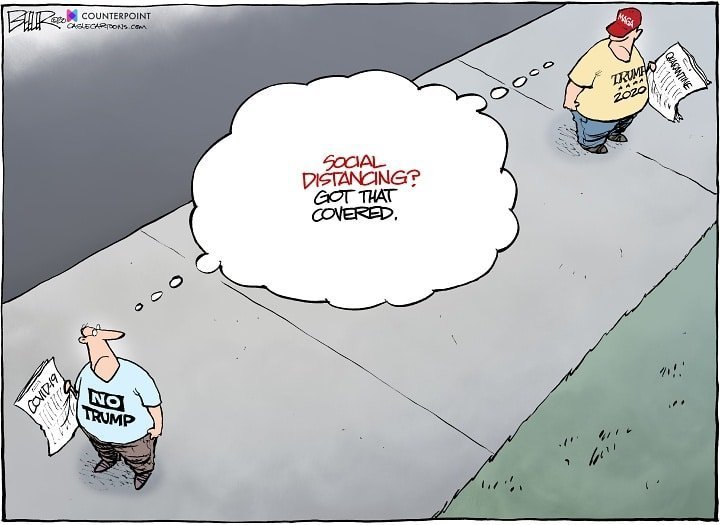
But that outcome is becoming harder to achieve. One reason is that a cottage industry pumps out an endless supply of politics-of-the-thing material. It’s evident on Facebook in the daily banter you see between Trump advocates and detractors. Trump supporters dip into that well as do Trump detractors, who have an insatiable appetite for seeking out and sharing a stream of “Did you see what Trump said/did today?!” Even reputable academics are getting into that act. The other day I read a 1300-word essay that included over 40 references to ‘Trump,’ ‘Trump’s, or ‘he’ (Trump). That’s about one Trump-reference every 35 words.
And, if there’s anything that my friend couldn’t have imagined back then, it’s this—just how much politics has devolved. For example, there’s what I call making an attributional pivot. That happens when a politician accuses another politician of the very same behavior that the first politician exhibits. A recent example is Trump’s reference to Speaker Pelosi as a ‘poor leader who always assigns blame to others.” Sound familiar?
Far worse, is when public well-being is compromised for the purpose of gaining a political outcome. For example, don’t you find it incredible that America can’t manufacture the needed number of COVID-19 screening tests? But can’t may not be the best word. A better description might be doesn’t want to.
With more tests available and taken, more people will be detected with the virus. That’s good for America, but not necessarily good politically—if the political intent is to keep numbers as low as possible. So how might a crafty politician get lower numbers and keep his ‘hands clean’ at the same time? For starters, diminish the capacity of responsible Federal units. Check. Then shift responsibility to an entity that’s less likely to get the job done effectively. In this case, we know that states are struggling to secure the number of tests they need. Bingo! A political objective trumps peoples’ lives (pun intended).
If you think shenanigans are a Trump or Republican thing only, then think again. Here’s an example. Recognizing the looming impact of COVID-19, NYC Mayor Bill de Blasio proposed locking down his city. The day was Sunday, March 15. The very next day (March 16), San Francisco Mayor London Breed, together with other Bay Area officials, announced they were locking down Northern California. But rather than have the West Coast pave the way an East Coast move, New York Governor Andrew Cuomo told a March 17 news conference that de Blasio didn’t have the authority to shut down the city—only he (Cuomo) could make that call. Furthermore, Cuomo said, “I have no interest whatsoever and no plan whatsoever to quarantine any city.”
Well, this story came to a classic politics-of-the-thing end. On Friday, March 19, California Governor Newsom locked down his state. The next day (March 20), Cuomo did the same—doing on Saturday what he said he wouldn’t do on Tuesday. You can argue that ‘the NYC situation got worse’ (it did, tripling to 3000 new cases reported on Saturday vis-à-vis the number of new cases reported the previous Sunday), but it’s also true that the COVID-19 situation poured gasoline on a burning fire between the governor and mayor. And those two were at it again, less than a month later, engaged in a public spat about how long NYC schools should remain closed.
There is no victory when politicians concentrate on the politics-of-the-thing. It often makes headlines, but it’s a chimera without substance—a distraction. It happens when politics becomes an end rather than a means. What really matters—always matters—is ‘the thing.’
That’s why I won’t cheer if Joe Biden is elected. I’ll be relieved. It means there’s hope—hope that critical ‘thing work’ will begin. I’m talking about reconstructing our public institutions so that they actually work, restoring the balance of power across the branches of government, energizing civic democracy, getting on with the business of improving social and economic conditions for all, and behaving with integrity and without impunity. And those are just starters.
To do those things—and to do any of them well—Biden, his associates, and the nation as a whole, including the all-important media—must devote less attention to the politics-of-the-thing and more attention to ‘the thing.’ If that happens, my colleague will smile. I will, too.

You can listen to this article—and other contributions from Frank Fear—at Frank’s podcast, Under the Radar. Hosted by Anchor.FM and available there for listening, Frank’s podcast is also available on seven other podcast platforms, including Apple, Spotify, Google Podcasts, Breaker, RadioPublic, Pocket Casts, and Overcast.
Frank Fear
Did you find this article useful? Please consider supporting our work by donating or subscribing.
Comments

Powered by RoundtableAn AI/DeFi-powered Enterprise Media Operating System. Learn more at Roundtable.io.© Roundtable 2026. By using this site you agree to the Terms of Use and Privacy Policy