
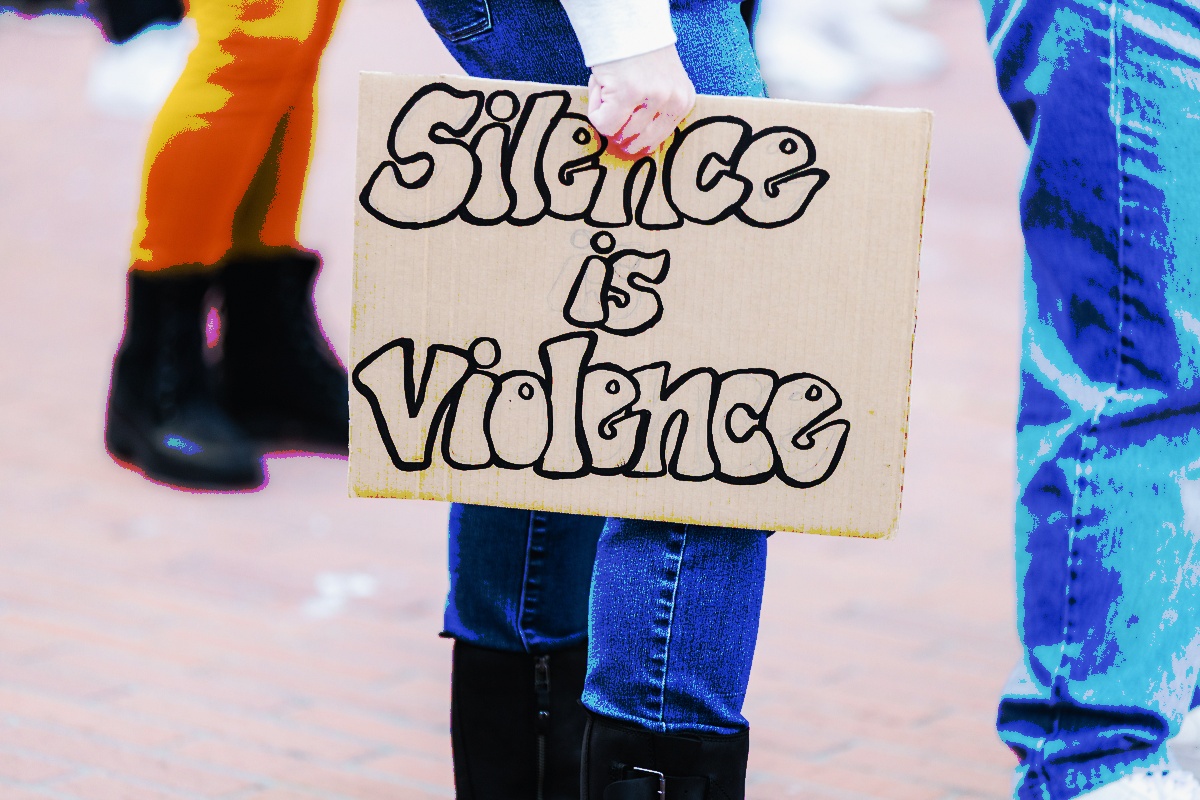
Photo by Jason Leung on Unsplash


Enforced Silence
Jan 30, 2024 6:03 PM
In recent months, several scholars have sounded the alarm that the United States is “sleepwalking towards authoritarianism.”
Silence today has become part of a politics where critical ideas are buried along with dangerous memories, and the bodies of journalists, poets, and those who lead the fight against oppression in its diverse modes. As Goya once warned, the degree to which truth and informed judgments are overcome by ignorance, superstition, and falsehoods, “the sleep of reason produces monsters.” Martin Luther King, Jr. gives a contemporary resonance to Goya’s warning in his famous 1967 speech , “Beyond Vietnam: A Time to Break the Silence.” Stating that a “time comes when silence is betrayal,” King made clear that the refusal to speak out eviscerates both the idea of democracy and the promise of resisting the mobilizing passions of fascism, especially militarism, poverty, and racism. His words alerted Americans to the dangers of refusing to speak out in the face of militarism, racism, and mass poverty. The challenge posed by King’s call to resist a complicitous silence in the face of injustice is exceptionally relevant today, particularly among mainstream media, politicians, and liberal and conservative pundits. At the heart of this challenge is the need to not only make detectable the current threats to democracy but also to understand how silence in the face of tyranny legitimates authoritarianism along with the risks it poses to any viable notion of justice, equality, and freedom., all of which should serve as a useful waring for everyone concerned about democracy.
In recent months, several scholars have sounded the alarm that the United States is “sleepwalking towards authoritarianism.” The concern is not unfounded given that in his run for the presidency in 2024, Trump has boldly telegraphed his aspirations to impose an authoritarian future on the United States. He has repeatedly injected authoritarian language, extremist ideas and threats of violence into the mainstream. Moreover, in doing so, he has created a climate of fear, intimidation, and anxiety that silences politicians, critics, and members of his own political party. Forecasting his authoritarian intentions, he has openly stated that the “he intends to terminate portions of the U.S. Constitution…target progressives as “vermin,” and WILL make himself a dictator ‘on day one’.” Moreover, on Truth Social, he claimed that a president should have blanket authority and total immunity “even for acts that ‘cross the line’.” He has repeatedly stated that if he regains the White House, “it will be a time for retribution” and revenge.[1]
Taking pages from Hitler’s speeches, he has also said that the biggest threat to the United States “is from within.” In this instance, he reproduces an updated version of McCarthyite slander with his claim that the country is being overrun by “communists, Marxists, fascists and the radical left thugs that live like vermin within the confines of our country, that lie and steal and cheat on elections, and need to be rooted out.”[2] His constant attacks on what he labels as the “enemy within” is code for inciting his MAGA followers to wage violence against people of color, critics, progressives, LGBTQ+ Americans, news networks, immigrants, feminists, and any other group that does not buy into Christian Nationalist, white supremacist views.[3]
Trump’s discourse overflows with the genocidal language used in the Third Reich.[4] The historian Heather Cox Richardson rightly notes that Trump’s “use of language referring to enemies as bugs or rodents has a long history in genocide because it dehumanizes opponents, making it easier to kill them. In the U.S., this concept is most associated with Hitler and the Nazis, who often spoke of Jews as “vermin” and vowed to exterminate them.”[5] He has claimed that immigrants “are poisoning the blood of our country” and will undergo “ideological screening” in order to enter the country legally. Millions of undocumented immigrants will be barred from the country while others will be rounded up, put into what amounts to Gulag camps, and subjected to unimaginably harsh policies.[6] Given Trump’s calls to shoot shoplifters, impose death penalties on drug dealers, and his suggestion that his former Chairman of the Joint Chiefs of Staff, Mark Milley, “deserves to be executed,” there is no reason to doubt Trump’s authoritarian designs.[7]
Related stories
In the current historical moment, language has increasingly forfeited its obligation to a politics of truth, justice, equality, and freedom, and in doing so has turned cannibalistic and cruel.
In the current historical moment, language has increasingly forfeited its obligation to a politics of truth, justice, equality, and freedom, and in doing so has turned cannibalistic and cruel. As political horizons and public life wither under the assault of an emerging fascism and a mainstream media that refuses to confront it, language appears to fail in the presence of what Zygmunt Bauman called “the emergence of modern barbarity.” [8] A continuing series of crises—political, cultural, economic, and ecological--are translated into emotional plagues of fear, lies, and violence produced by right-wing spectacles that have undermined the ability of the American public to address critically the endless attacks by tyrannical forces on democratic ideas, values, and institutions. Matters of historical context, interconnections, informed judgment, and critical analysis that refuse to divorce themselves “from social institutions and material relations of power and domination” are either ignored or disappear from public view.[9] Language in the age of gangster capitalism and fascist politics is under siege, functioning less as a vehicle of audacious truth and moral witnessing than as tool to purge democracy of its ideals. In the face of a politics of enforced silence, America is experiencing an era marked by what Brad Evans calls “a closing of the political,” grounded in the paralyzing assumption that “nothing can be done.”[10]
It is important to note that fascism not only arrives through the language of hate, bigotry, dehumanization, and military dictatorships as it did in Chile and Argentina in the 1970s; it also arrives through the everyday acceptance of an ethically debilitating silence. In the current moment, a deafening quietness among large parts of the public accompanies authoritarian threats to democracy. In part this is evident in the refusal of individuals, educators, pundits, and commanding institutions to speak out at a time marked by a relentless attack on critical ideas, memory, education, and democratic values, further accelerating the normalization of an emerging fascist politics. This is especially true with respect to the horrendous violence imposed on Palestinians by Netanyahu’s war of revenge and dispossession. A politics of silence facilitates a tsunami of manufactured ignorance advanced by the repression of dissent, the cowardice of the mainstream media, the unaccountability of social media platforms steeped in the astonishing toxicity of hatred, and a disdain for equality, freedom, and truth in a society governed by the corrupting force of “a sociopathic billionaire elite.”[11]
[12] The politics of silence increasingly works through multiple sites and seemingly contrasting impulses, often aligning itself with a reactionary disdain for the public good. In part, it does so by refusing to address the growing yet seemingly unrelated issues of Trump’s full embrace of fascist politics and the scourge of lawlessness and the growing attacks on freedom of expression and the struggle for social justice.
This is all the more reason to reclaim the language of the common good, to protect public and higher education from a fascist takeover, to reject the privatization of public goods, expand the power of unions and the rights of workers, people of color, women, immigrants, gay people, trans people and all those others considered excess and disposable. Silence has become the language through which people are either depoliticized or are willingly complicit with the economic and racial forces of totalitarianism. A King notes, it is the language of those “who accept evil without protesting against it.” What is needed is a language that translates into power—a critical language that expands the power of education, agency and justice before it is too late. That is, is a language that rethinks imaginatively the forces of militarism, poverty, racism, and sexism in light of the dramatic changes taking place technologically, culturally, and politically. Of course, a variety of movements that extend from Me Too and Black Lives Matter to the struggles over trans-gender rights, women’s reproductive rights, and ecological justice have provided a comprehensive language of empowerment, justice, and struggle that is fundamental to challenging racial capitalism, neoliberalism, poverty, and the war on sexual freedom, but more needs to be done to unify these movements under a wider political narrative such as a call for a socialist democracy.
Pro-democracy forces need to further a language that is theoretical, critical, and passionate. Central to such a language is a politics of emotion that creates what Ruth Ben-Ghiat calls communities of belonging that invite joy while mobilizing emotions that embrace compassion, justice, and hope.[13] What might be called a politics of identification and emotion is particularly important at a time when many people living in a neoliberal society are atomized, feel alienated, lonely, and invisible and subject to far-right emotional appeals to tribal forms of allegiance rooted in hatred, bigotry, and a poisonous nationalism. Anand Giridharads claims that today’s left is often too cerebral and too suspicious of what he calls empowering emotional appeals. He is worth quoting at length:
Today’s electoral left is highly cerebral. It is suspicious of the politics of passion. It doesn’t do emotional appeals. It doesn’t have much of a role for music, for the body, for in-person communing in public spaces, for catchy slogans, for arresting visuals…. Can those who defend the rule of law and pluralism and economic justice and human rights not only articulate those ideas but also appeal to the more basic human needs to belong, to have anxieties soothed, to have fears answered, to feel hope, or just to feel something at the end of bleak and tedious days… If this were an age defined by big policy questions and little else, that would be one thing. But it is an age defined by Big Feelings. By anxiety and fear and future dread and a great confusion… In an era such as this, leaving the politics of emotion, of passion, to aspiring autocrats is a dangerous abdication.[14]
There will be no justice or democracy in the United States unless a mass multi-class social movement emerges that combines political and individual rights with economic rights—that joins a movement for gender and racial equality with a movement for economic justice. This must also be a movement that speaks to people’s needs in a way in which they can recognize themselves and be moved to action.
Pro-democracy movements need to fight aggressively against the plague of silence produced and legitimated in mainstream politics and culture, one that normalizes indifference and covers over acts of violence that provide the conditions for a fascist politics to flourish. It is only then that a critical public consciousness can be awakened, ideas can be connected to power, and people can get out in the streets and challenge the fascists and neoliberal monetary interests destroying democracy. Only then will a multiracial working-class movement begin to bring I to fruition radical social and economic change. Only then will the question of “what kind of society do we want to live in” prompt a radical rethinking of the meaning and purpose of collective struggle. One path forward was made clear by Frederick Douglass who argued that “If there is no struggle, there is no progress….The struggle may be a moral one or it may be a physical one, but it must be a struggle… Power concedes nothing with a demand. It never has and it never will.”[15] Central to such a task is the need for a new political subject and mass movement guided by a language that rivals capitalism rather than adapts to it. As David Harvey has argued, the problems humanity faces are too severe to be addressed “without a strong anti-capitalist movement.”[16] Radical ideas are about more than fighting for incremental reforms. They will only succeed when rooted in a vision, sense of unified struggle, and institutional building based on anti-capitalist values that enable the development of a socialist democracy.[17]
[1] Peter Wade, “Trump Doubles Down on Dreams of Being a Dictator.” Rolling Stone [December 10, 2023]. Online: https://www.rollingstone.com/politics/politics-news/trump-doubles-down-dictator-day-one-1234922468/
[2] Aaron Blake, “How Trump's rhetoric compares with Hitler's.” The Washington Post [November 13, 2023]. Online: https://www.washingtonpost.com/politics/2023/11/13/how-trumps-rhetoric-compares-hitlers/
[3] Heather Cox Richardson “December 17, 2023” Substack [December 17, 2023]. Online: https://heathercoxrichardson.substack.com/p/december-17-2023
[4] Ibid., Aaron Blake, “How Trump's rhetoric compares with Hitler's.”
[5] Heather Cox Richardson, “November 13, 2023” Substack [November 13, 2023]. Online: https://heathercoxrichardson.substack.com/p/november-13-2023
[6] Jonathan Swan, Maggie Haberman and Charlie Savage, “How Trump Plans to Wield Power in 2025: What We Know.” The New York Times [December 26, 2023]. Online: https://www.nytimes.com/article/trump-2025-second-term.html
[7] Ruth Ben-Ghiat, “"Lock Them Up": Trump's Authoritarian Plans for 2025.” Lucid [November 22, 2023]. Online: https://lucid.substack.com/p/lock-them-up-in-camps-jails-and-psychiatric
[8] Zygmunt Bauman and Leonidas Donskis, Liquid Evil (London: Polity, 2016), p. 79.
[9] Khalid Lyamlahy, “The Professional Stranger: On Abdelkebir Khatibi’s “Plural Maghreb”,’ Los Angeles Review of Books (December 3, 2019). Online: https://lareviewofbooks.org/article/the-professional-stranger-on-abdelkebir-khatibis-plural-maghreb/
[10] Brad Evans, “The Promise of Violence in the age of catastrophe,” Truthout (January 5, 2014). Online: https://truthout.org/articles/the-promise-of-violence-in-the-age-of-catastrophe/
[11] Jonathan Crary, Scorched Earth: Beyond the Digital Age to a Post-Capitalist World (London: Version, 2022), p. 2.
[12] David Graeber, The Democracy Project: A History, A Crisis, A Movement (New York: Penguin, 2013), pp. xviii-xix
[13] Anand Giridharadas, “The real battleground of 2024 is emotion.” The.Ink [January 17, 2024]. Online: https://the.ink/p/the-real-battleground-of-2024-is
[14] Ibid.
[15] Frederick Douglass, "No Progress Without Struggle," available from The W.E.B. DuBois Learning Center, http://www.duboislc.org/html/BlackStruggle.html.
[16] David Harvey, “Neoliberalism Is a Political Project.” Jacobin, [July 23, 2016]. Online: https://www.jacobinmag.com/2016/07/david-harvey-neoliberalism-capitalism-labor-crisis-resistance/
[17] One excellent source here is Stanley Aronowitz, Left Turn: Forging a New Political Future (New York: Routledge, 2007).
Comments

Powered by RoundtableAn AI/DeFi-powered Enterprise Media Operating System. Learn more at Roundtable.io.© Roundtable 2026. By using this site you agree to the Terms of Use and Privacy Policy