
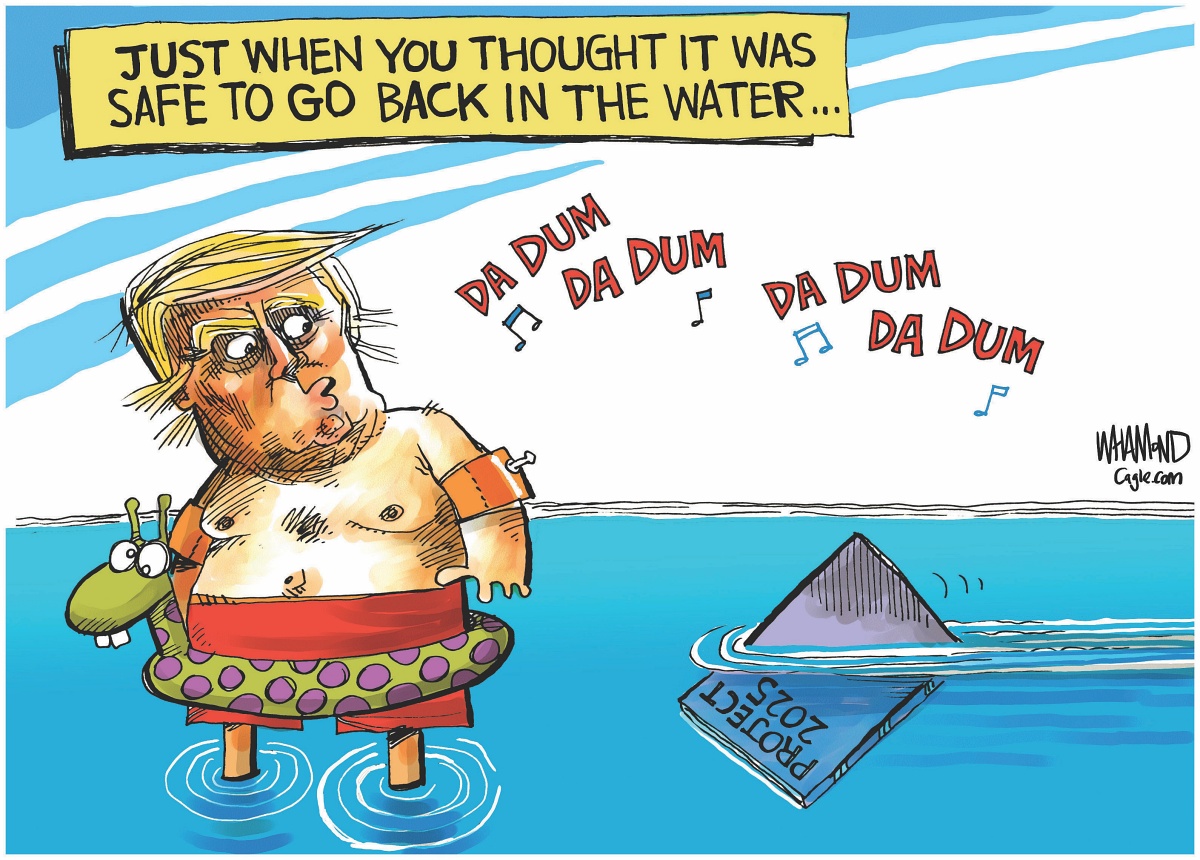
Cagle Cartoons: Dave Whamond


Project 2025
Aug 31, 2024 7:11 PM
While Trump has sought to disown this project, it generally tracks what he has said he wants to do and has done in the past.
President Trump has shown that he plans to abolish American democracy and substitute one-man rule. His conservative allies have provided a detailed plan to assist in the transition to a dictatorship, called Project 2025. Trump’s conduct, prior statements, and Project 2025 work together to defeat the rule of law at the heart of a functioning democracy. While Trump has sought to disown this project, it generally tracks what he has said he wants to do and has done in the past.
It is not widely appreciated that Project 2025 seeks to defeat the rule of law by adopting a model of government based on the democracy-destroying work of Trump’s authoritarian role—especially Hungary’s Viktor Orbán, a source of guidance for Project 2025. Project 2025, read in the context of Trump’s conduct and statements, helps Trump replicate his heroes’ dubious achievements to establish an American dictatorship. But grasping this requires, first, some understanding of what the rule of law is and how the American Constitution seeks to foster and preserve it.
The Rule of Law and the American Constitution
The Founders, those who framed and ratified the American Constitution, aimed to establish a rule of law. Authoritarian governments have law just like democracies do, but they do not have a rule of law. A rule of law implies that the law limits not only ordinary citizens but also government officials. In a democracy, officials, even the head of state, can only act pursuant to law and officials apply the law equally to all citizens, whether or not they support the current head of state and his party.
All governments, dictatorships as well as democracies, have laws that they enforce against citizens. Strict, harsh, or comprehensive enforcement of law against individual citizens frequently occurs in dictatorships and does not imply that they have a rule of law. In an autocracy, no rule of law exists because the government does not allow the constitution and laws to significantly curtail its own conduct and because it does not apply the law equally to all citizens.
Related stories
Project 2025 uses the term “rule of law” incorrectly to refer to government applying the law more harshly or as an instrument to advance party interests. The report, read carefully in light of the appropriate background, facilitates the decimation of the rule of law by setting the stage to use the law to persecute and subdue opponents of the Trump administration.
Because the Founders aimed to establish a rule of law, our Constitution parts ways with the European tradition of requiring government officials to swear allegiance to the head of state. Our Constitution requires government officials, including the President, to swear allegiance to the Constitution, i.e. to the law itself, rather than to a supreme leader.
That Constitution authorizes Congress to establish policies for the government through the enactment of laws signed by the President. Under the Constitution these laws become permanent unless and until amended by Congress. Neither the President nor the courts can change them.
The Framers of the Constitution in the Federalist Papers assured those considering whether to ratify it that the President would not become a monarch. The Constitution tasks the President not with dictating the course of government by himself, but instead with “tak[ing] care that the law be faithfully executed.” The Framers constantly referred to the President as the "chief magistrate,” to emphasize his role as the law’s chief servant. And the Constitution’s requirement that officeholders swear allegiance to the Constitution, rather than the President, obliges them to obey the laws Congress established, no matter what orders a President might issue.
The Founders recognized the danger that a President might want to turn government officials into “obsequious instruments of his pleasure,” as Hamilton explained in Federalist no. 76. To prevent that sort of “despotism,” the Constitution does not generally authorize the President to unilaterally appoint the chief officials of the federal government. Instead, for top posts he must nominate people loyal to the Constitution, so as to receive the “advice and consent” of the Senate. And the Constitution authorizes Congress to ensure complete independence for inferior officers, by empowering it to vest their appointment in the courts (or in the President or the heads of departments). This approach is designed to create a rule of law, where officials obey legal constraints and administer law impartially, rather than according to the dictates of an imperial President wishing to subdue the opposing party.
Donald Trump has a very different conception of presidential power than that found in the Constitution. During his term in office, Trump explained, wrongly, that under the Constitution he has total and absolute power. Project 2025 echoes his conception in softer language, constantly calling for government to carry out “the President’s agenda” rather than faithfully execute the laws Trump will inherit if he becomes President.
The idea of a presidential agenda was foreign to the Founders. In the early days, presidential “candidates” did not even campaign for office, as that was considered unseemly. Instead, they acceded to their supporters’ wishes that they make themselves available for election. They certainly did not run on a set of announced policy proposals, that was for Congress.
This part of the original Constitution long ago passed away. Today presidents do have an agenda—a set of changes that they have promised to make during their campaign to become President. But much of what they promise requires, under the Constitution, congressional legislation. They run for office advocating proposals for legislative change and funding, whether that be building a wall, renewing infrastructure, lowering taxes, abolishing government agencies, or deporting asylum seekers without a hearing. Government officials may not implement a President’s agenda under the Constitution unless and until a law is passed authorizing what the President wants to do. Presidential candidates do not like to emphasize this, but most of their agenda lies beyond their power to implement unless they can persuade the people’s representatives in Congress to act. A government that implements the head of state’s agenda rather than legislation is not a democracy based on the rule of law, but rather a dictatorship.
Viktor Orbán’s Creation of Autocracy and Project 2025
Donald Trump frequently praises autocrats like Hungary’s Viktor Orbán, Russia’s Vladimir Putin, and Turkey’s Tayyep Recep Erdoğan. All of these leaders were elected to office when their countries were democratic and over time destroyed the democracies they inherited.
They undermined the rule of law, persecuted political opponents whilst protecting corrupt supporters, shut down opposition media while bolstering friendly news organizations, and tilted the electoral playing field in their favor (or did away with free and fair elections altogether).
The Heritage Foundation, which led the creation of Project 2025, has close relations with Viktor Orbán. Project 2025 provides detailed guidance about how to follow Orbán’s lead in substituting autocracy for a democratic government in America. Therefore, it’s worth understanding how Orbán and other autocrats destroy democracies and establish dictatorships.
Persecution of Supporters and Protection of Corrupt Supporters
Viktor Orbán ended the independence of his prosecution service. With that accomplished, the prosecution service became an instrument of the ruling party. It protected frequently corrupt government supporters from prosecution. And it accused political opponents of corruption on the eve of elections but dropped the charges after the spotlight had moved away to avoid the embarrassment of losing in court.
Erdoğan began compromising the independence of his prosecution service to shut down an investigation of his government’s corruption. He not only brought the prosecution service under his control. He also brought the federal investigators (the equivalent of the FBI) under the political control lest they investigate his government’s corruption. Aided by increasingly harsh laws, Turkey has changed from an autocracy that only protected its own corruption to one that also jails independent journalists other critics in large numbers.
Ending Media Independence
A functioning democracy requires robust independent media. Orbán ended the independence of Hungary’s media regulator. He then used a variety of tactics to boost media outlets that support his government and shutdown independent media.
First of all, wealthy supporters purchased opposition media. Second, his government has deprived media outlets dependent on government support of revenue, leading to their collapse. Third, he denies licenses to independent outlets. Fourth, he sometimes uses defamation suits to put additional pressure on independent media. Fifth, he has converted public television, an important medium in Hungary, into an organ of state propaganda. These techniques together have led to the shutdown of all major opposition media in Hungary, allowing lies and propaganda to go largely unchecked. Erdoğan and Putin started their attacks on the media using these sort of financial pressures, but eventually took to simply jailing many independent journalists.
Tilting the Electoral Playing Field.
Viktor Orbán, like other autocrats, has entrenched himself in power through various measures “tilting the electoral playing field.” His government has remained in power and enacted sweeping measures establishing an autocracy even though his popular support has never been overwhelming.
Orbán has relied heavily on partisan gerrymandering, where district lines are drawn in such a way as to favor the election of Orbán’s supporters. Orbán has also relied on measures that make voting easy for his supporters but difficult for his opponents.
Other autocrats, like Belarus President Alexander Lukashenko and Venezuela’s President Nicolás Maduro, have gone further by rejecting the results of elections that they lost. Autocrats destroy the independence of electoral commissions to allow themselves to make elections unfair. These techniques lead to very long terms in office for the ruling autocrat, even when the Constitution says that their terms in office are limited.
Project 2025’s Authoritarian Playbook.
Project 2025 provides a plan to restructure government to enable autocracy. That plan basically follows the model established by autocrats in other countries who have destroyed the democracies they inherit.
Subverting the Department of Justice and the FBI
The Department of Justice (DOJ) serves many functions, including acting as the federal prosecution service. Functioning democracies protect the independence of prosecution services through express constitutional provisions, statutory law, or constitutional customs. In the United States, a constitutional custom prohibiting the President from making decisions about whom to investigate or prosecute has served that function. When President Nixon violated that norm by firing DOJ officials who would ensure investigation of his administration’s misconduct, Republicans and Democrats united to force him from office.
President Trump repeatedly sought to use the DOJ to unjustly persecute political opponents and shield himself and his supporters from accountability during his first term in office, in violation of long-established constitutional custom and his constitutional responsibility to “take care that the law be faithfully executed.” He asked the DOJ to investigate Joe Biden, Hilary Clinton, John Kerry, and other political opponents. The DOJ refused to accept these demands. Frustrated, Trump demanded that Ukraine investigate Joe Biden and threatened to withhold U.S. military assistance from an ally under a soon-to-be-realized threat of Russian invasion if this demand was not met. This abuse of power led to President Trump’s first impeachment.
Trump’s Attorney General William Barr also refused to accept a request to investigate Trump’s allegations of electoral fraud in the 2020 election, because Barr found no evidence of any fraud. The courts vindicated Barr’s choice not to allow Trump to use the DOJ to legitimize fake fraud claims, when they rejected all allegations of fraud in numerous lawsuits brought by Trump supporters. The judges rejecting Trump’s fake fraud claims included many judges whom he had appointed, suggesting that federal trial judges, for the most part, remain faithful to the rule of law.
Trump had more success in protecting his supporters. Under pressure from Trump Attorney General William Barr asked a federal judge to reduce a sentence that Michael Flynn had agreed to as part of a plea deal for lying about his contacts with the Russian Ambassador. Similarly, under heavy pressure from President Trump, attorney General Barr asked a federal judge to reduce the sentence career prosecutors had recommended for Roger Stone. Trump eventually pardoned both Roger Stone and his former campaign manager, Paul Manafort.
President Biden has since moved to restore the DOJ’s independence. He has not been involved in decisions about whom to prosecute of what sentences to seek.
His Attorney General has authorized investigations of Democrats and Republicans alike. Merrick Garland appointed a special counsel whom Donald Trump had brought into the Justice Department to investigate President Biden’s son, Hunter, leading to his conviction for lying about his drug use when applying for a weapons permit. The Biden Administration DOJ also obtained a conviction and a 25 year prison sentence for crypto billionaire Sam Bankman-Fried, the second largest contributor to Democratic candidates in 2022.
Attorney General Garland authorized a special counsel investigation of Donald Trump for his role in instigating the January 6 attempt to defeat the peaceful transfer of power and for stealing and sharing classified government documents. But he waited until January of 2023 to take this action in spite of obvious potential legal violations, suggesting that his decision to appoint special counsel certainly received due deliberation. While neither of these matters has come to trial, a trial court and the Colorado Supreme Court found after a five-day trial that Trump had engaged in insurrection because of his actions before and on January 6. The United States Supreme Court did not dispute this finding but held that states could not enforce the Constitution’s ban on insurrectionists holding office by excluding Trump from state ballots.
Subsequently, a jury unanimously concluded that Trump had criminally falsified business records to cover up hush money payments to Stormy Daniels. While Trump and his supporters have tried to link this case too to Joe Biden and a supposedly corrupt DOJ, a state prosecutor wholly independent of the DOJ brought this case and a jury, not the prosecutor or the judge, convicted Donald Trump.
President Trump has repeatedly called for investigation and prosecution of his enemies, including prominent Democrats and former Republican officials in his administration who stood up to his efforts to violently defeat the peaceful transfer of power. Using dehumanizing language borrowed from Hitler’s attempt to prepare the public for genocide, Trump describes those on the left as “vermin.”
Project 2025 lays the groundwork for both protecting law-breaking regime supporters and persecuting Trump opponents who commit no crimes in a second term. It recommends structural changes to make the FBI “politically accountable,” meaning accountable to President Trump, instead of accountable to the rule of law. (Project 2025, page 550). Copying Erdoğan, who curtailed independent federal investigative authority to protect his government from investigation of corruption, Project 2025 seeks to curtail the FBI’s ability to conduct investigations thought necessary by its leadership or the Deputy Attorney General, the second highest official in the DOJ. Project 2025 also recommends limiting the term of an FBI Director, which is currently set at ten years. This represents an attempt to make it easier to fire Christopher Wray, a Trump appointee who has proven an independent FBI Director willing to enforce the law even against far-right figures when they perpetuate or threaten violence. The document also mischaracterizes FBI attempts to limit threats of violence from Trump supporters to impugn FBI efforts to limit such threats’ effects. In instigating violence against federal judges, prosecutors, election workers, school boards, and sometimes their families, Trump and his supporters have moved beyond the tactics of Orbán and moved close to the tactics of Mussolini and Hitler. Project 2025 attempt to give these violent forces free reign by knee capping the FBI.
FBI investigations revealed that Russia had attempted to influence the 2016 presidential elections and the FBI also has concerns about Chinese efforts to influence presidential elections. Project 2025 seeks to curtail investigation of foreign interference in U.S. elections, allowing foreign autocrats to secretly influence U.S. elections.
Ending Media Independence
During Trump’s first presidential campaign he engaged in propaganda designed to prepare the public to accept and even applaud the destruction of independent media. Like Adolph Hitler, he characterized independent media—full of journalists and editors with a devotion to truth even if prone to the same biases as other people—of habitually “lying.”
Once in office, his supporters used libel suits to put financial pressures on independent media and other critics. All of these suits failed, but Fox News, a propaganda outlet devoted to supporting Trump, had to settle a libel suit when it was caught making deliberately false allegations about fraud through voting machines.
Trump’s allies, like Orbán’s, purchase independent media to sideline them. Elon Musk, for example, purchased Twitter and eliminated programs to limit the spread of foreign propaganda, misinformation and lies. Currently, much of the responsible independent local press has been bankrupted by competition from social media or purchased by large chains. Very large corporations control almost all significant independent media, and they might be tempted to shut down or compromise their outlets’ independence if the price is right or they anticipate that they may run into trouble from Trump if they remain critical.
Project 2025, however, proposes to use the power of government to pressure and perhaps shut down some of the most important independent media. Following Orbán’s playbook of defunding independent media, Project 2025, echoing Trump’s proposals during his last administration, calls on Trump to threaten to veto any bill that contains funding for the Corporation for Public Broadcasting. Project 2025, 247. \Project 2025 seeks to undermine the independence of the Federal Communication Commission (FCC), our independent media authority, again following the Orbán playbook. It then calls for using the FCC powers to put pressure on independent media, calling on the next Trump administration to order the formally independent FCC to deny NPR and other independent broadcasters access to the spectrum they currently occupy and to curtail public broadcasting’s exemption from licensing fees. Project 2025, 247-48.
Moreover, Project 2025 advocates using liability to protect hate speech and misinformation. Under current law, social media outlets are not liable for lies and falsehoods broadcast through their networks. Project 2025 advocates making social media liable for being responsible publishers and removing false and hateful posts. Project 2025, 848-89. The use of propaganda through social media aids fascism and authoritarianism by removing the basis of common factual understanding lying at the heart of responsible democracy. Project 2025 aims to further that project.
Tilting the Electoral Playing Field
The Stormy Daniels hush money trial is partly about one of Trump’s alleged violations of campaign finance law. Trump likely violated campaign finance law by not disclosing his hush money payments. And there are others.
It’s been widely reported that Trump and his supporters have been actively seeking to subvert the independent state and local electoral commissions that run elections and count the votes. They have attempted this through legislation authorizing political takeover of local election boards, election of officials willing to contest certification of correct elections results, and through threats of violence, which have led to mass resignations of honest local and state election officials.
Project 2025, however, focuses on the Federal Election Commission (FEC). The FEC administers federal campaign finance legislation, which seeks to curb corruption by limiting campaign contributions, prohibiting coordination with foreign supporters and political action committees, and requiring disclosure of campaign expenditures. The FEC has civil enforcement authority, which is designed to be difficult for a President to control, as the FEC is independent.
As President, Trump consistently sought to undermine the FEC in order to flout campaign finance laws and he and his allies have plans to complete the destruction of the FEC. The FEC never investigated Trump’s alleged campaign finance violations during his first term. Trump made sure of that by refusing to appoint FEC Commissioners to fill vacancies, thereby depriving the FEC of the quorum needed to vote to authorize investigations. Trump also sought to protect his allies after conviction of election-related crimes, for example, by successfully urging a shorter prison term for Roger Stone, who was convicted of obstructing investigation of Russian interference in the 2016 election, and then commuting what remained of his sentence.
For the next term, Project 2025 outlines plans to increase the corruption of the political process, protect Trump and his allies from corruption charges, and facilitate bogus corruption charges against political opponents. Project 2025 proposes legal and structural reforms that put Trump in a position to deliver the vengeance he has promised through abuse of campaign finance laws and to continue his efforts to protect himself and his supporters’ corruption from law enforcement.
Project 2025 calls for an increase in corruption of the political process by raising the limits on campaign contributions. Its authors also recommend that President Trump ask Congress to get rid of FEC’s independent civil enforcement power and to oppose proposals to make it easier for the FEC to authorize investigations of campaign finance violations. Trump himself has announced that he plans to take control over the independent agencies, which include the FEC. Project 2025 asks Trump to “instruct” the DOJ to only investigate campaign finance violations that clearly violate the law and never to do so when Republican Commissioners have blocked FEC enforcement, as they have often done in the past, thus crippling enforcement of campaign finance regulation against himself and his supporters.
But Project 2025 not only seeks to protect Trump and his allies from corruption charges, it also sets the stage for fake corruption charges against political opponents. The primary legal reform involves transferring the FEC’s civil enforcement authority to the DOJ. Since Trump can choose whoever he wants to fill senior positions in the DOJ and can fire DOJ attorneys who refuse to use prosecution as a harassment tool, this puts him in position to wield DOJ enforcement authority as a weapon against political opponents. Trump is likely to follow the model established Viktor Orbán by having the DOJ announce corruption investigations against political opponents just before elections only to drop the charges after the elections are over. The dropping of charges prevents a court from revealing that the charges are bogus, but the accusation can unfairly defeat opposition candidates.
Project 2025 also calls on the DOJ to cease protecting voting rights and instead to engage in voter suppression. It sets the stage for this by transferring the responsibility for elections-related offenses from the DOJ’s civil rights division to its criminal division. And it contemplates converting state and local officials’ efforts to facilitate voting into crimes. All of this is consistent with what the Republican Party is already doing on the state level in response to Trump’s continued lies about the 2020 election results.
In short, Donald Trump plans to use the apparatus of government to tilt the electoral playing field in his favor, to prevent FEC investigation of him and his allies, to harass voters and local officials, and to tar political opponents with official but bogus corruption charges. Project 2025 helps create the structural predicate for these key pieces of conversion to a dictatorship.
The Heritage Foundation likes to portray itself as defending freedom. By spearheading the work on Project 2025, it has abandoned that role and created an Orbán-influenced playbook helping Donald Trump to vanquish American democracy.
Comments

Powered by RoundtableAn AI/DeFi-powered Enterprise Media Operating System. Learn more at Roundtable.io.© Roundtable 2026. By using this site you agree to the Terms of Use and Privacy Policy