

Creekmore Company • Attribution-NonCommercial (CC BY-NC 2.0) • Flickr


Open DNC Convention
Jul 1, 2024 3:45 PM
An open convention would allow the Democratic Party to harness this energy, bringing fresh ideas and diverse voices into the fold.
The first prime-time presidential debate between President Joe Biden and President Donald Trump has laid bare a growing crisis within the Democratic Party, one that calls for bold action and a reimagining of our political process. As President Biden struggled through what many observers characterized as a difficult performance, the air of inevitability surrounding his renomination has given way to serious questions about the party’s direction and its ability to energize voters in 2024. His debate performance cannot be brushed off by party insiders.
This moment of uncertainty presents an opportunity—a chance to revitalize our democracy through the time-honored tradition of an open convention. Far from being a sign of weakness, an open convention could be the catalyst that propels the Democratic Party, and indeed American politics as a whole, into a new era of engagement and relevance.
The surge in support for third-party candidates like Jill Stein, Cornell West, and Robert Kennedy Jr. is not merely a fleeting protest vote, but a primal scream from an electorate desperate for authentic leadership and substantive policy discussions. These candidates, once dismissed as fringe figures, are now offering visions that resonate with voters on issues ranging from social justice and environmental protection to economic fairness.
An open convention would allow the Democratic Party to harness this energy, bringing fresh ideas and diverse voices into the fold. It would demonstrate a commitment to democratic principles and a willingness to evolve in the face of changing voter demands. Moreover, it would send a powerful message that the party is listening to its base and is unafraid to challenge the status quo.
Related stories
Critics may argue that an open convention risks party disunity or could be seen as undermining the incumbent. However, the greater risk lies in ignoring the clear signs of voter discontent. The Democratic Party stands at a crossroads—it can either embrace this wave of change or risk becoming increasingly irrelevant to a new generation of politically engaged citizens. The issues facing America today are too complex and too urgent to be left to business as usual. Climate change, income inequality, healthcare access, and racial justice demand bold, innovative solutions. An open convention would provide a platform for a robust debate on these critical issues, allowing the best ideas to rise to the top regardless of their source.
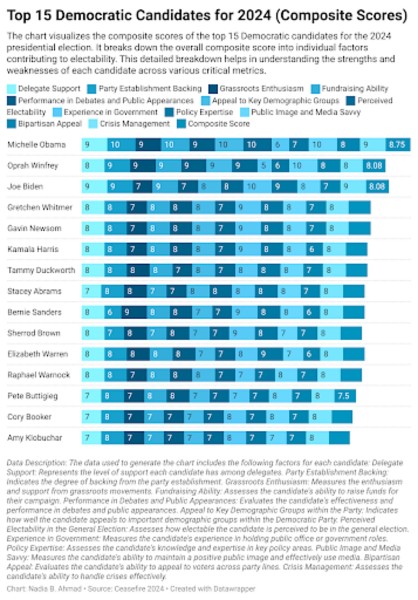
An open convention could help address the very real concerns about electability that have emerged in the wake of recent polling and debate performances. By allowing for a fair and transparent vetting process of multiple candidates, the party could ensure that it puts forward the strongest possible ticket for the general election. The call for an open convention is not about any single candidate—it's about reinvigorating the democratic process itself. It's a recognition that in times of political flux, flexibility and openness to new ideas can be a source of strength, not weakness.
Historically, open conventions have led to some of the most dynamic moments in American politics. They've allowed parties to adapt to changing circumstances and voter sentiments, sometimes resulting in unexpected but formidable tickets. In our current political climate, where voters are increasingly disillusioned with a system they see as unresponsive to their needs, a return to this more open and democratic process could help rebuild trust in our institutions.
The New York Times in an editorial has called for Biden to step down:“To make a call for a new Democratic nominee this late in a campaign is a decision not taken lightly, but it reflects the scale and seriousness of Mr. Trump’s challenge to the values and institutions of this country and the inadequacy of Mr. Biden to confront him.” President Biden has lost mainstream media, the intellectual class, the progressive base, and scores of youth, climate, and immigrant voters.
Of course, implementing an open convention would not be without challenges. It would require careful planning and a commitment to fairness from party leadership. But the potential benefits—a more energized base, a stronger platform, and a candidate with a genuine mandate from the party faithful—far outweigh the risks. I noted in The Intercept: “The Democratic Party is more invested in trying to maintain control than it is in trying to win an election in November.” As we hurtle towards 2024, it's time for a serious reality check. This election isn't just about picking a president—it's about deciding the future direction of American democracy. The recent debate performance was a wake-up call, and ignoring it would be political malpractice.
The Democratic Party has a choice to make. It can cling to the familiar and risk further alienating voters, or it can embrace the opportunity for renewal that an open convention represents. By opening up the process, the party could tap into the wellspring of progressive energy that is currently finding its outlet in third-party candidates. An open convention would be a recognition that our system is resilient enough to withstand scrutiny and flexible enough to adapt to changing times. As we face the challenges of the 21st century, let's not shy away from bold solutions. Let's embrace the democratic spirit that has always been at the heart of the progressive movement and trust in the wisdom of the people to chart the best course forward.
The time for an open convention has come. The only question is whether the Democratic Party will have the courage to seize this moment and write a new chapter in American political history.
Nadia Ahmad: Growing discontent has fueled a surge in support for third-party candidates, threatening to upend the traditional two-party dynamic and potentially tilt the balance in key swing states.More Videos
Comments

Powered by RoundtableAn AI/DeFi-powered Enterprise Media Operating System. Learn more at Roundtable.io.© Roundtable 2026. By using this site you agree to the Terms of Use and Privacy Policy