
Phil Roeder • Attribution (CC BY 2.0) • Flickr


Not Voting in November
Jun 26, 2024 6:15 AM
Unlike the 94 percent of oldsters who say they would “definitely vote,” the youngsters probably have many decades of life before them, decades in which they will have to live with the consequences of a second Trump term.
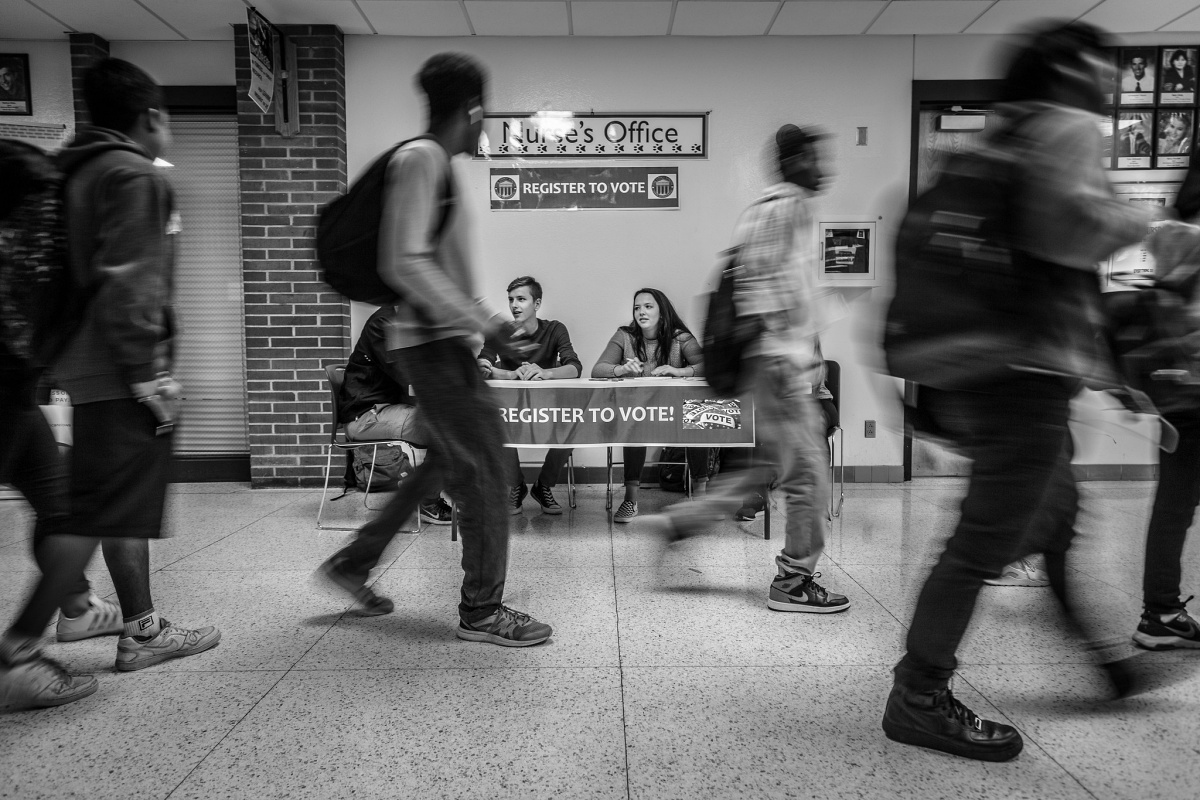
In a late June 2024 CBS poll, only 66 percent of registered voters between the ages of 18 and 29 said they would “definitely vote” in November. For those 65 and over, the percentage was 94 percent. But, if the young stay home like one-third of them indicate they might, they could be making a tragic mistake. (Or, in some cases, if they vote “third party.”) Why? Because likely voters under 30 favor Biden over Trump by a 61 to 38 percent margin.
The eighteenth-century statesman and Irish philosopher Edmund Burke is sometimes quoted as saying, “The only thing necessary for the triumph of evil is for good men to do nothing.” Although there is no evidence that he ever actually stated this, a later political philosopher, John Stuart Mill, did say something similar: “Bad men need nothing more to compass their ends, than that good men should look on and do nothing.”
Either way, the idea is the same. The result of “good men” (and women) doing nothing--i.e., not voting--could mean “the triumph of evil” or the bad. For Trump is evil, and so are some of the people he would appoint to important positions.
No! No way, some might object. Look at Trump’s previous presidency. It wasn’t a complete disaster or, as you claim a new four-year term might be, “a tragic mistake.” Such objections, however, fail to account for Trump’s evolution, or more accurately, his devolution or degeneration. He has learned some lessons from his first term, and indications are that a second term, if it occurs, could be much worse.
Related stories
But more specifically, why might younger voters be making a “tragic mistake”? Primarily because, unlike the 94 percent of oldsters who say they would “definitely vote,” the youngsters probably have many decades of life before them, decades in which they will have to live with the consequences of a second Trump term.
Regarding those possible consequences, one need look no further than the environmental consequences. As Sen. Bernie Sanders recently wrote, “If Donald Trump is elected, our kids and grandchildren are going to continue to see rising global temperatures that will lead to shorter lifespans and worse mental health; increased instances of food and waterborne disease; human and animal diseases; increased exposure to wildfires that will mean more heart and lung diseases; and flooding during extreme weather events. . . . It will mean substantially increased risk of wars, social unrest, and mass migrations. It will mean an estimated $100 trillion in lost global economic activity, with more than 100 million people thrown into extreme poverty.”
As Sanders also indicated, there are many other reasons to oppose Trump. He’s “a racist, a sexist, a xenophobe, a homophobe, and a religious bigot.” He’s “now a convicted felon who is just as unfit for office as he was before the jury announced its verdict.”
So why are a third of young voters unsure they will vote in November? Well, the CBS and other polls indicate some of the reasons, but I would add another--the lack of a moral imagination. It can be defined as “the power that compels us to grant the highest possible reality and the largest conceivable claim to a thought, action, or person that is not our own, and not close to us in any obvious way.” And its lack in our political culture has sometimes had dire consequences. In 1968, for example, Kentucky writer Wendell Berry in “A Statement against the War in Vietnam” stated, “We have been led to our present shameful behavior in Vietnam by this failure of imagination, this failure to perceive a relation between our ideals and our lives.”
To stimulate our imaginations we might turn to works of fiction like Sinclair Lewis’s It Can’t Happen Here (1935) or Philip Roth’s The Plot Against America (2004). Both novels imagine an authoritarian, racist president coming to power in the USA.
Lewis’s President Buzz Windrip, who in the novel defeats Franklin Roosevelt in the 1936 election, possesses significant characteristics that remind us of Trump: “vulgar, almost illiterate, a public liar easily detected, and in his ‘ideas’ almost idiotic.” He possessed an “uncommon natural ability to be authentically excited by and with his audience, and they by and with him. . . Oh, he was common enough. He had every prejudice and aspiration of every American Common Man. . . . and the superiority of anyone who possessed a million dollars . . . He regarded . . . poetry not daily syndicated in newspapers and all foreigners, possibly excepting the British, as degenerate.” In regard to racism, Windrop’s platform “condemned the Negroes--since nothing so elevates a dispossessed farmer or a factory worker on relief as to have some race, any race, on which he can look down.”
Roth’s fictional Charles Lindbergh is the same famous aviator who, in 1927, became an American hero by completing a non-stop solo flight from New York to Paris. Only the fictional hero, unlike the real one, runs for president in 1940 and defeats Franklin Roosevelt. Both the fictional and real Lindbergh, however, are like Trump in admiring strong rulers; in emphasizing “America first” and supporting more isolationist, go-it-alone policies; and in their racism.
Roth writes of “Lindbergh’s contention that the Jews’ ‘greatest danger to this country lies in their large ownership and influence in our motion pictures, our press, our radio, and our government.’” He adds Lindbergh’s words concerning “our inheritance of European blood,” “dilution by foreign races,” and “the infiltration of inferior blood” being shared “by a rabid constituency . . . flourishing all across America.” An excellent 2016 Washington Post article notes that the fictional “Lindbergh moves Jews from urban centers into the rural heartland through an ominous Office of American Absorption,” and [Lewis’s] “Windrip creates concentration camps for dissidents; establishes a sham judiciary; and bars black Americans from voting, holding public office, practicing law or medicine, or teaching beyond grammar school.”
Lewis’s novel appeared just a few years after Hitler came to power in Germany, and the writer knew Nazi Germany well. His wife, Dorothy Thompson, was a journalist often residing in Germany. Between 1931 and 1934 she wrote 15 well-researched articles covering the rise of Hitler and conditions in Germany for The Saturday Evening Post and other magazines. She also wrote the 1932 book I Saw Hitler!
To stimulate our imaginations further, as with Lewis’s approach, some familiarity with Hitler’s makeover of Germany in the 1930s is helpful. And as new research indicates, the Trump-Hitler comparison is looking more common-sensible every day.
A good place to start is with Richard Grunberger’s The 12-Year Reich (1971). It has 30 chapters that examine various aspects of Nazi life, e. g., “Denunciation,” “The Civil Service,” “Justice,” “The Family,” “The Cinema,” “Press and Radio,” “Religion,” and “The Jews.” Reading these chapters, we can see how the Nazis transformed German life--a scary scenario for sure. For example, in the chapter “Denunciation” we read: “Denunciation took place at all levels of society. . . . The fear of denunciation gripped all those who had any sympathy for Jews. . . . The emotional tension brought about by war [begun in 1939] naturally intensified the mood of suspicion and increased the flow of denunciation.”
Would Trump transform U. S. life? He and many of his followers are certainly planning to. Two indications of this are
- an April-2024 interview Trump gave to Time magazine conducted by reporter Eric Cortellessa, who also interviewed many top Trump advisers and shared his experiences in a piece entitled “How Far Trump Would Go”; and
- The Heritage Foundation’s Project 2025, which is “a self-described playbook of what a new Trump presidency would do in its first 180 days.”
According to Cortellessa, Trump would use the U.S. military to “carry out a deportation operation designed to remove more than 11 million people from the country,” and “he would let red states monitor women’s pregnancies and prosecute those who violate abortion bans.” He would also reduce the checks and balances that normally limit a president’s powers, especially regarding law enforcement and Department-of-Justice autonomy. He also “would be willing to fire a U.S. Attorney who doesn’t carry out his order to prosecute someone, and he would “appoint a ‘real special prosecutor’ to go after Biden.” Moreover, Trump “is weighing pardons for every one of his supporters accused of attacking the U.S. Capitol on Jan. 6, 2021, more than 800 of whom have pleaded guilty or been convicted by a jury.” Moreover, he would “deploy the National Guard to American cities as he sees fit. . . . possibly without the request of governors.”
One final imagination stimulant. Imagine a world where many spokespeople or institutions on the Left are disabled or shut down, as they were in Nazi Germany. (I’ll leave it to your imaginations to picture how this might be done.) And not only those on the Left, but also some honest, decent people on the Right (see, e.g., here and here, and think of Liz Cheney.) Instead, just as Nazi Germany had its Heinrich Himmler, Joseph Goebbels, and Alfred Eichmann (and innumerable others), in a second Trump presidency we might have to deal with the likes of some of the following:
- The Proud Boys--“Since the Jan. 6 Capitol riot, four former Proud Boys leaders have been convicted in federal court of seditious conspiracy, each sentenced to 15 or more years in prison. At least another 70 members were charged with participating in the violence. . . . Some Proud Boys say they are preparing to emerge once again as a physical force for Trump, drawn to his hardline nationalism and convinced their leaders will be pardoned if he wins. Trump himself promises to pardon convicted Jan. 6 rioters if he’s elected.”
- Lara Trump--Married to Donald’s son Eric Trump and co-chair of the Republican National Committee. After Maryland Republican Senate candidate Larry Hogan urged citizens to respect the verdict in the recent Trump hush money trial, she said Hogan “doesn’t deserve the respect” of any Republican, and called his comments “ridiculous.”
- Former Trump National Security adviser Gen. Michael Flynn--Following the Trump loss in 2020, Flynn wanted Trump to suspend the U. S. Constitution, impose martial law, limit the press, and under military supervision hold a new election.
- Former Trump lawyer and adviser Rudy Giuliani.
- Longtime Trump adviser and confidant Steve Bannon, who is due “to spend four months in a Connecticut penitentiary starting July 1.”
- Many of Trump supporters in Congress--e.g., Marjorie Taylor Greene, Lauren Boebert, and Matt Goetz. Ironically, Boebert, a House member from Colorado, is a gun rights activist, attended Rifle High School, and owned the Shooters Grill in Rifle.
- South Dakota Governor Kristi Noem--once thought a possible Trump Vice-Presidential contender, her chances were hurt when it was revealed that she shot and killed her family’s hunting dog.
If all of the above seems almost comical at times, voters, including young ones, would be making a tragic mistake if they took the Trump challenge too lightly. And, as E. F. Schumacher once wrote, they need to have their “imagination rushing in where bureaucratic angels fear to tread.” Trump’s desire for revenge is not going away. As NBC News reported just a few weeks ago, Trump has “increasingly focused on the idea of ‘retribution’ against his enemies if he returns to the White House.”
Comments

Powered by RoundtableAn AI/DeFi-powered Enterprise Media Operating System. Learn more at Roundtable.io.© Roundtable 2026. By using this site you agree to the Terms of Use and Privacy Policy