
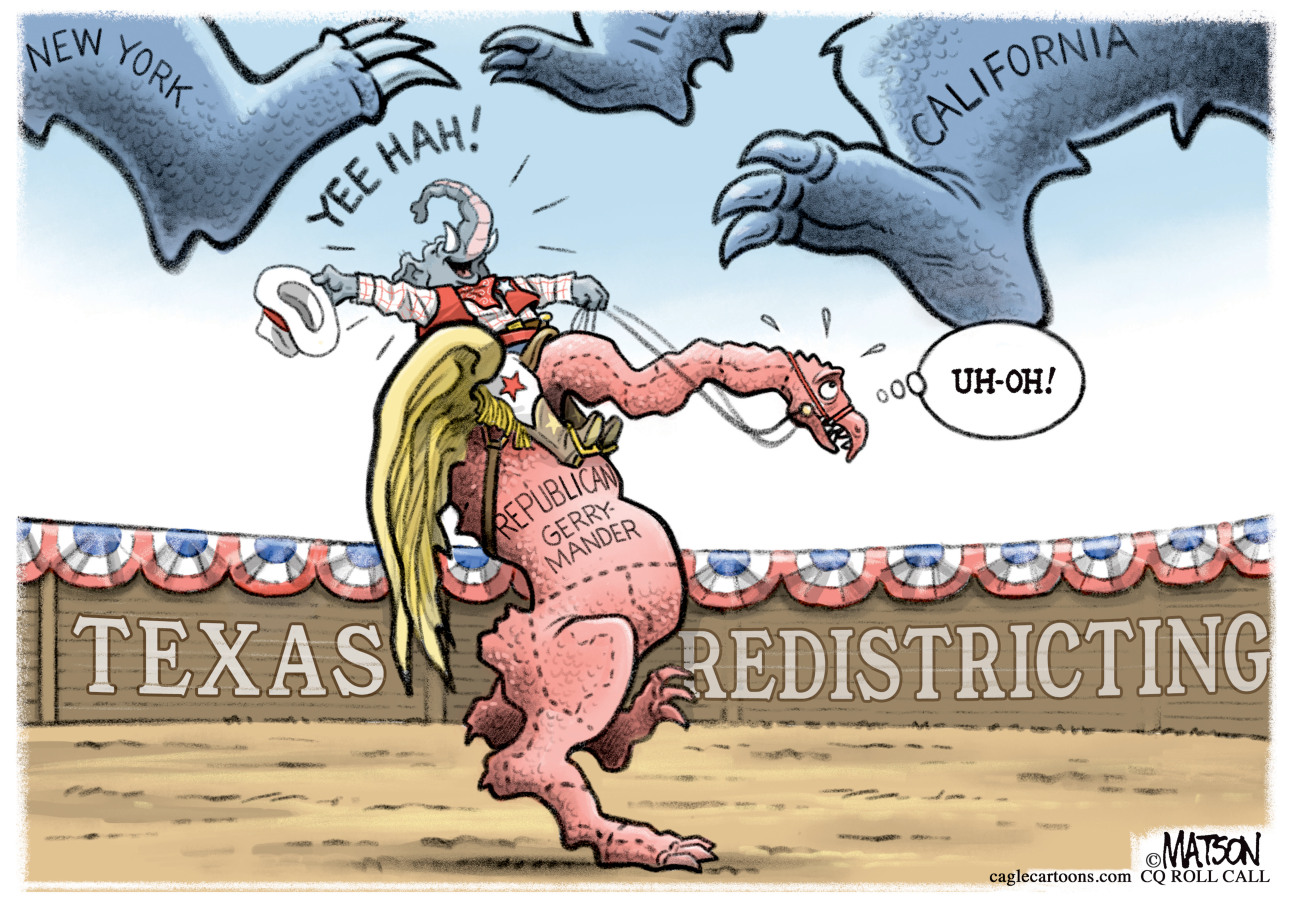


Map Wars: Texas vs. California
Aug 27, 2025 12:02 AM
Updated Aug 27, 2025 12:05 AM
As partisan redistricting escalates, Los Angeles can break the winner-take-all trap with multi-seat districts and proportional ranked choice voting.
The national redistricting scandal unleashed by Donald Trump’s grab for more US House seats in Texas is still roiling from coast-to-coast. Governor Gavin Newsom has upped the ante by signing a California redistricting plan to neutralize Texas (though Newsom’s plan must be approved by voters, since in 2010 California legislature was unilaterally disarmed via a voter-enabled independent redistricting commission). The battle lines are set, Deep Red versus Deep Blue. Meanwhile Common Cause, for decades the nation’s leader of redistricting reform, has tried to thread a policy needle by issuing a statement on mid-decade redistricting with six new “fairness criteria” that gives a faint blessing to the Democrats’ counter-attack, but only under prescribed conditions.
The nation is holding its breath over what comes next. Yet it all seems so pointless. Each partisan side is clawing to gain a few inches of turf against the other. It’s like the battlefront between Ukraine and Russia, trench warfare, hand-to-hand, crawling on bellies to push the front lines in the right direction. It’s “winner take all” combat in which one side will win…but the nation itself will lose. What hope is there for the future?
Here’s the hope, and it is playing out in Los Angeles, the “City of Angels.”
A charter commission in Los Angeles is weighing various political reforms that could amount to either something significant or the usual ho-hum. LA is dominated by Democrats, so this is another chance for Democrats to show that they “get it,” and start enacting political reforms to open up our democracy and make it work for everyday people. Or, as usually happens, Democrats will once again fail at doing anything positive or with actual “abundance” when it comes to bettering our democracy, and then try to blame it all on Donald Trump.
Related stories
But there’s a key role for Common Cause and other believers in representative democracy and governance to play, if they are open to adjusting their strategy.
The tragedy of LA’s rotten racial politics…and big city corruption
Los Angeles is still stumbling to find its way forward after its nearly three-year old scandal over three of its Latino city councilors being caught in a hot mic moment using ugly racial and homophobic insults. But that’s not the only LA scandal -- three other city councilors have been sentenced to prison for corruption, and a fourth one just went on trial.
WTF LA! For a 15-member city council that’s a lot of bad behavior. Local democracy is seismically buckling, and it all can be traced to – “winner take all” elections.
Specifically, the single-seat district system that LA has used for decades to elect its 15 member city council. In a “multi-everything” city like Los Angeles, district elections only serve to amplify and exacerbate the turf wars over representation and the land-use issues that continually challenge megalopolis urban centers. Because of quirky local laws, a city council member has enormous control over “discretionary” funds, licensing, zoning as well as land-use issues within his/her district. That “bolsa familia” provides incentive for payoffs from preferred “customers”, er, I mean constituents.
“Winner take all” is synonymous with “if you win, I lose,” and when you have a city of nearly 4 million residents, each representing their own parochial interest group of one, all trying to get their piece of the pie – including political representation – it is a formula for political dissatisfaction and alienation. When you add to that city council members ruling over their districts like their own personal fiefdoms, in which they control the cookie jar, it is a formula for criminal behavior.
This is a return to the Boss Tweed/Tammany Hall type of corrupt politics that unleashed the Progressive Era of political reform in the early 1900s. It’s like a bad Hollywood horror flick that one cannot exit, in which the hockey-masked assailant keeps rising again and again. It’s baaa-ack!
What has gone unsaid
Returning to the Latino city councilors and their degrading remarks: amidst all the scandalous headlines, an important realization was missed. When you set aside the shocking and disgraceful racist and homophobic gossip recorded in that secretly mic’ed private meeting, these leaders were trying to grapple with a very real – and unfair – dilemma of the Los Angeles political landscape. Not many people I have spoken to about this ever took the time to listen to the audio of that controversial conversation or read any of the transcripts. When you actually listen, lurking beneath the deplorable language is not only a focus on the political checkerboard game of redistricting, but a keen awareness that only one racial group can win each “winner take all” district, and all other racial groups must lose.
At the time of the scandal in 2022, the makeup of the 15 member city council was four Latino councilors (27% of the council), three Black (20%), two Asian (13%) and six White (40%). Compare that to the most recent US Census data in 2020, which found that the racial demographics of Los Angeles are 48% Latino, 8.8% Black, 11.8% Asian and 28.5% White.
Looking at this from the fairness standard of what is known as “authentic representation” – in which groupings of like-minded voters should be able to win representation roughly equal to their residential population – the Latino community should hold six or seven out of 15 city council seats, the Black community one council seat, Asians two seats and Whites four. Even if you factor in the difference between voting age population (VAP) and Citizen VAP, since some of those Latinos are not citizens and therefore ineligible to vote, it’s still pretty clear that Latinos are vastly underrepresented in LA, compared to African-Americans and Whites. When you set aside the repulsive talk in that now-infamous conversation, it was clear that this reality of Latino underrepresentation was the purpose of that meeting. The Latino leaders were trying to figure out how to draw district lines so that the Latino community would come closer to fair – that is, racially proportional – representation.
As a result of the 2021-22 redistricting, in the middle of which this disgraceful clandestine discussion occurred, new district lines were drawn. Based on the current city council district lines, here is the current racial composition on the council:
5 Latinos (a pickup of one seat)
3 African-Americans (no change)
2 Asian Pacific Americans (no change)
5 whites (decline of one seat)
So after all of the controversy and a new redistricting plan, Latinos are still substantially underrepresented, the Asian population is a little bit overrepresented, and the African-American and white populations are overrepresented. If the disgraced Latino leaders were conspiring to create some Latino advantage, they were not very successful.
In the aftermath of this scandal, a number of groups led by Common Cause understandably called for an independent redistricting commission (IRC) for LA – if you are going to use “winner take all” single-seat districts, then an IRC is a no-brainer. There is simply no good reason to leave the legislative line-drawing in the hands of incumbents and political party apparatchiks, since they will try to manipulate the lines in favor of their own reelections and that of their faction. To its credit, the LA city council took advantage of this “reform moment,” as the Los Angeles Times called it, and voted to authorize a ballot measure to implement an independent redistricting commission (IRC). Finally in November 2024 LA voters overwhelmingly passed a ballot measure to establish an IRC, which will be empaneled to draw council lines following the next Census in 2030.
But that’s five years away. And the irony is that the current system — without an independent redistricting commission — has served the Black community quite well, with three out of 15 city councilors. They and Whites have been punching above their weight, while the underrepresented Latinos have been punching below their weight. In reality, the Black community may well lose representation when the authorized IRC is put into place at the end of this decade.
Will an Independent Redistricting Commission (IRC) make a difference in LA?
Can an Independent Redistricting Commission hope to wring some lemonade from these lemons? Maybe yes, maybe no. In San Francisco, where I have lived for many years, its IRC saw a major failure in 2022 when the mayor was able to capture the IRC, and her allies on the IRC managed to set the Asian and Black communities at each other’s electoral throats. Some of San Francisco’s commission members were publicly saying similar things that the three Latino councilmembers in LA said in a private discussion, just without the racial and homophobic slurs. They were openly discussing how Asians/Chinese deserved more representation and Blacks deserved less, based on population measures.
Certainly at the very least an independent redistricting commission (IRC) allows reformers to say that incumbents are no longer drawing their own district lines, and that is a modest step toward reducing public cynicism. But LA’s problems are so much deeper than that, with its history of corruption and convicted city councilors. The closer one looks, the more it becomes clear that many of the problems attributed to gerrymandering, and the corruption swirling around that in Los Angeles, are actually problems of basing the elections on the use of “winner take all” single-seat districts.
In the fraught political landscape of Los Angeles, nothing magnifies the turf wars, whether between different racial groups, downtown vs. neighborhoods, progressives vs. moderates vs. conservatives, the wealthy vs. middle-class vs. the poor, or exacerbates housing and transportation inequities and other land-use issues, more than this “if you win, I lose” brand of politics. Redistricting battles in many cities, even those with IRCs, have produced corrosive bitterness as each minority group and community of interest claws for its share of a limited commodity: political representation. The shortcomings of this approach are increasingly hard to ignore. A “multi-everything city” like Los Angeles needs to use a better democratic method that is not based on these toxic “winner take all” incentives and dynamics.
Innovation: multi-seat districts using Proportional Ranked Choice Voting
What if Los Angeles took a different approach? What if there is a method in which all sides, all racial groups, all constituencies and groupings of voters, can win their fair share of representation?
Let’s close our eyes for a moment and imagine a different kind of democracy for Los Angeles. The current charter commission already is considering whether LA should increase the number of seats on the city council to greater than 15, where it has been stuck in size since 1925 when the population was a quarter of what it is now. Again, this is a no-brainer. I realize that many people can’t stand politicians and understandably react, “Why would we want more of them?” But Los Angeles has – by far – the largest city council districts of any major metropolitan area. With nearly 4 million people, each city council district contains approximately 260,000 residents. Chicago with almost 3 million people has 50 city council districts each representing about 56,000 residents. New York City, with twice the population of LA, has 51 city council districts each representing about 166,000 people.
So LA’s enormous, highly populated districts of over a quarter million people, overseen by a single city councilor with veto power over discretionary spending and land-use issues, have contributed greatly to poor constituent service and a civic frustration and alienation that feeds the unpopularity of city government.
Imagine if we increased the size of the city council from the current 15 seats to 33 seats, each representing about 121,000 Angelenos – still twice as large as Chicago’s or San Francisco’s districts, but a magnitude similar to New York City and Houston’s. That’s a good start.
But let’s take another step. Imagine that in this new LA future we are not going to elect the city councilmembers using the same old “winner take all” method based on the corrupted, criminal-inducing single-seat districts. Instead of having one council member per district, there will be three councilors each nested within their own district, and a total of 11 three-seat districts.
Hmmm, interesting. But let’s innovate another step. Besides increasing the number of council seats to thirty-three and electing them in 11 three-seat districts, within each district the councilors will be elected by an electoral method known as proportional ranked choice voting (PRCV). Under the rules of PRCV, when electing three seats at once, a candidate would need 25% of the vote to win one of those three seats. That key difference would open up representation to any constituency group, coalition or community of interest that can win a quarter of the vote in one of these 11 three-seat districts.
If you look at the current city council district map of Los Angeles (link here), you can see some immediate benefits compared to any map that might be drawn by an indepent redistricting commission (IRC). Using data for the estimated voting age population in each of the current 15 districts, Latino voters and candidates would be in a strong position to win one or two of the three seats in most of the 11 three-seat districts – a solid chance to win close to a majority of council seats. In three or four of the 11 districts, the Black community would be in a strong position to win a seat in each district with 25% of the vote, and in other districts the Black vote would be influential. The Asian vote also would be strong in several of these districts, approaching the 25% victory threshold, and influential in other districts. In some districts you could end up with two Latinos elected and one African-American; or one Latino, one White councilmember and one Asian.
A lot more Angelenos, no matter their race or where they live, would be able to cast a vote for their favorite candidates and see them win one of the three seats. Virtually every Angeleno, wherever they live and whoever they are, would be able to vote for a winning candidate. Compare to the status quo council districts, where candidates need a majority of the vote to win, and so up to 50% of voters in a district can waste their votes on a losing candidate.
Neighborhood-based representation and multiple representatives
And please note: three-seat districts with a 25% victory threshold still allows neighborhood-based representation. That’s because candidates would not need to campaign across the entire district, instead they would look to win votes in their own neighborhoods and then mobilize pockets of voters in other parts of their district who naturally gravitate to their viewpoint and policies.
Consider the strange case of Los Angeles City Council District 15 (CD15). Because of its uniquely elongated shoestring district reaching all the way south to the Port of Los Angeles, the racially and culturally distinct neighborhoods of San Pedro, Wilmington, Watts, Harbor City, and the Harbor Gateway have all been packed into the same district and so must share a single city councilor. Yet eight of the eleven councilmembers (and the last six in a row) going back nearly 100 years have come from San Pedro. Despite accounting for less than one-third of the district's population, San Pedro has enjoyed outsized influence as the district's base of political power. If CD15 elected its city councilor as part of a three-seat district, racially diverse communities like Wilmington and Watts — which have far different issues of environmental and social justice than San Pedro — would be far more likely to also elect a representative from their areas than under LA’s current single-seat system, even one drawn as fairly as possible by an IRC
Elected officeholders would also no longer be the kingpin of their own personal single-seat district fiefdom. Multi-seat districts, with three elected councilors per district, would act as a check against the type of behavior that has resulted in three city council members convicted for corruption, and a fourth likely about to be convicted. Each three-seat district would be competitive for several political viewpoints, and coalitions would be able to form fluidly in response to the pressing issues of the day, instead of in backroom deals with racial or land-use arm twisting, inside of a fixed grid of district lines that don’t change for 10 years.
Proportional ranked choice voting also allows voters to express the complex racial-ethnic and political identities that so many Angelenos align with today. A Black Christian conservative, a gay Latino, an Asian American businesswoman, a white Goth nurse, an immigration-concerned Latina, a Green libertarian, may not fit neatly into the usual categories of race, culture and partisanship. Proportional RCV allows voters to, in effect, “district themselves” by expressing who they are via their rankings of multiple candidates. The ranked ballots liberate voters to pick their favorites without worrying about voting for spoiler candidates. They also allow like-minded organizations to prevent splitting their votes among too many like-minded candidates.
In New York City, which uses ranked choice voting within its one-seat city council districts, women of color hold a majority of city council seats because like-minded candidates were able to run in the same contests and not spoil each other or split the vote. With RCV, more voters can enthusiastically rank the candidates they truly like and who represent their views. Los Angeles would greatly benefit from this brilliant feature of ranked ballots, which encourages coalition-building instead of zero-sum, “if you win, I lose” campaigns.
The truth is, everyone deserves representation. But winner-take-all district elections can never deliver that, even with a IRC. As our multi-everything cities continue to “rainbowize,” proportional voting promises authentic representation to more individuals and constituencies, as well as the best chance for realizing a colorful mosaic that both respects differences and knits them together into a more unified whole.
The boroughs of Los Angeles?
Just as tantalizing as this multi-racial cross-fertilization of politics and culture would be the idea of each of these 11 three-seat districts becoming a borough of LA. New York City is famous for its boroughs, each with its distinctive politics and culture. Certain services could be placed into the hands of the boroughs, and carefully selected powers could be devolved. The vibrant neighborhood councils, which have become part of the fabric of LA politics, could be further empowered at the borough level. The boroughs of Los Angeles could play an instrumental role in revitalizing the severed connection between every day Angelenos and their downtown city government.
Los Angeles, meet Portland
Sounds like a fantasy? About 200 jurisdictions across the US have adopted some form of proportional voting, usually to resolve voting rights disputes over minority representation. And in Portland, Oregon, a city of nearly 700,000 with a racially-conflicted past, a multi-racial charter commission voted 17-3 to allow voters to decide in November 2022 on a charter amendment to implement a borough-type system elected by proportional ranked choice voting.
As Portland expanded its council from five to 12 seats, the commission had a choice of moving to a representation method based on single-seat districts, like LA uses, but they discovered a problem: Portland’s various racial minority constituencies were too geographically spread out, with too many competing claims for representation, to benefit from drawing “majority-minority” districts. Plus, even if you could do that, what happens to the minority voters that don’t live in the right gerrymandered district? They end up with no representative, disempowered and out of luck.
So the Portland charter commission took another route. The system that was adopted by 58% of Portlanders now elects a total of 12 seats in four districts of three seats each. That configuration creates some borough-like geographic representation combined with broader city-regional representation. In its first election in 2024, voters elected a historically diverse and gender-balanced city council, with half women and five councilors of color, roughly matching the demographics of the city. The council also has three members who are renters, and the councilmembers’ ages range from 28 to 70.
In one of Portland’s three-seat districts, which covers historically underrepresented East Portland, the three winners included two-labor endorsed candidates and a business-endorsed candidate, including two women of color. In another three-seat district, two of the winners were endorsed by labor groups as well as a leading business group. The third winner received endorsements from a different coalition – including the Sierra Club, the Working Families Party and Portland DSA.
As FairVote points out, several of Portland’s races were marked by collaborative campaigning and less negative messaging between the frontrunners, as often happens in RCV races. Candidates realized they would benefit from a coalitional style of campaigning – finding areas of compromise with rival candidates, and asking for second-choice support from their rivals’ supporters. In one three-seat district, two candidates became known for campaigning jointly with each other and encouraging their supporters to rank both of them, first and second in any order. This strategy apparently worked, because both were elected.
Some of the findings of the Portland charter commission, which was very much led by leaders and organizations of color, are particularly illuminating for LA’s situation. Here are excerpts from one of its final reports:
“Multiple representatives per district addresses the fact that it's incredibly difficult for any one single elected individual to represent the diversity of viewpoints and experiences. Having multiple people allows for a greater chance that more viewpoints and experiences will be represented.”
“The Charter Commission believes multiple representatives per district will help community members connect directly with their elected leaders and increase accountability between Portlanders and elected leaders.”
LA’s future = America’s future
Issues of political representation and voter inclusion and engagement in multi-everything cities are delicate and complex, like the wings of a colorful butterfly. Much is at stake, especially since LA is a microcosm of the galloping demographic shifts taking place across the nation. Los Angeles’s charter review commission, provided with a broad mandate to design a new democracy for this multi-everything metropole of Angelenos, has great potential to weave LA into a colorful mosaic of neighborhoods and boroughs that respects differences and also knits them together into a more unified whole.
Rather than continuing this bitter clash over “if you win, I lose” politics, Los Angeles should embrace the Golden Rule of Representation: “Give unto others the representation you would have them give unto you.” In the throes of the nationwide redistricting meltdown led by Trump’s outrageous power grab in Texas, and Common Cause’s dream of independent redistricting commissions (IRC’s) across the land that has fallen off a cliff, Los Angeles represents a new opportunity for Common Cause and other reformers to lead in an innovative direction that is better suited for multi-everything cities like Los Angeles, and also for our multi-everything country.
Comments

Powered by RoundtableAn AI/DeFi-powered Enterprise Media Operating System. Learn more at Roundtable.io.© Roundtable 2026. By using this site you agree to the Terms of Use and Privacy Policy