
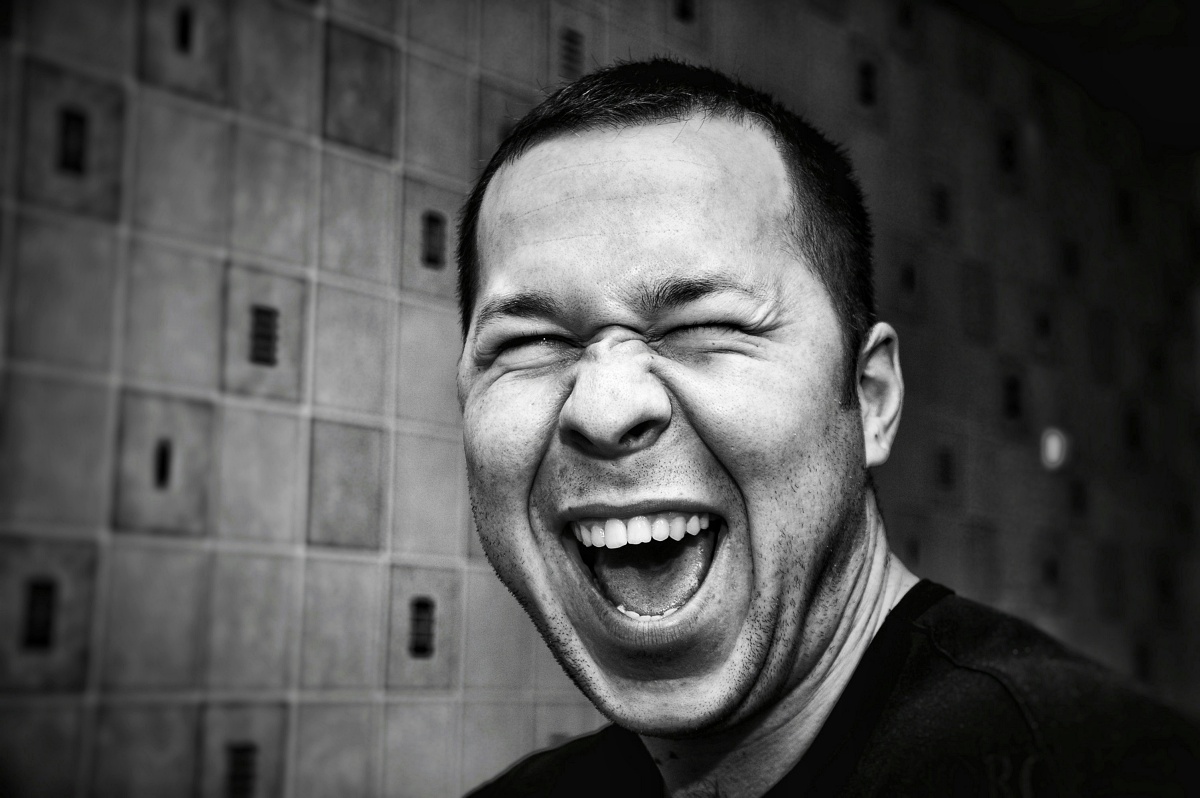
Photo by Denis Agati on Unsplash


Laugh Often
Feb 3, 2024 1:45 AM
Is it completely accidental that a major contrast between one of our best presidents (Lincoln) and one of our worst ones is the possession of a sense of humor?
Why should you take the advice in this title? 1. Humor is good for you. 2. It looks like the buffoon Donald Trump will be the Republican candidate for president. “Buffoon” you say, what do you mean? Well, look at the Merriam-Webster definition: 1. “a ludicrous figure,” and 2: “a gross and usually ill-educated or stupid person.” Do they fit Trump or not?
Most readers of this online magazine will probably say “yes.” But many might object that taking his candidacy seriously is better than laughing at or about him. I would simply respond that we can—and should—do both.
To make my case, I call my first witness—Reinhold Niebuhr (1892-1971). He was not only one of the outstanding U. S. theologians of the twentieth century, but also one of our more profound political thinkers—and one greatly admired by President Barack Obama. In a most insightful essays on humor, Niebuhr wrote that the “less we are able to laugh at ourselves the more it becomes necessary and inevitable that others laugh at us.”
This is my first point: Trump is incapable of laughing at himself, thus we need to do so. Over five years ago, I began an essay contrasting him to Abraham Lincoln, who was known for his humor. “In The War Years Lincoln biographer and poet Carl Sandburg wrote, ‘Lincoln was the first true humorist to occupy the White House. No other President of the United States had come to be identified, for good or bad, with a relish for the comic.’ More recently, Richard Carwardine has devoted a whole book to Lincoln's humor. In contrast, former FBI director James Comey has stated that he never personally witnessed President Trump laugh, and conservative columnist Max Boot has written, ‘Has there ever been a president as humorless as Donald Trump? Doubtful.’” (Note: in referring to the humorlessness of Trump, Boot is thinking more of the benign or self-deprecating type of humor exercised by Lincoln or President John Kennedy, "a master of self-deprecatory humor,” than of the mean-spirited mocking type sometimes evidenced by Trump.)
Related stories
Few voters, even among Trump followers, have linked Trump with wisdom. Tough, vindictive, stubborn maybe, but wise? I don’t think so.
Is it completely accidental that a major contrast between one of our best presidents (Lincoln) and one of our worst ones (according to historians) is the possession of a sense of humor? (See also here.) I think not. In Niebuhr’ humor essay he also wrote, “To meet the disappointments and frustrations of life, the irrationalities and contingencies with laughter, is a high form of wisdom.” And few voters, even among Trump followers, have linked Trump with wisdom. Tough, vindictive, stubborn maybe, but wise? I don’t think so.
If Niebuhr is correct in linking humor with wisdom—and I think he is.—Trump’s lack of both is rooted primarily in one major cause—his egotism. Wisdom scholar Robert Sternberg believes that wisdom involves seeing “things from others’ perspectives as well as one’s own,” but that many lack wisdom because they are “susceptible to four fallacies.” He labels them egocentrism, omniscience, omnipotence, and invulnerability, and all four are tied up with too big an ego and overestimating one’s own importance.
Trumps egotism has long been evident. Already before being elected president in 2016 he had made a whole slew of statements such as the following: “Sorry losers and haters, but my I.Q. is one of the highest—and you all know it!” He also bragged about having “the world's greatest memory.” Yet, although egotism helps prevent political wisdom, it is a quality we should desire in any president.
Rather than possessing the humility to realize that like the rest of us humans, he is only one of billions now living, and that like everyone else he has his imperfections and is prone to error—“To err is human,” said poet Alexander Pope—Trump becomes extremely defensive if any of his many flaws are mentioned.
Besides Niebuhr on humor and Trump’s own statements and behavior, additional insight on Trump’s lack of humor and lack of wisdom is provided by Sophia McClennen, the author of Trump Was a Joke: How Satire Made Sense of a President Who Didn’t (2023, hereafter TWJ). A professor of International Affairs and Comparative Literature at Penn State University, she is also a columnist at Salon.com and the author, co-author, or editor of numerous other works including several dealing with humorist and TV host Stephen Colbert and with Latin America.
Her general assessment of Trump can be ascertained by the following description in TWJ, where she writes of his “poor reasoning skills, weak command of the English language, megalomaniacal ego, toxic and fragile masculinity, constant need for attention, bullying racism and sexism, tendency to exaggerate and speak in hyperbole, and extraordinary lack of self-awareness.”
In her TWJ book she points out some of the reasons why humorists loved to mock him: “his arrogant hubris and his cocky way of suggesting that he knew how to fix the world’s problems, despite personally having failed multiple times in his own business dealings.”
Unlike most other presidents he didn’t seem to be able “to simply ignore the barbs and focus on his work.” Instead, he got angry and “regularly engaged in public battles” with comedians, especially those with TV shows. Often, “he whined about unfair treatment.” On other occasions he claimed the so-called humorists were not even funny. But whatever his comeback, his colossal ego could not deal with perceived insults by responding with any self-deprecating statements, even if insincere.
Niebuhr again helps explain why, “a humorous acceptance of fate is really the expression of a high form of self-detachment. [Has Trump ever reflected self-detachment?] If men do not take themselves too seriously, if they have some sense of the precarious nature of the human enterprise, they prove that they are looking at the whole drama of life not merely from the circumscribed point of their own interests but from some further and higher vantage point.”
Beyond his “own interests” was a destination Trump simply seemed unable to reach. He has not been able to do what Niebuhr recommends: don’t take ourselves “too seriously”; “recognize the ludicrous and absurd aspects” of our pretensions; and admit that “we are rather insignificant little bundles of energy and vitality in a vast organization of life.”
From her perspective, McClennen is mindful that employing humor can sometimes undermine political advancement. Given the extreme polarization in our country the gibes aimed at Trump can sometimes prompt his supporters to dig in their heels. But she praises humorists like John Stewart, John Oliver, and Jimmy Kimmel for combining “satirical commentary with an earnest commitment to democratic institutions and the public good.” (That furthering the public or common good should be the main aim of politics has been espoused by many political experts.)
She is most helpful in indicating how her preferred type of humor—satire—can hinder, actually retard, someone like Trump. “Satire is dedicated to exposing human folly, and its goal is to inspire critical thinking and reasoned social engagement.”
Moreover, in an essay that appeared in the middle of last year, she not only noted that humor can alleviate “depression, fear, sadness and other negative emotions,” but that “people who consume satire are more likely to attend rallies, discuss politics, donate to a political party, wear political buttons and vote than viewers of traditional late-night comedy shows.” Satirical “bits have the potential to help the young voting demographic watching these clips engage with the election and vote. They also help frame political positions in ways that make the stakes of the next election easy to grasp.” (Her comment about engaging “the young voting demographic” is especially important because a heavy anti-Trump vote is especially dependent on young people. The return of Jon Stewart on 12 February as Monday-night host of ‘The Daily Show” and executive producer for other nights of the program should also help arouse younger and now not-so-young former viewers of his.)
In the second paragraph of the present essay, I indicate that “we can—and should—do both.” And by “both” I meant take Trump’s candidacy seriously and laugh at his foolishness. Since I have frequently quoted Niebuhr in this essay, it is only fair to recognize that he also wrote that laughter alone is not enough to deal with great evil. Satirizing Trump can energize some anti-Trump voters, tilt some undecided voters against him, and might even convert a few pro-Trumpites, but satire alone is not enough. Patient, serious, reasoned opposition is also needed.
It is no secret that Trump appeals to people’s basest instincts. “I am your retribution,” is one of his many appeals. Recent polling indicates that voters correctly perceive him as a polarizing figure, one likely to further divide our country. As in so many other ways, he is the opposite of Lincoln, who preferred to appeal to “the better angels of our nature.”
In the last paragraph of a recent book, I included the following words: “The best humor reflects such virtues as love, humility, compassion, empathy, and tolerance; it is not mean-spirited or hateful; it should reflect the realization we are all fallible creatures, prone to errors and misjudgments; it can be a helpful means in seeking the common good.” Tolerant, not “mean-spirited,” and “seeking the common good” those should be the aims of our anti-Trump humor. We should not wish evil upon Trump, just the prevention of his malignancy upon so many of the rest of us.
Comments

Powered by RoundtableAn AI/DeFi-powered Enterprise Media Operating System. Learn more at Roundtable.io.© Roundtable 2026. By using this site you agree to the Terms of Use and Privacy Policy