
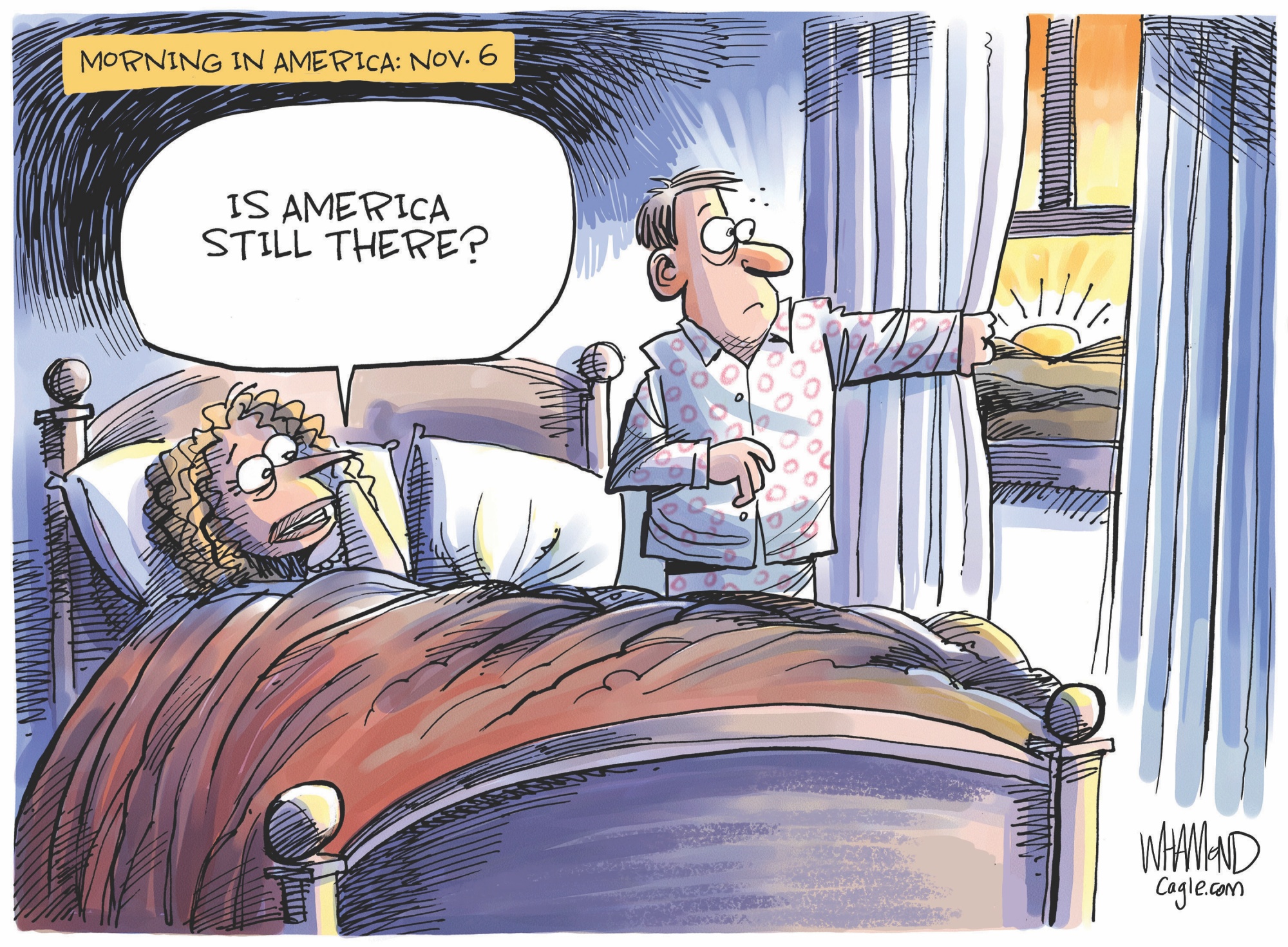
Illustration by Dave Whamond on Cagle Cartoons


The values and justice we progressives fight for, especially regarding climate change, are just too important, especially for younger people, to abandon.
Nov 7, 2024 4:09 PM
The values and justice we progressives fight for, especially regarding climate change, are just too important, especially for younger people, to abandon.
I know. I know. Like many of you, my fellow progressives, I awoke on November 6th to discover Donald Trump had again been elected our president.
And my first feeling was despair.
How could our fellow citizens prefer such a man to a decent and positive human being like Kamala Harris? One of my friends is talking about moving to Europe, and I understand how he feels. But then I recalled another emotion that might be more appropriate - hope.
Hope is a virtue I was taught about in my Catholic elementary school, and I was reminded of it by an email sent to me recently by a friend. It contained musings on that virtue by Earl Boyea, the Catholic bishop of Lansing Michigan.
Related stories
According to his words, hope is one of the “three Theological virtues . . . infused in us in Baptism and so are of divine origin.” And the bishop quoted St. Paul’s “Letter to the Hebrews”: Hope keeps our eyes focused on . . . what is placed before us. . . . Without this virtue of hope, we would give up.”
During my graduate study at Georgetown U., I heard the French Catholic and existentialist philosopher and dramatist Gabriel Marcel give a talk and later read his 1942 essay, “A Metaphysic of Hope.” He ended it writing of hope as a “transcendent act - the act establishing the vital regeneration of which this experience affords both the pledge and the first-fruits.”
That essay was written during a time of much French despair, the occupation of part of the country, including Paris, by Nazi occupiers in World War II. But despite all the horrors of that war, there was the French resistance and eventual liberation of France, thanks in great part to U. S. forces.
Only I am not suggesting an armed resistance as demonstrated by various European fighters, but rather the non-violent tactics of people like Gandhi and Martin Luther King Jr. (MLK), who was greatly influence by Gandhi.
One of the followers of MLK was Jesse Jackson, and at the Democratic National Convention in 1988 he delivered a powerful message about hope:
You must never stop dreaming. Face reality, yes, but don't stop with the way things are. Dream of things as they ought to be. Dream. Face pain, but love, hope, faith and dreams will help you rise above the pain. Use hope and imagination as weapons of survival and progress, but you keep on dreaming, young America. Dream of peace. Peace is rational and reasonable. War is irrationable in this age and unwinnable. Dream of teachers who teach for life and not for a living. Dream of doctors who are concerned more about public health than private wealth. Dream of lawyers more concerned about justice than a judgeship. Dream of preachers who are concerned more about prophecy than profiteering. Dream on the high road with sound values. . . . Never surrender to a high moral challenge.
And near the end Jackson repeated, “Keep hope alive.”
Like MLK, South Africa’s Nelson Mandela was influenced by Gandhi, and like Jackson he kept hope alive during the 27 years he spent in prison (released in 1990). He gave the name Zaziwe, meaning “Hope” to one of his granddaughters.
Finally, we have Barack Obama. Reflecting his 2008 campaign for the presidency was that iconic poster displaying his face with the word “Hope’’ below it. Earlier we had his Keynote Address at the 2004 Democratic National Convention in which he referred to hope as,
“God's greatest gift to us, the bedrock of this nation; the belief in things not seen; the belief that there are better days ahead. I believe we can give our middle class relief and provide working families with a road to opportunity. I believe we can provide jobs to the jobless, homes to the homeless, and reclaim young people in cities across America from violence and despair. I believe that as we stand on the crossroads of history, we can make the right choices, and meet the challenges that face us.”
A few years later his book The Audacity of Hope: Thoughts on Reclaiming the American Dream (2006) appeared. In his Epilogue he referred to hope as,
“the best of the American spirit, I thought - having the audacity to believe despite all the evidence to the contrary that we could restore a sense of community to a nation torn by conflict; the gall to believe that despite personal setbacks, the loss of a job or an illness in the family or a childhood mired in poverty, we had some control - and therefore responsibility—over our own fate. It was that audacity, I thought, that joined us as one people. It was that pervasive spirit of hope that tied my own family’s story to the larger American story, and my own story to those of the voters I sought to represent.”
These words were written before he became president, but he went on to be elected to that office for two terms, the first Black man to hold our highest position.
Besides politicians and civil rights leaders like MLK, psychologists and philosophers tell us that hope is good for us. One of my favorites of the former occupation, who is also a futurist, is Tom Lombardo. In his Future Consciousness (2017) he writes of hope as one of the character virtues we need in order to flourish.
In Understanding Hope: A Brief Philosophical Exploration, Drawing on Theology, Psychology, and Personal Loss (2022), philosopher Philip D. Smith mentions Obama and many others in his thorough investigation of hope and concludes that “most people readily think of hope as a good thing. It saves us from despair, and it sustains us in the pursuit of difficult goals.”
All well and good my fellow progressives might respond, but how do we keep our hopes up during a second Trump presidency?
- Remember that almost half of our voters opposed Trump (about 47 % voted for Harris), including a higher percentage of those with college degrees and women - untainted by machismo - and many thinking conservatives
- Don’t regard all those who voted for Trump as the enemy. Think of the words of Jesus on the cross, “Father, forgive them; for they do not know what they are doing” (Luke 23:34.) (See also "The Trump Voters May Be Better People than You Think.")
- Remember, as Harris said in her concession speech, “Sometimes the fight takes a while,” or as Obama liked to quote MLK, “The arc of the moral universe is long, but it bends toward justice.”
- Remain open to the possibility that the future might not be as bad as we fear. It’s possible, for example, that some Republican members of Congress will once again discover their dormant backbones and oppose some of Trump’s policies.
- But, whether four occurs or not, recognize that the values and justice we progressives fight for, especially regarding climate change, are just too important, especially for younger people, to abandon. As I wrote more than two years ago, “work, work, work. Persist, persist, persist. Be determined, but also patient.”
Comments

Powered by RoundtableAn AI/DeFi-powered Enterprise Media Operating System. Learn more at Roundtable.io.© Roundtable 2026. By using this site you agree to the Terms of Use and Privacy Policy