


Jun 10, 2026 4:50 PM
From fighting dark money and corporate influence to confronting Trump-style corruption, the Georgia senator is attracting attention far beyond his 2026 reelection campaign.
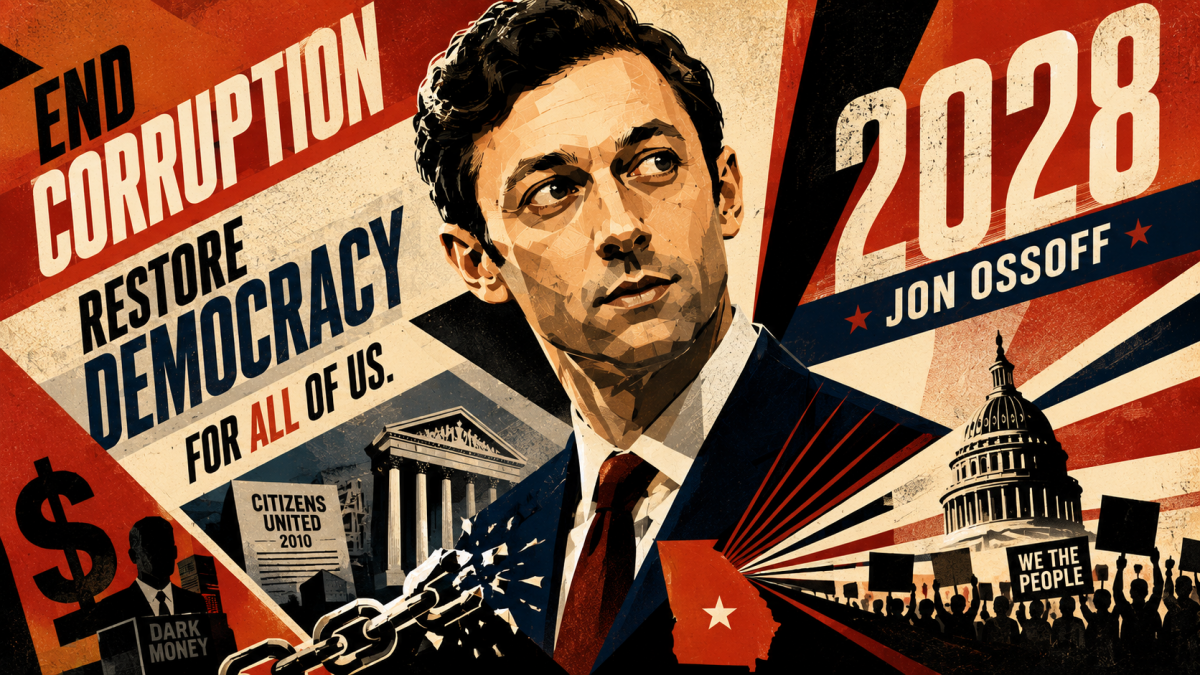
Michelle Goldberg—or whoever came up with the New York Times (NYT) headline (“Why Everyone Wants Jon Ossoff to Run for President”)—might have been exaggerating a bit, but the senior senator from Georgia is certainly worth serious consideration. Goldberg starts off her piece writing about a subject I have previously addressed—Trump’s profitering from the presidency. She notes, “The scale and reach of the Trump family’s self-enrichment is so astonishing it can test the limits of human cognition, so when Ossoff talks about it, he usually picks one example to zero in on.”
Before winning his Senate seat in 2020, Ossoff ran Insight TWI, which produced documentaries about international corruption and human rights abuses. He believes “that corruption is at the core of oppression” and that “kleptocracy, corruption and authoritarianism so often go hand in hand.”
According to Goldberg, he blames “much of what’s gone wrong in American politics” on Citizens United, “the 2010 Supreme Court decision striking down restrictions on corporate and union spending in American elections.” He would like to “amend the Constitution to get dark money out of politics, which he thinks could bring people together rather than further polarize them.” On a related topic, he points to Big Pharma’s lobbying to keep the price of prescription drugs high as one example of “the corporate capture of American lawmaking.”
He thinks that “Trump is a demagogue who has exploited the underlying rot of systemic corruption, and the widespread disillusionment and cynicism that flows” from it. Trump “has promised “to unrig the system and then proceeded simply to re-rig the system for himself.”
Related stories
Goldberg observes that “movements that have defeated authoritarianism . . . usually use precisely this formula: a sweeping denunciation of corruption with a reclamation of national mythology.” The mythology she writes about is Ossoff’s version of the American Dream.
His “dream” bears resemblance to that of the late Georgia congressman John Lewis, whom Ossoff once worked for and considers a mentor, as well as Martin Luther King, Jr. and, almost a century earlier, Frederick Douglass, who in 1869 stated that “our greatness and grandeur will be found in the faithful application of the principle of perfect civil equality to the people of all races and of all creeds, and to men of no creeds.”
Goldberg thinks that Ossoff’s combination of a “sweeping denunciation” of Trump’s self-enrichment with a noble American dream—contrasted with Trump’s white nationalism—is a winning formula, but also that Ossoff’s background is almost ideal for a 2028 presidential candidate. “He’s young [39] and handsome, with a picture-perfect family: a beautiful wife who works as an obstetrician-gynecologist and two small daughters. He’s a Southerner from a reddish state with a history of wooing Black voters. And he’s a Jewish critic of Israel who, as much as anyone in politics today, has the potential to bridge the Democratic Party’s agonizing divide over Zionism.” (Goldberg points out that “in 2024, Ossoff was one of only 19 senators to sign on to Bernie Sanders’s resolution calling for an embargo on certain arms to Israel,” saying that “the American people are rightly horrified by the lack of sufficient concern for innocent Palestinian life that has left so many children unnecessarily dead in Gaza, without limbs or riddled with shrapnel.”)
Goldberg compares him with another young senator who later became president—Barack Obama. And, like Obama when talk of his possible running for our highest office emerged during his Senate campaign in 2004, Ossoff denies any interest in running for the presidency. In spring 2026, he emphasized midterm elections later this year (when he’s up for reelection): “If we do not restore checks and balances in these midterm elections, I don’t know that we have a free and fair presidential election in 2028.”
Although the 2028 presidential election is still more than two years away, Ossoff still has to win his 2026 Senate election—he’s ahead by 7-9 points over a potential Republican opponent—and to win the Democratic presidential nomination he will have to defeat some worthy opponents. Obama’s chief strategist, David Axelrod, thinks that if Ossoff wins Senate re-election by a comfortable margin, people will urge him to run for the presidency. And Goldberg believes that it “can only help him to look like someone who needs to be persuaded.”
Comments

Powered by RoundtableAn AI/DeFi-powered Enterprise Media Operating System. Learn more at Roundtable.io.© Roundtable 2026. By using this site you agree to the Terms of Use and Privacy Policy