


Nov 27, 2016 6:33 PM
Updated Mar 8, 2024 4:35 PM
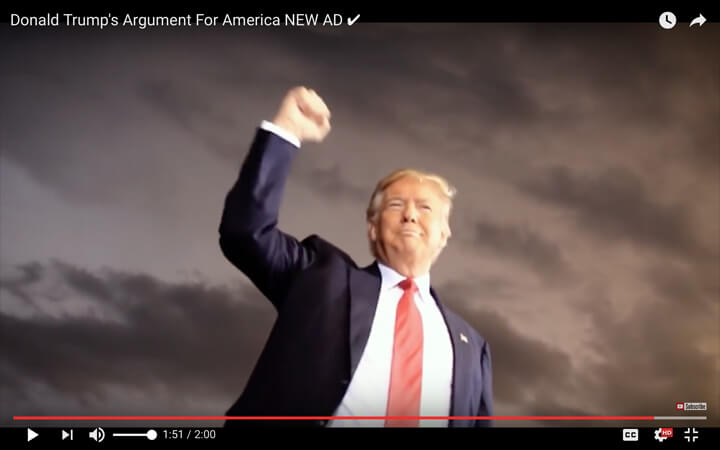
Marcy Winograd: Trump's "Argument for a New America" shares with Hitler's “Triumph of the Will” a documentary style, nationalistic message, working class jargon, godly or mythological symbolism, and strategic camera angles that elevate the savior.
Are Pro-Israel Defenders Appeasers or Dunces?
In Argument for a New America,” President-elect Donald Trump's epic swing state commercial—the one released shortly after Trump hired Breitbart publisher Steve Bannon as his campaign manager—bares a stunning resemblance to Hitler’s two-hour “Triumph of the Will,” the 1935 propaganda film German director and actress Leni Riefenstahl made at Hitler’s request years before he ordered the Final Solution.
It was 1935. Hitler had been elected leader without a popular mandate, only 44% of the vote, and needed to mobilize the nation behind his vision of a master race, expounded in his manifesto, “Mein Kampf.”
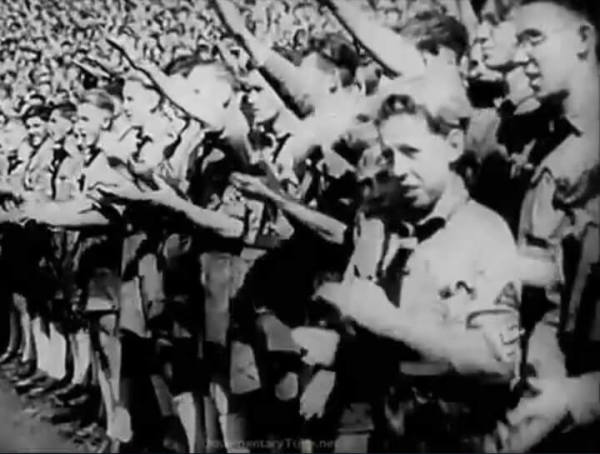
To cultivate support for his ascendant Germany of pure Aryan blood, Hitler turned to the talented Riefenstahl to direct a film that would glorify him as Germany's savior from a fractured and forgotten nation that had been humiliated in its World War I defeat. Hitler wanted her to highlight his 1934 speech to the Nazi Party Congress in Nuremberg, where some 700,000 followers applauded his message of a unified and omnipotent Germany.
Riefenstahl, who denied knowledge of Hitler’s later smoke-billowing crematoriums, produced a gripping tribute to the Nuremberg spectacle of orderly Swastika-wearing Germans parading at packed rallies with militaristic marching bands.
Related stories
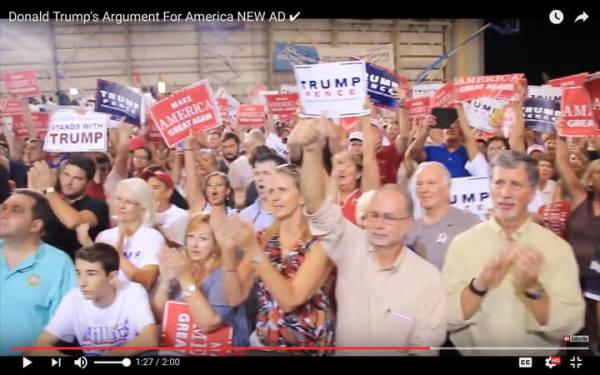
Trump's "Argument for a New America" shares with Hitler's “Triumph of the Will” a documentary style, nationalistic message, working class jargon, godly or mythological symbolism, and strategic camera angles that elevate the savior—Hitler, Trump—to make us, the viewers—the frustrated masses—feel like participants in the cataclysmic heart-pounding making of history.
Consider the eerie similarities in the descriptions and visuals below.
First, tone.
Both Trump's swing state ad and Hitler's propaganda film are more documentary than commercial, realistic and jingoistic in tone. Neither one includes commentary, except for the leaders whipping up the fervor of the crowd. Cheers erupt; signs wave. The camera captures a sea of supporters -- women, men, and children -- in close-ups and wide angles.
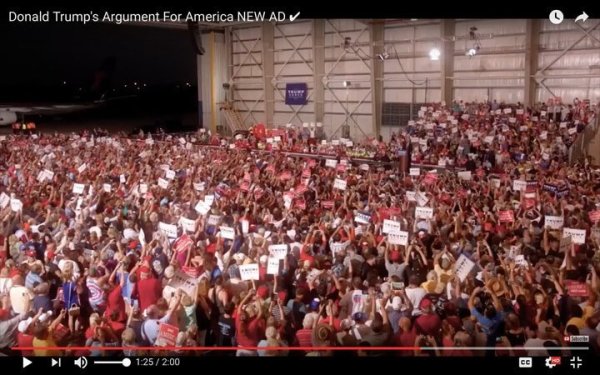
Both propaganda pieces offer panoramas and dolly or tracking shots, putting the viewer in the scene, at the rally, an agent of change, part of what Trump calls "our movement." Something big is happening, unfolding, as though in real time, and we are there, staring at the leader, be he the Fuhrer or the candidate, each the strong man who can fix what ails the country, then seeing the scene from his vantage point, from behind as Hitler or Trump face their adoring fans.
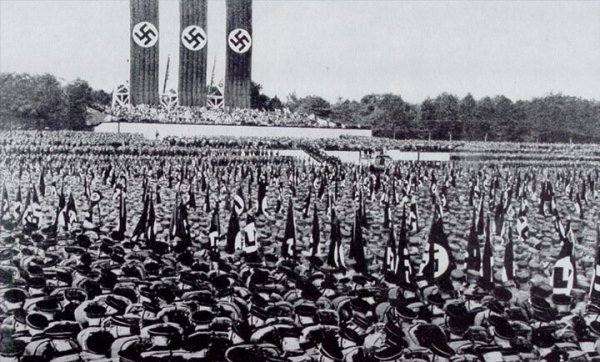
Both propaganda pieces promote nationalism, one appealing to war-vanquished and economically depressed Germans uniting to save the fatherland; the other reaching out to forgotten Americans fearful of losing their jobs – lest they haven’t already lost them -- to take back their country from immigrants, elites and outsourcers to "make America great again." In promoting a nationalistic frenzy, in invoking the theme that a destroyed country can rise from the ashes to again become unified and mighty, both Hitler and Trump plunder and distort language and ideas of Karl Marx, the author of the Communist Manifesto, who exhorted the workers of the world to overthrow their capitalist oppressors to seize the factories for themselves. Hitler refers to "comrades in arms" to the "struggling" to "no more class divisions," while Trump accuses the “global power structure” of having “robbed our working class, stripped our country of its wealth and put that money into the pocket of a handful of large corporations …” Later, Trump, a billionaire real estate magnate owning a string of phallic-contoured hotels and expansive golf courses stretching from Palm Beach to Dubai, says, “I’m doing this for the people and the movement …”
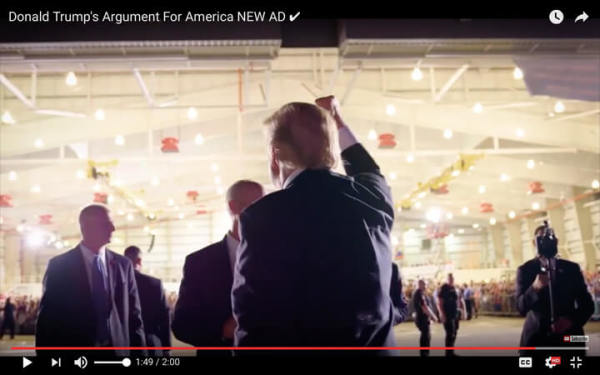
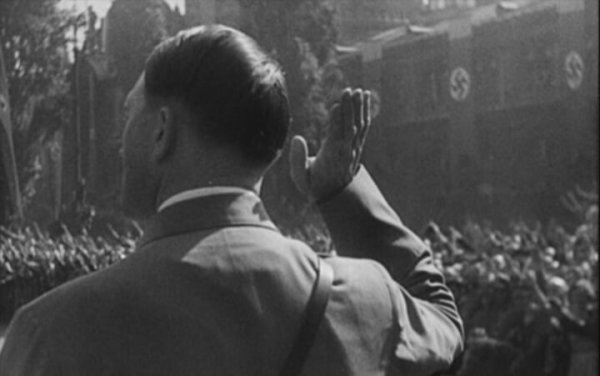
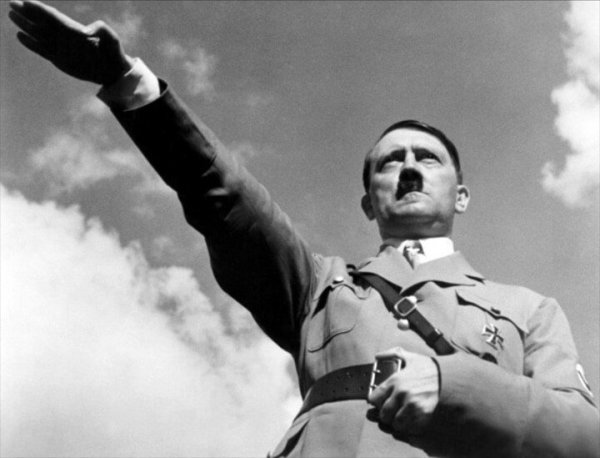
Both “Triumph of the Will” and “An Argument for a New America” employ mythological and evangelical symbolism, as though the leaders descend from heaven, perhaps as Christ returning to Earth in The Second Coming, or as Zeus about to descend from Mount Olympus to rescue us from our otherwise infernal fate. Hitler salutes against a backdrop of clouds; Trump raises a combative fist also against a backdrop of clouds. The vertical camera angle forces the viewer to gaze up at these figures, these messiahs, placing the saviors at the top of the hierarchy, the people below on the lowest rung. Indeed, in other public commentary, Trump has spoken directly of his martyrdom through his willingness to absorb the “slings and arrows” arrayed against him by international conspirators in order to make America great again.
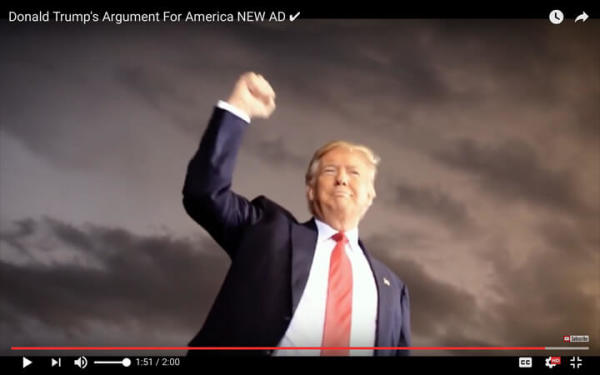
Could the Trump campaign, presumably under Bannon’s direction as Trump’s campaign manager from August to November, 2016, have copied camera shots, verbiage, and symbolism from Riefenstahl’s propaganda film? Or, at the very least, could Bannon or Trump have sought inspiration from “Triumph of the Will”?
“An Argument for a New America" is a searing and persuasive two-minute commercial with an unsubtle anti-Semitic message suggesting America’s demise—the empty factories, the struggling cities, the government corruption – was the Jews’ fault because they were the boogie men and women controlling or at least in cahoots with the actors – Hillary Clinton wearing a gold suit, a smiling President Obama – responsible for Wall Street’s thievery and an international financial conspiracy.
Trump’s ad, which aired a week before the election and drew hundreds of thousands of hits on its YouTube postings, features piles of bundled hundred dollar bills, vertical upward camera angles of cold towering Wall Street skyscrapers, an imposing Federal Reserve Board bronze seal, United Nations representatives and their diverse flags, and three high profile Jews -- philanthropist George Soros, Federal Reserve Chair Janet Yellen, and Goldman Sachs CEO Lloyd Blankfein – whose recognizable faces flash before us as we hear Trump, in a speech delivered in October, 2016, in Florida, rail against those who control the "levers of power in Washington" as well as "global special interests."
Where have we heard this kind of diatribe before?
The anti-Semitic meme summons The Protocols of the Elders of Zion, the forged minutes from a fictional late 1800’s Switzerland meeting at which powerful Jews supposedly plotted to dominate the world by seizing control of the economy. Long after the document was proven fake, auto magnate Henry Ford paid to print a half a million copies to distribute throughout the U.S. Adolf Hitler also got his hands on the forged minutes to ensure they were taught as fact, not fiction, in German schools – all the better to instill resentment and hatred needed to fuel the Final Solution; the extermination of millions of European Jews in the gas chambers of concentration camps hidden in plain sight.
After Jonathan Greenblatt, Chief Executive of the Anti-Defamation League, told the press and public that Bannon, the publisher of Breitbart News, had “presided over the premier website of the ‘alt right – a loose-knit group of white nationalists and anti-Semites,” the Zionist Organization of America hoped Bannon (ultimately a no-show) would attend their New York dinner, while others -- Alan Dershowitz, a prolific author and Harvard law professor, and Joel Pollak, Dershowitz’s former law student, now Breitbart senior editor and in-house counsel, hit the national airwaves to shield Bannon from further charges of anti-Semitism.
According to the ardent supporters of Israel’s far-right Prime Minister Benjamin Netanyahu, Greenblatt was way off base with his outrageous accusations against a die-hard ally of Israel. How could Bannon possibly be anti-Semitic when he had opened a pro-Israel Breitbart office in Jerusalem and published a steady stream of attacks on defenders of Palestinian rights? Never mind what Bannon’s angry ex-wife said, in the heat of divorce proceedings eons ago about Bannon not wanting their child to attend school with Jews; the guy had never uttered an anti-Semitic word in his whole patriotic life. Breitbart News even went so far as to accuse Greenblatt of defamation, a legal claim that because Bannon is a public figure and Trump hasn’t had the opportunity to change libel law, requires knowledge of falsity and reckless disregard of the truth.
Bannon’s defenders had more than one reason to prosecute Greenblatt in the press. Courageously deflating GOP trial-balloon talk of a Muslim-oriented registry, Greenblatt had asked all Americans to join him in pledging to register as a Muslim should a future Trump administration impose such a registry – one hauntingly evocative of the hundreds of legal decrees – including one ordering Jews to wear yellow identification Stars of David -- issued in Nazi Germany in the years leading up to The Holocaust.
Did the Anti-Defamation League get it right about Bannon’s embrace of white nationalism and anti-Semitism? Trump’s campaign propaganda ominously points to yes.
How could Bannon’s pro-Israel defenders, among them rabbis, the Zionist Organization of America, a Harvard law professor and his former student, have missed the connections and disturbing parallels between the propaganda for Trump and Hitler? The similarities in message and craft between Trump’s swing state campaign commercial and other late-campaign speeches and Hitler’s epic propaganda film are unmistakable, clearly enough to give Bannon’s pro-Israel defenders reason to pause and wonder if they have, indeed, been played – or worse, mocked – by evidently more astute and pragmatic students and practitioners of historical propaganda; ambitious cynical souls who dared to adopt the techniques of a film that laid the groundwork for the annihilation of 11-million people, and were bold enough to employ similar anti-Semitic memes and imagery that would advance the call to “make America great again” or, as critics contend, make America whiter and more Christian again.
Marcy Winograd
Comments

Powered by RoundtableAn AI/DeFi-powered Enterprise Media Operating System. Learn more at Roundtable.io.© Roundtable 2026. By using this site you agree to the Terms of Use and Privacy Policy