


Feb 5, 2016 1:22 AM
Updated Feb 10, 2022 10:52 PM
Ernest Canning: Though the allegations have yet to be independently verified, both the appearance of impropriety and the mere possibility that a presidential candidate could be indicted should be a matter of grave concern for the electorate.
Are the reports accurate? Did the FBI expand its investigation from Hillary Clinton's misuse of classified information on her private email server to "public corruption" relating to a possible "intersection" between U.S. State Department approval of foreign weapons sales and contributions to the Clinton Foundation? Is it true there's a "substantial likelihood" that Hillary Clinton will be indicted? We don't really know.
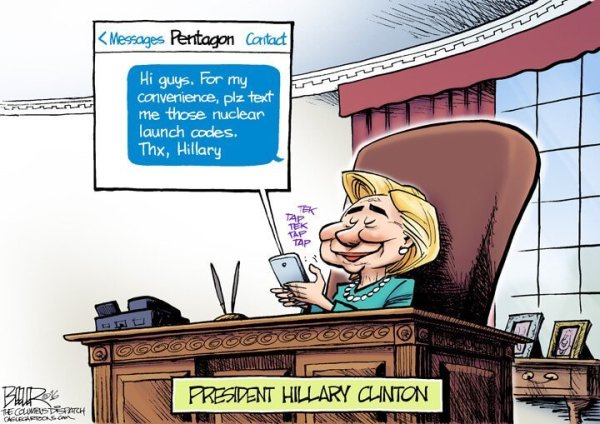
We do know that Hillary Clinton had been less than accurate when she claimed there were no classified materials on her unprotected server. The State Department acknowledged there were 22 messages on that server that contained "top secret" information. We also know that, while she served as Secretary of State, the State Department approved massive sales of arms, including U.S. fighter jets. We know that the sellers were U.S. military contractors who contributed large sums to the Clinton Foundation. The weaponry was purchased by foreign nations that had also contributed large sums to the Clinton Foundation.
But the only direct sources we have for the public corruption/likely indictment allegations are former right-wing politicians (Tom DeLay and Rudy Giuliani), a former conservative U.S. Attorney (Joseph diGenova), and the notoriously unreliable Fox "News" network. Giuliani, I would caution, is not just a former Republican mayor and presidential candidate. He's a former federal prosecutor who worked alongside of and later lobbied for the confirmation of U.S. Attorney General Loretta Lynch. All of these direct sources, however, rely on unnamed sources, some of whom are said to be in the FBI.
Though the allegations have yet to be independently verified, both the appearance of impropriety and the mere possibility that a presidential candidate could be indicted should be a matter of grave concern for the electorate.
Though the allegations have yet to be independently verified, both the appearance of impropriety and the mere possibility that a presidential candidate could be indicted should be a matter of grave concern for the electorate.
Related stories
Quid Pro Quo?
Foreign governments and entities may perceive the Clinton Foundation as a means to gain favor with the secretary of state - Cautionary advice offered by Sen. Richard Lugar (R-IN), Jan. 13, 2009 Hillary Clinton confirmation hearing.
In Could Clinton's email scandal lead to federal charges, The Hill's Chuck Hobbs focused primarily on the fact that Hillary's email correspondence contained "top secret" information. He compared her handling of classified information on her private email server to what occurred when General and former CIA Director David Petraeus conveyed classified information to his paramour, journalist Paula Broadwell.
While I don't wish to minimize laws governing the handling of classified materials, I think it fair to say that Hillary's email indiscretion entailed a lapse in judgment. If, however, the FBI could establish sufficient evidence of a quid pro quo between State Department approval of arms sales and contributions to the Clinton Foundation, it could have far more serious ramifications. The grounds for impeachment include “treason, bribery, and other high crimes and misdemeanors." A quid pro quo would amount to bribery.
As revealed by David Sirota and Andrew Perez of the International Business Times, Hillary Clinton's tenure at State proved quite profitable for the U.S.-based military-industrial complex. Twenty nations that had donated money to the Clinton Foundation, they add, paid $165 billion for U.S. arms whose sellers also donated to the Clinton Foundation. That was "nearly double" the amount those 20 nations paid "during the same period of President George W. Bush's second term."
It doesn't stop there. While Hillary served as Secretary of State, the Clinton family fortune was enhanced when Bill Clinton received money from the military-industrial complex "for speaking engagements," according to Sirota and Perez.
The ties didn't end when she left office. "Hillary Clinton has received more money from arms and military service companies than any other candidate during the presidential campaign."
Timing: What If?
I am ardent Bernie Sanders supporter. I admire the Vermont senator's aversion to negative campaigns. Bernie prefers to focus on substantive issues. He acknowledges, however, that the FBI's legal investigation into Hillary's alleged improprieties must be allowed to "proceed unimpeded."
If an indictment were handed down, the fallout could not be avoided. The timing of an indictment could have a profound impact upon our nation's political future.
If Indicted During Primaries
I suspect that even if an indictment were handed down during the primary process, Bernie would be too much of a gentlemen to exploit it. He understands that this election entails much more than his becoming the next president. Bernie seeks nothing less than revolutionary transformation. Oligarchy must be dismantled; democracy restored. This is possible only if knowledge regarding issues that matter is conveyed to an aroused electorate who then become an unstoppable political force.
During General Election
One certainly could not expect a genteel response from Republicans. To the contrary, there is every reason to believe the devotees of inequality would exploit an indictment in the same manner that they used the Monica Lewinsky scandal to weakenAl Gore's 2000 campaign. They did so, shamelessly, even though Gore had nothing to do with it.
If an indictment were to be handed down after a Clinton nomination, it could threaten the very survival of our democracy. Elections have consequences. In 2000 the GOP ability to exploit a faux "scandal" culminated in a $3 trillion war of choice in Iraq, the deaths 4,486 American soldiers and a Middle East quagmire we've yet to escape. What would happen if, unlike Gore, the Democratic nominee was not only the center of the scandal, but also under indictment?
Post-Election
If an indictment were to be handed down after she were elected, Hillary Clinton's ability to govern could be crippled. Impeachment proceedings could loom large. If the evidence were sufficient to support a "public corruption" charge, a President Hillary Clinton could be removed from office.
Should Democrats Gamble Against Possible Indictment?
By every objective measure -- issue polls, crowd size, head-to-head polls, enthusiasm -- Bernie Sanders is the most electable candidate.
Integrity is Sanders's greatest asset. So much so that even Sen. John McCain (R-AZ), while acknowledging "strong disagreement with him on basic philosophy," praised Bernie for being "an honest man," adding "his word is good."
In fact, Bernie's reputation for integrity is so solid amongst those who identify with the American right that 71% of respondents to a Fox "News" online poll found Bernie to be the "most truthful" candidate. Hillary Clinton came in third on that poll, receiving only 8%. At 13%, Donald Trump came in a distant second.
The specter of a possible Hillary Clinton indictment is another matter altogether. It's like a dark cloud on the horizon. We can't know for sure what evidence the FBI has amassed. Thus, we don't know whether she will be indicted. But she very well could be.

That makes a vote for Hillary during the primaries a huge gamble -- one that could have devastating consequences for democracy and for our future.
Ernest Canning
Comments

Powered by RoundtableAn AI/DeFi-powered Enterprise Media Operating System. Learn more at Roundtable.io.© Roundtable 2026. By using this site you agree to the Terms of Use and Privacy Policy