
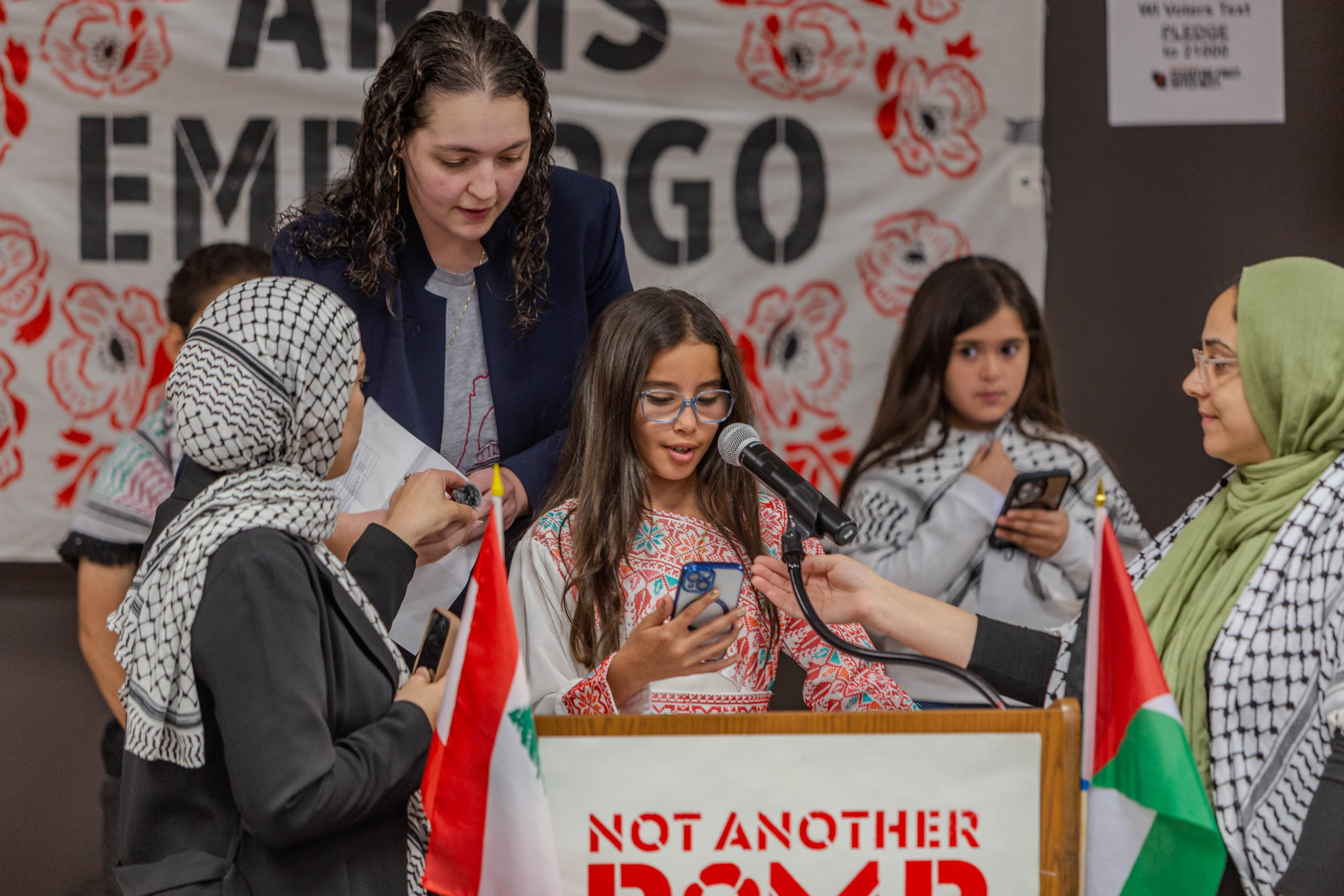
Milwaukee children’s pre-election press conference urges voters to vote against genocide. (Photo: Listen to Wisconsin)


Genocide Collides
Nov 21, 2024 5:48 PM
Did Muslim and Arab voters cost Harris the election? Absolutely—but they had help.
Two days before the election, Palestinian-American children in Wisconsin held a pre-election press conference, delivering a direct appeal to voters: “We will not forget what you do in this election. Be against genocide as voters.” The event coincided with the anniversary of the Gaza Children’s Press Conference at Al-Shifa Hospital, where over 10,000 children had lost their lives in Israeli airstrikes at the time. Despite the children’s searing calls for a ceasefire, President Joe Biden and Vice President Kamala Harris failed to respond.
The fate of the children who pleaded with the world to stop U.S.-supplied bombs from falling on them remains unknown. However, their counterparts in Wisconsin brought the issue directly to American voters. “Kids in Gaza are the strongest in the world. You deserve the best future. You deserve peace and freedom,” said Safaa, age 7, speaking in Arabic, addressing the children in Gaza. Addressing adult voters, Hadi, age 8, asked, “When you see a kid who is hungry or dying, what do you do? How can you be silent if kids are dying?”
“Money should be spent on food, water, education, jobs, and homes—not on genocide. Israel is killing children and dropping bombs. Babies who are not even a year old are being killed,” said Mira, age 11.
While Gaza may not have been a priority on every voter’s agenda, enough people appeared to heed the call nationwide. Harris lost Wisconsin by 29,417 votes, with Donald Trump winning the state and clinching the Presidency. All third-party, anti-genocide candidates collectively received 17,056 votes, with Jill Stein securing the majority. Together, these numbers reflect a clear shift, underscoring the role Gaza played in shaping voter sentiment and influencing the outcome.
Related stories
During the primary in April, 47,000 people cast “uninstructed” ballots to express their displeasure with Biden’s refusal to call for a ceasefire. Wisconsin has an estimated population of 70,000 Muslims, with approximately 40,000 eligible voters. Biden had narrowly won the state in 2020 by 20,682 votes.
In mid-October, journalist Richard (RJ) Eskow warned in Common Dreams that the Gaza crisis might not only drive Muslim and Arab American voters away from the Democratic Party but also sway other key demographics. Drawing on data from a variety of sources, Eskow estimated Democrats could lose enough votes across differenet demographics to cost Harris the election in swing states.
However, corporate media and political elites have largely minimized Gaza’s impact on the election–especially in the immediate days that followed, reflecting a familiar bias. Historically, many Americans haven’t connected foreign policy spending with domestic struggles, but today this awareness is evolving.
The August 2024 Chicago Council Survey (CCS) found that “three months out from Election Day, “Americans largely agree the government should prioritize domestic spending over defense or foreign aid [emphasis added].” Instead, Americans favor increased funding for healthcare, education, infrastructure, and Social Security. They remain generally skeptical of foreign aid, underscoring a shift toward prioritizing domestic national well-being.
Swing state voters weigh Gaza and grocery prices
In a CNN town hall in October, Anderson Cooper asked Harris how she would address voters considering a third-party candidate or abstaining due to Gaza. In a response that went viral, Harris acknowledged the tragedy of Palestinian deaths but pivoted to emphasize rising grocery prices—an issue she pledged to tackle. By contrast, Trump’s messaging in Michigan’s Arab American community underscored “No new wars, family values, affordable groceries.”
A September Cato Institute-YouGov survey revealed that foreign policy could significantly influence the 2024 election, with slim majorities in Michigan and Wisconsin (52%), and Pennsylvania (50%), stating they would be less likely to support a candidate who disagrees with them on foreign policy, even if aligned on other issues. Despite this, Harris stubbornly dismissed these concerns. In early October, she told The View that she wouldn’t change anything from Biden’s last four years—except perhaps adding Republicans to her cabinet—a statement that quickly went viral.
Economic hardship undeniably compounded voter frustrations in 2024. A February 2024 Forbes article by grocery analyst Errol Schweizer revealed that by early 2023, U.S. household purchasing power had dropped 7%, with over 70% of Americans financially stressed and 58% living paycheck to paycheck. Rising prices for essentials, high-interest rates, and cuts to SNAP benefits are stretching household budgets thin.
Similar to Eskow's warning, The New York Times reported in late October that the Trump campaign identified only 5% of voters as undecided, compared to the Harris campaign's generous estimate of 10%. Notably, the Times’ own polling aligned more closely with Trump’s analysis. Dubbed “target persuadables” by Trump’s team, these voters were disproportionately younger, racially diverse, and economically vulnerable, with many deeply influenced by Israel's genocidal violence in Gaza.
Michigan: A microcosm of American voters
Harris and Trump campaigns, both fine-tuned their messaging to engage with this small but pivotal group in the final days leading up to the election. Harris deployed the fiercely anti-Palestinian Congressman Ritchie Torres of New York to Michigan in an effort to secure Jewish voter support. She also sent former President Bill Clinton to engage with Michigan’s Arab and Muslim communities. Clinton referred to the occupied West Bank as "Judea and Samaria," claiming that Jews were present there before Islam existed, and absolved Israel of responsibility for civilian deaths, stating, “Hamas makes sure that they're shielded by civilians; they'll force you to kill civilians if you want to defend yourself.”
The Harris campaign, driven by hubris and a clear blatant disregard for Muslim and Arab voters, made this shift all the more inevitable.
An analysis by the Detroit Free Press based on precinct-level data revealed an unsurprising significant decline in support for Harris within communities with large Arab American populations. Cities like Dearborn, Dearborn Heights, Hamtramck, and Melvindale experienced notable drops in Democratic votes compared to 2020.
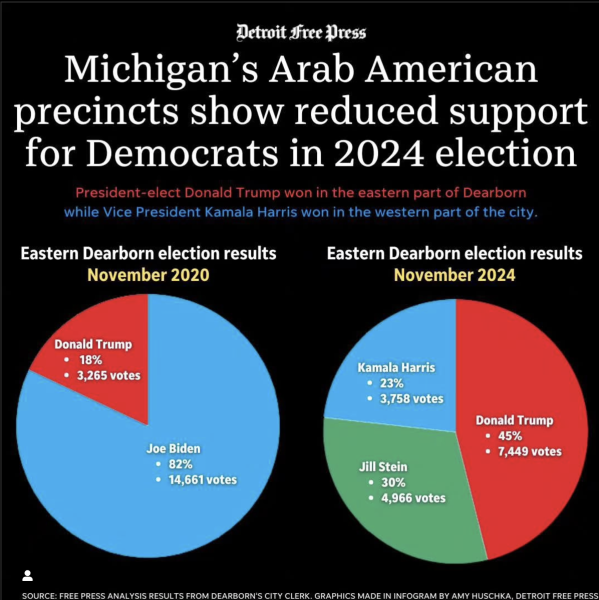
Journalist Niraj Warikoo, writing for the Detroit Free Press, explains: “Arab American and Muslim voters interviewed by the Free Press mainly blamed the Biden administration's handling of foreign policy in the Middle East, but also sometimes cited economic and social issues.”
Michigan, like the rest of the nation, saw decreased voter turnout as many Democrats abstained due to dissatisfaction with both candidates. Younger and working-class voters, outraged by the Gaza genocide and disillusioned with the Biden-Harris administration, rejected Harris’s reliance on fear tactics over meaningful policies to end the violence. The path to victory was clear: anti-war voters seeking a ceasefire. Instead, by courting Republicans and promising to appoint them to her cabinet, Harris alienated her base, paving the way for widespread voter apathy.
Now, Trump is doing the job Harris aspired to—cosplaying as a Republican—only this time, it’s the real deal.
Philadelphia, the “Mecca of the West”
Instead of focusing on solidifying her traditional base in Pennsylvania, which includes the Arab and Muslim Americans who are credited with propelling Biden to victory in 2020, Harris concentrated on courting Republicans disenchanted with Trump. .
Confident in her approach, Harris campaigned in Pennsylvania with neoconservative Republican and anti-abortionist Liz Cheney, even as Harris emphasized abortion access. This attempt to offset losses among Arab, Muslim and other pro-Palestinian voters by appealing to demographics presumed less invested in the genocide in Gaza, left her appearing inauthentic and unable to energize key voters.
Warning signs were evident long before Harris arrived in Philadelphia for her debate with Donald Trump.
Warning signs were evident long before Harris arrived in Philadelphia for her debate with Donald Trump. The Abandon Harris movement (formerly Abandon Biden) urged protest voters to write in “No Joe,” a choice equivalent to selecting “uncommitted” in other states, resulting in over 55,000 such votes during the primary in April.
Pennsylvania is home to over 145,000 Arab Americans and one of the largest Black Muslim populations in the U.S. Writing for hyphen, Journalist Denise Clay, on November 4, highlighted the critical role of Philadelphia in Harris’s campaign, referred by some as the “Mecca of the West” because of the city’s 250,000-strong largely Black Muslim community. “Harris cannot afford to alienate Black Muslims in the region,” she posited.
On the eve of the election, Harris’s campaign leaned hard into star power, hosting a large line-up of celebrities-studded concert in Philadelphia featuring figures like Lady Gaga and Oprah Winfrey. However, this strategy failed to counter Trump’s gains among working-class voters. On November 5th, Trump won Pennsylvania by 139,771 votes, securing 50.4% to Harris’s 48.6%. Lower turnout in Democratic strongholds and Trump’s appeal among working class white, Black, and Latino voters eroded her margins, flipping the state for Trump, which Biden had won by a margin of 80,000 votes in 2020. Despite spending $20 million on celebrity endorsements and concerts aimed at young voters—a sum now equal to her campaign’s debt—Harris couldn't close the gap.
This outcome had been anticipated by The Philadelphia Inquirer analysis in October, that working-class neighborhoods in Philadelphia, traditional Democratic bastions, are drifting toward Republicans, driven by rising costs and broken promises.
Gaza reverberates through the blue wall
Outrage over the Biden administration's handling of the war in Gaza had a noticeable effect on Harris’s campaign, even in deep blue New York. Jasmine Gripper, co-director of the New York Working Families Party, pointed to over 50,000 voters who left the presidential field blank on their ballots—exceeding the numbers from the “Leave It Blank” campaign during the Democratic primary. “These voters didn’t shift overwhelmingly to the Republican side,” Gripper told New York Focus. “They simply stayed home and chose not to vote.”
Even Hawaii, despite being part of the “blue wall,” saw 29.1% of voters choose “uncommitted” during the primaries—the highest percentage in any state—earning 5 delegates to the Democratic National Convention (DNC). This trend carried into the general election, where Harris lost votes compared to Biden’s 2020 numbers, while Trump gained significantly more votes in 2024 than he did in 2020. Though Harris ultimately won the state’s 4 electoral votes, the rise in Trump’s significant margins over his 2020 numbers signals a shift in voter sentiment that is similar nationwide.
In March, Hawaii became the only state to call for a ceasefire in a near-unanimous vote. Many Hawaiians identify with the Palestinian struggle for independence and decolonization, drawing parallels to Hawaii’s own history as a former U.S. colony.
From state to state, and county to county, results varied, but it all points to a noticeable shift that can be attributed safely to the Gaza effect, compounded by economic concerns.
Aid to foreign wars exposes domestic neglect
The frustrations of working-class voters upset over Gaza resonate nationwide, including in Arizona, amidst anger over growing economic inequality. In April 2024, The Nation reported on rising tax resistance among younger Americans, driven by grievances over U.S. support for Israel’s genocide in Gaza. Arizona resident Sarah Gambino, a 36-year-old rideshare driver, called foreign aid to Israel a betrayal, telling The Nation, “I never realized the extent to which our tax dollars are exploited and spent on visible war crimes.”
Consider North Carolina, where economic concerns are compounded by prolonged struggles with hurricane recovery. Rebuild NC, created to aid families after Hurricanes Florence (2018) and Matthew (2016), remains plagued by funding shortfalls, leaving thousands in unsafe or temporary housing to this day. Despite requesting $1.1 billion for Florence recovery, the state received just $542 million, resulting in years of delays and hardship for survivors. The unparalleled devastation from Hurricane Helene in 2024 has only worsened these challenges.
Initial damage estimates from Helene in North Carolina alone are $53 billion. When asked about funding for Hurricane Helene, Biden initially responded to a reporter by claiming that they had already provided more than was necessary. However, Biden has now requested $100 billion from Congress to support recovery efforts across six disaster-stricken states, including those impacted by Helene. The last comparable federal aid request was $90 billion for Hurricane Katrina recovery, which devastated New Orleans in 2005.
How did North Carolina fare for Harris? Trump beat Harris by a bigger margin than he beat Biden in 2020. Even before the devastation brought by recent floods, dissatisfaction among voters was evident during the primary, with 13% selecting “no preference” on their ballots in a show of solidarity with the “uncommitted” grassroots movement sweeping the country to demand a ceasefire in Gaza—just 2% shy of earning a delegate to the DNC.
Despite support for active U.S. global engagement dropping to a historic low of 56% this year, and following a resounding electoral defeat, the Biden-Harris administration remains focused on wars.
Despite support for active U.S. global engagement dropping to a historic low of 56% this year, and following a resounding electoral defeat, the Biden-Harris administration remains focused on wars. Meanwhile, a record 43% of respondents in the CCS report believe that the U.S. should stay out of world affairs, marking the largest increase in this sentiment in the organization's 50-year history of surveying.
Contrast the neglect of America's working class with how the federal government quickly allocates billions for international military spending, like the $230 million aid pier in Gaza, which was dismantled after 25 days due to weather and security issues, providing just one day of aid. Instead of pressuring Israel to use existing land routes, the U.S. prioritized this costly, ineffective venture as a political ploy to ease International pressure off of Israel.
Just days ago, Secretary of State Antony Blinken, speaking in Brussels, reiterated unwavering support for Ukraine, declaring, “President Biden is committed to make sure that every dollar we have at our disposal will be pushed out the door between now and Jan. 20.” Since 2022, the U.S. has provided $174 billion in aid to Ukraine, while Israel received a record $22.7 billion in aid (and counting) this year alone. This rapid mobilization of resources for foreign conflicts starkly contrasts with the neglect faced by American citizens at home.
The U.S. national debt has reached $35 trillion and continues to climb.
Such trade-offs between foreign aid and domestic priorities are often overlooked, not only in policymaking but by pollsters who compartmentalize issues into artificial categories, failing to capture their interconnectedness. Immigration is a clear example: while it is treated as separate from economic concerns, much of the anti-immigration sentiment stems from underlying economic fears, with people linking their financial struggles to perceived impacts from immigration on wages or job opportunities.
Conclusion: an irreversible political awakening
A March 2024 Gallup survey revealed that 74% of U.S. adults are closely following the ‘Israeli-Hamas conflict,’ with support for Israel’s actions dropping significantly across all major political groups—down 18 points among Democrats and Independents, and 7 points among Republicans.
The year-long broadcasts of Gaza's industrial-scale slaughter, funded by U.S. taxpayers, has shattered America’s self-image as a moral leader. An October 2023 report from CCS found that 65% of Americans still want the U.S. to prioritize human rights globally, but fewer now view it as “the greatest country”—a decline particularly notable among Democrats and Independents.
The 2024 election marks a transformative convergence of economic hardship and foreign policy discontent. Corporate media, the Israel lobby, and the establishment have a vested interest in shielding Israel—a mass-murdering ethno-nationalist state—while alienating a growing number of Americans repulsed by the unprecedented violence. These forces aim to dismiss pro-Palestinian sentiment as fringe rather than transformational. Yet, the rise of groups like Abandon Harris and coalitions of disaffected communities is directly challenging entrenched systems of exploitation, destruction, and the subjugation of the wretched of the earth. This growing political awareness signals a weakening of their grip on power.
For the few skeptics within the movement, their failure to recognize their rising power stems from psychological exhaustion, fueled by witnessing history’s most documented and live-streamed genocide. However, Palestine has moved to the center of the political stage.This momentum is irreversible.
It’s not just the economy, stupid. It’s Gaza.Today, all politics is global.
Comments

Powered by RoundtableAn AI/DeFi-powered Enterprise Media Operating System. Learn more at Roundtable.io.© Roundtable 2026. By using this site you agree to the Terms of Use and Privacy Policy