



May 30, 2026 9:36 PM
Presidential polls show a scattered field of underwhelming candidates, even as Trump remains larger-than-life
Here’s my (simplified) theory of (presidential) change. Holding elected office is a tough job. The elected leader has to make a lot of controversial decisions, and every time a decision is made there is somebody somewhere who is unhappy. Usually a lot of somebodies, who get upset over one decision or another. That’s the nature of representative democracy.
After being in office for a few years, enough voters are ticked off about something you’ve done, and the public has slowly grown sick of seeing you on their TV and smart phone screens. “Face fatigue” sets in. Once the elected leader reaches that critical point, every time the candidate’s face pops up in their feed it only reminds the voter about something negative. At that point, after two terms and eight years, more than anything the public just wants to turn the page and move on to the next new and shiny face.
Every four years, a lot of money is spent, and polling and research conducted, trying to predict who’s going to win the next presidential election. Methodologies based on economic trends, right track/wrong track perceptions, the so-called “misery index” which adds the inflation rate and the unemployment rate together, all get their turn in the spotlight. Historian Allan Lichtman uses his 13 true/false questions that he calls The Keys to the White House to predict presidential winners (which he got wrong in 2024).
But to me, it’s a lot simpler than that. Since FDR, the dominant pattern has been that every eight years and two terms, Face Fatigue sets in and the American public votes out the incumbent president’s party. The honeymoon is over, you’ve worn out your welcome. Most voters don’t think deeply about “the issues,” they vote based on vague impressions and some often hard-to-define sense of self-interest. The public got sick of Obama. Before that they were sick of George W Bush. Before that they were sick of Bill (and Hillary) Clinton, on and on. One-term Biden was an anomaly because he looked so old in his debate with Trump that it spooked a lot of swing voters, denying him a second term. Jimmy Carter was a one-term anomaly because he told people in the middle of an oil crisis to put on their sweaters, lower their thermostats, and then couldn’t rescue the US hostages from Iran. He looked weak, and Americans don’t like weak leaders.
Related stories
George H.W. Bush was a continuation of Reagan, so they actually got an anomalous three terms out of it. And Trump? He’s wearing out his welcome, bigly time. He will tar the next GOP nominee, whether J.D. Vance or Marco Rubio, the way George W. Bush tarred John McCain. Assuming the Democrats nominate the right candidate – and it’s an honest, fair election – the presidency should be theirs.
Who will be the Democratic standard bearer?
So which Democratic candidate will be the right one? A recent poll by Lake Research Partners of 2028 Democratic primary voters found that the two Democratic front runners are Kamala Harris and Gavin Newsom. The poll used ranked choice voting, and Harris had 26 percent of first rankings, followed by Newsom with 17 percent, Pete Buttigieg with 16 percent, followed by Senator Mark Kelly, Alexandria Ocasio-Cortez, Josh Shapiro and other Democratic hopefuls. After the RCV tally, Harris bested Newsom, 52 percent to 48 percent.
To me, this is bad news for Democrats. As a Californian, I really don’t see how either Harris or Newsom can be elected president. It’s partly a matter of trying to win the votes of very different electorates in different elections. To get elected as governor or US Senator from California, you have to say and do things to appeal to blue state Californians, as well as state-based organized interest groups, that are going to backfire against you when you try to win votes nationwide.
It’s a simple matter of optics. In 2024, the Trump campaign ran billions of versions of an ad attacking Harris for being supportive of trans rights. The ad slogan “Kamala is for they/them, President Trump is for YOU” resonated bigly in 2024, and will still be effective in 2028. Newsom has tried to walk back some of his own positions on various liberal issues in preparation for his presidential run, but that won’t matter because those interviews, Twitter posts and video clips still exist. You can’t wave a magic wand and disappear them. His opponent will feature his original statements in ad after ad. The leopard can’t change its spots very easily.
Beyond that, Newsom actually has a governing record to run on, and it’s not a good one. He was elected in 2018, and whether the issue is housing, homelessness, prices and affordability and more, Democrats – like Republicans – have fumbled the ball when it comes to solving real problems in real people’s lives. That’s why, even as Trump’s polling numbers plummet, Democrats aren’t necessarily the beneficiary of the roller coaster in opinion, especially not among key demographics. As reckless, divisive and corrupt Donald Trump is, remarkably many voters do not see Democrats as a great alternative when it comes to actually helping them in their individual lives.
Newsom’s many policy failures will haunt his campaign
I’ll give you one example of Newsom’s failure to solve a real problem in real people’s lives – the spiraling cost of home energy. More specifically, his failure to rein in a California company found guilty of numerous crimes, including manslaughter and destroying people’s property, even as Governor Newsom has allowed this company to continually increase prices to consumers and award higher pay to incompetent executives. In short, Newsom had a chance to get this one right, and he blew it.
Pacific Gas and Electric (PG&E) provides natural gas and electricity to 16 million people in northern and central California, from Bakersfield in the south to the Oregon and Nevada state lines. I’m sure it’s a tough job, that’s a lot of people over a giant service area that need energy for their homes and businesses.
And unfortunately, if I don’t like PG&E’s prices or service, I can’t shop for another company. PG&E, as an investor-owned utility, has been granted a monopoly over its 70,000 square mile area by the California government. In return, the company is required to get permission from the California Public Utilities Commission (CPUC) to increase its rates. Even before Trump’s ill-advised and illegal war in Iran and its impact on oil prices, PG&E’s rates were up 41% over the past three years and 101% over the last decade, many times higher than the rate of inflation.
But apparently that wasn’t enough for PG&E. So their lobbyists went to Governor Newsom and asked if it could implement – wait for it – a “new billing structure.” Uh oh.
Shifting the blame, Democrat-style
Previously, all billing was based strictly on usage – the number of kilowatt-hours used multiplied by the rate per kilowatt-hour, which in California has been around 38 to 40 cents per kilowatt hour – the highest rate in the country after Hawaii, which is hindered by being an island with limited energy supply. For the new billing format, PG&E instead asked that all customers pay a mandatory Basic Services Charge of about $24 per month, regardless of how many kilowatt hours used, which – I was told by a PG&E representative – is “designed to cover infrastructure costs.”
And in return PG&E lowered the price per kilowatt hour to about 32.6 cents per kilowatt hour. PG&E swore that this would mean that customers would actually pay either the same on their monthly bill, or some customers would pay a little bit less.
But that’s not how it worked out. I have had two monthly bills now with the new billing method. In the first month, I paid 43% more for electricity than I would have paid if the old billing system was used. In the second month, I paid about 16% higher with the new billing system. WTH!
When PG&E and other utilities proposed this, utility watchdog groups were skeptical, saying this was going to turn into a “back door” rate increase. Nevertheless, Governor Newsom and Democratic leaders sneakily pushed through the authorizing legislation for this billing change using a legislative trick – they attached the bill as a “trailer” to an existing bill, which is usually reserved for inconsequential additions. There were no committee hearings, no public testimony, no debates or standalone floor votes in the Assembly or Senate. Even many of the legislators later complained that they didn’t know that the PG&E trailer was in the bill.
But it gets worse. This backdoor increase came on top of six PG&E rate increases in 2024 and two more in 2025, granted by Newsom’s CPUC. Even as PG&E enjoyed record profits in 2024, and profits rose in 2025 by $118 million to $2.59 billion. Even as its CEO receives $19.8 million in compensation, a 25% increase. PG&E is ranked 175th on the Fortune 500 list, it’s not exactly broke, like so many Californians are.
When I spoke to a PG&E representative on the phone, at first he sounded syrupy and nice in that scripted “customer service voice” as he explained that company costs have increased dramatically, “just like everyone else’s costs.” And singing the hit tune for liberal-minded people, he said the company “needs more money to invest in renewable energy production” and to build out the power grid for electric cars. It was a well-rehearsed script.
But he got snippy and sarcastic when he finally admitted that, with the new monthly fee and billing structure, it’s those households that use less electricity and power who are seeing their monthly bills increase, while energy hog households that use greateramounts of electricity and power are seeing their monthly bills decrease. So, if you’re a frugal or conscientious consumer who bought energy efficient appliances, invested in solar panels, avoid using the dishwasher during peak hours, and turn off lights to keep your usage low, your PG&E bill has gone up. Yet energy vampires who live in McMansions and use lots of power are seeing their bills decrease.
How wacky is that? The Utility Tax (as some are calling the monthly fee) is increasing electricity bills on four million California households that use less energy. The average household will see a bump in what they pay annually of roughly $400. This goes against all previous conservation efforts which tried to incentivize reducing use of electricity and heat.
We went round and round. Company PR flacks are steeped in their own reality distortion field. But no wonder so many Californians are now fuming over their utility bills. And Governor Newsom and the Democrats seem cluelessly oblivious.
PG&E: Democrats’ favorite dangerous and disaster-prone company
But it gets worse for Newsom. The high prices and soaring profits might be acceptable if PG&E provided good service, and was ambitious in implementing renewable energy (which it’s not). But the company has long had a deeply disturbing safety record. Its service has resulted in a number of deadly disasters and many deaths in recent years under Democrats’ watch, both Governor Newsom and Governor Jerry Brown.
In 2019, PG&E was forced to declare bankruptcy to shelter the company against over $30 billion in liability lawsuits – nearly six times its market capitalization – from catastrophic California wildfires caused by its negligence and equipment failures. That includes the 2018 Camp Fire, which killed 87 people and wiped off the map the town of – ready for this? – Paradise, which was reduced to black burned rubble and standalone chimneys. More like Paradise Lost!
I still remember another incident, a deadly pipeline explosion in the Crestmoor neighborhood of San Bruno, just south of where I lived in San Francisco in September 2010. Eight people were killed and their homes blown up due to PG&E’s failure to inspect gas lines over many years. The initial blast shot a fireball more than 1,000 feet in the air, and the USGS registered the explosion and resulting shock wave as a magnitude 1.1 earthquake. In 2023, a smaller version happened again in nearby Daly City.
Just last year, multiple blackouts before Christmas and New Year’s Day left tens of thousands of San Francisco residents without electricity for several days. PG&E has pled guilty to numerous felonies related to safety violations, manslaughter and injuries to firefighters stemming from numerous California wildfires. In 2022, PG&E ended five years of federal probation after being convicted in the San Bruno explosions, with the judge noting that, even during its probation the PG&E equipment sparked 31 wildfires which the judge referred to as a “crime spree,” as he called the company a “continuing menace.”
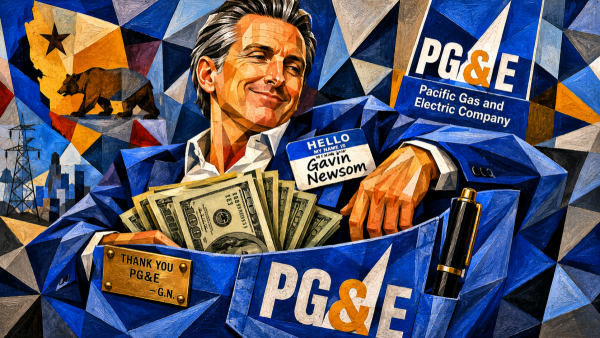
How many companies tied to fatal disasters can still secure rate hikes from government regulators and boost executive pay? PG&E’s reputation is about as popular as a wildfire, and yet Governor Newsom and his CPUC are perceived as being in the pocket of this corrupt and dangerous company. This major policy failure, along with a number of others, has resulted in Face Fatigue setting in for Newsom in California. Team Newsom will counter that it cracked down on PG&E, and certainly he got in front of the cameras and tried to grandstand his way to restitution. But no one was fooled by that. A coalition of political leaders, including 22 mayors and some county supervisors, called for Newsom to turn PG&E into a customer-owned utility, which would not be required to pay dividends to shareholders and would have been exempt from federal taxation. Those savings could have been passed on to consumers, or invested in a modern and safe energy policy, as well as greater renewables. But that was too bold of a step for Newsom, and instead consumers are suffering one rate increase after another to pay for this company’s catastrophic blunders and misdeeds.
There is an obvious parallel here, to when President Obama responded so limply to the 2008 housing market collapse and failed to hold banks or corporate leaders accountable, bailing out Wall Street more than Main Street. Obama’s failure to demonstrate boldness and responsiveness festered throughout his two terms and fed the “resentment machine” that Trump then stoked in 2016 to succeed Obama as president.
The anger and frustration of Californians toward PG&E is matched only by a rising sense that their political leaders are nonresponsive and incapable of reining in such flagrantly egregious corporate behavior. Governor Newsom has been the protector-in-chief of this renegade company, shielding it from liability for its destructive behavior and shifting the financial burden of its lawbreaking away from its shareholders and onto everyday ratepayers.
And now Gavin Newsom wants to be president? I can just imagine the 30 second ads: “Have you heard about PG&E, Gavin Newsom’s favorite company?” Kind of like this:
Comments

Powered by RoundtableAn AI/DeFi-powered Enterprise Media Operating System. Learn more at Roundtable.io.© Roundtable 2026. By using this site you agree to the Terms of Use and Privacy Policy