


Aug 3, 2026 5:23 PM
Democratic Socialists of America is winning elections and attracting young activists—but its growing influence raises difficult questions about communism, public ownership, constitutional democracy and political power.
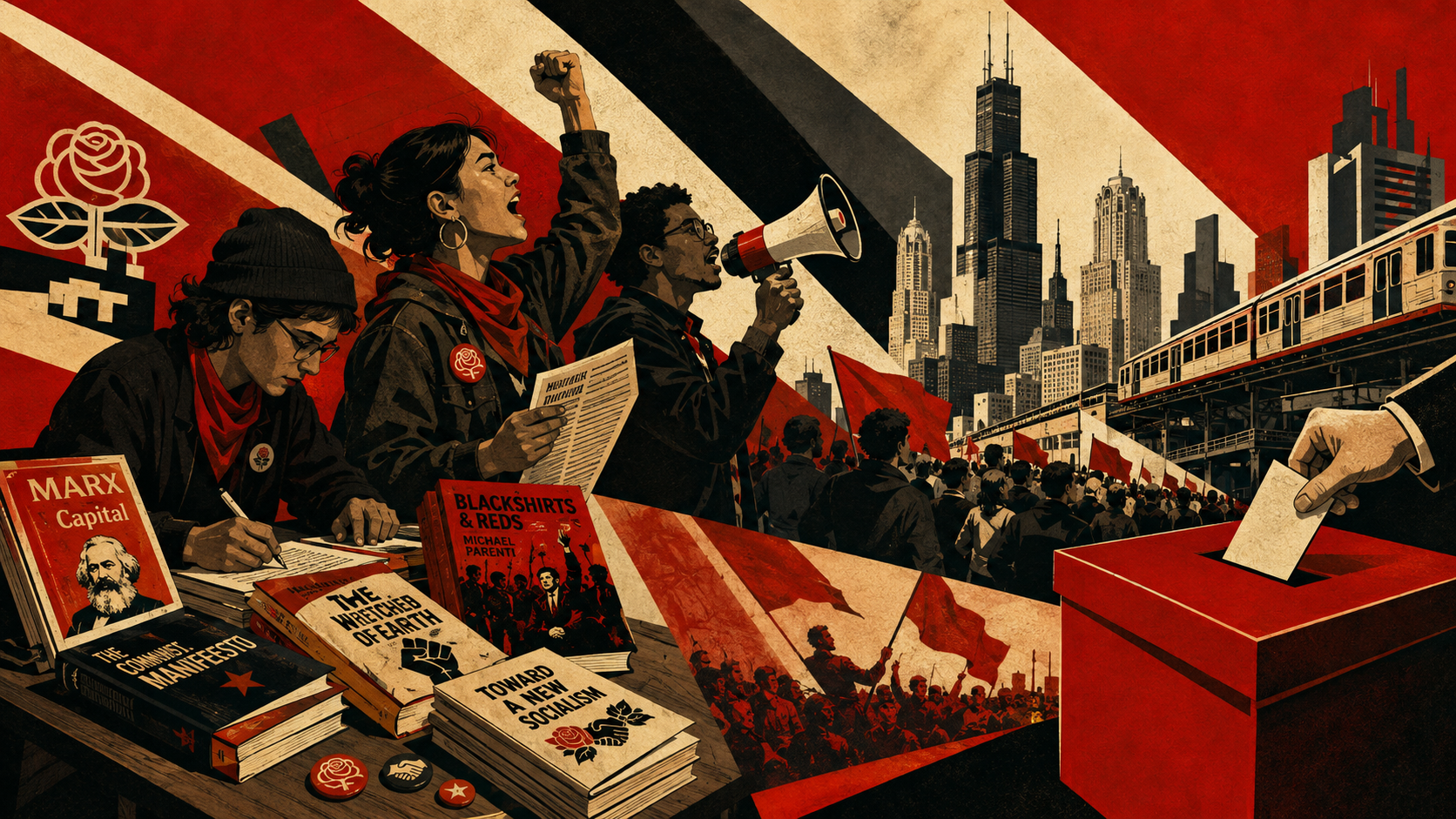
At the Democratic Socialists of America gathering in Chicago this weekend, young activists celebrated a series of impressive electoral victories, attended workshops in socialist political education and browsed tables displaying copies of The Communist Manifesto.
One is tempted to ask how many of those buying the famous little book have actually read it.
That may sound dismissive. It is not intended to be. The Democratic Socialists of America, commonly known as DSA, deserves to be taken seriously—more seriously, perhaps, than some of its most enthusiastic members appear to take the history behind their own language.
DSA is not, despite frequent descriptions to the contrary, the “Democratic Socialist Party.” It is a membership organization that generally works through Democratic primaries while insisting that it is not part of the Democratic Party establishment. It now describes itself as the largest socialist organization in the United States, with more than 100,000 members and chapters in every state. Its national website says its goal is a society in which working people democratically control both the economy and government.
Related stories
The distinction matters. DSA is not simply campaigning for somewhat higher taxes, stronger unions and a better social safety net. Those goals are shared by many liberals, progressives and social democrats who do not consider themselves socialists. DSA’s newly revised national program proposes a much more fundamental reordering of American economic and political life.
Its “Workers Deserve More” agenda includes universal health care, housing guarantees, stronger labor rights, a Green New Deal and expanded public services. Those are proposals that many Americans may find attractive, particularly after decades of stagnant wages, rising housing costs, medical debt and concentrated corporate power.
But the program goes considerably further. It calls for social or public ownership of major corporations, abolishing the Senate, replacing the existing presidency and Supreme Court with institutions subordinate to a newly empowered legislature, dismantling Immigration and Customs Enforcement, allowing permanent residents to vote and ultimately replacing the two-party system with a multiparty democracy.
Those are not merely reforms. They constitute a proposal for a different constitutional order.
Why Socialism Is Appealing Again
It is easy for older Americans to underestimate why socialism attracts younger people.
They did not grow up during the Cold War. They do not automatically associate the word with Stalin, East Germany, political prisons or Soviet tanks rolling into Hungary and Czechoslovakia. They associate capitalism with the system they have personally encountered: unaffordable apartments, student loans, insecure employment, medical bills, climate disasters and billionaires purchasing political influence.
When they hear “socialism,” many do not imagine state control of every farm and factory. They imagine health care as a right, tuition-free public education, stronger unions, paid family leave, affordable housing and a government willing to restrain monopolies.
In other words, many young Americans use the word socialism to describe policies that Europeans would call social democracy.
That linguistic confusion has been politically useful to DSA. The organization can speak to voters through popular proposals such as Medicare for All and universal childcare while maintaining a membership broad enough to include Bernie Sanders-style social democrats, democratic socialists, Marxists, anti-capitalists and self-described communists.
That ideological breadth is both its strength and its danger.
DSA-backed candidates have recently achieved notable victories, particularly in heavily Democratic urban districts. The organization has developed an increasingly effective campaign operation, and its membership reportedly reached approximately 120,000 this summer. Yet DSA remains deeply divided between practical electoral organizers and factions seeking a more explicitly revolutionary break with capitalism and the Democratic Party.
The pragmatic wing asks: What can we win?
The ideological wing asks: What compromises will corrupt us?
Every successful political movement eventually confronts that tension. DSA is confronting it now.
What Did Marx Actually Mean?
The sight of young democratic socialists buying The Communist Manifesto is not inherently alarming. Citizens should read Marx. They should also read Adam Smith, John Stuart Mill, Frederick Douglass, W.E.B. Du Bois, Hannah Arendt and the Federalist Papers.
The problem begins when a historical text becomes a devotional object rather than something to be interrogated.
Marx and Engels wrote the Manifesto in 1848, amid the brutal working conditions of early industrial capitalism. Children labored in factories. Workers had few political rights, little security and virtually no protection against injury, hunger or arbitrary dismissal. Marx correctly recognized that industrial capitalism was concentrating wealth, transforming social relationships and producing deep conflicts between owners and workers.
Many of his criticisms remain unsettlingly recognizable.
But Marx did not merely propose better wages, public hospitals or stronger labor unions. He argued that class conflict would lead workers to overthrow the bourgeois order, abolish private ownership of productive property and eventually eliminate class society itself.
DSA members frequently distinguish this vision from the authoritarian governments that later called themselves communist. They argue that Soviet dictatorship was a betrayal of socialism rather than its fulfillment. Democratic socialism, they insist, seeks collective economic power through elections, civil liberties and popular participation rather than one-party rule.
That distinction is real and should not be brushed aside.
Yet it does not settle the central question: Can a government eliminate concentrated private economic power without creating concentrated political power?
History suggests that this is much harder than socialist theory acknowledges.
When government becomes the principal owner, employer, lender and distributor of necessities, political dissent can become economically dangerous. The same institution that regulates speech or opposition may also control one’s job, housing and access to resources. Even a movement beginning with democratic intentions must explain what institutional barriers will prevent public ownership from becoming bureaucratic domination.
Simply adding the word democratic does not answer the question.
Is DSA Communist?
Calling every DSA member a communist is inaccurate and intellectually lazy.
The organization contains many people who seek reforms through elections and do not advocate Soviet-style government. DSA-backed Colorado congressional candidate Melat Kiros, for example, has explicitly said that she is not a communist and does not support every plank in the national organization’s program. She favors policies including Medicare for All, universal childcare and a shorter workweek while rejecting proposals such as abolishing the Senate and defunding the police.
But it is equally misleading to pretend communism has no meaningful presence within DSA.
Marxist and revolutionary caucuses operate openly inside the organization. Some members regard democratic reforms as steps toward ending capitalism rather than as ends in themselves. Socialist educational programs study the Communist Manifestonot merely as history but as a text with continuing strategic relevance. DSA’s ideological ecosystem ranges from Scandinavian-style welfare-state politics to explicit revolutionary Marxism.
The honest answer, therefore, is that DSA is not a communist organization in any simple sense—but communists are part of it, Marxism influences it, and its national program extends far beyond ordinary liberal reform.
That should neither be sensationalized nor concealed.
Bill Maher’s Warning
On Real Time Friday night, Bill Maher warned that the Democratic Party was being “colonized” by socialist activists. He pointed to unpopular positions involving policing, prisons, borders and capitalism and argued that Democrats risk allowing a highly organized ideological faction to define the entire party.
Maher’s language was characteristically provocative. But the warning should not simply be dismissed as another attack from an aging centrist uncomfortable with young activists.
A relatively small movement can exercise influence far beyond its numbers when its members are disciplined, energetic and willing to perform the unglamorous labor of politics: knocking on doors, recruiting candidates, attending local meetings, mastering endorsement procedures and turning out voters in low-participation primaries.
DSA appears to understand organizing better than much of the Democratic establishment.
Its opponents often respond with name-calling. DSA responds with volunteers.
That is one reason it is winning.
The Democratic Party’s corporate wing also bears responsibility for creating the conditions in which socialist politics has revived. A party that celebrates economic growth while ordinary families cannot afford homes, health care or childcare should not be surprised when voters seek a more radical vocabulary. Politicians who defend capitalism without confronting its failures are recruiting socialists more effectively than any Marxist reading group ever could.
But electoral energy does not excuse intellectual carelessness.
A movement that invokes communism, however playfully or selectively, assumes an obligation to confront what governments acting in communism’s name actually did. It must be willing to discuss political imprisonment, censorship, forced collectivization, famine, party dictatorship and the suppression of independent labor organizations—not as unfortunate propaganda circulated by capitalists, but as historical realities.
It must also explain why its own concentration of economic authority would avoid those outcomes.
The Questions DSA Must Answer
DSA is right about several fundamental things.
American democracy is weakened by extreme inequality. Corporations exercise far too much power over elections, workplaces and public policy. Health care should not depend upon employment or wealth. Workers deserve stronger unions and greater authority in the institutions that shape their lives. Housing should not become an investment vehicle that leaves millions unable to afford shelter.
Those beliefs do not frighten me.
What concerns me is the tendency of ideological movements—left and right—to replace difficult thinking with moral certainty.
DSA must tell Americans what it means by “public ownership.” Would small businesses remain privately owned? Could individuals accumulate wealth? Could workers leave publicly owned enterprises and establish competitors? Would newspapers and digital platforms remain independent? Who would allocate investment capital? Could voters reverse socialist policies and restore private ownership if they chose to do so?
Most importantly: What happens when the people disagree with the revolution?
The American right is already demonstrating how quickly a movement can discard democratic restraints while claiming to speak for “the people.” The left must not answer that danger with its own version of majoritarian certainty.
Democracy is more than achieving the correct outcome. It includes preserving institutions that allow opponents to organize, speak, publish, own property, compete for power and someday defeat us.
Read the Book—Then Read the History
So, by all means, buy The Communist Manifesto.
Read its indictment of exploitation. Consider its insights into class and power. Recognize why its language electrified workers who possessed little property, security or political influence.
Then keep reading.
Read about the Russian Revolution and the crushing of the Kronstadt rebellion. Read the testimony of political prisoners. Read George Orwell, Václav Havel and Aleksandr Solzhenitsyn. Read the democratic socialists who opposed both capitalism’s abuses and communist dictatorship. Study the labor movements that expanded democracy rather than abolishing it. Examine the Nordic countries, whose generous public systems operate alongside competitive markets, private enterprise and multiparty constitutional government.
And read the history of American capitalism honestly as well: slavery, company towns, strikebreaking, child labor, racial exclusion, union suppression and the purchase of political power.
No economic system should be protected from history.
The rise of DSA is not a passing curiosity. It reflects genuine suffering, justified anger and a growing conviction that the existing Democratic establishment has failed to address the economic insecurity of ordinary people.
That makes this movement important.
It does not make it right.
DSA’s victories should force Democrats to confront inequality, corporate power and the collapse of economic security. But DSA must also confront the unresolved contradictions within its own coalition: reform or revolution, democracy or ideological discipline, regulated markets or abolition of capitalism.
The young people buying Marx in Chicago may be helping to shape the future of the American left.
Let us hope they read past the slogans.
Comments

Powered by RoundtableAn AI/DeFi-powered Enterprise Media Operating System. Learn more at Roundtable.io.© Roundtable 2026. By using this site you agree to the Terms of Use and Privacy Policy