


Jan 30, 2026 1:17 AM
Updated Jan 30, 2026 11:51 PM
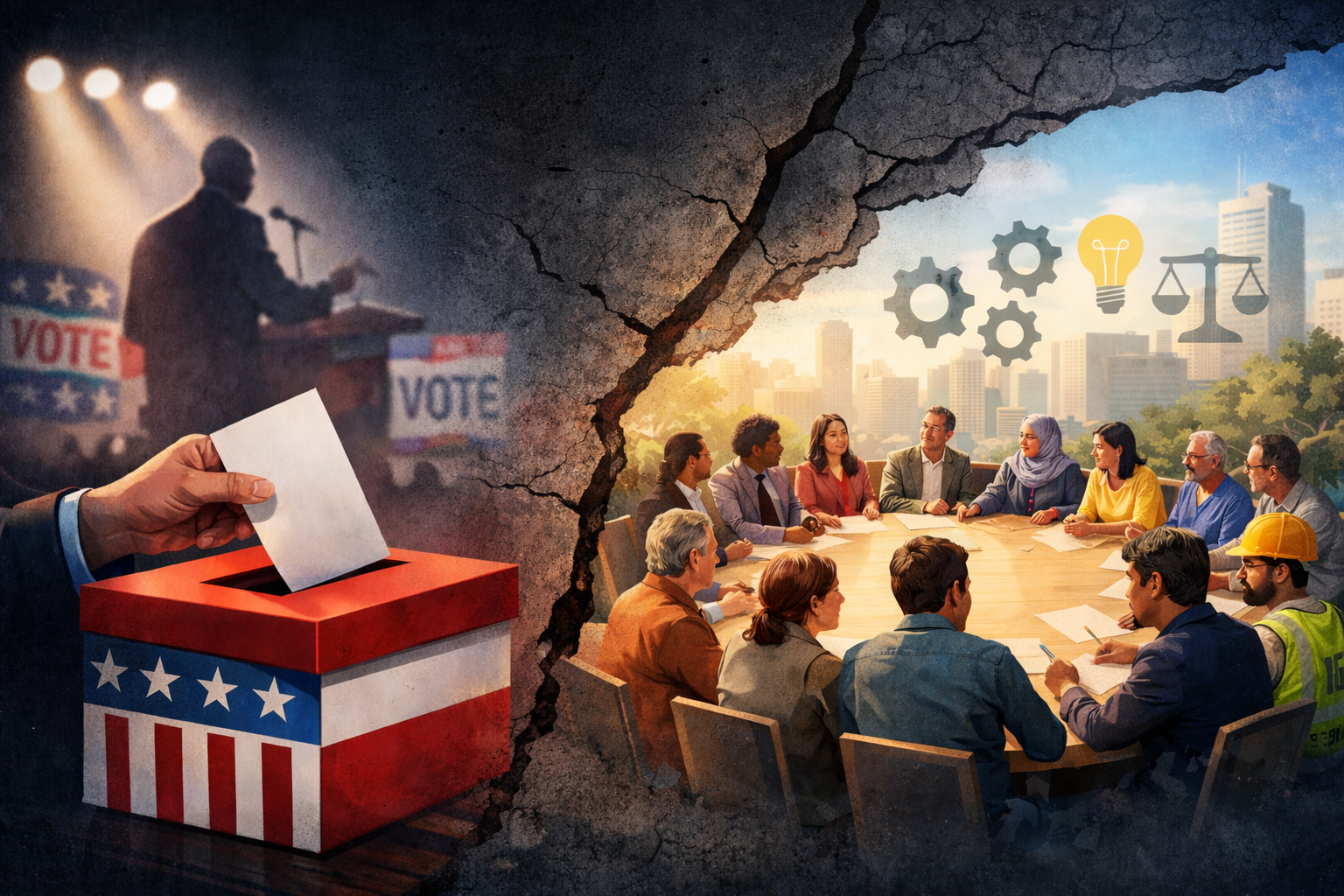
Voting alone cannot protect rights, produce sound policy, or hold power accountable. Democracy is failing not because citizens are incapable—but because the system was never designed to use their judgment.
What Is Government For—And Why Elections Alone Can’t Do the Job
The arrest of journalists Don Lemon and Georgia Fort while doing their jobs is not just another news item. It is a reminder—one of thousands in recent years—that constitutional rights in the United States are increasingly treated as conditional. When the First Amendment becomes optional, it forces a deeper question, one we should still be able to ask freely:
What is government for? And what role do elections actually play in fulfilling that purpose?
These questions matter precisely because elections have been elevated to something they cannot bear on their own. Voting has been treated as the core of democracy, sometimes even its entirety. But the evidence of the last half-century tells a different story. Policy outcomes routinely diverge from what most people want. Inequality widens regardless of who wins. Entire populations remain materially insecure, unheard, and politically expendable decade after decade.
That is not a mystery. It is a design problem.
Related stories
The Role of Government: Capacity, Protection, and Coordination
At its most basic level, the role of government is not spectacle, messaging, or even representation in the narrow electoral sense. Government exists to do three things that individuals and markets cannot reliably do on their own:
- Protect fundamental rights and liberties Freedom of speech, press, assembly, bodily autonomy, and due process are not self-enforcing. They require institutions willing and able to restrain power—including their own.
- Build and maintain collective capacity Government exists to ensure that people have the material conditions—housing, healthcare, education, infrastructure, environmental safety—necessary to live, think, work, and participate in civic life.
- Coordinate complex systems in the public interest Modern societies require coordination across time, geography, and competing interests. Markets optimize for profit; government is supposed to optimize for public purpose.
When government fails at these tasks, democracy becomes performative. Rights become fragile. And elections become rituals disconnected from outcomes.
Why It’s So Hard to See What Government Actually Does
Political scientists Martin Gilens and Benjamin Page spent ten years assembling data to answer a deceptively simple question: Do elected officials enact policies that align with what most Americans want?
Their conclusion—that economic elites and organized interests exert far more influence over policy than ordinary citizens—is now widely cited. But what often goes unexamined is why such a basic question required a decade of research.
The answer is not academic difficulty. It is institutional opacity.
The American political system is not designed to make it easy for ordinary people to trace:
- which policies were enacted,
- by whom,
- under whose influence,
- and with what material consequences.
There is no single, public, citizen-friendly way to evaluate how an elected official performs once sworn into office. With the rare exception of a political spectacle like Donald Trump, most elected officials operate largely out of public view—not because their decisions are insignificant, but because there is no tool that makes those decisions easy to see, trace, or understand. That absence is not an accident. Complexity protects power.
Elections Measure Preference—Not Judgment
Elections ask a narrow question: Which option do you prefer right now, given what you know at this moment?
They do not ask:
- what people would decide with time,
- with credible information like an incumbent's track record,
- with exposure to tradeoffs,
- or with the opportunity to reason together.
This distinction matters.
Political scientist James Fishkin has spent decades demonstrating that public opinion changes—often dramatically—when ordinary people are given balanced information and the opportunity to deliberate. His work on deliberative polling consistently shows that polarization decreases, understanding increases, and policy preferences become more coherent when citizens are treated as thinkers rather than targets.
The implication is uncomfortable for conventional politics:
What elections capture is not democratic judgment. It is opinion under poor conditions.
If people appear reactive or misinformed, that is not a civic failure. It is a design failure.
Elections Concentrate Power by Design
Even if voters were perfectly informed, elections would still do what they are structurally designed to do: concentrate governing power in a narrow elite.
Running for office in the United States requires:
- access to money,
- elite networks,
- free time,
- institutional backing,
- and skill in political performance—fundraising, branding, debating—rather than demonstrated governing competence.
The result is a governing class drawn from a thin slice of society: wealthier, more insulated, more credentialed, and less exposed to the consequences of policy failure partly because they are generally not impacted by the policy and their constituents are clueless about the policies they've supported.
This is not accidental. Elections in the United States have always functioned as a filtering mechanism—selecting for polish and access while mistaking elite credentials for governing capacity.
The outcomes are visible everywhere: endless war, widening inequality, normalized homelessness, environmental collapse. These are not failures occurring despite the system. They are failures produced by it.
Democracy Loses Capacity Before It Loses Legitimacy
Political theorist Hélène Landemore, in Open Democracy, argues that elections are not neutral democratic tools. They are structurally oligarchic. They narrow participation and truncate the collective intelligence of the public.
This is not about turnout.
It is about who is allowed to exercise judgment.
Landemore draws on research—including Scott E. Page’s work in The Difference—showing that cognitive diversity, not elite homogeneity, produces better solutions to complex problems.
When governance is monopolized by a small, self-selecting class, democracy loses not just legitimacy—but capacity.
In other words, elections don’t merely limit who holds power. They limit how well power is exercised.
Precarity Undermines Democracy Before the Ballot Is Cast
There is another truth we rarely acknowledge: people cannot deliberate while living in precarity.
A population burdened by housing insecurity, medical debt, unstable work, surveillance, and constant stress is a population deprived of democratic capacity. Elections held under those conditions do not reflect consent. They reflect exhaustion.
Government’s failure to provide material stability is not separate from democratic decline. It is one of its primary causes.
Beyond Voting: What Democracy Looks Like When It’s Taken Seriously
If elections are not enough, what is? This is a great time in our history to ask this question, especially in light of the actions of the current president who has recently suggested that we don't need elections.
Around the world, governments are experimenting—quietly and unevenly—with citizens’ assemblies selected by lottery, the same way juries are selected. These bodies are demographically representative, time-limited, compensated, and supported by expert testimony.
Ireland used such assemblies to address abortion, marriage equality, and climate policy—producing recommendations that later won overwhelming public support. Oregon uses citizen panels to evaluate ballot initiatives, improving voter understanding and trust.
These institutions do not replace expertise. They integrate it.
They do not eliminate disagreement. They structure it.
Most importantly, they treat citizens as co-governors, not periodic consumers of political brands.
Legitimacy Comes From Participation, Not Pageantry
Critics warn that expanding citizen participation would be messy or slow. But the status quo is already unstable. A system that consistently fails while insisting it represents “the will of the people” corrodes trust by design.
Legitimacy does not come from ballots alone.
It comes from inclusion, reasoning, and shared responsibility.
Fishkin shows what people decide when democracy is done properly.
Landemore shows why democracy must be redesigned so that happens routinely.
Together, their work points to a simple conclusion:
The problem is not that people are unfit for democracy.
The problem is that our institutions are unfit for people.
Elections Are a Beginning—Not a System
Voting matters. Elections should remain regardless of what Donald Trump is planning. But treating them as the apex of democracy has left us governed by spectacle, money, and manufactured division.
Democracy is not a performance we watch every four years.
It is a capacity we either build—or suppress—every day.
If we want a government capable of protecting rights, solving problems, and sustaining a free society, we must stop asking whether citizens are capable of self-government and start asking whether our system is designed to allow it.
Right now, it isn’t.
And that is not a failure of the public.
It is a failure of design - one that can be redesigned.
Further Reading
- Open Democracy – Hélène Landemore
- When the People Speak – James Fishkin
- Democracy and Deliberation – James Fishkin
- The Difference – Scott E. Page
- Against Elections – David Van Reybrouck
Comments

Powered by RoundtableAn AI/DeFi-powered Enterprise Media Operating System. Learn more at Roundtable.io.© Roundtable 2026. By using this site you agree to the Terms of Use and Privacy Policy