
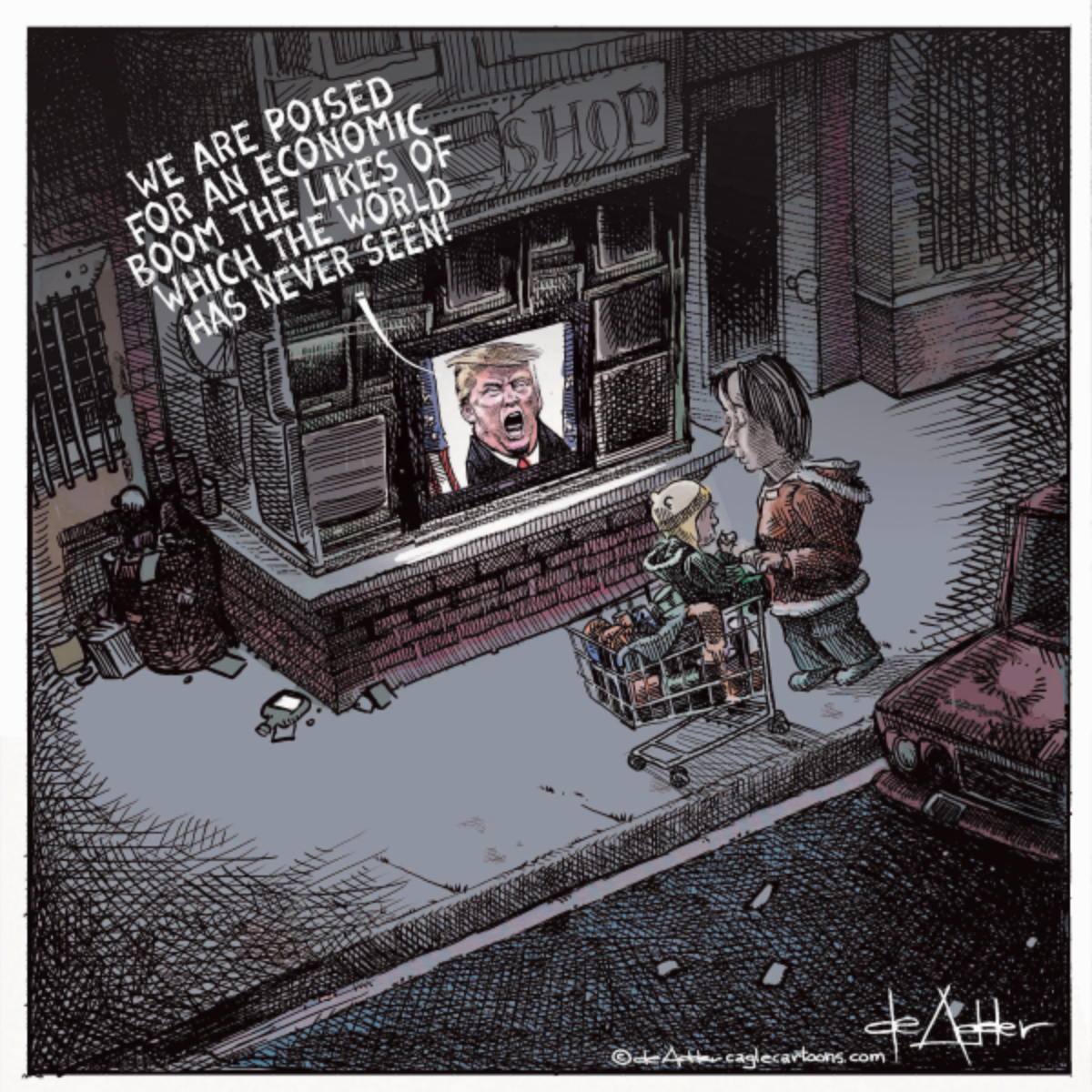
Cagle Cartoons: Michael de Adder


May 7, 2026 1:42 AM
Updated May 7, 2026 2:18 AM
Considering that we have had 45 presidents and some were pretty bad, that’s quite a statement, especially given the adverb “easily.”
In a late April 2026 New York Times Opinion column, Thomas Edsall declared “Trump Is ‘Easily the Worst President in U. S. History.’” Considering that we have had 45 presidents and some were pretty bad, that’s quite a statement, especially given the adverb “easily.” Worst than Lincoln predecessor, James Buchanan, who thought the issue of slavery was not very important and whose poor leadership helped bring about the Cvil War? Worst than Andrew Johnson, who succeeded Lincoln and undermined Reconstruction, thus blocking civil rights for freed slaves (mainly in the defeated Southern states)?
But although I’m a historian, my speciality is not U. S. history, but that of Russia. So I’ll leave it to those better qualified than myself to decide. One way of doing this is to look at surveys that asked scholars with more expertise than I possess to examine the question of best and worst presidents. One of the most recent examinations is that of the 2024 Presidential Greatness Project Expert Survey, which was conducted in November and December of 2023. “Respondents included current and recent members of the Presidents & Executive Politics Section of the American Political Science Association” and other “social science experts in presidential politics.” Altogether, “154 usable responses were received.”
This survey, as compared to any of the first two decades of our present century, has the advantage of allowing the rankers to consider the role of President Trump’s claim that the 2020 election was “stolen” from him by Joe Biden and forces loyal to him. Perhaps partly because of that fact, Trump was selected as our “worst president.” But that judgment was made before Trump’s second term began, and now—more than a year into that term—there is certainly more data available to judge Trump’s ranking among our presidents.
Thus, without considering the defects of presidents like Buchanan and Andrew Johnson—ranked second and third worst respectively by the 2024 survey—let’s turn to Edsall’s column to see why he thinks “Trump Is ‘Easily the Worst President in U.S. History.’” (See here, as an example of most surveys that include at least part of Trump’s first term, and he is listed along with Buchanan and Andrew Johnson, in the bottom five of our 45 presidents.)
Related stories
Edsall divides his article into two parts. In Part 1, he lists the main reasons he personally thinks Trump is the worst; in Part 2 he indicates some of the reasons that experts he contacted think Trump is so bad.
But let’s start with his own personal judgments. He begins with the deaths Trump is, or will be, responsible for: “Projections suggest there will be millions of dead men, women and children as a result of his budget cuts, which were made without direct congressional approval. A study published in The Lancet, the London-based medical journal, found that Trump administration cuts in U.S.A.I.D. funding ‘would result in approximately 1,776,539 all-age deaths and 689,900 deaths in children younger than 5 years’ in 2025 alone.
In the remainder of his article, Edsall also mentions other deaths that Trump will bring about. For example, “If successful, the E.P.A. would gut pollution rules that were estimated, according to The Associated Press, to save “more than 30,000 lives annually.”
Since the number of climate-crisis deaths that Trump will eventually be responsible for is still unknown at this time, perhaps the best we can project is to quote Sen. Bernie Sanders’ words in mid 2024:
“If Donald Trump is elected, our kids and grandchildren are going to continue to see rising global temperatures that will lead to shorter lifespans and worse mental health; increased instances of food and waterborne disease; human and animal diseases; increased exposure to wildfires that will mean more heart and lung diseases and flooding during extreme weather event...It will mean substantially increased risk of wars, social unrest, and mass migrations.”
There are also the deaths that will result from the Trump administration’s canceling of “funding for lifesaving scientific and medical research.” Edsall adds, “In their steadfast disregard for scientific study, Trump and his appointees have purposely elevated unfounded fears of vaccines, effectively guaranteeing more childhood illness and infection epidemics.”
The author does not figure into his death toll all the deaths resulting from Trump’s support for Israeli Prime Minister Netanyahu in his wars against Palestinin Gazans, Lebanon, and Iran, but they are substantial. Nor does Edsall factor in any additional Ukrainian deaths that might have resulted from Trump’s less than fulsome support of Ukraine. However, in fairness to Trump, it must be admitted that some of his peace efforts—he has claimed to have “settled eight wars”—might have saved some lives.
Besides the deaths caused by Trump’s hostility to renewable energy sources, Edsall suggests other poor consequences resulting from the president’s hostility to alternate sources. For example, he has “undermined America’s ability to compete with China” in furnishing such energy. In general, so Edsall writes, “Trump makes no secret of his disdain for renewable energy and the concept of climate change.” And he quotes Trump’s words that the concept is “the greatest con job ever perpetrated on the world.” It was “made by stupid people that have cost their country’s fortunes and given those same countries no chance for success.”
Financial losses and gains are another area that Edsall identifies. Losses he has caused others—“Trump’s pardons cheat victims out of an astounding $1.3 billion in restitution and fines, allowing fraudsters, tax evaders, drug traffickers to keep ill-gotten gains.”And personal gains—“his family’s companies receive millions through cryptocurrency purchases from foreign companies and crypto operators subject to U.S. regulation.” (See my last September’s “Donald Trump Profiteer in Chief.”)
A final personal negative on Edsall’s Trump list is his weakening of U.S. alliances: “Trump’s threats to pull out of NATO and his tariffs, not to mention his endless carping against and routine faulting of European leaders, have alienated allies who have stood with us for more than seven decades.” And Edsall cites a recent poll that indicates those polled in Poland, Spain, Belgium, France, Germany and Italy thought that the USA was a greater threat to them than China.
Among the reasons for Trump’s low ranking provided by seven of the professors he contacted are the following:
“He’s driven a deep divide into the country: between the states, between migrants and many others, between classes and between the intellectual elite and the rest of the country.
He’s slashed the size of the federal bureaucracy and made federal jobs much less attractive.
He’s fundamentally undermined the idea of an annual budget process and the concept of a balanced federal budget.”
He’s eroded “trust in the U.S. by European and Asian allies”; and caused “erosion of U.S. dominance of higher education; and huge budget deficits.”
He’s “created a permission structure for future presidents to disregard statutes any time they find those statutes inconvenient.”
His “mass firing of dedicated and experienced civil servants has made government dumber and weaker and will make it harder to attract talented replacements.”
The damage he has caused “to scientific and medical research, the environment, relations with allies and trading partners, disaster preparedness, consumer safety, higher education, military leadership, civil rights, etc. will take years to repair even in cases where that is possible.”
Trump has set a terrible precedent for presidents who come after him: “Norms can be broken, repeatedly and openly, without necessarily paying much of a price.”
Trump has weakened “trust in the long-term credibility of U.S. government commitments. This applies to private businesses, government employees and international allies.”
This list is not solely due to Trump. One of the professors indicated that the Supreme Court also shares some blame—and a backboneless Congress could also be added to the blame-sharers.
Finally, Edsall could have added more reasons why Trump has become the worst of our presidents. Two I would add are
- his complete lack of respect for truth-telling and
- his attempts to dismantle diversity gains.
Regarding the first, we can go back to Republican Sen. Jeff Flake’s early 2018 statement: “2017 was a year which saw the truth—objective, empirical, evidence-based truth—more battered and abused than any other in the history of our country, at the hands of the most powerful figure in our government. It was a year which saw the White House enshrine “alternative facts” into the American lexicon, as justification for what used to be known simply as good old-fashioned falsehoods.” And 2017 was almost a decade ago. Think of all the Trumpian untruths that have been spewed since then.
Regarding the second reason—dismantling diversity gains—I can do no better than referring readers to my “Do We Want the America of Frederick Douglass or Donald Trump?” Historian Jill Lepore referred to Douglass’s advocacy of a “composite nation” as “a strikingly original and generative idea, about a citizenry made better, and stronger, not in spite of its many elements, but because of them.” In trying to take us back toward white male supremacy, Trump is moving in the opposite direction. No wonder Edsall’s last line is, “Voters in this country twice elected a president with no ethics, no empathy and no end to his narcissism.”
Comments

Powered by RoundtableAn AI/DeFi-powered Enterprise Media Operating System. Learn more at Roundtable.io.© Roundtable 2026. By using this site you agree to the Terms of Use and Privacy Policy