
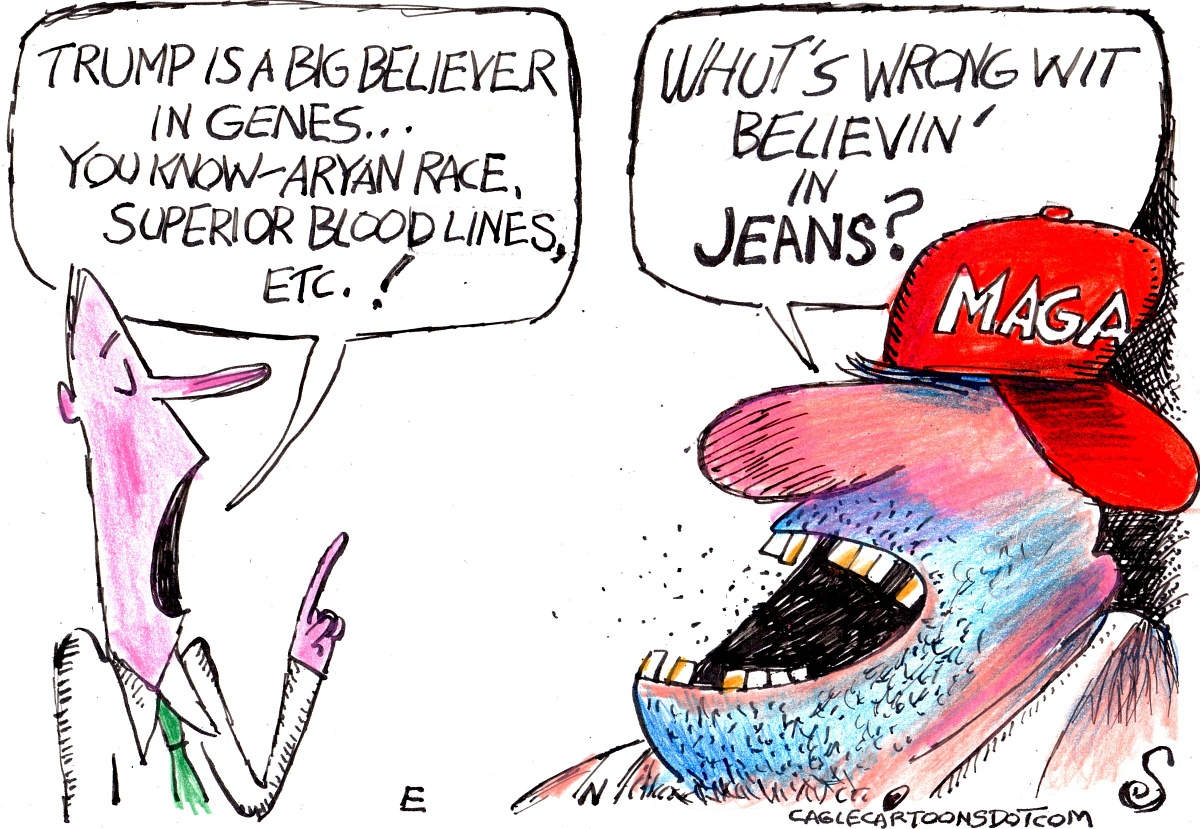
Cagle Cartoons: Randall Enos


Obsession with Genes
Oct 16, 2024 3:47 PM
As his campaign once again unfurls with promises of mass deportations, his words carry a venomous echo, invoking a grotesque image of migrants as carriers of a genetic blight.
"How about allowing people to come to an open border, 13,000 of which were murderers."
"Many of them murdered far more than one person, and they're now happily living in the United States. You know, now a murderer, I believe this, it's in their genes. And we got a lot of bad genes in our country right now."—Donald Trump
In a fevered display of racist vehemence, former President Donald Trump recently cast a virulent aspersion upon migrants, brandishing a macabre theory that seemed to resemble the cursed bloodlines of eugenic lore that we long thought had disappeared into history’s silver spittoon. With words laden with an ominous finality, he spoke of "bad genes" fueling the murderous inclinations of certain groups of dark-skinned migrants. His proclamation, delivered during a fervent exchange on The Hugh Hewitt Show, summoned specters of an era steeped in the pseudoscience of eugenics.
Trump wasted no time in unleashing his tirade, lashing out against Vice President Kamala Harris, whom he accused—without evidence—of plotting to install a communist regime, a notion as sweeping as it was baseless. Amidst this invective of veiled threats and conspiratorial musings, Trump laid blame for the so-called open borders at her feet, painting a grim picture of what he claimed to be an influx of some 13,000 murderers "happily living" within U.S. borders. It was with chilling ease that he connected this alleged criminal tide to a hereditary flaw, proclaiming, "You know, now, a murderer—I believe this—it’s in their genes. And we got a lot of bad genes in our country right now." Numerous reports on Trump’s vile assertions have brought the topic of eugenics to the fore of the presidential race.
Related stories
Trump’s numbers are based on heavily manipulated statistics about the criminal conviction records of people with cases in immigration court. The cases can be traced back several decades, some long before President Joe Biden was in office, and which include people currently serving prison time.
Trump has never been at home in the world of granular insight, and this was no isolated incident of rhetorical extravagance. Indeed, it marked yet another chapter in Trump’s pattern of dehumanizing language aimed at undocumented immigrants. As his campaign once again unfurls with promises of mass deportations, his words carry a venomous echo, invoking a grotesque image of migrants as carriers of a genetic blight. Last autumn, he wove a similar dark narrative, speaking of immigrants "poisoning the blood" of the nation—a phrase steeped in the lexicon of white supremacists and Hitlerian discourse, drawing swift rebuke from civil rights advocates.
The former president’s evocation of the so-called "racehorse theory" of genes, as he has done in the past, speaks to his disturbing reverence for the notion that superior "bloodlines" are forged through selective breeding. His portrayal of those who cross U.S. borders as inherently dangerous by virtue of their heritage reveals a view steeped in the most invidious racial paranoia. This narrative is starkly contradicted by studies, including recent findings from Stanford University and the Cato Institute, which show that undocumented migrants are statistically less likely to commit crimes than native-born citizens.
Yet, Trump remains undeterred, doubling down on his inflammatory rhetoric as he seeks to reclaim his mantle. With each utterance, he conjures up a specter of an America threatened by an alien "other," fueling fears with tales of shadowy figures lurking at the gates, seeking to corrupt the nation's blood. This rhetoric is not new to America and it has come to define the worst of MAGA ideology.
As the dust and clamor of the Industrial Revolution spread their fingers across the land, and the reverberations of the French Revolution cast their tremors into the decades that followed, a seed of thought took root in the restless minds of the age. From the fires of economic expansion fueled by the ruthless spirit of laissez-faire liberalism, to the chilling indifference that shadowed the Great Irish Famine, a storm was brewing in Victorian England. The virtues of free-market capitalism, venerated and untouchable, pushed the gears of progress, yet left the suffering of the impoverished unattended, their silent cries mingling with the smoke of factory chimneys.
As urban landscapes swelled with the wretched and weary, as disease gnawed at the fringes of the population, as violence brewed and emigration carved its own pathway through the masses, the social fabric strained and tore under the weight of rapid change.
In these turbulent times, England’s old Tudor poor laws, remnants of an age now fading, gave way to a new order: the care of the destitute was no longer the sacred charge of the church, but now a duty thrust upon the shoulders of the state. The colonies poured forth their people, seeking refuge, seeking hope, and yet their arrival stirred unease, a desire to “solve” the problems their presence seemed to bring.
Amidst this churning sea of upheaval, Joseph Arthur, Comte de Gobineau, a French aristocrat, peered out with a gaze of dread. The banners of democracy fluttered like ghostly harbingers, stripping the gilded power from the hands of those he believed born to wield it. Gobineau, haunted by the specter of the 1848 revolution, saw in the rising tide of common voices the undoing of all he held dear. He was the first to cast forth the dark and insidious notion that blood and heritage marked the measure of a man, that “lesser peoples” were gaining ground on the noble-born elite. Gobineau penned his notorious Essay on the Inequality of the Human Races (1853-55), a treatise in which he proclaimed, with perverse conviction, the superiority of the “Nordic” race, providing a twisted legitimacy to the belief that the Aryan stock held the right to dominion—a belief that would haunt the coming century.
It is no accident that we hear echoes of Gobineau’s racist ideology in Trump’s distain for immigrants from “shithole countries” (African countries, Haiti and El Salvador) and his preference for Nordic races : “Do we have any people coming in from Denmark? How about Switzerland? How about Norway?”
Trump’s comments wrench the historical memory of the country back into the dusty halls of early 20th-century America, where gilded ideals of progress intertwined with pernicious moral decay.
Trump’s comments wrench the historical memory of the country back into the dusty halls of early 20th-century America, where gilded ideals of progress intertwined with pernicious moral decay.
In 1915, a physician whose name now rings like a sinister refrain—Dr. Harry Haiselden—revealed the dark heart of a man who believed in the sanctity of selective suffering. He embodied the haunting figure of eugenic thought that swept across the nation. Eugenics was the lurking manifestation of an ideology that whispered through the corridors of hospitals and homes alike. His medical ideology loomed over cradles and incubators, poised to strike at the heart of innocence in the name of a twisted notion of perfection. Haiselden's belief that certain lives were unworthy—tainted, he would say, by the "curse" of deformity or imperfection—became his grim creed. As a dark consequence, Haiselden refused to operate on an infant whom he felt would be born irredeemably defective. Haiselden’s method of execution was the silent denial of medical intervention.
Haiselden became a specter of renown almost overnight, his grim visage looming in newspaper columns and on the lecture circuits, where he would spew forth unholy diatribes that echoed like a dirge across the land.
Trump’s racehorse theory recalls the ethereal specter born of a society intoxicated by the ideals of eugenics, where scientific progress was corrupted by racial purity and the fevered dream of a flawless society. The eugenics movement, with its preoccupation with bloodlines and pedigree, slithered its way into the minds of many, from scholars to laymen, coloring their perceptions of who was fit to live and who was not. The banners of "Better Babies" and "Fitter Families" fluttered like ominous heralds at state fairs, much like those MAGA banners of Rambo Trump at the Chosen One’s racist, sexist and misogynistic rallies.
Trump’s obsession with genes reflects the ominous manner in which he champions the horrors of nature over the sanctity of nurture. Through Trump, the twisted tendrils of eugenics becomes a stark reminder that the pursuit of perfection often begets a monstrous reflection in the darkened mirror of history.
It is worth remembering that in 1917, a film was born—a grim offspring of twisted ideals—christened The Black Stork. Penned by Jack Lait, a scribe of the Chicago American, this celluloid creation was borne aloft on the wings of a sweeping promotional campaign. It would haunt the silver screens of America for more than a decade, carrying its dark gospel from coast to coast. Dr. Harry Haiselden played himself, cast as the cold-blooded oracle of eugenics. In the film he warns a young couple of the supposed perils of parenthood, should their child be born defective. His words, chilling and unflinching, served as a eugenic prophecy. And when that dreadful prediction materialized, the mother—stricken with despair—allowed her infant to succumb to death. As the scene unfolds, the lifeless child appears to ascend into the spectral embrace of Christ, a surreal image that blends blasphemy with tragedy. But make no mistake, The Black Stork was no mere film; it was a calculated campaign, a clarion call for eugenic ideology. Its chilling message cast a shadow across the nation, poisoning minds with its insidious allure.
The film’s advertisements rang out like a dark sermon, masquerading under the label of a "eugenic love story." They ominously quoted Swiss eugenicist Auguste Forel: “The law of heredity winds like a red thread through the family history of every criminal, of every epileptic, eccentric, and insane person. Shall we sit still … without applying the remedy?” In 1917, one advertisement delivered the harrowing line, "Kill Defectives, Save the Nation and See The Black Stork," a statement so stark that it laid bare the dangerous doctrine at its heart. Eugenic euthanasia was no longer a whispered theory, but an accepted topic of conversation, and the notion of gassing the unwanted hovered just out of reach, a chilling prelude to horrors yet to come. We need to ask ourselves: What is the logical conclusion emanating from Trump’s hatred for those born in “shithole countries” with “bad genes”? Keep them out of the country, deport them en masse, put them in cages or holding camps, or is something worse at play?
America’s obsession with eugenics quickly spread its malignant roots overseas, entwining itself with fervent minds in France, Belgium, Sweden, and England. And nowhere did it take hold more firmly than in Germany, where eugenics found eager disciples among the intelligentsia and the powerful. Correspondence crossed the Atlantic as scholars exchanged ideas, seemingly oblivious to the monstrous implications of their designs. They spoke of racial purity, of sterilization, of a world purified by their calculated science, heedless of the human costs that lay in wait.
In Germany, American eugenic principles were eagerly adopted and twisted into even darker forms. As America touted eugenic sterilization, Germany prepared to carry these ideologies to their most inhuman extremes.
Scholars, lawmakers, and influencers of the day must be reminded that The Black Stork and its abhorrent ideals have consequences that reach far beyond any single nation. The world stands at a perilous crossroads, and if we fail to confront the specter of eugenics head-on, we risk a descent into an era where humanity itself becomes expendable, sacrificed on the altar of a false, retrograde purity.
In the chaotic early 1920s, Germany teetered on the brink of collapse. The nation, battered by World War I, found itself plunged into economic ruin. Hyperinflation raged, devouring the currency’s value and sparking despair among its citizens. In this atmosphere of turmoil, Adolf Hitler and his Nazi party emerged, seizing the moment with venomous rhetoric that played on widespread fears and grievances exacerbated by racist denunciations of migrants and Jews.
Among the most fervent admirers of eugenics was a bitter corporal and former postcard painter named Adolf Hitler, languishing in a German prison after sentencing for his role in the Beer Hall Putsch of November 8, 1923.
Among the most fervent admirers of eugenics was a bitter corporal and former postcard painter named Adolf Hitler, languishing in a German prison after sentencing for his role in the Beer Hall Putsch of November 8, 1923. The attempted coup in Munich by right-wing members of the army and the Nazi Party had been foiled by the government, and Hitler was charged with high treason. Despite his conviction, Hitler was out of jail before the end of the year, with his political position stronger than ever. While in prison Hitler devoured American eugenic texts, finding within their pages a dread gospel. He scribbled fan mail to the towering figures of American race theory—Davenport, Popenoe, Grant—all of whom he revered as prophets of a new, twisted faith. This young man with a Charlie Chaplain moustache would carry their doctrines to terrible fruition.
The failed Beer Hall Putsch initially seemed like the end for Hitler, but it would instead prove to be his launchpad. At his trial, the spotlight burned brighter than ever. Thousands watched, among them journalists from around the globe. Hitler grasped the opportunity with both hands, transforming the courtroom into his personal stage. Prosecutors, intimidated by threats from Hitler’s zealous student followers, dared not confront him directly.
Over the course of the 25-day trial, Hitler skillfully molded public perception, presenting himself as a hero fighting for Germany’s revival rather than a traitor facing conviction. In a defiant closing statement, he dismissed the authority of the court, declaring that he would ignore its verdict, for he believed that the “Eternal Court of History” would absolve him.
Hitler began writing his chilling screed, Mein Kampf, while in prison. By the time of his release, his influence had only grown. Within eight years, the man who once stood as a defendant was now Germany's ruler, his poisonous ideology spread far and wide.
Hitler’s eugenic ideals found ample inspiration in the writings of Madison Grant, who saw himself as the custodian of Nordic purity. In The Passing of the Great Race, Grant proclaimed: "The laws of nature require the obliteration of the unfit and human life is valuable only when it is of use to the community or race.". It was a call to arms for those who would shape the world in the image of their narrow vision. And when, in the early 1930s, Grant and his ilk received a letter from this corporal-turned-political-upstart, they read it with a macabre satisfaction, for their dark offspring had taken root.
Indeed, history tells us that Hitler found inspiration in American ideologies that, at the time, embodied a troubling mix of nationalism and pseudo-scientific theories on race. The American eugenics movement, in particular, provided a grim blueprint that the Nazis would later expand upon with devastating consequences. Hitler was not only aware of these movements but saw in them a validation of his own beliefs and a model for the racial purity he sought to impose upon Germany.
The American eugenics movement had, by the early 20th century, firmly entrenched itself in the social and political landscape. Laws promoting sterilization, segregation, and exclusion had been enacted in numerous states, all under the guise of improving the nation's “genetic stock.”
It’s a history stained with a belief that some lives are simply more valuable than others, that society can be engineered for so-called “perfection” by wielding authority over who can and cannot thrive. Trump’s language and actions have resurrected these ideas, stirring the echoes of an era when America sought to classify, control, and, ultimately, discard those deemed unfit. It’s an alarming revival of a philosophy that not only once held sway here but also inspired one of history’s darkest regimes abroad.
Trump is a master of the craft of chaos and his weapon is repetition. He prods and provokes, like a devilish puppeteer, seeking not merely to shock but to sculpt the psyche itself, twisting among his base, the mind’s inclination for stability until it accepts his dark reign as the new order of things. It is a strategy that has gone by many names, each as sinister as the last: normalization, desensitization, the fouling of reason’s well. By flooding the senses with a deluge of the abnormal, he renders the monstrous familiar and the familiar strange, casting a pall over what was once the light of truth.
In resurfacing these eugenicist ideas, Trump isn't merely recounting the past; he is flirting with a dangerous worldview that aims to divide, dehumanize, and debase. His words pull at the frayed edges of a nation still haunted by a time when eugenics led to slavery, Jim Crow, lynchings and the Holocaust, offering a grim reminder of the consequences when prejudice masquerades as science. In doing so, Trump casts a chilling pallor over the present, forcing us to reckon with a past that is closer than we may care to admit.
Comments

Powered by RoundtableAn AI/DeFi-powered Enterprise Media Operating System. Learn more at Roundtable.io.© Roundtable 2026. By using this site you agree to the Terms of Use and Privacy Policy