


Jul 16, 2026 2:58 AM
Updated Jul 16, 2026 3:14 AM
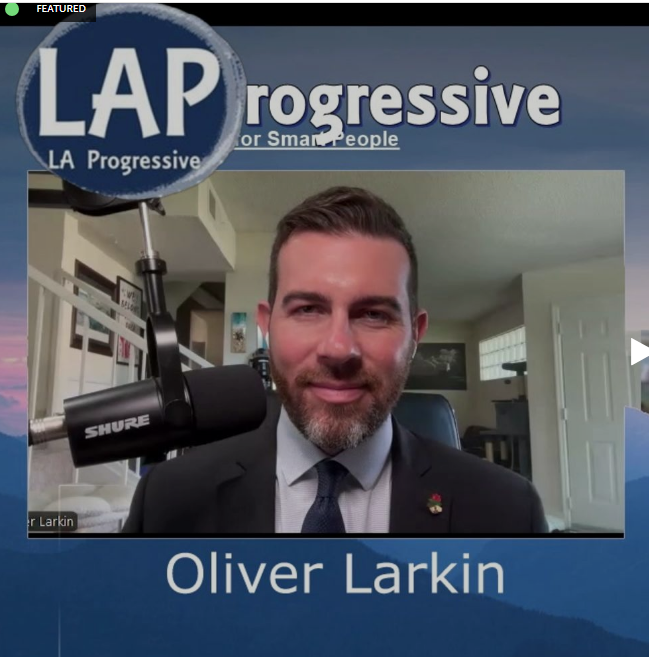
The union organizer and democratic socialist challenging Rep. Jared Moskowitz argues that Democrats cannot defeat the right by imitating it
Florida is rarely the first place progressives look for encouraging political news.
Once regarded as the nation’s most important swing state, Florida has moved sharply to the right under Republican control. Donald Trump has carried the state three times. Gov. Ron DeSantis has used it as a testing ground for attacks on public education, immigrants, LGBTQ communities, reproductive freedom and organized labor. Meanwhile, Florida Democrats have repeatedly responded to Republican victories by moving toward the political center—or further right—in hopes of winning back conservative voters.
Oliver Larkin believes that strategy has failed.
Larkin, a union organizer, activist and member of the Democratic Socialists of America, is challenging incumbent Rep. Jared Moskowitz in the Democratic primary for Florida’s newly configured 25th Congressional District.
Related stories
He is running on Medicare for All, a $25 federal minimum wage, universal childcare, paid family and medical leave, stronger labor protections and an end to private prisons. He supports abolishing qualified immunity and the federal death penalty. He also calls for ending U.S. support for Israel’s assault on Gaza and redirecting military spending toward the needs of working people at home.
For Larkin, these positions are not a political liability. They are the basis of a Democratic revival.
“We’ve gone from being a purple state—a swing state—to nominating these very conservative Democrats that adopt the Republican Party’s positions,” Larkin told LA Progressive. “And we’ve seen our state go further and further to the right.”
His argument is straightforward: Democrats will not defeat Republicans by becoming less distinguishable from them.
Larkin describes himself as a first-time candidate but a longtime organizer.
After college, he was working as a line cook for $7.25 an hour while carrying student-loan debt and watching the healthcare system fail members of his family. Inspired by Bernie Sanders’ 2016 presidential campaign, he left his job and traveled to New Hampshire as a volunteer.
That campaign gave him a political vocabulary for frustrations he had already experienced personally.
He later helped unionize his workplace with the NewsGuild-Communications Workers of America and continued organizing in South Florida, including with the Broward County chapter of the Democratic Socialists of America.
His campaign platform reflects that background. Larkin speaks less about expanding narrowly targeted assistance than about establishing universal economic rights.
“The things that we need to live the American dream” include healthcare, childcare, education, paid leave and wages sufficient to live on, he said.
Paying for those programs, he argues, requires confronting the enormous sums the United States spends on war, military contractors and support for foreign governments.
“We have to end our addiction to these endless wars overseas,” Larkin said, “so that we can reduce the cost of living here locally and return our democracy back to the power of the working class and away from the billionaires and oligarchs.”
Larkin’s campaign is not simply an ideological challenge to the Republican Party. It is also an indictment of Democrats who cooperate with the Trump administration or adopt conservative positions in the name of bipartisanship.
His target is Moskowitz, who has represented South Florida in Congress since 2023 and previously served in DeSantis’ administration as Florida’s director of emergency management.
Larkin repeatedly describes Moskowitz as a “DeSantis Democrat.”
Among his principal criticisms are Moskowitz’s participation in the congressional DOGE Caucus and his vote for the Laken Riley Act, legislation that expanded mandatory immigration detention and gave state officials greater power to challenge federal immigration decisions.
Moskowitz was among 46 House Democrats who supported the measure.
To Larkin, votes such as these reveal the danger of Democrats accommodating Trump’s agenda rather than confronting it.
“We’re seeing the direct harm that these Democrats who are working with the Trump administration are causing,” he said, pointing to federal layoffs, attacks on collective bargaining agreements and the expansion of immigration detention and deportation.
Larkin also criticizes Moskowitz for trading stocks while serving on the House Foreign Affairs Committee, including investments involving defense contractors. Moskowitz has faced scrutiny over stock-reporting violations, although he has said the trades were made by a financial adviser without his direct involvement.
The broader issue, Larkin argues, is a political system in which lawmakers may personally profit from companies affected by the policies they oversee.
“When there is this level of private profit motive in our foreign-policy apparatus,” he said, “it is going to keep happening until we have a majority in Congress that is able to stand up and draw a line in the sand.”
Florida’s congressional map has again been redrawn by Republicans, and the revised 25th District is more favorable to the GOP than the district Moskowitz previously represented.
Larkin acknowledges that Trump carried the territory encompassed by the new district in 2024. But he rejects the conclusion that Democrats must therefore nominate a centrist.
He sees the new district’s geography as an organizing opportunity.
The district now connects communities across Palm Beach, Broward and Miami-Dade counties, bringing together a multiracial electorate that includes significant Caribbean, Central American, South American and Jewish populations.
It also brings together progressive organizations and Democratic Socialists of America chapters that had previously operated in separate congressional districts.
“We have a really robust field-organizing apparatus that we’re using to contact voters,” Larkin said.
His campaign is relying on door-to-door conversations, volunteer canvassing and direct challenges to the incumbent’s voting record. Larkin says he personally knocks on doors, often campaigning in a tie and short sleeves beneath the South Florida sun.
He believes many voters—including independents—are alarmed by immigration raids, federal job cuts and the growing reach of the Trump administration.
The campaign’s task, as he sees it, is to convince those voters that the answer is not a more cautious Democratic Party.
“We need to stand up to both political-party establishments,” Larkin said, “because the Republicans have not served us and the Democrats have failed to stop them.”
Larkin’s candidacy raises a question confronting much of the American left: Can the Democratic Party be transformed, or must it eventually be replaced?
His answer is pragmatic rather than sentimental.
He recalls former Rep. Keith Ellison’s description of political parties as vehicles—useful only to the extent that they move people toward a desired destination.
For Larkin, that destination includes universal healthcare, living wages, union rights, tuition-free public education, childcare and paid leave.
“The Democratic Party can be that vehicle,” he said, “but not with the current political leadership within it.”
Larkin is not presently calling for abandoning the party. He points to the success of democratic socialists and working-class progressives who have defeated establishment-backed candidates in Democratic primaries.
But he does not believe elections or internal party reform will be sufficient by themselves.
The New Deal, he notes, was driven by organized labor. Civil-rights legislation was forced onto the national agenda by a mass movement. Women’s rights, LGBTQ rights and other democratic advances likewise required pressure generated outside formal party institutions.
“We have always needed outside pressure to bend this party,” Larkin said.
That is the role he believes unions, community organizations, social movements and the Democratic Socialists of America must continue to play.
“I’m not quite ready to break away from the Democratic Party when progressives are seeing such amazing success running within it,” he said. “But we need to be clear-eyed.”
Larkin’s campaign website originally offered detailed positions on healthcare, housing, immigration and agriculture but lacked a similarly developed criminal-justice platform.
When asked about that omission, he said the campaign planned to add one.
His stated positions are considerably more expansive than those of most Democratic congressional candidates.
Larkin supports abolishing private prisons, ending qualified immunity, passing the George Floyd Justice in Policing Act and eliminating the federal death penalty. He favors removing cannabis from the federal controlled-substances schedules and easing restrictions that impede research into the therapeutic use of psilocybin.
He also wants to eliminate what he describes as the extraction of profit from incarcerated people and their families.
The GEO Group, one of the country’s largest private prison and immigration-detention corporations, is headquartered in Boca Raton, near Larkin’s home. The company has been one of the major beneficiaries of the federal government’s expansion of immigration detention.
Larkin argues that the harms extend beyond the operation of prisons themselves. Private companies charge incarcerated people and their families for telephone calls, electronic messages, financial transfers and basic services that preserve contact with the outside world.
He has experienced that system personally.
Without identifying the incarcerated person, Larkin described receiving calls from the Broward County Jail and being required to enter credit-card information before he could speak with his loved one.
The clock began running immediately.
“You have the register running—the receipt running—for every minute that you’re spending on the phone,” he said. “It adds to the stress and the alienation.”
Family contact should be understood as a basic human need and an essential part of rehabilitation, he said—not another captive market from which corporations can extract revenue.
“The criminal-justice system currently alienates people,” Larkin said. “It isolates them, and it does not rehabilitate them.”
Larkin connects criminal justice to economic policy.
He argues that many offenses emerge from conditions of desperation: unaffordable housing, medical debt, food insecurity, job loss and the absence of a meaningful social safety net.
“When 60 percent of people are working paycheck to paycheck, one layoff, one missed day of work, one car accident or one illness could send things spiraling,” he said.
That does not mean harmful conduct should be ignored. It means the government should stop pretending that punishment can substitute for meeting human needs.
Larkin contrasts the aggressive policing of poor communities and immigrants with the comparatively weak enforcement directed at wealthy tax evaders, corporate misconduct and political corruption.
“We need to stop treating immigration like a violent crime when it is a civil infraction,” he said. “We don’t need a militarized Immigration and Customs Enforcement agency.”
ICE did not exist until 2003, he noted. Humane immigration administration existed before the agency and could exist without its present detention-and-deportation machinery.
“What we do need to see with greater enforcement,” Larkin added, “is cracking down on corruption in the highest levels of business and government.”
Larkin is unambiguous about qualified immunity, the judicial doctrine that frequently shields law-enforcement officers from civil liability unless a plaintiff can show that the officer violated a right that was “clearly established” in a closely comparable prior case.
“We need to end qualified immunity for law-enforcement officials,” he said.
Larkin slightly overstated the doctrine during the interview when he suggested that qualified immunity prevents criminal prosecution. It applies to civil lawsuits, not criminal charges. His larger point, however, was that government agents too often escape meaningful accountability for misconduct.
“We need to have one even standard of justice,” he said, “and not hold agents of the state above everyone else.”
He sees the lack of accountability surrounding police and federal immigration agents as part of the country’s broader movement toward authoritarianism.
A government that can detain, injure or kill without meaningful consequences, he argues, will inevitably use those powers more aggressively.
Larkin also supports abolition of the death penalty.
“It is far too much power for any government to have the ability to murder its citizens,” he said.
His opposition is both moral and practical. The death penalty has repeatedly produced wrongful convictions, has been imposed disproportionately against Black defendants and other marginalized groups and has proven incapable of eliminating human error.
Florida remains among the states most committed to capital punishment and has accelerated executions under DeSantis.
“It is not something that I think our nation wants on its conscience,” Larkin said.
Foreign policy occupies an unusually prominent place in Larkin’s campaign.
He describes Israel’s assault on Gaza as genocide, condemns the system imposed on Palestinians in the occupied West Bank as apartheid and supports Palestinian self-determination and equal rights.
He rejects the suggestion that foreign policy is separate from the everyday concerns of voters in South Florida.
“When we see a trillion dollars cut from Medicaid and yet we’re sending billions and billions of dollars every single year to a foreign military,” he said, voters are entitled to ask whose needs the government is choosing to meet.
The same political system that claims universal healthcare is unaffordable, he argues, routinely finds money for weapons, military contractors and war.
Larkin also links the Palestinian struggle to American racial history. Citing conversations with former Ohio state Sen. Nina Turner, one of his campaign endorsers, he compared the separate legal and political systems governing Israelis and Palestinians in the West Bank to Jim Crow.
His central demand is equal rights.
“We must uphold equal rights for all people and not have multiple tiers of citizenship,” he said. “That’s not an acceptable way for any country to behave.”
Larkin’s position places him in direct conflict with Moskowitz, a staunch supporter of Israel who has harshly criticized members of Congress calling for an arms embargo or ceasefire.
Larkin argues that Democrats’ refusal to confront U.S. complicity in Gaza is connected to their larger political failure.
Party leaders repeatedly tell voters that all other disagreements must be set aside to defeat Trump, he said. Yet that appeal failed in 2016, barely succeeded in 2020 and failed again in 2024.
The party cannot defend democracy abroad or at home while refusing to confront powerful donors, military contractors and the Israeli government, he argues.
“We have to challenge these Democrats and assert a different vision for the country,” Larkin said.
Larkin traces his political commitment to growing up in Fort Lauderdale and witnessing the effects of climate change in South Florida.
Flooding, extreme heat, rising seas and stronger storms were not abstract predictions. They were visible warnings.
He became involved in Barack Obama’s 2008 presidential campaign hoping to see bold climate legislation. When that promise went largely unfulfilled, he moved toward Sanders and a more explicitly working-class politics.
Since then, Larkin says, he has worked on campaigns, organized a union and joined local struggles supporting LGBTQ youth, opposing toxic landfills and resisting transfers of public land to luxury developers.
“I care deeply about South Florida,” he said.
That attachment is central to his case for running as an outspoken progressive in a state much of the national Democratic Party appears to have written off.
Florida’s rightward movement is not evidence that progressive politics cannot succeed there, Larkin contends. It is evidence that the political strategy pursued by state and national Democrats has failed.
The answer is not retreat. It is organization.
“We have to care about South Florida,” he said. “Florida is worth fighting for.”
The Democratic primary for Florida’s 25th Congressional District is scheduled for August 18, 2026.
Comments

Powered by RoundtableAn AI/DeFi-powered Enterprise Media Operating System. Learn more at Roundtable.io.© Roundtable 2026. By using this site you agree to the Terms of Use and Privacy Policy