


Democracy Is Threatened
May 11, 2024 4:00 PM
The fact that more than twice as many Republicans than Democrats listed “Values” as their top concern reflects a serious error that Democrats have made.
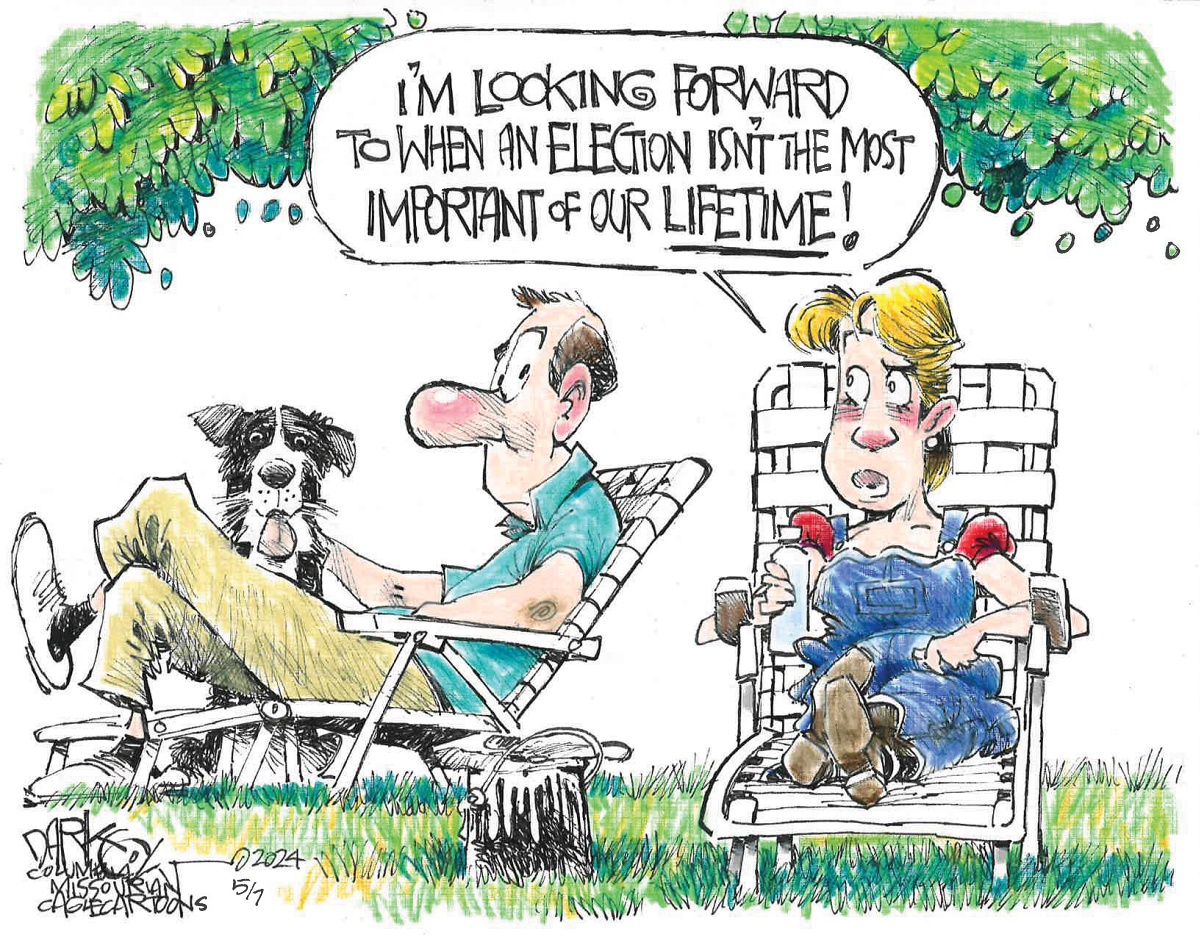
In late April 2024, a NPR/PBS NewsHour/Marist Poll asked U. S. citizens, “ From this list, which one of the following concerns you most about the United States´ future.” Among those who said they were “definitely voting in November's Election,” the top three answers were 1)“Fascism and Rise of Extremism”; 2) “Values”; and 3) “Becoming Weak As a Nation.” 35 % (47 % of Dems, 14% of Reps, 15% of Inds) chose #1. 24% (14 % of Dems, 36% of Reps, 24% of Inds) chose #2. And 21% (11 % of Dems, 30% of Reps, 11% of Inds) chose #3. No other choice (there were four other ones) climbed above 9%.
These top three choices and the political identifications (Dem, Rep, or Ind) of those who made them tell us a great deal. Almost half of polled Democrats are very worried about “Fascism and Rise of Extremism,” and without a doubt they see this danger springing primarily from Donald Trump.
The fact that more than twice as many Republicans than Democrats listed “Values” as their top concern reflects a serious error that Democrats have made: they have allowed Republicans to monopolize caring about the issue. Already in 2006, future President Obama recognized the problem in his book The Audacity of Hope, where he wrote, “I think that Democrats are wrong to run away from a debate about values. . . . [They] should be the heart of our politics.”
In 2010 I quoted these words in “Health Care Reform and Liberal Values,” which also stated, that values like “compassion, tolerance, pluralism, and rationality helped bring about some of the great human rights advances of the last century. And it is liberals, not conservatives, who were in the forefront of battling for these gains.”
Related stories
Since that time I have often mentioned the importance of values, for example in the LA Progressive essay "Conflicting Values Key to Political Differences" (Dec. 2022). It stressed such values as tolerance, empathy, humility, rationality, kindness, and optimism. It mentioned Donald Trump’s lack of respect for the value of truth. And it concluded that “Democrats and progressives should welcome any debate about which sides’ values would better serve our beleaguered nation.”
One other poll that needs citing is a recent one conducted by the Pew Research Center. In it only 69% of voters said “it really matters which candidate wins the presidential contest this November.” Four years ago, 74% thought it mattered in the 2020 election.
Is it really possible that less voters today, compared to four years ago, think it matters whether we elect Trump or Biden? Four years ago Trump’s refusal to accept 2020 election results was still in the future. So too was his encouragement of Jan.-6-2021 attackers on the U.S. capitol building. Ditto for all his recent signals that regaining power is more important to him than maintaining U. S. democracy; all his recent authoritarian rants; all the warnings that too many Republicans and other disrespectors of democracy are willing to follow him; and all the signs, some of them coming from conservatives and a minority of Republicans, that he could undermine our democratic traditions.
Let’s look at some of these recent indicators that if elected in 2024 he intends to be authoritarian, not democratic—fascistic is a more complex matter, depending in part on one’s definition of the term. (See Andrew Marantz’s “Why We Can’t Stop Arguing About Whether Trump Is a Fascist” in a March, 2024 New Yorker issue.)
Perhaps most revealing is an April-2024 interview Trump gave to Time magazine. It was conducted by reporter Eric Cortellessa, who also spoke with many top Trump advisers and provided his view of the experiences in a piece entitled “How Far Trump Would Go." What follows (in quotes) are some of his conclusions.
Using the U.S. military, Trump “would carry out a deportation operation designed to remove more than 11 million people from the country,” and “he would let red states monitor women’s pregnancies and prosecute those who violate abortion bans.” Perhaps most alarming are his plans for reducing the checks and balances that normally limit a president’s powers, especially regarding law enforcement and Department-of-Justice autonomy.
Trump “would be willing to fire a U.S. Attorney who doesn’t carry out his order to prosecute someone, breaking with a tradition of independent law enforcement that dates from America’s founding.” He has indicated that he would “appoint a ‘real special prosecutor’ to go after Biden,” and “he is weighing pardons for every one of his supporters accused of attacking the U.S. Capitol on Jan. 6, 2021, more than 800 of whom have pleaded guilty or been convicted by a jury.” Moreover, he would “deploy the National Guard to American cities as he sees fit. . . . possibly without the request of governors.” Cortellessa believes that “such moves” would have “potentially catastrophic” consequences for maintaining any tradition of equal justice.
The interviewing reporter also writes much about Trump’s foreign policy views and mentions his fondness for Vladimir Putin and other “authoritarian leaders like President Xi Jinping of China, Prime Minister Viktor Orban of Hungary, or former President Jair Bolsonaro of Brazil.” But this essay will continue its focus on domestic developments, emphasizing particularly the growth of Trump support since 2016, but also indicating growing warnings of Trump authoritarianism and why more potential voters are not more alarmed.
During Trump’s presidency (2017-2021) he was limited somewhat by those who surrounded him in the executive branch and by certain members of Congress. In interviewing Trump, Cortellessa noted that some of his former Cabinet officials “refuse to endorse” him this time. Trump admits that’s true, but all signs are that if elected again, he’ll appoint only “yes men” and women.
When he assumed the presidency, Mitch McConnell (R) was the Senate Majority Leader and Paul Ryan (R) the Speaker of the House of Representatives. Both men thought that once in office Trump would begin acting more like a traditional Republican. McConnell, now Minority leader, said that he was “confident that Trump would change, that they would change Trump, that they were the mainstream conservative[s] and Trump would adapt to that.” Ryan, no longer in Congress, has recently stated that he won’t vote for Trump in 2024—“all of his tendencies are basically where narcissism takes him, which is whatever makes him popular, makes him feel good in any given moment.”
Ryan thus joins a small, but significant number of Republicans and/or conservatives, who have turned against Trump, many of them alarmed at his character defects and authoritarian tendencies. They include former members of Congress like Sen. Jeff Flake (AZ) and Rep. Liz Cheney (WY), as well as present Sen. Mitt Romney (UT); retired-federal-judge J. Michael Luttig; and many conservative journalists such as David Brooks and Michael Gerson.
Trump’s authoritarianism could combine with structural weaknesses—such as our electoral-college predominance that makes it possible for a candidate to loose the popular vote and still become president—to decrease our democratic practices. In their 2023 book, Tyranny of the Minority: Why American Democracy Reached the Breaking Point , authors Steven Levitsky and Daniel Ziblatt identify some of these deficiencies. And Levitsky has been quoted as expressing “significantly more” concern about the future of American democracy since Trump has ramped up his anti-democratic behavior.
Another recent cause for concern is that various Trump supporting groups with authoritarian leanings are already planning anti-democratic moves if he is elected. The Heritage Foundation’s Project 2025 is often mentioned. According to the admittedly leftist leading Media Matters, “its extreme agenda represents a threat to democracy, civil rights, the climate, and more.” But PBS Newshour’s regular Friday night liberal commentator, Washington Post associate editor Jonathan Capehart, recently stated that “what was most chilling” to him was the discovery that the Heritage Foundation is only “one of four groups out there right now that are who are planning for a Trump 2.0 administration, taking on various aspects, so that, if he does indeed win election in November . . . he will be able to get a whole lot of things done, because they will have figured out where the guardrails are, how to remove them, how to remove the people who . . . who would stand in the way of things that they want to do.”
Finally, we turn to why more U. S. citizens are not more alarmed at the prospect of a second Trump term. One explanation would quote Al Gore’s The Assault of Reason (2007): “Why do reason, logic and truth seem to play a sharply diminished role in the way America now makes important decisions?” And, “The persistent and sustained reliance on falsehoods as the basis of policy, even in the face of massive and well-understood evidence to the contrary, seems to many Americans to have reached levels that were previously unimaginable.” This seems even more true today.
But to quote a more up-to-date source, let’s turn to a neoconservative, who has often been criticized by liberals and progressives—Robet Kagan. In late April, he contributed an opinion piece to The Washington Post. His explanation for why not enough citizens care about maintaining our democracy? “Too many no longer care enough whether the system the Founders created survives and are ceding the ground to those, led by Trump, who actively seek to overthrow. . . . the unique political system established by the Founders based on the principles of universal equality and natural rights. That, plain and simple, is what this election is about.”
Kagan makes many good points, and his article should be read in its entirety, but especially on target is his observation that “many of Trump’s core supporters insist they are patriots, but whether they realize it or not, their allegiance is not to the Founders’ America but to an ethnoreligious definition of the nation [the supremacy of white Christians] that the Founders explicitly rejected.” Kagan ticks off why many groups including CEOs of major corporations may support Trump, and he asks “about the average Republican voter.” But he feels such voters may think “their narrow interests are served by a Trump victory, and although they may not be Christian nationalists themselves, their views as White Americans make them sympathetic to the complaints of the anti-liberals.”
Another citizen like Kagan with a complicated political past, once a Republican, but strongly opposed to Trump is Tom Nichols, a staff writer at The Atlantic and the author of the 'Atlantic Daily' newsletter. In an early May edition of the latter, he wrote about two “important reasons that many people are not taking Trump seriously enough.” One is “Americans don’t pay attention to politics, and when they do, they frequently blame the current president for whatever is going wrong in their lives.” A second reason is that “Americans simply cannot imagine how badly Trump’s first term might have turned out, and how ghastly his second term is likely to be. Our minds are not equipped to embrace how fast democracy could disintegrate.” (I have frequently written about the paucity of imagination in public life and quoted such writers as Wendell Berry—e.g., we need “the creative imagination rushing in where bureaucratic angels fear to tread—without this, life is a mockery and a disgrace.”)
Nichols ends his newsletter with the following words. “Trump’s most alarmist opponents are wrong to insist that he would march into Washington in January 2025 like Hitler entering Paris. The process will be slower and more bureaucratic, starting with the seizure of the Justice Department and the Defense Department, two keys to controlling the nation. If Trump returns to office, he will not shoot democracy on Fifth Avenue. He and the people around him will paralyze it, limb by limb. The American public needs to get better at imagining what that would look like.”
These words appeared in early May, 2024. We still have six months to insure that they do not become prophetic.
Comments

Powered by RoundtableAn AI/DeFi-powered Enterprise Media Operating System. Learn more at Roundtable.io.© Roundtable 2026. By using this site you agree to the Terms of Use and Privacy Policy