
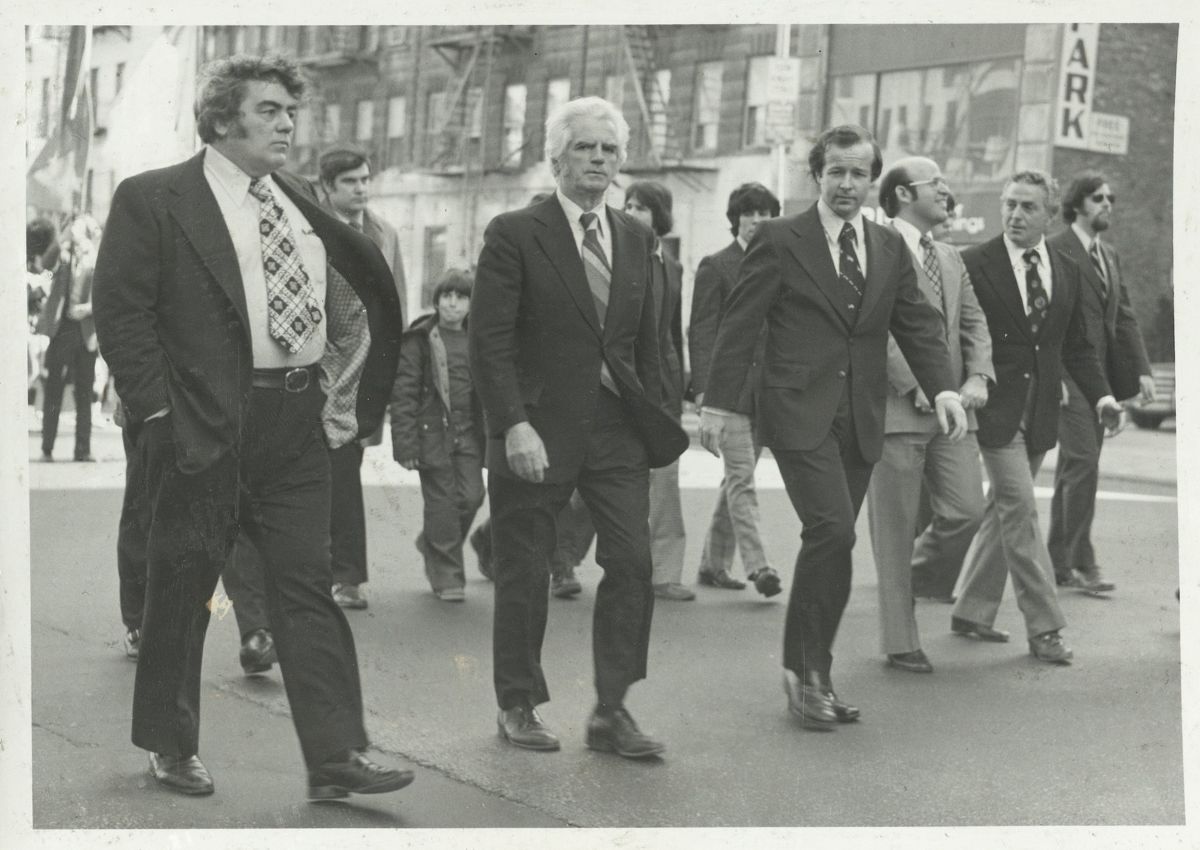
Paul O'Dwyer walks in late February, 1976, memorial march in New York for Frank Stagg, a Provisional IRA member from County Mayo who died on hunger strike in Wakefield Prison in England that February. To O'Dwyer's right is columnist Jimmy Breslin; to his far left are Bronx borough president Robert Abrams and Bronx congressman Mario Biaggi. (Credit: The Irish People Collection at the IUPUI University Library.)


Churlish U.S. Political Arena
Jun 26, 2024 3:58 PM
Updated Jun 26, 2024 7:03 PM
New media sites, misinformation, and demagoguery have diminished the willingness of national politicians to treat opponents as fellow human beings or to take account of their perspectives
Is civility in American politics dead? If not, then it’s surely on life support, with Donald Trump jeering over the wounded body.
Republican candidates take his cue, meting out personal insults against rivals. And in anticipation of the two televised presidential debates, Joe Biden and Democrats have been less inclined to turn the other cheek.
But our cringe-worthy political arena won’t be tamed by the debates’ microphone muting rules. The climate cannot really be blamed, either, on the convictions of Trump in the Stormy Daniels matter and Biden’s son Hunter on drug charges—nor even on decades of interacting global disruptions, whether pandemics or invasions. Though the decade of the ’70s featured the Vietnam War, Watergate, Middle East conflicts, and inflationary oil shocks, the levels of vituperation in the political discourse then were not even close to what they are today.
The difference is that new media sites, misinformation, and demagoguery have diminished the willingness of national politicians to treat opponents as fellow human beings or to take account of their perspectives. Lost in the often-infantile din are chances for a serious, sustained back-and-forth on pressing issues, whether migration, inflation, or extreme weather. Insults crowd out possibilities for light or, heaven forbid, a middle ground.
Related stories
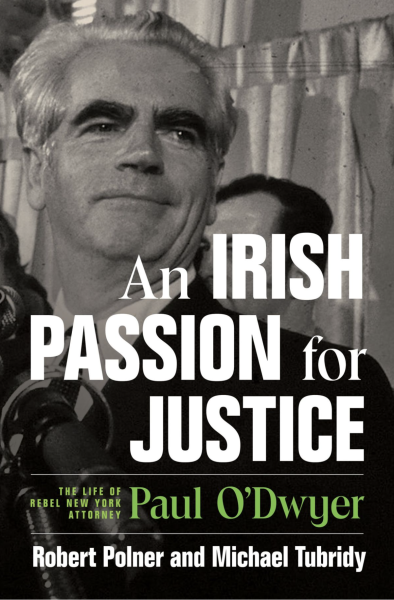
We’re certain that this dismal state of affairs would have dismayed the subject of our newly published biography, An Irish Passion for Justice — the late Paul O’Dwyer. An Irish-born New Yorker of the left in the 20th century, he ran for the House and Senate when, with the notable exception of the wild-firing Joe McCarthy, politicians were expected to talk about issues in some depth and avoid character assassination.
The erudite columnist Murray Kempton characterized O’Dwyer, a Democrat, as a “kindly radical,” and it summed him up aptly, barring the occasional flash of disgust when someone insulted the memory of his brother, Bill, New York City’s mid-20th century mayor.
In keeping with a more decorous era that now feels like very long ago indeed, the younger O’Dwyer (he died in 1998 at age 90) made alliances across the political spectrum, traded letters with those with whom he differed—William F. Buckley Jr., to name one—and sought out Republican support for his most sought-after goal, to end the sectarian conflict in Northern Ireland known as The Troubles.
Whether decrying via a microphone the Nixon administration for the 1970 secret invasion of Cambodia, or the editors of The New York Times through a bullhorn for ignoring the notorious 1989 murder of prominent Catholic human rights lawyer in Ulster, O’Dwyer’s objections remained rooted in policies and practices, not personalities, and would never have fitted into today’s venomous politics.
The slide into childish name-calling was not as sudden as it might sometimes seem.
Because a largely respectful style of debate still prevailed on the national stage, for instance, a 1968 on-air tussle between Gore Vidal and Buckley, in which the liberal novelist called the Conservative oracle a “crypto-Nazi” and Buckley termed his detractor a “queer,” drew notoriety. Yet it seems almost tame by the standards of today’s moment-by-moment traffic in falsehoods, name-calling, click bait, racial fear-mongering and personal grievance.
And its nearest antecedent, aside from McCarthy’s anti-communist witch hunt centered in 1950’s Washington, could perhaps be Richard Nixon’s derision of his 1950 Democratic Senate opponent Helen Gahagan Douglas as “pink all the way down to her underwear.”
President Nixon’s speechwriter John McLaughlin further toxified modern political discourse with his strikingly original “The McLaughlin Group,” a TV show that traded in the traditional Sunday morning discussion panel for a pugilistic format of tirades, shouts and insults.
Pat Buchanan, a frequent guest on the weekly catfight (and a former Nixon speechwriter himself), proposed to fellow conservatives deprived of their longtime Communist foes a new “cultural war…for the soul of America” as a Republican candidate for the White House in 1992.
Soon enough came the anti-liberalism fulminations of Rush Limbaugh on right-wing talk radio, as well as the evolution of Fox News into conservative agitprop for millions of TV viewers.
The potential for actual violence threatened to rise when Republican House member Randy “Duke” Cunningham of California’s 50th District remarked in 1992 that the Democratic leaders should be “lined up and shot.” In the Jan. 6, 2021, Capitol attack, makeshift gallows and chants of “Hang Mike Pence” rang out amid the chaos that followed Trump’s unsupported claims that his defeat in the just-concluded presidential election was fraudulent.
If Trump embraced churlishness by tagging his Republican opponents with schoolyard epithets at nationally televised debate forums in 2016 (“Little Marco Rubio” was just one, eliciting Rubio’s disparagement on the size of Trump’s hands) verbal abuse has reached high-tide flooding because far too many candidates, in both parties, have discovered that castigating rivals crudely can be a ticket to media attention and a winning strategy.
No single presidential debate will curb that dynamic, since it draws voters’ eyes just as sure as a car wreck brings rubbernecking. But the behavior will eventually moderate if enough voters are willing to punish the perpetrators at the polls, rewarding reasonableness over pettiness and giving our fragile democracy a chance to persevere.
This article first appeared in The Irish Echo.
Comments

Powered by RoundtableAn AI/DeFi-powered Enterprise Media Operating System. Learn more at Roundtable.io.© Roundtable 2026. By using this site you agree to the Terms of Use and Privacy Policy