


May 1, 2025 4:04 PM
Updated May 1, 2025 9:19 PM
Centrist Liberal win comes at the cost of progressive New Democratic Party’s future.
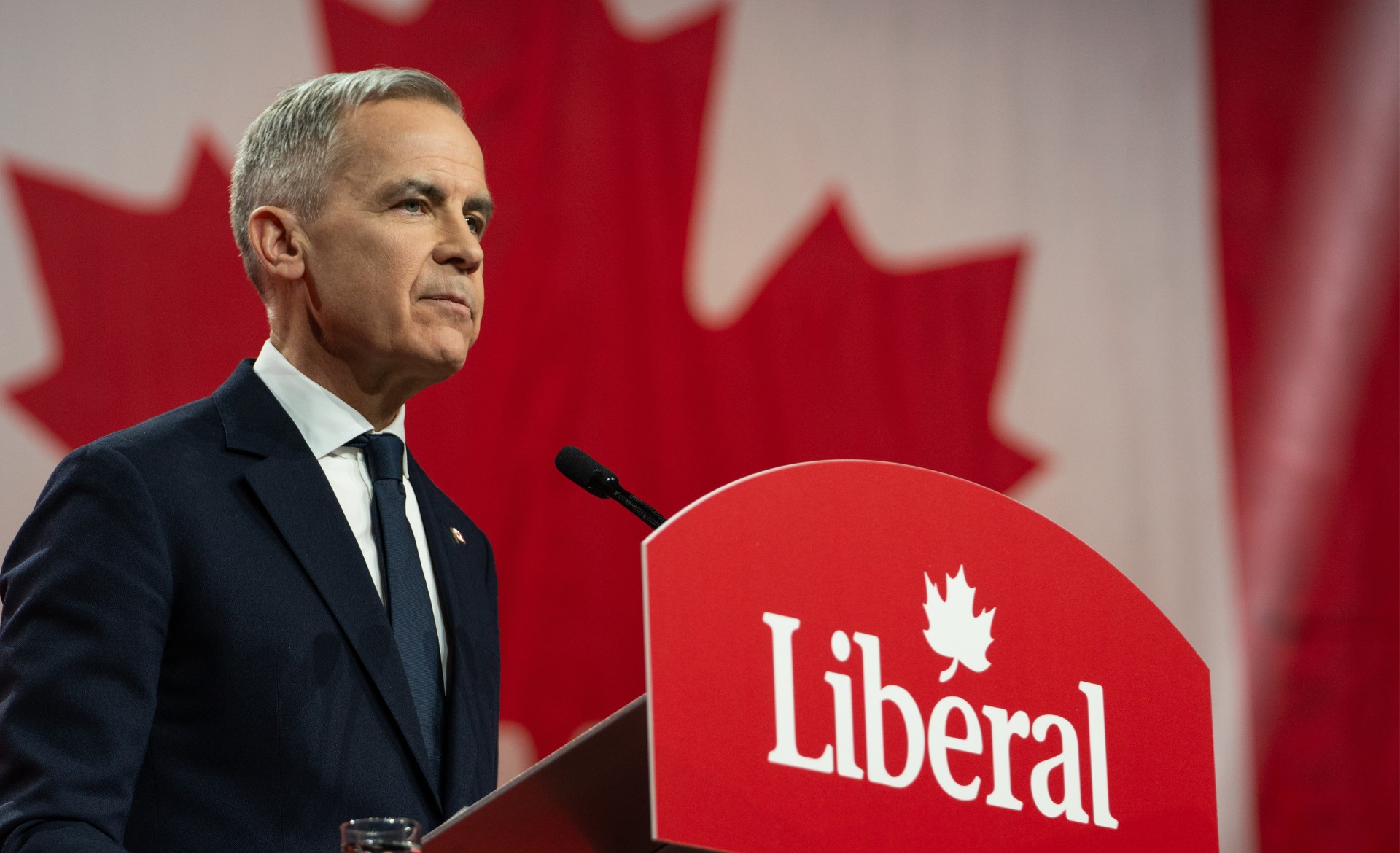
Canadian federal elections normally draw little international attention. But this week’s was different. In the wake of U.S. President Donald Trump’s threats against the country’s sovereignty and imposition of crippling tariffs, much was at stake. With 68.7 percent voter turnout, the highest in three decades, Canadians beat back “MAGA Maple” conservatives to elect Liberal Prime Minister Mark Carney, to the relief of many.
Congratulations poured in from around the world. Leaders of France, the United Kingdom, the Netherlands, Ukraine, Australia, Chile, NATO, the European Commission, and the United Nations all lauded Carney’s victory in statements that made reference to global challenges, shared democratic values, free and fair trade, principled leadership, and international rule of law.
On social media, regular Americans—presumably non-MAGA ones—thanked Canada profusely for standing up to a bully. Quipped humorist Leslie Gaar: “Canada is the friend who deals with a midlife crisis by going to therapy, giving up booze, and finding a healthy partner. Meanwhile, we took up meth, got back with our toxic ex, and are currently driving our cybertruck off a cliff.”
Vermont Sen. Bernie Sanders characterized Trump as the election loser, saying “It only took 100 days for you to convince Canadians that the far right has no place in government.” Indeed, Trump acknowledged his role in the election. But he viewed the Liberals’ victory as a win, since the candidate that hated him the least prevailed.
Related stories
Democracies in peril
Perhaps one of the reasons Canada is now such a beacon of progressive inspiration is that democracies around the world are becoming a threatened species. By the Visual Capitalist website’s estimate, less than 7 percent of countries around the world are full democracies. Except for Canada, the vast majority of full democracies are in Europe. The U.S. is currently labeled a flawed democracy, however if things continue as they are going, it could well join the 39.2 percent of countries classified as authoritarian regimes.

Canada’s election represented a breathtaking turnaround for the Liberal Party. Just months ago, the right-wing Progressive Conservative Party, led by Pierre Poliviere, was considered a slam-dunk to win a majority government. Former Liberal Prime Minister Justin Trudeau, elected in 2015, had become deeply unpopular with Canadian voters. Trudeau was also deeply unpopular with Trump, who gleefully called him “Governor Trudeau,” in reference to the threat to make Canada the 51st state. Despite repeated calls for Trudeau to step down, he lingered well beyond his expiration date until deciding to resign in January.
Trump is a shrewd master strategist, at least in his own mind. Rather than convincing Canadians to join the U.S. like placid sheep, as he apparently expected, his threats unified the country like nothing before. Canadian flags were suddenly everywhere, U.S. goods were boycotted, and Canadians stopped traveling south of the border, causing an estimated $6 billion hit to the U.S. travel industry. Canadians’ anger and determination was on full display as its men’s team beat the U.S. team in Canada’s national sport, hockey. It continued all the way to the ballot box.
Carney made the threats against Canada’s sovereignty the centerpiece of his campaign, while Poliviere, once considered a shoo-in, struggled to pivot and distance himself from the wannabe dictator to the south. It didn’t help that Trump, ever eager to insert himself in other countries’ affairs, declared he’d rather work with Carney than Poliviere.
Strong minority government vs majority
The Liberal Party led by Carney succeeded in winning 169 seats to the Progressive Conservative Party’s 144. Under the parliamentary system, that entitles the Liberal Party to form a minority government. With three more seats, it would have been able to form a majority government. As a minority government, the Liberals will have to join with another party to govern, as they did with the NDP during the Justin Trudeau years.
In a surprising turn of events, Poliviere lost the seat he’d held for two decades. Parliamentary rules allow him to run in a by-election a year from now, providing he can convince a colleague to give up their seat. Popular with his base, Poliviere vows to stay on as leader of the Progressive Conservatives until then.
Although many applaud the Liberals’ success at holding back the forces of conservatism, it came at a steep cost—the near-total collapse of the more progressive New Democratic Party. Almost across the board on election night, NDP candidates came in distant third to Liberal and Conservative candidates. By the time the carnage was over, the NDP held only seven seats, making it unable to qualify as an official party. Among the 17 lost was the British Columbia seat NDP Leader Jagmeet Singh had held since 2019.
The near-annihilation of a once-strong political party has Canadians concerned. Parliamentary systems normally feature multiple parties representing the full ideological spectrum. Among Canada’s 16 registered parties are the Animal Protection Party, the Green Party, the Marijuana Party, and the Christian Heritage Party. The idea is that multiple parties provide more democratic options, and allow for flexibility as times change.
In this week’s election, the NDP lost many longtime party stalwarts as NDPers “lent their votes” to the Liberals to keep the Conservatives from power. In terms of the popular vote, support for the NDP declined by 11 percent, about the same percentage by which Liberal votes increased. Votes for the Conservative Party, meanwhile, increased by 7.5 percent, while support for the Green Party and Block Quebecois declined by about 1 percent each.
Following the U.S.’s lead
Pundits on national broadcaster CBC seemed troubled that the two main political parties were duking it out at the smaller parties’ expense. They used the word “polarization” frequently. The worry, they said, is this is what elections look like in the United States. And if Canadians know anything, it’s that they don’t want to be Americans.
But the forces that propelled Trump into office, not once but twice, do not respect borders. As in the U.S., conservatives have focused on jobs and cost-of-living issues to connect with the workers that traditionally supported the Liberals and NDP. Oil-rich Alberta and other parts of Canada’s West are staunch conservative strongholds akin to the U.S.’s Texas and Midwest. This time around, conservatives even made gains in the suburbs of Toronto.
Canada’s federal election outcome will certainly result in much soul-searching, as the left-wing NDP licks its wounds, and the right-wing conservatives figure out how to win text time. For the time being, however, the center holds.
Comments

Powered by RoundtableAn AI/DeFi-powered Enterprise Media Operating System. Learn more at Roundtable.io.© Roundtable 2026. By using this site you agree to the Terms of Use and Privacy Policy