


May 17, 2026 4:41 PM
Updated May 17, 2026 7:58 PM
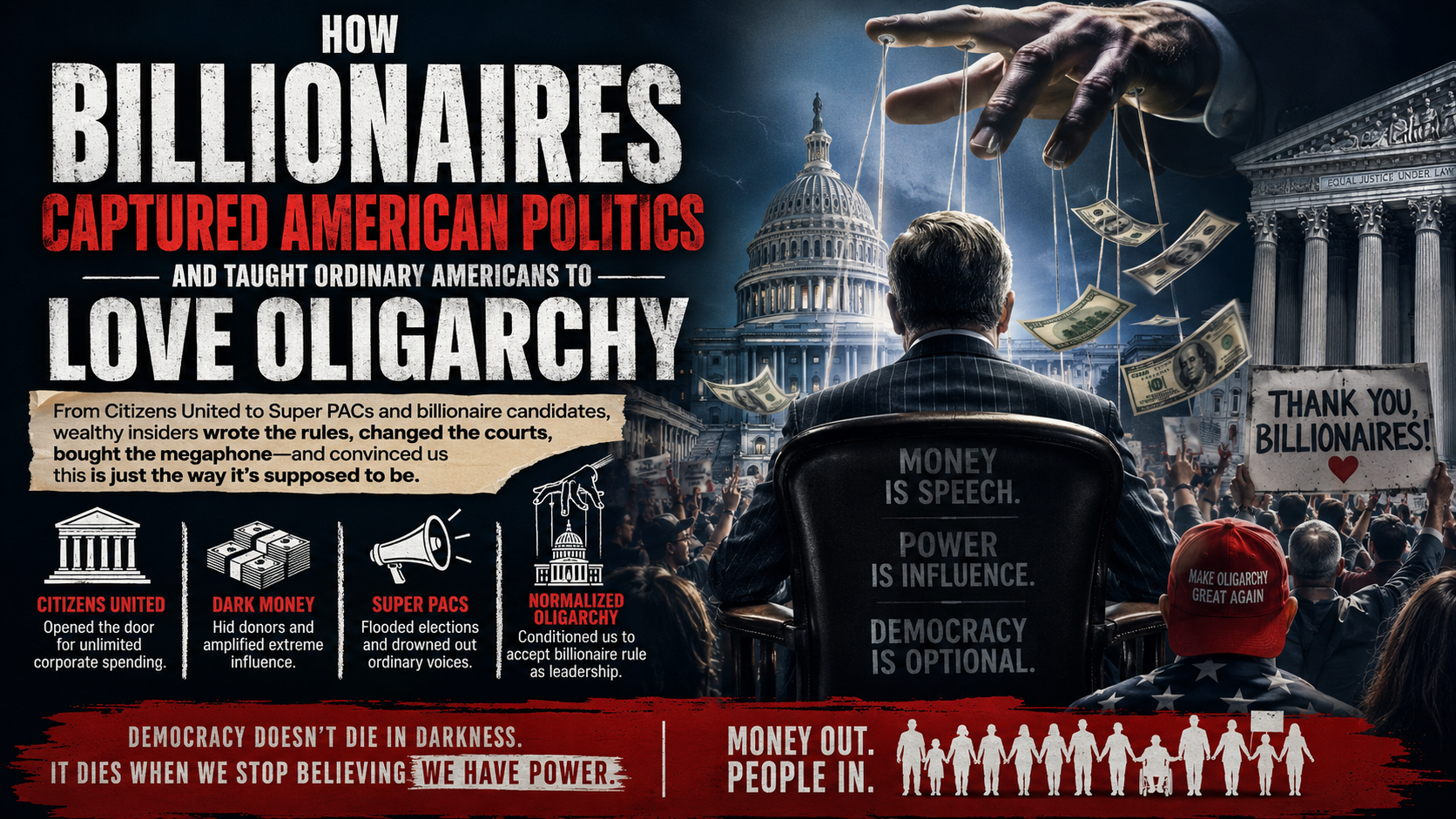
From Citizens United to Super PACs and billionaire candidates, America’s political system has steadily normalized concentrated wealth, weakened democratic accountability, and conditioned citizens to view oligarchs as saviors rather than threats to democracy.
Around the time Citizens United v. Federal Election Commission was decided, the slogan “Money Out, People In” became a rallying cry throughout progressive movements across the country. The phrase captured a growing public alarm that American democracy was being overwhelmed by concentrated wealth and corporate political influence.
In California, that sentiment eventually found expression in ballot-measure activism and constitutional amendment campaigns aimed at overturning Citizens United and restoring limits on money in politics. One of the most visible efforts was California Proposition 59, which asked California voters whether elected officials should use all of their constitutional authority to overturn Citizens United through a constitutional amendment or other means.
Proposition 59 passed overwhelmingly, signaling broad public frustration with the growing power of wealthy donors, Super PACs, and corporate money in American elections.
How time changes things...
Related stories
This articles tells a story many Americans still struggle to fully see. It is the story of how the United States moved, step by step, away from democratic accountability and toward oligarchy—a system in which wealth itself is understood and accepted by the people as political power.
The progression did not happen overnight. Nor did it happen through a military coup. It happened through law, culture, media normalization, and the gradual merging of economic power with political authority.
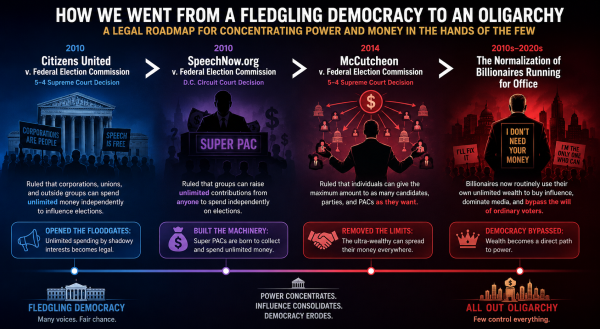
Three court decisions accelerated this transformation:
- First came Citizens United v. Federal Election Commission, which allowed corporations and outside groups to spend unlimited money influencing elections under the theory that money is protected speech.
- Then came SpeechNow.org v. Federal Election Commission, which created the legal architecture for Super PACs capable of raising unlimited sums from billionaires and corporate interests.
- Finally came McCutcheon v. Federal Election Commission, which further dismantled limits on political giving by wealthy individuals.
Together, these decisions normalized a dangerous idea: that extreme wealth should carry extreme political influence.
But the problem did not stop at campaign donations.
Over time, the country also normalized billionaires themselves running for office and using their personal fortunes as political weapons. The message embedded in this shift is subtle but corrosive: democracy no longer belongs to organized citizens; it belongs to those wealthy enough to dominate attention, media ecosystems, and political infrastructure.
This transformation helps explain why ordinary Americans increasingly feel politically powerless.
One of the most important pieces of research on this subject came from political scientists Martin Gilens and Benjamin Page. Their landmark study found that average citizens have little independent influence on federal policy outcomes when compared to economic elites and organized business interests. In other words, public opinion alone often does not drive national policy. Wealth does.
That is not democracy functioning properly.
History repeatedly shows that concentrated power tends to produce entitlement, rule-breaking, and disregard for democratic norms.
And when wealth becomes insulated from accountability, the behavior of elites often changes. History repeatedly shows that concentrated power tends to produce entitlement, rule-breaking, and disregard for democratic norms. Democracy depends on guardrails. Oligarchy begins when wealth becomes powerful enough to ignore them.
The behavior of Donald Trump illustrates this danger vividly. Trump’s repeated disregard for legal constraints, institutional norms, conflicts of interest, and democratic guardrails reflects more than individual personality flaws. It reflects a broader culture in which extreme wealth and celebrity create a sense of exemption from ordinary accountability.
The deeper danger is psychological.
Americans have increasingly been trained to look upward for salvation—to billionaires, celebrity entrepreneurs, wealthy candidates, and “strong men” who claim they alone can fix the system.
But democracies do not survive because wealthy heroes rescue them.
Democracies survive when ordinary people build civic capacity together. They survive through labor organizing, local participation, independent media, neighborhood institutions, voting rights protections, public accountability, and collective action.
A functioning democracy requires citizens, not saviors.
The central lesson of this moment is not merely that money has corrupted politics. It is that Americans must relearn how to operate as a democratic people rather than as spectators waiting for wealthy elites to solve problems they often helped create.
Concentrated wealth has largely failed to address the environmental damage produced by the economic system from which that wealth emerged. Despite decades of warnings about climate change, pollution, habitat destruction, and ecological instability, the incentives driving extreme wealth accumulation have too often prioritized short-term profit over long-term planetary sustainability.
That reality leaves the responsibility with the public.
Real environmental change will not come from waiting for billionaire benevolence. It will come from organized democratic pressure strong enough to force institutions, corporations, and political leaders to act in the public interest.
We may have democracy, or we may have wealth concentrated in the hands of a few, but we cannot have both. - Supreme Court Justice Louis Brandeis
The billionaire class may possess enormous financial power, but collective civic power is ultimately greater—if people choose to use it. Democracies weaken when citizens begin surrendering their agency and imagining themselves as powerless before concentrated wealth.
If we want to repair the damage—to our democracy, our economy, and our environment—we have to stop relinquishing our power and start exercising it together.
Supreme Court Justice Louis Brandeis said, “We may have democracy, or we may have wealth concentrated in the hands of a few, but we cannot have both.” On the matter of democracy, no truer words have been spoken.
Here is a list of books that offer additional insight:
- Democracy in Chains by Nancy MacLean
- Plutocrats United by Richard Hasen
- Minority Rule by Ari Berman
- Dark Money by Jane Mayer
Comments

Powered by RoundtableAn AI/DeFi-powered Enterprise Media Operating System. Learn more at Roundtable.io.© Roundtable 2026. By using this site you agree to the Terms of Use and Privacy Policy