


Jun 16, 2017 10:59 PM
Updated Mar 8, 2024 4:36 PM
John Peeler: The closest parallel to this half century of increasingly intense conflict lies in the decades before the Civil War. May we find the resources to avoid a repeat of that tragic, bloody conflict.
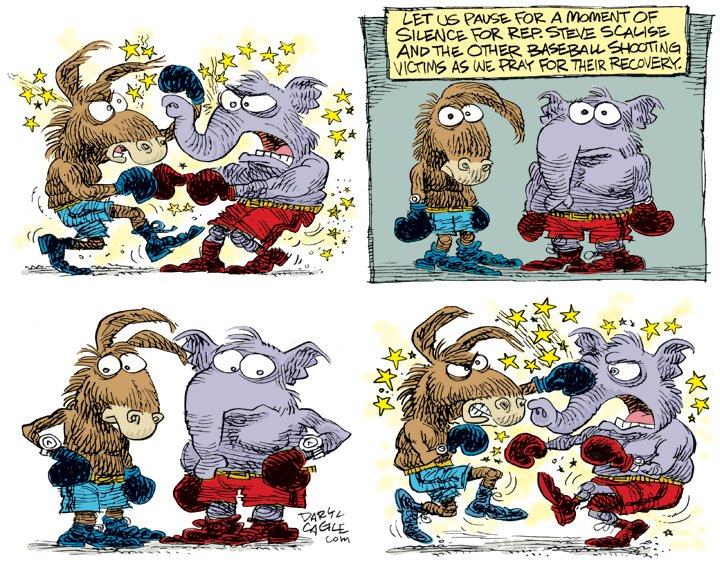
After a dispiriting series of bloody right-wing assaults since the campaign, we finally have one committed by a Sanders supporter: the shooting of Majority Whip Steve Scalise and several others at a baseball field in Alexandria.These assaults by crazy people pose the question whether political polarization has gone too far.
The roots of polarization go back a long way.One place to start is the Republican sweep of 1994, led by Newt Gingrich and the famous “Contract with America,” a program that sought to dismantle much of the old Great Society.But we can probably take it all the way back to the Civil Rights and Great Society programs of Lyndon Johnson.That period marked the decisive takeover of the Democratic Party by its northern, urban, liberal wing, and the corresponding migration of Southern whites to the Republican Party.The Republicans became more homogeneously conservative; the Democrats, liberal.
From this perspective, the intense partisanship of the 21st century is just the culmination of a trend, and the 2016 campaign and the early Trump presidency the apotheosis of that trend.The closest parallel to this half century of increasingly intense conflict lies in the decades before the Civil War.May we find the resources to avoid a repeat of that tragic, bloody conflict.
The closest parallel to this half century of increasingly intense conflict lies in the decades before the Civil War.May we find the resources to avoid a repeat of that tragic, bloody conflict.
The issues between the parties—or between distinct segments of the nation—are perhaps not as stark as the issue of slavery, but are nonetheless fundamental.Liberals and the Left increasingly demand and work toward a society of growing openness and inclusiveness, in which inequality is minimized and capitalist excesses are controlled.
Related stories
Conservatives and the Right increasingly demand and work toward a society that respects and protects the traditional values of rural white America, maintains social hierarchy, and reduces regulation of the economy.
The Left recognizes global warming as a fundamental threat to human civilization; the Right is at least skeptical, if not in complete denial.
The Left tends to be skeptical of military action abroad (though not unanimously or consistently so); the Right favors a strong military and tends to favor intervention abroad (though not unanimously or consistently so).
These issues are basic: they have to do with what kind of society we are to be, and the visions are not consistent.Can we survive as a democracy where our side wins some elections and loses some, when the stakes are so fundamental?Can we survive as a civil society able to work together on common problems, when our differences are so deep?
It won’t be easy.It’s obvious that we must be dedicated to protecting individual rights, especially for those with whom we disagree.It’s obvious that we need to protect and respect the integrity of our elections, whatever the outcome.It’s less obvious just what that would mean, what with Republican obsession with voter fraud, and Democratic outrage about gerrymandering and other manipulation.Can we, finally, agree on what constitutes electoral integrity?
A really hard change for both sides will be to stop personalizing their differences.Republicans demonized Bill and Hillary Clinton, Democrats, George W. Bush, Republicans, Barack Obama, and now, of course, the Democrats are all over Donald Trump.For people who are into politics, this is one of the things that makes it fun, but if there’s one thing that sets a climate for political violence by the unhinged, this is it.
Democracy entails a great paradox that we need to embrace: we must boldly defend our ideas and vigorously criticize those of our opponents, while admitting that we might be wrong.
John Peeler
Comments

Powered by RoundtableAn AI/DeFi-powered Enterprise Media Operating System. Learn more at Roundtable.io.© Roundtable 2026. By using this site you agree to the Terms of Use and Privacy Policy