

Henk Sijgers • Attribution-NonCommercial (CC BY-NC 2.0) • Flickr


Apostolic Reformation
Oct 7, 2024 5:11 PM
Most progressives support Harris, but if we look back at the Progressive movement of the 1890-1914 period, we see a strong religious influence.
Although my "Christian Nationalism is an Oxymoron" was posted earlier on LA Progressive (LAP), a new postscript to it is now needed. "The Violent Take It By Force: The Christian Movement That Is Threatening Our Democracy" has just appeared, and it spells out how one branch of that movement especially is a threat to our political tradition. The author is Matthew Taylor, a scholar at the Institute for Islamic, Christian, and Jewish Studies, which is a nonprofit organization devoted to advancing interreligious dialogue and understanding. He has also co-authored several articles with Bradley Onishi, who was discussed extensively in the “Oxymoron” essay mentioned above. And like Onishi he comes from a Protestant evangelical tradition, but then came to criticize a branch that now vigorously supports Trumpism. (Taylor grew up in Southern California, but then earned a Ph.D. in religious studies from Georgetown.)
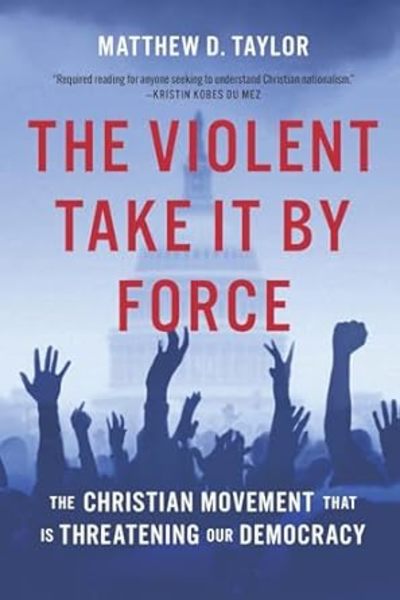
One of the interesting points that Taylor makes in his new book is that “Christian symbolism, Christian prayers, Christian music, and Christian citations of the Bible were rife among the riotous crowds” perpetrating the 6-January-2021 Capitol Riot.
But he certainly does not criticize Christians in general, not even all Evangelical Christians (many of whom voted for Trump in 2016 and 2020), but rather a specific group that “thrived in relative obscurity.” But it was one that “built the theology of Christian Trumpism and then inspired thousands of Christians to show up on January 6 to fight for Donald Trump.” It’s name? The New Apostolic Reformation (NAR).
It is a leading element in the charismatic, evangelical, nondenominational movement that is the fastest-growing segment of U.S. Christianity. The NAR’s “theological ideas around politics and spiritual warfare are increasingly setting the agenda for the religious right in America and quickening our polarized, zero-sum political environment.”
Related stories
One of the NAR leaders that Taylor introduces us to is Paula White, whom he describes as “a White House employee...the central spiritual adviser to President Trump.” Another source (from Salon.com) notes that she “gave the invocation at Trump’s inauguration in 2017, at his re-election campaign kick-off in 2019 and his Jan. 6, 2021, pre-insurrection rally. At the 2019 event, she stated, “Let every demonic network that is aligned itself against the purpose, against the calling of President Trump, let it be broken, let it be torn down in the name of Jesus.”
According to Taylor in an NPR interview, soon after she became a White House employee, she began the 1Voice Prayer Movement and invited many “NAR leaders in to come and strategize for this prayer movement.” Once Trump denied results of the 2020 election, many of these same leaders became “pivotal to gathering Christians and propagandizing Christians,” telling them that Trump was “God's destined candidate” and that he did not lose the election.
The main problem with Paula White and other NAR leaders is they’re using terms like “demonic network” to refer to those “against the calling of President Trump.” As Taylor said on NPR “if you believe that a demonic conspiracy is hijacking the election, well, you don't really need evidence to believe that, right? It's just [NAR] prophets saying this....I mean, one-third of the country still believes that the 2020 election was stolen, and many, many Christians have bought into that....[including] two-thirds of white evangelicals.”
Besides White, Taylor also points to another NAR leader, Lance Wallnau, who just recently hosted an event at which Republican VP nominee JD Vance spoke. According to the Huffington Post, which wrote about Vance’s appearance, Wallnau believes “Trump is destined to save America” from Harris. In a PBS interview Taylor indicated that Wallnau said that she “is a manifestation of demons, that you can't even listen to her because it's just demons speaking through her. He accused her of using witchcraft to present herself in an appealing way in the most recent debate.”
Thus, as Taylor points out, our present political polarization is not one of Christians versus secularists—Harris, for example, is a Baptist, Biden a Catholic—but as Taylor’s subtitle indicates a particular “Christian Movement That Is Threatening Our Democracy,” that is “The New Apostolic Reformation.” True, it is part of the broader world of Evangelicals, and most of them support Trump. But not all. In late September The Christian Post, a rght-wing publication, ran a piece entitled “Evangelicals for Harris spends over $1M on anti-Trump Ad Campaign.”
Most progressives support Harris, but if we look back at the Progressive movement of the 1890-1914 period, we see a strong religious influence. In her highly acclaimed These Truths (2018), historian Jill Lepore writes, “Much that was vital in Progressivism grew out of Protestantism, and especially out of a movement known as the Social Gospel, adopted by almost all theological liberals and by a large number of theological conservatives, too.”
There is also the considered opinion of psychologist Jonathan Haidt in his “The Righteous Mind: Why Good People Are Divided by Politics and Religion” (2012). He quotes approvingly the following sentence: “By many different measures religiously observant Americans are better neighbors and better citizens than secular Americans—they are more generous with their time and money, especially in helping the needy, and they are more active in community life.” And Haidt backs up his statement with polling and statistical data.
He also gives a fair assessment of the traditional right and left wings of our political process. Quoting one reliable source, he describes the “Reagan narrative” thusly:
Once upon a time, America was a shining beacon. Then liberals came along and erected an enormous federal bureaucracy that handcuffed the invisible hand of the free market. They subverted our traditional American values and opposed God and faith at every step of the way.… Instead of requiring that people work for a living, they siphoned money from hardworking Americans and gave it to Cadillac-driving drug addicts and welfare queens. Instead of punishing criminals, they tried to “understand” them. Instead of worrying about the victims of crime, they worried about the rights of criminals.… Instead of adhering to traditional American values of family, fidelity, and personal responsibility, they preached promiscuity, premarital sex, and the gay lifestyle … and they encouraged a feminist agenda that undermined traditional family roles.… Instead of projecting strength to those who would do evil around the world, they cut military budgets, disrespected our soldiers in uniform, burned our flag, and chose negotiation and multilateralism.… Then Americans decided to take their country back from those who sought to undermine it.
On the other side, he believes that “the liberal radio host Garrison Keillor [a frequent contributor to LAP] captured the spirit and self-image of the modern American left when he wrote: ‘I am a liberal, and liberalism is the politics of kindness. Liberals stand for tolerance, magnanimity, community spirit, the defense of the weak against the powerful, love of learning, freedom of belief, art and poetry, city life, the very things that make America worth dying for.’”
Haidt also agrees with two central liberal or progressive principals:
- “The only force left on Earth that can stand up to the largest corporations are national governments, some of which still maintain the power to tax, regulate, and divide corporations into smaller pieces when they get too powerful.”
- “Some Problems [I think of climate change] Really Can Be Solved by [Government] Regulation.”
Furthermore in regard to religion and politics, I think of my own experience. In over 20 years in Catholic schools and universities, I met many fine people whose Christian religion made them better people, people willing to help their neighbors. And I have written long wisdom profiles of Catholic converts like Dorothy Day and the socialist economist and environmentalist E. F. Schumacher, both of whose values were in direct contradiction to most of Trump’s views.
I have also often written admiringly of Pope Francis, whose writings on capitalism, climate change, and immigrants contradict Tumpian statements. (See here for a list of my 21st century publications.)
No, the polarization is not between Christians and secularists. It’s primarily between those who still maintain some respect for truth (mainly centrists and leftists) and those who are willing to swallow—or at least tolerate—the most lying president in our nation’s history.
Progressives and those of us on the Left are not without our faults. Like all humans we are fallible creatures. But the following words of Rick Shenkman, in his 2016 book “Political Animals,” apply more to Trump’s followers than to ourselves:—“The record of our history suggests that, given a choice between a harsh truth and a comforting myth, we have been inclined to embrace the latter.”
And, as Taylor so correctly emphasizes, the Trumpian “myth”—or myths or lies—are “threatening our democracy.”
Comments

Powered by RoundtableAn AI/DeFi-powered Enterprise Media Operating System. Learn more at Roundtable.io.© Roundtable 2026. By using this site you agree to the Terms of Use and Privacy Policy