
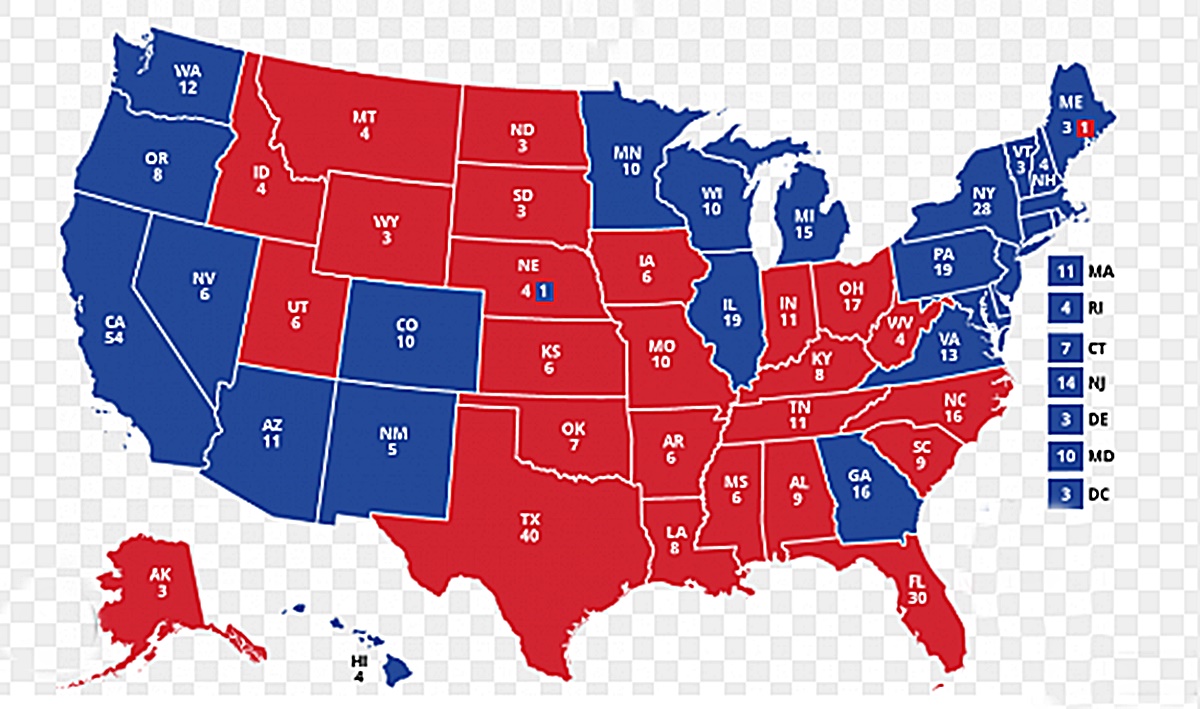


The Electoral College 2024
Jan 16, 2024 2:47 AM
The Electoral College puts progressives behind the eight ball. Given that, this is a plea to Progressives for the 2024 Election.
Twice in recent years, in 2000 and 2016, the Democratic candidate has lost the presidential election despite receiving more votes than their Republican opponent. This was largely thanks to the deplorable Electoral College. Another important factor in each of those two outcomes was the campaign of a progressive third-party candidate drawing votes away from the Democratic candidate.
In 2000, Al Gore lost the presidency to George W. Bush because of the progressive, third-party candidate: Ralph Nader. The outcome of that Presidential race came down to which candidate had won Florida. After a prolonged and bitter vote counting process, Bush won Florida by a mere 537 votes. That was because Nader received over 97,000 votes in Florida, many of which would have gone to Gore if Nader were not on the ballot. Clearly, Nader cost Gore the election
In 2016, Hillary Clinton won the popular vote by almost three million votes but lost to Donald Trump as a result of losing close races in three battleground states. Quite likely, Green Party candidate Jill Stein, cost Clinton the election by waging a very aggressive campaign demonizing Clinton. Stein argued that Clinton was as every bit as bad as Trump, even claiming that deciding between Trump and Clinton was like choosing between “cholera and gonorrhea.”
Somewhat less widely reported is how close Trump came to winning the 2020, election, thanks again to the Electoral College. Despite losing the popular vote by over seven million votes, Trump could have won the election, fair and square without even having to cheat, had he gotten a total of approximately 50,000 more votes in the key states Georgia, Wisconsin, and Arizona.
Related stories
What may motivate a progressive to vote for a third-party candidate in a presidential election and thereby risk helping the Republican win the presidency? Here is a list of some possible rationales for supporting a third-party candidate despite the potential risk posed by a Republican winning: (1) There is no real risk because the difference between the Democratic and Republican candidates is so small. (2) Although there is some risk, it is outweighed by the need to pressure the Democratic party to nominate better and more progressive candidates in the future (3) Although there is some risk, it is delusional to think that the Democratic Party will ever favor the fundamental changes that are needed. The best hope for the future is to create a robust, progressive third party. (4) It is not a strategic decision, but instead a personal one in which the voter can define themself as a member of an idealistic and high-minded movement.
Let’s focus on the 2024 presidential election. The danger of Trump to our democracy is so terrifyingly clear that already Democrats Bernie Sanders, AOC, and a number of prominent Republicans have endorsed Biden. Can ultra progressives be convinced to support Biden in a Biden/Trump rematch? Can Jill Stein, who is again seeking the Green Party nomination be convinced to drop out and support the Democrat?
But what if the Republican candidate is not Trump? With the danger of a second Trump presidency gone, many progressive leaders might feel it’s safe to focus primarily on some important but divisive issues, such as Israel’s treatment of the Palestinians. If too many progressives feel that the Democratic candidate is lacking on these issues, that could affect their voting decision. A Republican victory by someone other than Trump still poses grave risks, the likes of which have never been seen, not only to our democracy but also to the future habitability of our planet.
Regarding our democracy, already the Electoral College gives the Republicans a huge advantage. The Supreme Court which ought to be an institution to help protect our democracy, has instead in recent voting issue rulings, only added to the Republicans’ unfair advantage. Even if a 2024 president is a Republican other than Trump, that person would not only need to placate the Trump base, but might also be willing to make use of some of Trump’s ideas for going after the “vermin” on the progressive left. Not just the Supreme Court, but all federal courts could be further infused with right-wing ideologues who further weaken not just democracy safeguards but also the previously recognized reproductive rights.
Regarding climate change, the two the leading Trump challengers, Ron DeSantis and Nikki Haley, are in the pocket of the fossil fuel industry and thus unlikely to take real action to combat the existential threat posed by `climate change. For example, although Ron DeSantis has been making funding available for the construction of sea walls in vulnerable communities in Florida, he still refuses to address the underlying cause of the problem. Haley, who recently received the endorsement of the Koch brothers, has been deceptively pushing carbon capture as an alternative to reducing fossil fuel use. Although this technology is in its early stages and it would do little to reduce greenhouse gas emissions in the near future, it does have one big advantage (for her) of not alienating the fossil fuel industry.
The stakes in the 2024 election are so enormous that the phrase, the likes of which have never been seen, warrants repeating. An apt analogy for moving toward the impending 2024 election is that it’s like approaching a potential black hole. Recall that in astrophysics a black hole has a gravitational field with such a strong sucking force strong that nothing can escape it, not even light. Ultra-progressives need to realize that if the Republicans win the 2024 presidential election, the force of the consequences could be inescapable and irreversible, that not only would it suck the life out of our democracy, but also it will imperil the future habitability of our planet. My plea to ultra-progressives is that past rationales for supporting a third-party candidate don’t apply to the 2024 presidential election. If ever there was a time to settle for a less than ideal candidate, it is in 2024 and to vote for the Democrat whoever it is.
Comments

Powered by RoundtableAn AI/DeFi-powered Enterprise Media Operating System. Learn more at Roundtable.io.© Roundtable 2026. By using this site you agree to the Terms of Use and Privacy Policy