


May 27, 2026 8:17 PM
Updated May 27, 2026 8:22 PM
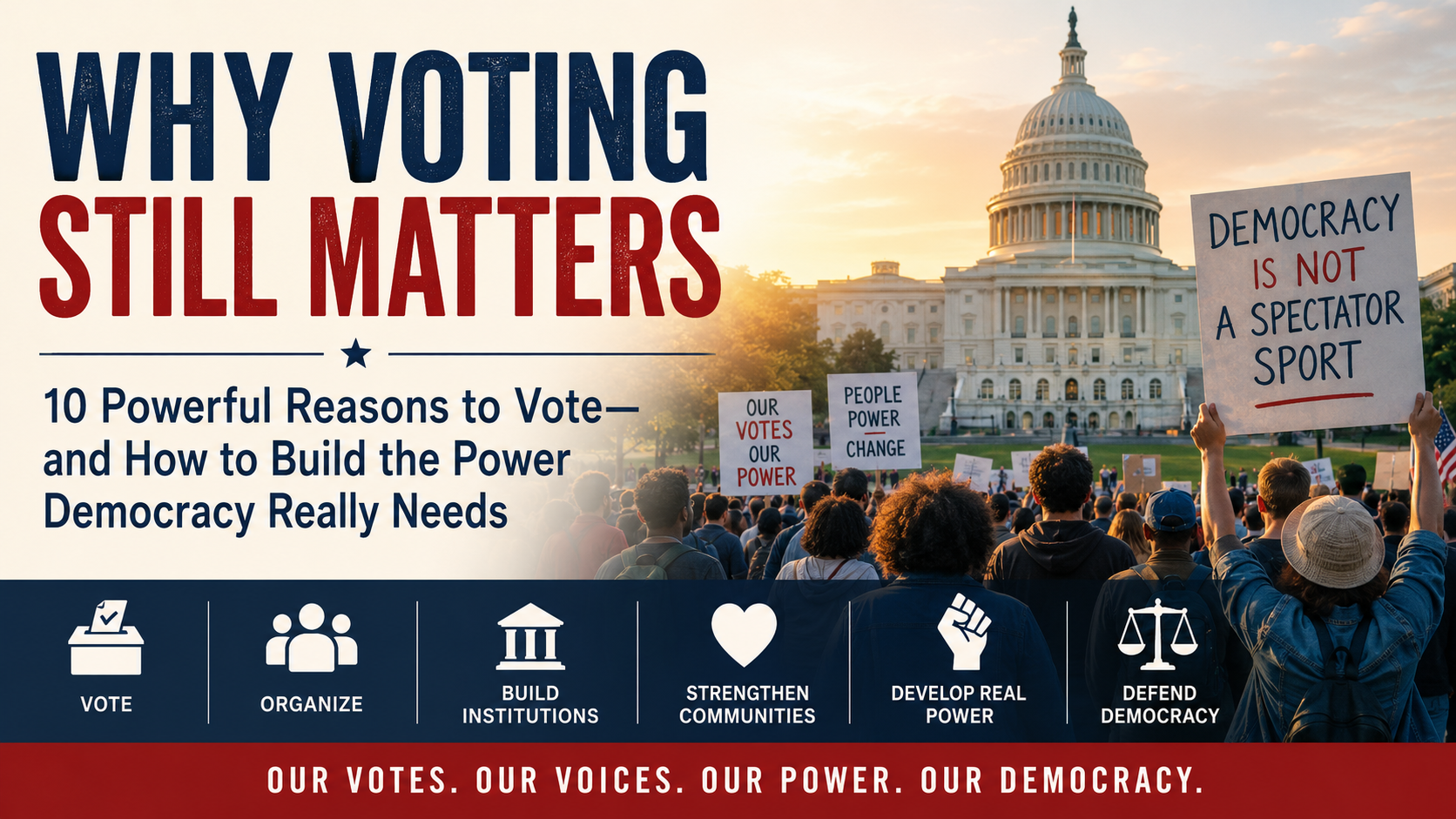
Despite what the Gilens-Page study revealed about concentrated wealth and political power, abandoning the electoral process can accelerate authoritarianism and deepens harm for the most vulnerable among us.
Martin Gilens and Benjamin I. Page conducted a 10-year study of 1,800 policy decisions and found that wealthy individuals and powerful corporations exert far more influence over government policy than average citizens. In some cases, their study found that the desires of average people had no influence at all on how policy decisions were made.
A lot of people read that study and asked: “Then why vote at all?”
But even if one accepts much of their structural critique, there are still powerful reasons to vote — not because voting alone is sufficient, but because abandoning voting entirely often accelerates the very conditions people are worried about.
Here are 10 of the strongest reasons.
1. Voting Still Shapes the Terrain of Harm
In spite of the study, elections still influence who controls institutions, how aggressively policies are enforced, who gets appointed to courts and agencies, what kinds of coalitions gain legitimacy, and how much damage vulnerable communities experience.
Related stories
There are real-world differences in:
- judicial appointments,
- labor protections,
- voting rights,
- environmental regulation,
- union policy,
- reproductive rights,
- education,
- healthcare access,
- policing,
- immigration enforcement,
- civil liberties,
- and whether democratic procedures themselves remain intact.
People living closest to the edge of precarity often feel these political differences first — and most directly — in their daily lives.
Voting may not produce the society people ultimately hope for, but it can influence how much harm is done while longer-term organizing and power-building continue. In that sense, voting can buy time. But time only matters if it is used to organize, build institutions, strengthen communities, and develop real collective power.
2. Authoritarian Movements Benefit From Withdrawal
Historically, anti-democratic or authoritarian movements often gain strength when:
- citizens disengage,
- democratic legitimacy collapses,
- cynicism deepens,
- people conclude participation is pointless,
- or populations assume earlier victories permanently solved underlying structural problems.
Many scholars of the post–civil rights era argue that after major victories like the Civil Rights Act of 1964 and the Voting Rights Act of 1965, parts of the country began treating racial democracy as largely “resolved,” even though many underlying systems of inequality, segregation, economic exclusion, and racialized political backlash remained intact.
Authoritarian factions rarely stop participating because others become disillusioned or believe the fight is over. They usually become more organized.
In that sense, mass withdrawal can unintentionally cede institutional terrain to the most disciplined and power-seeking actors. The gradual gutting of the Voting Rights Act is one example of what happens when democratic victories are treated as permanent.
3. Voting Preserves Democratic Space for Larger Organizing
Voting alone rarely produces major structural transformation.
But democratic openings often create conditions where:
- unions can organize,
- journalists can investigate,
- protest movements can function,
- independent media can survive,
- lawsuits can proceed,
- educators can teach,
- and organizers can build institutions.
Without those openings, larger democratic reconstruction becomes much harder.
Voting can help preserve the civic oxygen necessary for deeper change — but it is not a substitute for the deeper organizing required to achieve that change.
4. Local Elections Often Matter More Than People Realize
National politics dominates attention, but many of the systems shaping daily life are local:
- prosecutors,
- judges,
- sheriffs,
- school boards,
- city councils,
- water boards,
- zoning commissions,
- district attorneys,
- and state legislatures.
Small organized groups can dramatically influence these institutions because turnout is often extremely low.
At the local level, wealthy interests and corporations are sometimes less organized, less coordinated, or less focused than they are in national politics. A city council race, school board race, water district election, or judicial race may not initially attract the same level of billionaire funding, lobbying infrastructure, or national media attention as presidential or congressional politics.
That can create openings where relatively small groups of organized citizens still exert meaningful influence.
This does not mean that local politics is “free” from concentrated wealth. It means that the barriers to influence are sometimes lower, the scale is smaller, turnout is lower, and organized communities can occasionally compete more effectively before larger power structures fully mobilize against them.
5. Voting Is One Tool, Not the Entire Toolbox
One of the biggest conceptual mistakes in American political culture is treating electoral politics as if it is either:
- the complete solution,
- or completely meaningless.
History suggests neither is true.
Most major democratic advances required combinations of:
- critical civic education and democratic consciousness-building,
- protest,
- organizing,
- litigation,
- journalism,
- labor pressure,
- cultural change,
- economic disruption,
- coalition-building,
- and electoral participation.
The Civil Rights Movement did not ignore elections. Labor movements did not ignore elections. Reconstruction-era Black political movements did not ignore elections.
Voting is weak if it is viewed as the only way to participate.
It becomes more meaningful when attached to organized civic power. It becomes most meaningful when undergirded by political awareness rooted in historical understanding, media literacy, and structural analysis.
6. Participation Helps Prevent Learned Helplessness
It’s a slippery slope. I have witnessed this repeatedly in my own life. People who withdraw from voting generally withdraw completely or never begin to engage civically.
They often seem to lose any sense that the system belongs to the public at all.
But beyond that, social scientists maintain that humans are psychologically shaped by whether they see themselves as participants or spectators.
When people don't participate and are disengaged, they can slide into:
- fatalism — “Nothing will ever change no matter who wins.”
- passivity — “Someone else will handle it.”
- atomization — “I'm not a joiner, anyway. Nothing collective ever works.”
- despair — “It’s already over. The country is too far gone.”
- political learned helplessness — “It’s pointless to fight people with that much money and influence.”
Participatory acts and celebrating even small victories can help maintain:
- civic identity — “The most important office in a democracy is the office of the people.”
- solidarity — “United we win. Divided we fall.”
- agency — “Never doubt that a small group of thoughtful, committed citizens can change the world; indeed, it's the only thing that ever has.”
- collective struggle — “The power of the people is greater than the people in power.”
There is substantial evidence supporting the broader argument that civic disengagement, democratic withdrawal, media fragmentation, and institutional distrust helped create conditions in which Donald Trump and the radical right gained and retained mass support.
Those same conditions have increasingly contributed to authoritarian tendencies within American politics.
7. Voting Can Be Defensive Rather Than Utopian
Some people continue voting not because they believe elections alone will save democracy, but because they view voting as:
- slowing deterioration,
- preventing worse outcomes,
- buying time,
- protecting vulnerable populations,
- or preserving institutional footholds.
This is less a romantic theory of democracy than a defensive one.
Black women’s voting patterns are a good example of this. In both presidential elections involving Donald Trump, Black women overwhelmingly voted for the other candidate, making them one of the most consistently pro-democracy and anti-authoritarian voting blocs in the country.
Despite having long experience with institutional failure, exclusion, and broken promises, Black women did not broadly respond by withdrawing from civic participation or embracing grievance-driven strongman politics. Instead, many continued to engage electorally, organize collectively, and support coalitional approaches aimed at protecting democratic institutions, civil rights, and vulnerable communities — even while recognizing the deep imperfections of the system itself.
History often turns on whether democratic institutions survive long enough for broader reconstruction movements to emerge.
8. Power Rarely Voluntarily Expands Participation
One lesson of American history is that voting rights themselves were usually won through struggle:
- abolition movements,
- Reconstruction,
- women’s suffrage,
- labor organizing,
- Civil Rights activism,
- and Voting Rights campaigns.
People fought, bled, and died for participatory rights precisely because political participation affects the distribution of power — even imperfectly. That helps explain why efforts to suppress voting remain so politically important.
If voting were entirely meaningless, powerful interests would not work so aggressively to:
- suppress votes,
- gerrymander districts,
- restrict ballot access,
- flood elections with money,
- manipulate media narratives,
- or shape judicial rules around elections.
9. Voting Keeps Open the Possibility of Future Reconstruction
Perhaps most importantly:
Democratic reconstruction requires institutional footholds.
If people who want a more humane, multiracial, democratic society completely abandon electoral participation, they risk leaving institutional power entirely in the hands of forces moving toward authoritarian nationalism, oligarchy, or permanent minority rule.
Voting does not guarantee transformation.
But abandoning voting can help close pathways through which transformation might later occur.
10. Democracy Is Also a Civic Practice
Democracy is not merely a mechanism for selecting leaders.
It is also:
- a habit,
- a culture,
- a collective practice,
- and a learned expectation that ordinary people have standing in public life.
Once populations lose that expectation entirely, rebuilding democratic culture becomes vastly harder.
That may ultimately be one of the greatest dangers facing the United States now:
not merely polarization, but a growing disbelief that ordinary people matter at all.
And once that belief collapses, societies become extremely vulnerable to concentrated power.
The 1 Reason Voting Doesn't Matter
The one condition that makes voting useless.
Voting alone is insufficient. Without organizing, institution-building, community strengthening, political education, and the development of real collective power, voting is not worth a hill of beans. Democracy is sustained through continuous participation, not occasional trips to the ballot box. And when democratic engagement weakens, the burdens are not shared equally. Black and Brown communities, poor and working-class people, immigrants, the elderly, the disabled, and those living closest to the edge of precarity are usually the first to absorb the damage — and often the hardest hit. At the same time, a serious reckoning with party politics and the limitations of the two-party duopoly is overdue. There is no good reason the Democratic Party should have remained so unprepared while women lost autonomy over their own bodies, the Voting Rights Act was hollowed out, and preventable gun violence continued devastating communities across the nation. Voting can sometimes slow deterioration and preserve democratic space, but preserving space is meaningless unless that time is used to build stronger movements, stronger institutions, and a more durable democratic culture.
Comments

Powered by RoundtableAn AI/DeFi-powered Enterprise Media Operating System. Learn more at Roundtable.io.© Roundtable 2026. By using this site you agree to the Terms of Use and Privacy Policy