


Jul 7, 2026 1:54 PM
Updated Jul 7, 2026 2:00 PM
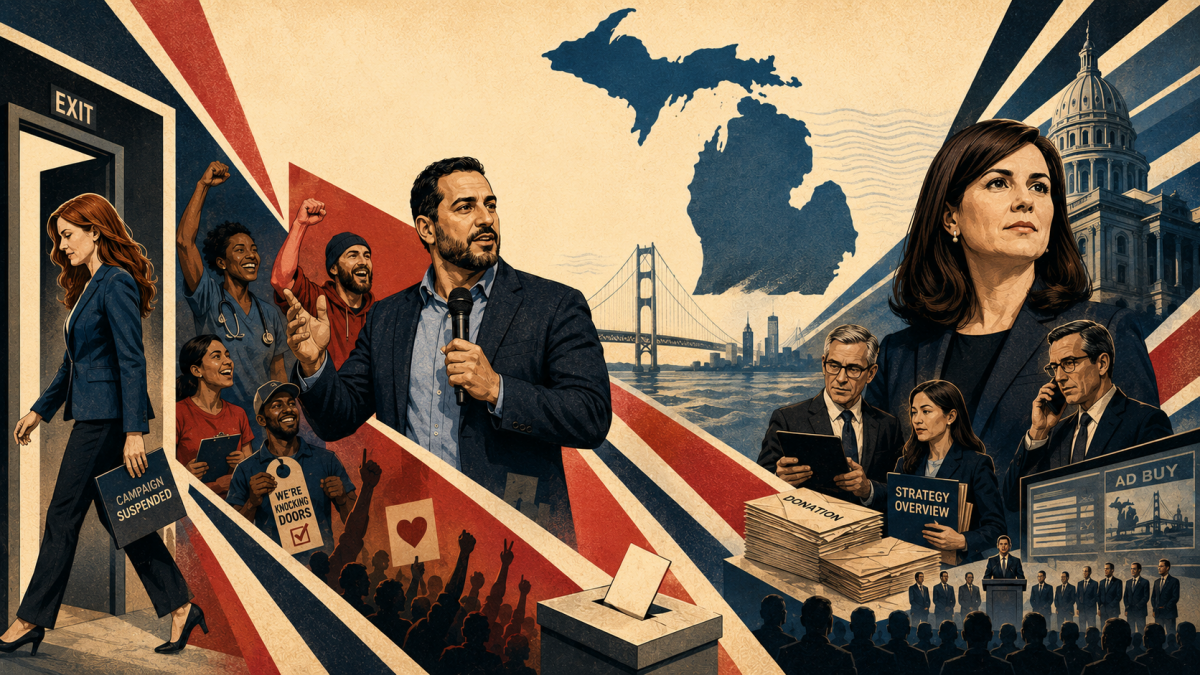
The two-way Democratic primary will test whether establishment money can overcome Abdul El-Sayed’s progressive momentum, labor support, and grassroots energy.
Mallory McMorrow launched her U.S. Senate campaign with a literal spine. It was a clever prop and a sharper metaphor. Democrats in Washington, she argued, had lost theirs. She built a national brand on that promise of a backbone with the viral 2022 floor speech, the book, the campaign video gleaming under studio lights.
On Sunday, roughly seventy-two hours after Alexandria Ocasio-Cortez endorsed Abdul El-Sayed, McMorrow suspended her campaign.
She declined to endorse either of her former rivals, Rep. Haley Stevens or El-Sayed, saying only that whoever wins on August 4 will have her full support against Republican Mike Rogers. It was a graceful exit, and she deserves credit for reading the room. The polls had collapsed under her. One survey last week had her at 7.5 percent. She had struggled to raise the money a statewide race demands, and reporting indicates that retiring Sen. Gary Peters had privately urged her to step aside so the establishment could consolidate behind Stevens.
Within hours of her announcement, Attorney General Dana Nessel, a McMorrow ally, endorsed Stevens. The consolidation play is underway, right on schedule. The establishment believes that narrowing the field to a binary saves them.
Related stories
New York just taught us how that movie ends.
The Adams Precedent
Last fall, Eric Adams abandoned his re-election bid for mayor of New York City. The strategic logic was identical to what Michigan's donor class is running now in terms of clear the lane, consolidate the anti-progressive vote behind a single establishment vehicle, in that case, Andrew Cuomo, and count on fear of the left to do the rest.
Instead, Adams's exit solidified Zohran Mamdani. The race collapsed into exactly the binary the establishment wanted, and the binary clarified everything. Voters were no longer choosing among personalities and lanes; they were choosing between a movement with energy and a machine with money. Mamdani won decisively in November, and every post-mortem noted that consolidation does not manufacture enthusiasm. You cannot merge two candidates’ donor lists into a reason to believe.
McMorrow’s exit sets up the same experiment in a purple state. On paper, strategists say it should help Stevens. Yet even Republican consultants concede El-Sayed has shown the most energy, momentum, and organic reach of anyone in the field. That is the Mamdani signature, where the establishment wins the endorsement press releases while the insurgent wins the voters.
The Choice Is Now Unmistakable
With McMorrow gone, the primary is what it always was underneath, a referendum on what the Democratic Party is for.
On one side stands Stevens, backed by Chuck Schumer, Debbie Stabenow, Nessel, and more than $10 million from the AIPAC-linked United Democracy Project super PAC, which launched its first attack ad against El-Sayed last week. On the other stands Abdul El-Sayed, backed by Bernie Sanders, Chris Van Hollen, the UAW, and now AOC, in the first contested Senate primary endorsement of her career.
Ocasio-Cortez sat out other races. She waited. And when she finally moved, she moved for a Rhodes Scholar physician who rebuilt Detroit's health department after bankruptcy, erased medical debt for Wayne County residents, and has spent a decade proving that health care as a human right is a governing agenda. And she framed the endorsement on electability in an existential moment, so that El-Sayed gives Democrats their best chance to hold the seat. The left is no longer conceding the electability argument. It is making it.
Abdul El-Sayed is very confident he can beat Republican Mike Rogers and win Michigan’s U.S. Senate seat in November.
“He generally has the charisma of a doorknob,” El-Sayed told HuffPost in a 45-minute interview last week. “He carries all the MAGA baggage, but he also has the aesthetic of the guy at a country club who sneers at you from his Lincoln. He’s not really hard to beat.”
“By the time I’m done with him, his golf buddies down in Florida are going to be calling him the names I call him,” he continued, referencing Rogers’ time living in the Sunshine State following his departure from Congress in 2015. “I hope that 20 years from now, he still thinks of me.”
The two candidates meet Tuesday in a televised debate, the first of the binary era. Stevens now has to defend Schumer’s blessing and AIPAC’s money on a stage with no third candidate to absorb the contrast. McMorrow, remember, was the first candidate in this race to say she would not back Schumer as leader. Her voters did not sign up for the machine.
Where McMorrow's Voters Actually Go
The conventional wisdom says her coalition splits so that electability-minded voters and some women drift to Stevens, while her anti-establishment and progressive supporters, including those alienated by Stevens's staunch AIPAC-aligned posture on Israel and Gaza move to El-Sayed. Even Michigan analysts who see a strategic boost for Stevens admit McMorrow's supporters don't fit neatly into either camp.
But here is what the split-the-difference analysis misses, and what New York proved: in a binary between energy and inevitability, the undecideds break late toward the candidate who gives them a reason to show up. El-Sayed was already leading in multiple polls before the field narrowed with 41 percent in one survey, 46 in another. Mamdani never had that luxury when Adams stepped aside, so he built his majority from behind. Abdul starts the two-way race ahead with the AOC endorsement still landing, the UAW knocking doors, and a debate stage coming where clarity is his forte.
There's an irony in McMorrow's spine prop outlasting her campaign. She was right about the diagnosis that Democrats need backbone. Michigan voters simply concluded that the candidate who best embodies it is the one who took on Big Pharma’s debt machine, corporate polluters, and his own party's donor class, and is still standing, still leading, one month out.
The establishment cleared the field in New York and got Mayor Mamdani. It is clearing the field in Michigan and, if the pattern holds, it will get Senator El-Sayed, the first Muslim American ever elected to the United States Senate, from a state Donald Trump carried, on a platform of Medicare for All and worker power. That is not a liability for Democrats. That is the future arriving on schedule.
August 4 will tell us whether the Democratic Party's future runs through its consultants or its communities. Michigan progressives should head to the polls with their spines intact.
Comments

Powered by RoundtableAn AI/DeFi-powered Enterprise Media Operating System. Learn more at Roundtable.io.© Roundtable 2026. By using this site you agree to the Terms of Use and Privacy Policy