
Gage Skidmore • Attribution-ShareAlike (CC BY-SA 2.0) • Flickr


Trump-McMahon Approach to Education
Nov 22, 2024 8:35 PM
Updated Nov 23, 2024 12:46 AM
The pairing of Trump’s culture war rhetoric with Linda McMahon’s corporate mindset could lead to a power slam of reforms that privatize education and prioritize profits over students.
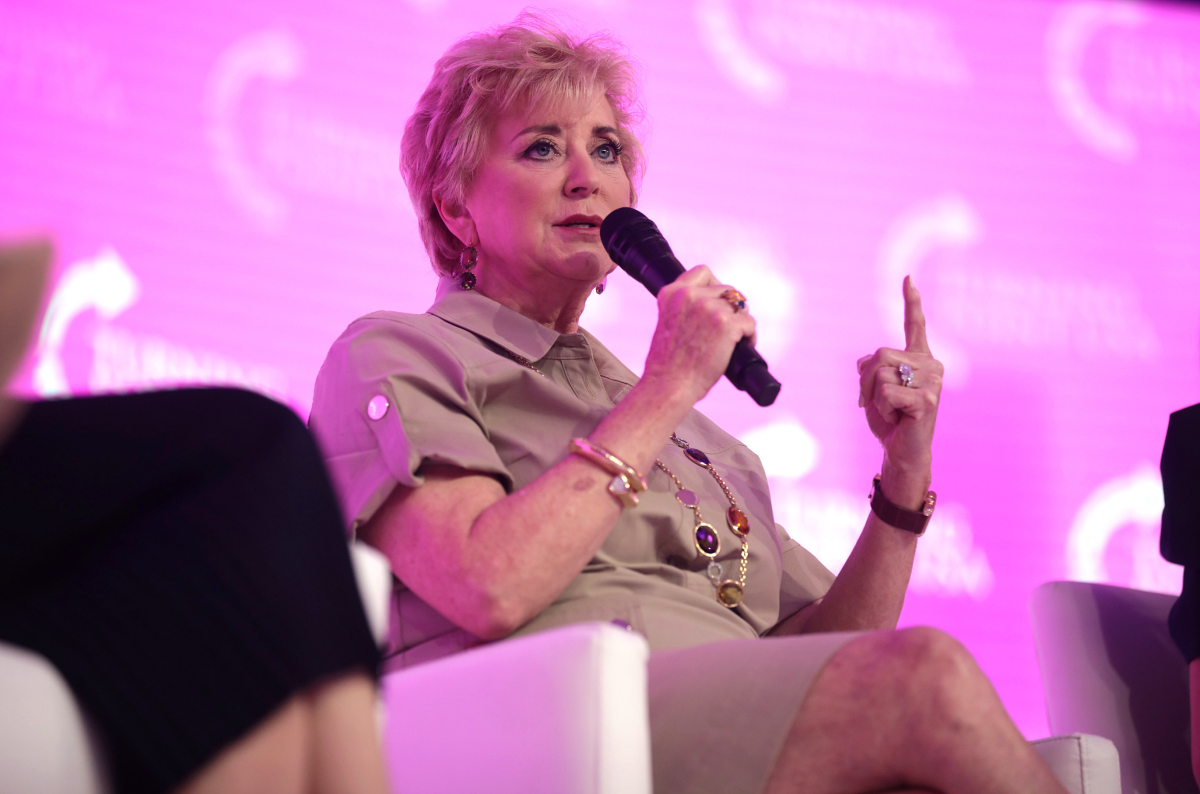
In an unprecedented move that feels ripped straight from a WWE storyline, Donald Trump has chosen Linda McMahon, former CEO of World Wrestling Entertainment, to lead the Department of Education. A longtime ally of Trump and a proponent of charter schools, McMahon is now poised to take center stage in what could become a WrestleMania-style overhaul of American public education.
For Trump, a self-proclaimed fan of WWE and UFC theatrics, this appointment seems less about qualifications and more about spectacle. McMahon’s background in entertainment and business management is worlds apart from the nuanced challenges of guiding the nation’s schools. But under Trump’s vision—where education becomes a battleground for ideological supremacy—this unconventional pick might make twisted sense.
The reforms they’re promising could deliver a devastating blow to public education. Equity initiatives, protections for marginalized students, and even the federal Department of Education itself could be placed on the chopping block, leaving the public school system on the ropes. Instead of bolstering opportunities for all students, these policies threaten to replace inclusion with indoctrination and strip classrooms of their vital role in fostering critical thinking.
This appointment isn’t just shocking; it’s a stark warning. The pairing of Trump’s culture war rhetoric with McMahon’s corporate mindset could lead to a power slam of reforms that privatize education and prioritize profits over students. And the ultimate finishing move? The abolition of the Department of Education, a longtime goal of Trump’s most ardent supporters.
Related stories
As this tag team steps into the ring, the stakes couldn’t be higher. Will this be the final count for public education, or can communities rally to protect schools from being turned into ideological octagons? The fight for the soul of American education has just begun—and it looks like it’s going to be brutal.
It could be the underdog’s last fight against a cult-worshipping Trump imposing his MAGA brand of masculinity and fascist politics on the American public.
The result? A power slam of reforms that risks turning classrooms into ideological gladiatorial arenas, with equity and inclusion counted out before the emperor manages to raise his thumb. Public schools, already struggling under the weight of systemic inequities, could face a plethora of changes that strip away federal protections, divert resources to privatization, and even lead to the ultimate finisher: the abolition of the Department of Education itself.
In this high-stakes match, the future of American education hangs in the balance, as the loudest voices threaten to drown out the needs of the quietest ones. Will the nation’s schools rise from the mat, or is this down for the final count for public education as we know it?
As Donald Trump readies himself to return to the White House, his blueprint for America’s future sharpens into focus—a stark departure from aspirations of equity and fairness. When it comes to education, his vision will likely bear an uncanny reflection of Florida under Governor Ron DeSantis, where the machinery of public schooling has been repurposed to obliterate diversity, equity, and inclusion (DEI) initiatives, and social justice programs are swept aside like dust from a gilded table.
The term social justice, exalted by the United Nations as a beacon of fairness in resource distribution, equal rights, and institutional reform, now hangs in the crosshairs. It is a doctrine rooted in confronting systemic inequalities—racial, economic, gendered, and environmental. Yet in Trump’s America, these principles are rebranded as existential threats, facing their fiercest opposition yet.
Florida serves as a grim prologue as McMahon is likely to follow its example. There, DEI programs have been slashed, their champions vilified, their goals framed as subversive distractions from “real” governance. The very pillars of fairness and inclusion have been cast as ideological indulgences, obstacles in the path of what DeSantis and Trump alike call the “restoration of American greatness.” Under this banner, schools have had their curricula narrowed, their purpose reshaped into an echo chamber of selective history and sterile conformity.
For Trump, these policies are not simply practical; they are strategic, amplifying his campaign to crush what he disparages as “woke” culture. Movements that demand racial justice, gender equality, or environmental responsibility are painted as assaults on the nation's identity. This rebranding weaponizes fear, pitting progress against tradition in a zero-sum game that sacrifices the vulnerable at every turn.
Gone will be the programs that have sought to lift marginalized voices, narrow achievement gaps, and champion underrepresented perspectives. Trump’s approach envisions a rollback not only of federal protections but of the very philosophy of equity itself. The scaffolding of justice—programs that challenge racial segregation, address gender pay gaps, and prepare communities for environmental crises—will be dismantled brick by brick. What will remain is a façade of neutrality, behind which power, privilege, and inequality will fester unchallenged.
Where education once stood as the great equalizer, it will become a mechanism for entrenching divides. Classrooms will be stripped of critical conversations, reduced to rote recitations of unexamined histories.
The consequences are existential. Where education once stood as the great equalizer, it will become a mechanism for entrenching divides. Classrooms will be stripped of critical conversations, reduced to rote recitations of unexamined histories. Federal initiatives addressing systemic inequities will be cast aside, replaced by a stark landscape where the privileged thrive and the marginalized are left to fend for themselves. The scene outside a recent performance of The Diary of Anne Frank was chilling but is likely to increase under a Trump presidency: a group of roughly 20 neo-Nazi protesters gathered in the parking lot, waving swastika flags and shouting vile antisemitic slogans. Their chants, caught on video and shared widely on social media, included horrifying justifications of Anne Frank’s murder in the Bergen-Belsen concentration camp, alongside cries of “Heil Hitler” and “Heil Trump.” Such behavior underscores a stark resurgence of hate in public spaces with Trump’s election win.
The juxtaposition of this hateful display against a performance meant to educate and remind audiences of the atrocities of the Holocaust underscores the urgent need for vigilance and education.
Linda McMahon’s appointment as Secretary of Education embodies this unsettling future. A co-founder of World Wrestling Entertainment, she is more familiar with choreographed conflict than with the nuanced struggles of the classroom. Her advocacy for charter schools and her alignment with Trump’s anti-DEI crusade will make her less a steward of education and more a foot soldier in the broader war against public institutions.
McMahon’s ascension is not a mere administrative shift; it is a signal flare, announcing Trump’s intent to dismantle the Department of Education and reforge it in his image—or abolish it altogether. This is no longer about reforming education but about reprogramming it, transforming schools into arenas of ideological warfare and stripping federal oversight of its power to protect the vulnerable.
The stakes are staggering. Under Trump’s stewardship, education risks becoming a hollow shell—a marketplace of privilege where inclusion is a relic, diversity an afterthought, and justice a casualty. The battle for the soul of America’s schools is now not only a fight for children’s futures but for the nation’s moral compass. The question remains: Will this be the era in which America’s promise of equity finally succumbs to the relentless march of division? Or will the defenders of justice find a way to restore the balance before the damage becomes irreversible?
McMahon’s past reads like a parable of modern politics: a thin veneer of qualification cloaked in allegiance to Trump’s agenda, a firebrand promoter recast as the steward of America’s classrooms.
Trump’s directive to McMahon is nothing short of a body slam to the Department of Education itself: dismantle it, scatter its remnants to the winds, and leave the states to wrestle with the aftermath. This ambition aligns with Project 2025, the conservative manifesto promising a wholesale reimagining—or annihilation—of federal oversight in education.
McMahon’s track record offers little solace to those who see public education as a vital thread in the nation’s fabric. Her fleeting stint on Connecticut’s State Board of Education over a decade ago pales against her deeper legacy: bankrolling pro-Trump PACs, rallying crowds with the fervor of a seasoned promoter, and echoing Trump’s cries against “woke” ideology. On the 2010 Senate campaign trail, she championed charter schools and lambasted federal overreach, previewing the ideological warfare she now brings to the national stage.
Critics have drawn quick comparisons to Betsy DeVos, Trump’s first Secretary of Education, whose tenure was marked by similar inexperience and ideological zeal. Yet, McMahon’s charge feels even more radical. While DeVos sought to reshape education through vouchers and privatization, McMahon’s appointment signals a graver mission: the obliteration of federal involvement altogether. Her tenure may not be one of reform but of dismantlement, a final act that could redefine education in America.
The stakes could not be higher. Programs like Title I and IDEA, which provide lifelines to high-poverty schools and students with disabilities, hang precariously in the balance. Without federal oversight, these initiatives risk being gutted or redirected into ideological battlegrounds. Classrooms could become the frontlines of Trump’s culture wars, as the fight over curriculum content, LGBTQ+ rights, and racial history intensifies. For the most vulnerable students, McMahon’s leadership—or lack thereof—may feel like a steel chair to the back, an unprovoked assault on their already tenuous lifeline to opportunity.
The dismantling of the Department of Education would be more than bureaucratic downsizing; it would be the symbolic evisceration of a system that has, however imperfectly, strived to level the playing field.
The tools of equity and accountability could, under McMahon’s hands, be wielded instead as weapons of division, and the dreams of millions of students—dreams of opportunity, dignity, and a brighter future—could be left trampled in the ideological dust.
One truth looms large: the battle over the soul of American education has never been fiercer, nor the stakes for its future more perilous.
Policies protecting marginalized groups and ensuring civil rights could be upended, leaving behind an education landscape shaped not by justice but by political expediency.
Transgender students, already navigating a hostile cultural landscape, face some of the most alarming threats. Policies enabling transgender girls and women to participate in women’s sports could be rescinded, and broader civil rights protections under Title IX may be gutted. This rollback would mark a profound setback in the fight for gender equity and signal a broader erosion of protections for LGBTQ+ students nationwide.
In higher education, deregulation looms large. Trump’s vision includes reducing oversight of colleges and universities participating in the $1.6 trillion federal student loan program. This deregulation would create fertile ground for predatory institutions to exploit vulnerable students, particularly those from low-income communities, perpetuating cycles of debt without delivering quality education or job prospects.
Trump’s education policies, inspired by DeSantis’ Florida model, aim to divert funding from public schools into vouchers and charter schools, further starving public institutions of resources.
Trump’s education policies, inspired by DeSantis’ Florida model, aim to divert funding from public schools into vouchers and charter schools, further starving public institutions of resources. Programs like Title I, designed to support high-poverty schools, and IDEA, which funds services for students with disabilities, already operate on stretched budgets. Under a Trump administration, these programs could be weakened further, jeopardizing the educational prospects of millions.
The emphasis on culture wars—targeting curriculum content, LGBTQ+ rights, and racial education—would turn classrooms into a field of nightmares. National assessments and data collection systems, such as the Nation’s Report Card, could become tools of partisan propaganda, framing achievement gaps as failures of culture rather than symptoms of systemic inequities.
Trump’s broader conservative agenda, encapsulated in the Project 2025 blueprint, outlines an even graver possibility: dismantling the Department of Education entirely. This strategy would scatter its functions across other federal agencies, fundamentally altering their intent.
The $1.6 trillion federal student loan program could shift to the Treasury Department, prioritizing financial transactions over students' educational outcomes.
The Justice Department would take on civil rights enforcement, a move likely to politicize these protections, reducing their effectiveness and accessibility.
In such a scenario, vital programs could face extinction. The absence of Title I funding and support for students with disabilities would deepen existing inequalities, leaving public schools unable to fulfill their mandate of providing equal opportunities for all.
The Department of Education, for all its imperfections, serves as a cornerstone of the nation’s commitment to equity and opportunity. Its dismantling would not merely be a policy shift but an ideological pivot away from the ideals of fairness and inclusion that have guided public education for decades. What would remain is a fragmented, inequitable system where privilege dominates and the marginalized are further disenfranchised.
Choke Holds and Classrooms
The nightmare has already begun in Oklahoma.
History teaches us that every era has its zealots, those who cast their visions in the stark colors of their own convictions. Oklahoma Superintendent Ryan Walters seems intent on playing that part, proposing a bold—and bewildering—mission: to place “God Bless the USA Bibles” in every classroom. The fusion of faith and politics has taken a dramatic new turn with Walters’ promotion of the "God Bless the USA Bible," inspired by Lee Greenwood's patriotic anthem. This peculiar blend of scripture and nationalism has become a rallying cry for Donald Trump and his supporters, embodying a vision of America steeped in both religious fervor and political allegiance.
Trump's use of Greenwood's ballad, a fixture at his rallies, amplifies the symbolic weight of this Bible, turning it into more than just a book—it’s a statement of identity for his movement. Trump’s Holy Week message, urging Americans to "Make America Pray Again," positioned the Bible as both a spiritual guide and a cultural artifact for his MAGA vision of America. Priced at $59.99, it blurs the line between sacred text and political merchandising. It has the U.S. flag on its leather cover and includes the texts of the Declaration of Independence, the Constitution before amendments, the Bill of Rights, the Pledge of Allegiance, and the chorus of Greenwood's song "God Bless the USA" in Greenwood's handwriting. Trump, licensed his name in in partnership with country singer Lee Greenwood for the branded Bible, and there is some irony in that it was printed in China, casting aside potential jobs for American workers, while Trump criticizes China’s trade practices as unfair. Wikipedia writes:
In June 2024, Oklahoma State Superintendent of Schools Ryan Walters issued a memo announcing that all public schools in Oklahoma would be required to teach the Bible, including the Ten Commandments, directing "that every teacher, every classroom in the state will have a Bible in the classroom and will be teaching from the Bible in the classroom."[14][15] In September 2024, Walters opened bids to supply the Oklahoma Department of Education with 55,000 Bibles. The bid documents required that "Bibles must be the King James Version; must contain the Old and New Testaments; must include copies of the Pledge of Allegiance, Declaration of Independence, U.S. Constitution and the Bill of Rights; and must be bound in leather or leather-like material." Under these conditions, this Bible and another endorsed by Donald Trump Jr. are the only versions eligible.[16] The two versions are sold for $60 and $90; free or far cheaper versions of the Bible are readily accessible.
A version of the $59.99 God Bless the USA Bible has taken on a controversial new twist, commemorating what it calls the "July 13 assassination attempt" on Donald Trump in Pennsylvania. The cover now features Trump’s name prominently above the phrase, “The Day God Intervened.” Notably, the phrase appears to have been added after the Bibles were initially produced, raising eyebrows about its marketing and theological implications.
Trump, addressing supporters credited divine intervention for his survival, stating, “My would-be assassin did not succeed by the hand of providence and the grace of God.” The dramatic retelling casts the incident as a near-miraculous event, aligning with the growing narrative within Trump’s circle that he is divinely chosen.
The decision to link a sacred text to a specific political moment—and one tied to a claim of providential protection—has drawn both praise from loyalists and condemnation from critics. Supporters see it as a powerful testament to their faith in Trump’s leadership, while detractors argue it represents a troubling fusion of political idolatry and religious symbolism.
The Bible, already controversial for its association with Trump’s rallies and its ties to Lee Greenwood’s patriotic anthem, further illustrates how Trump’s brand of politics continues to blur the lines between faith and political allegiance.
The "God Bless the USA Bible" raises complex questions about the intersection of religion and nationalism. Is it a sincere effort to inspire faith, or is it a commodification of both patriotism and spirituality? For those critical of such gestures, it appears as a calculated appeal to solidify a base that views Christianity not just as a faith but as a defining feature of their political identity.
The very idea of a “God Bless the USA Bible” is itself a kind of Rorschach test for our times. Are we meant to read it through the lens of one man’s ethos? Or does it become merely a symbolic monument to a MAGA ideology that exalts personality over principle?
In another move that epitomizes the dangers of conflating education with political propaganda, Oklahoma State Superintendent Walters has also issued a mandate to school leaders that flies in the face of the foundational principles of public education. He requires all Oklahoma schools to play a video of himself praying at his desk where he not only blames “radical left” movements and “woke teachers unions” for supposed attacks on religious liberty but also invites students to join him in prayer for President-elect Donald Trump. In doing so, Walters signals his intent to transform classrooms into arenas of ideological control. In an interview with News Nation, he said "We wanted to make sure it was crystal clear to parents, teachers, and kids—we will not allow any more state-sponsored atheism going on in our schools."
A grassroots pushback has emerged in Oklahoma against State Superintendent Ryan Walters’ controversial directives, as the nonprofit Defense of Democracy introduces opt-out forms for parents seeking to shield their children from his influence. This includes Walters’ widely criticized prayer video, which he recently mandated to be played in classrooms across the state.
“I pray for our leaders to make the right decisions; I pray in particular for President Donald Trump,” Walters declares in the video.
The organization’s opt-out forms offer parents a tool to explicitly refuse their children’s participation in Walters’ initiatives. One form addresses the prayer video directly, while another tackles his push to integrate the Bible into classroom instruction—a move viewed by critics as a violation of the separation of church and state.
Walters actions do not amount to a call to faith; it is a call to compliance. His attempt to commandeer public education as a pulpit for partisan prayer primed to take on “state-sponsored atheism” is a clear and chilling violation of the separation of church and state, and an affront to the diverse beliefs and experiences of Oklahoma’s students and their families. Will students and their families targeted by MAGA-friendly teachers and administrators be discarded as “enemies of the people” if they refuse to pray for the health and well-being of Donald Trump?
Education must be a space for dialogue, not dogma—a sanctuary where students can critically engage with the world, not be conscripted into a singular narrative whose protagonist is Donald Trump (I won’t refer to him as a felon or criminal since such messaging that zeroes in on Trump’s conviction underperforms with voters and dehumanizes those in the criminal justice system who do not possess the power and money enjoyed by Trump) .
Walters’ video reduces education to indoctrination, erasing the plurality that defines democratic society. It transforms classrooms into echo chambers for power, silencing the voices of teachers and students who dare to think differently.
What we clearly need is courses on critical patriotism, where American history and governance can be taught through a critical pedagogy of critique, possibility and hope.
Trump's messaging seems to echo an older tradition where religion is wielded not just for individual salvation but as a rallying point for collective identity and action.
Trump's messaging seems to echo an older tradition where religion is wielded not just for individual salvation but as a rallying point for collective identity and action. Whether this Bible will deepen faith or simply reinforce partisan divides remains a question for historians, theologians, and the American people to grapple with in the years to come.
What remains clear, however, is that Walters’ plan is nothing more than a thinly veiled attempt to cement a worldview that privileges the powerful while marginalizing those who resist. It disregards the lived experiences of students, tramples on the rights of educators, and makes a mockery of public education’s role as a bridge to critical consciousness and societal transformation.
As educators committed to liberation, we reject this dystopian vision. Public schools must remain places where students learn to question, critique, and imagine alternatives—not where they are coerced into political allegiances under the guise of prayer. Walters’ vision is not about religious liberty; it is about ideological domination, a betrayal of the principles of equity, justice, and freedom that education must uphold.
We stand united against this encroachment on our classrooms. Let us reclaim education as a space of hope and resistance, where the light of critical pedagogy can pierce through the darkness of imposed orthodoxy. Our students deserve nothing less than the truth, and we will fight for their right to seek it freely.
Walter’s gambit is no ordinary proposal. It smacks of the medieval, where monarchs inscribed their likenesses onto coins as symbols of divine authority. Walters’ plan echoes those eras when rulers conflated faith with power, blending the ethereal and the temporal into tools of dominion. But here, instead of a cross on a banner, it’s a book bearing the name of a modern political figure, poised to sit on desks meant for lessons in freedom.
Supporters will no doubt hail Walters’ directive on prayer as a return to "traditional values," though the tradition seems less rooted in shared spirituality than in the tribal politics of a divided nation. “This is about teaching children the values that made America great,” Walters declares, as if the past were a single narrative carved in stone, not a kaleidoscope of struggles and triumphs.
Critics, meanwhile, see the shadows of authoritarian regimes, where education becomes a tool not to illuminate but to indoctrinate. The placement of such a text in classrooms evokes the old specter of the divine right of kings—a chilling echo of when state and faith were wielded as one, suppressing dissent and diversity in the name of order.
If Walters’ crusade succeeds, it may mark a turning point in the battle for the soul of American education. It is not merely the separation of church and state that trembles under the weight of such a proposal, but the fragile idea that classrooms should nurture independent thought rather than impose preordained dogma.
Historians may one day look back on this as a cautionary tale—a moment when the compass of education risked spinning wildly toward the magnetic pull of personality cults. For now, we stand at the crossroads, where the ink of history has not yet dried, and the battle for the narrative of our times continues to rage.
In my travels throughout America Latina, I met a teacher union leader who recounted how all the union leaders before him were assassinated, and he has come to terms with the prospect that he, too, will almost certainly be assassinated. Such bravery exhibited by educators who have experienced teaching in countries that have experienced fascist dictators and death squads. Fascist leaders always lead to government violence directed at citizens.
As an alternative to Waters proposals on prayer and Bibles, I would recommend an engagement with liberation theology, an important movement that is grounded in Catholic social justice teachings and Christianity. The theology of liberation, rooted in the struggles and spiritual aspirations of Latin America, emerged as a transformative response to the progressive winds of change ushered in by the Second Vatican Council (Vatican II). This landmark event in Catholic history sought to reconcile the Church with the social, political, and economic realities of a rapidly changing world. It marked a dramatic shift for an institution that, for decades, had been staunchly resistant to aligning itself with social justice movements—often viewing them through the lens of anti-communism and treating them with suspicion or outright condemnation.
This resistance was codified in Divini Redemptoris, Pope Pius XI’s 1937 encyclical that denounced communism as a “satanic scourge.” For much of the 20th century, such declarations tethered the Church to an oppositional stance against leftist movements, even those rooted in Catholic traditions, such as Dorothy Day’s Catholic Worker Movement. Ironically, Day, whose mission of radical solidarity with the poor once drew the ire of Church authorities, is now on the path to sainthood, illustrating the complex, evolving relationship between the Church and social justice.
It was Pope John XXIII, with his bold vision for a more engaged and compassionate Church, who set the stage for liberation theology. Convening Vatican II in 1962, he called for aggiornamento—a renewal that sought to open the Church to the "signs of the times" and to engage actively with the struggles of humanity. This included addressing systemic injustice and recognizing the dignity of all people, especially the marginalized and oppressed.
In the wake of Vatican II, liberation theology took root in the soil of Latin America, where gross inequalities and social upheavals demanded a theological response. It was a spirituality of action, one that emphasized the preferential option for the poor, the need for structural transformation, and the inextricable link between faith and justice. Figures like Gustavo Gutiérrez, Leonardo Boff, and Oscar Romero carried this vision forward, interpreting the Gospel as a call to stand with the downtrodden and to challenge systems of oppression. Paulo Freire, an inspiration to teachers across the globe, helped formulate some of the paths taken by liberation theologians and priests serving the poor.
Liberation theology was not without controversy, however. Its critics within the Church accused it of being too closely aligned with Marxist analysis, a charge that often ignored the deeply spiritual and pastoral dimensions of the movement. Yet, despite this opposition, it profoundly reshaped the Catholic Church’s mission in Latin America and beyond, inspiring countless clergy and laity to view their faith not as an escape from the world’s troubles but as a mandate to transform them.
The legacy of liberation theology remains a powerful reminder of the Church’s capacity for renewal and its potential to stand as a beacon of justice in the face of oppression.
The legacy of liberation theology remains a powerful reminder of the Church’s capacity for renewal and its potential to stand as a beacon of justice in the face of oppression. Its origins in Vatican II reflect a pivotal moment when the Church dared to ask what it means to live out the Gospel in a world crying out for justice, hope, and liberation. In my own work, I have tried to merge ideas of liberation theology with that of critical pedagogy and the creation of a pedagogy of liberation aligned with activist intellectuals such as Paulo Freire, Henry Giroux, bell hooks, Antonia Darder and others.
Ryan Walters, wielding his so-called “Trump Bible” like a cudgel, an emblem of ideological hegemony cloaked in the sanctimony of tradition, is a stark rejection of critical consciousness, a denial of humanity’s capacity to transform the world, and an attempt to shackle minds to dogma rather than free them for dialogue.
Let us be clear: this is not education—it is an assault on the soul of learning. Education is no arena for passive absorption, no mere vessel for a powerful few to pour their ideas into the many. It is a living, breathing dialectic—a dynamic engagement between the learner and the world, a conversation that transforms both. Freire called this praxis: the alchemy of theory and action, where we balance precariously on the blade of our reality, not as objects acted upon, but as subjects who act.
To accept Walters’ vision would be to surrender this radical act of being, to abandon the sacred practice of dialogue that makes us human. Freire reminds us that dialogue is not merely an exchange of words, but a communion of consciousness. In true education, students and teachers alike are remade in the crucible of collective understanding. In this space, knowledge is not a commodity; it is liberation.
The “Trump Bible,” and state directive prayer, whatever symbol of power it might embody, seeks to dismantle this dialogue. It is a tool of banking education, the depositing of preordained truths into minds treated as empty vaults. Such a model annihilates the possibility of conscientização—the awakening of critical consciousness that Freire described as humanity’s greatest hope. Without it, we cannot read the world’s inequities, much less write its transformation.
But we refuse to bow. We, as educators, must rise like poets of possibility, armed not with scripture twisted into chains but with the power of dialogical learning. Ours is the pedagogy of the question, not the answer; the pedagogy of freedom, not fear. We teach so that students may act—not merely adapt—and in acting, reclaim the world from those who would bind it.
This fight is nothing less than a battle for the human spirit. Walters and his ilk seek to freeze consciousness, to reduce education to an echo chamber of power, where the loudest voice drowns out the multitude. But we know that consciousness is alive, social, and dialectical. It cannot be contained. Ideas, born in struggle and solidarity, are weapons for change.
Now is the time to sharpen them. To confront this “Trump Bible” and state mandated prayer, not as a curriculum but as a clarion call for resistance. The classroom is our arena of a revolution for freedom. Let us make it a sanctuary of critical consciousness, where praxis breathes life into thought, and thought becomes action. Let us turn this moment of crisis into a rebirth for education, a renaissance of what it means to be human.
Because to teach is not to dictate. To teach is to liberate. Saint Oscar Romero, who as Archbishop of San Salvador, recognized this through his struggles with the fascist regime in El Salvador, as his priests were being tortured and killed. He condemned the attacks on campesinos who were murdered by government death squads. Which is why, in the end, he was cut down by a government assassin while presiding at a memorial Mass in the Carmelite chapel of the Hospital de la Divina Providencia on March 24, 1980.
The Thunderdome looms and the spectacle darkens, as the latest chapter in the ongoing drama unfolds. The spectacle of professional wrestling, long a theater of larger-than-life personas and high-octane drama, now faces a scandal that threatens to shatter its veneer of showmanship--a recent lawsuit alleging that Linda McMahon knowingly enabled Melvin Phillips Jr., a former ringside announcer, to exploit young "Ring Boys" under the guise of employment. These boys, tasked with assembling and disassembling the wrestling ring, were allegedly drawn into a harrowing abuse scheme orchestrated by Phillips—a chilling subplot hidden behind the pyrotechnics and glitzy facade of professional wrestling. McMahon denies any wrongdoing.
In this grotesque arena, the rules are few, the stakes immense, and the crowds bay for blood. America’s fragile experiment teeters, its identity reframed as a theater for grievance and glory, where the wasteland becomes the stage, and the end—somehow—feels both inevitable and unthinkable.
Comments

Powered by RoundtableAn AI/DeFi-powered Enterprise Media Operating System. Learn more at Roundtable.io.© Roundtable 2026. By using this site you agree to the Terms of Use and Privacy Policy