
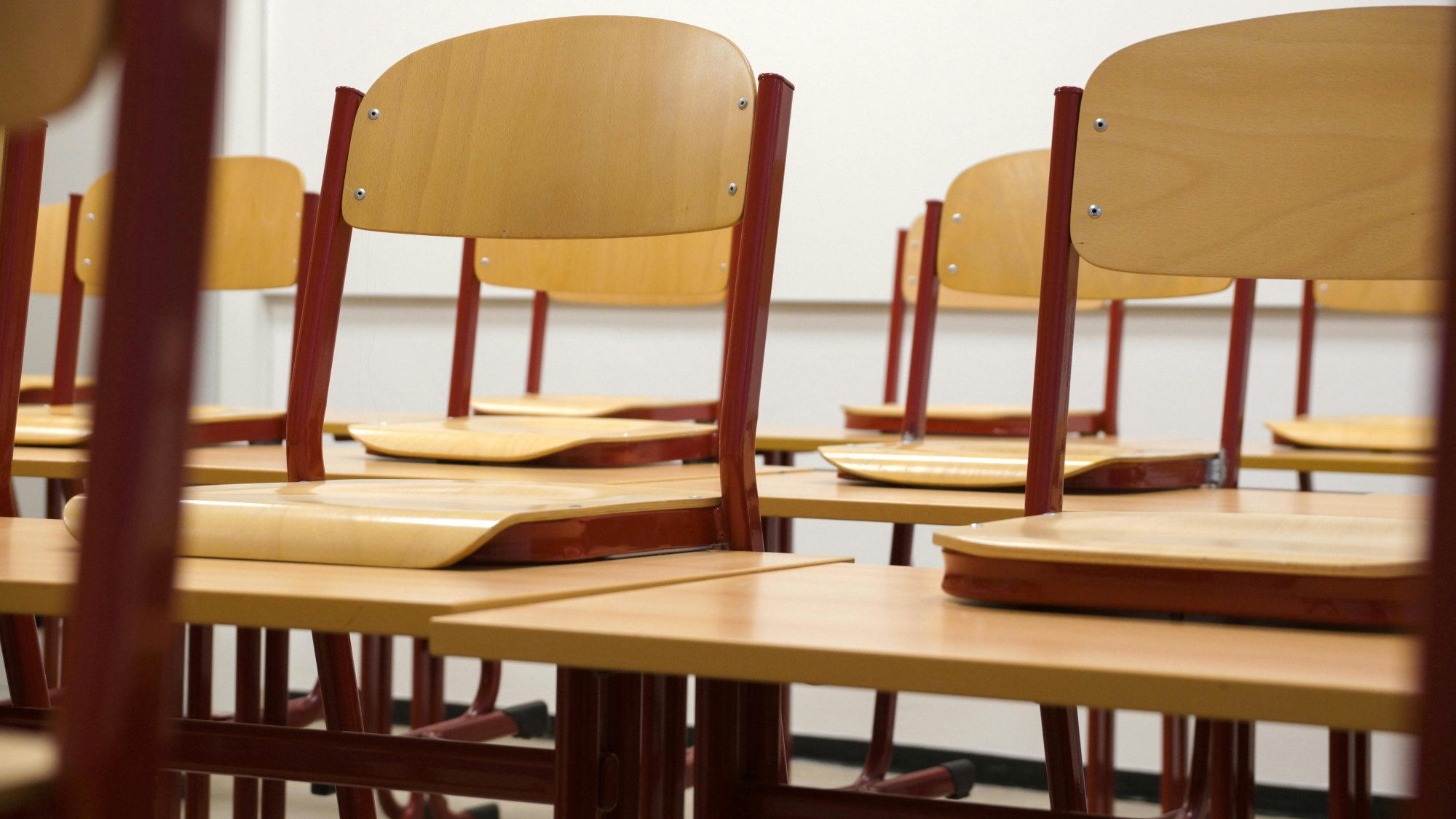


If schools are failing it is because they are being defunded, privatized, transformed into testing centers, and reduced to regressive training practices.
Sep 6, 2024 3:33 AM
If schools are failing it is because they are being defunded, privatized, transformed into testing centers, and reduced to regressive training practices.
Since the 1970s, a form of predatory capitalism called neoliberalism has waged war on the welfare state, public sphere and the common good. This mode of governance argues that the market should govern the economy and all aspects of society. It concentrates wealth in the hands of a financial elite and elevates untrammeled self-interest, unchecked individualism, deregulation, and privatization as the governing principles of society.
Under neoliberalism, everything is for sale and the only obligation of citizenship is consumerism. We live in an age when economic activity is divorced from social costs, while policies that produce racial cleansing, militarism, and staggering levels of inequality have become defining features of everyday life.
This is a plague of political, economic, and pedagogical terrorism.Between 2020 and 2023, the Covid-19 pandemic laid bare the shortcomings of a market-driven social order, highlighting its disregard for fundamental human needs such as healthcare, access to food, decent working conditions, fair wages, and quality education. Neoliberalism views government as the enemy of the market, limits society to the realm of the family and individuals, embraces a fixed hedonism, and challenges the very idea of the public good.
The pandemic revealed in all its ugliness, neoliberalism’s death-producing mechanisms of systemic inequality, deregulation, a culture of cruelty, and an increasingly dangerous assault on the environment. It has also made visible an anti-intellectual culture and pedagogy of repression that derides any notion of critical education, that is, an education that equips individuals to think critically, engage in thoughtful dialogue, appropriate the lessons of history, and learn how to govern rather than be governed.
Related stories
Across the global landscape, another crisis is unfolding as students rally for Palestinian freedom and statehood, boldly positioning themselves on the right side of history. However, their peaceful demonstrations often meet with brutal repression by armed police officers, illustrating the grim reality of state violence and the specter of an emerging fascism.
Increasingly, democratic institutions such as the independent media, schools, the legal system, health systems, certain financial institutions, and higher education are under siege. The promise, if not ideals, of democracy are receding as those who breathe new life into a fascist past are once again on the move, subverting language, values, civic courage, vision, and critical consciousness.
Education has increasingly become a tool of domination, as entrepreneurs of hate target workers, the poor, people of color, refugees, immigrants, and others considered disposable. The present moment stands at a historical juncture in which the structures of liberation and authoritarianism are vying to shape a future that appears to be either an unthinkable nightmare or a realizable dream.
It is hard to imagine a more urgent moment than now to make education central to politics. What is at stake is a view of education as both a moral imperative and political project, rooted in the goal of emancipation for all people.
What is being assaulted by the far-right and fascists is a mode of critical pedagogy that encourages human agency, enables people to be not only critical thinkers, but also actively engaged social actors. If we are going to develop a politics capable of awakening our critical, imaginative, and historical sensibilities, it is crucial for educators and others to recognize the central role of critical pedagogy.
This approach is essential for shaping agents, identities, and values that foster a citizenry that is knowledgeable, informed, and critically attentive and willing to hold power accountable. Drawing on the legacy of Paulo Freire, this pedagogical project recognizes that there is no democracy without well-informed and engaged citizens.
This is a pedagogical practice that calls students beyond themselves, affirms the ethical imperative for them to care for others, embraces historical memory, works to dismantle structures of domination, and enables students to become subjects rather than objects of history, politics, and power. If educators are going to develop a politics capable of awakening students’ critical, imaginative, and historical sensibilities, it is vital to engage education as a project of individual and collective empowerment—a project based on the search for truth, an enlarging of the civic imagination, and the practice of freedom.
We live at a time when the unthinkable has become so normalized that anything can be said and everything that matters unsaid. Moreover, this degrading of truth and the emptying of language makes it all the more difficult to distinguish good from evil, justice from injustice. Under such circumstances, democratic societies are rapidly losing a language and ethical grammar that challenges the political and racist machineries of cruelty, state violence and targeted exclusions (Winderson 2012: 1-32).
Central to the current political moment is the development of a language of critique and possibility. Such a language is necessary to expose, resist and overcome the tyrannical fascist nightmares that have descended upon the United States, Brazil, Argentina, Hungary, and a number of other countries plagued by the rise of right-wing populist movements and neo-Nazi parties.
In an age marked by social isolation, information overflow, a culture of immediacy, consumer glut, and spectacularized violence, it is more crucial than ever to take seriously the idea that a democracy cannot endure or be safeguarded without citizens who are civically literate and critically engaged.
Critical pedagogy both in its symbolic and institutional forms has a vital role to play in fighting the resurgence of false renderings of history, white supremacy, religious fundamentalism, an accelerating militarism, and ultra-nationalism. Moreover, as fascists across the globe are disseminating toxic racist and ultra-nationalist images of the past, it is essential to reclaim education as a form of historical consciousness and moral witnessing.
This is especially true at a time when historical and social amnesia have undermined the foundations of civic culture, matched only by the masculinization of the public sphere and the increasing normalization of a fascist politics that thrives on ignorance, fear, the suppression of dissent, and hate.
The merging of power, new digital technologies, and everyday life have not only altered time and space, they have expanded the reach of culture as an educational force. A culture of lies, cruelty, and hate, coupled with a fear of history and a 24/7 flow of information now wages a war on attention spans, and the conditions necessary to think, contemplate, and arrive at sound judgments.
Education as a form of cultural work extends far beyond the classroom and its pedagogical influences. It plays a crucial role in challenging and resisting the rise of fascist pedagogical formations and their rehabilitation of fascist principles and ideas (see, for example, Mayer 2019).
Any viable notion of critical pedagogy needs to create the educational visions and tools to produce a radical shift in consciousness; it must be capable of recognizing both the scorched earth policies of a gangster capitalism marked by staggering inequalities, settler colonialism, and the twisted anti-democratic ideologies that support it. This shift in consciousness cannot occur without pedagogical interventions that speak to people in ways in which they can recognize themselves, identify with the issues being addressed, and place the privatization of their troubles in a broader systemic context.
Thus, there can be no authentic politics without what I call a pedagogy of identification. Lacking this understanding, pedagogy all too easily becomes a form of either symbolic violence or is reduced to a jargonistic rhetoric that assaults and shames, in one instance, and confuses in the other.
What it does not do is educate a broader set of publics and audience. At the same time, if academics are going to function as public intellectuals, they need to combine the mutually interdependent roles of critical educator and active citizen. In doing so, they should not only address their work to a broader public and important social issues, they also need to develop a language that connects everyday troubles to wider structures and presses the claim for economic and social justice.
Taking a term from the scholar Ariella Azolay, educators need to practice what might be called a form of pedagogical “citizenship” with a focus on its ability, when practiced thoughtfully, to remind us of our mutual responsibilities (Cole 2019: 17). At the same time, critical educators must resist the temptation of oversimplification and hold the bar of analysis high while still being able to speak to a diverse and broader audience.
One of the challenges facing the current generation of educators, students, and others is the need to address the question of what education should accomplish in a society. Or more pointedly, what is the role is of education in a democracy? What pedagogical, political, and ethical responsibilities should educators, musicians, artists, journalists, and other cultural workers take on at a time when there is an alarming rise of authoritarian regimes across the globe, especially in formally democratic countries such as Turkey, Hungary, India, and Italy.
How can educational and pedagogical practices be connected to the resurrection of historical memory, new modes of solidarity, a resurgence of the radical imagination, and broad-based struggles for an insurrectional democracy? How can education be enlisted to fight what the cultural theorist Mark Fisher once called neoliberalism’s most brutal weapon “the slow cancellation of the future?” (Fisher 2014: 2)
Such a vision suggests resurrecting a radical democratic project that provides the basis for imagining a life beyond a social order immersed in massive inequality, endless assaults on the environment, and elevates war and militarization to the highest and most sanctified national ideals. Under such circumstances, education becomes more than an obsession with accountability schemes, testing, market values, and an unreflective immersion in the crude empiricism of a data-obsessed market-driven society.
In addition, it rejects the notion that colleges and universities should be reduced to sites for training students for the workforce—a reductive vision now being imposed on public and higher education by high tech companies such as Facebook, Netflix, and Google who want to encourage what they call the entrepreneurial mission of education (Singer 2017).
Education and pedagogy should provide the conditions for young people to think about keeping a democracy alive and vibrant, not simply training students to be workers. An education for empowerment that functions as the practice of freedom should provide a classroom environment that is intellectually rigorous and critical, while allowing students to give voice to their experiences, aspirations, and dreams.
It should be a protective and courageous space in which students should be able to speak, write, and act from a position of agency and informed judgment. It should be a place where education does the bridging work of connecting schools to the wider society, connects the self to others, and addresses important social and political issues.
It should also provide the conditions for students to learn how to align themselves with an increased sense of social responsibility, coupled with a passion for equality, justice, and freedom. As a rupturing practice, critical pedagogy must refuse to equate capitalism with democracy.
In doing so, it must make clear that one cannot discuss fascism without addressing capitalism. Any viable critical pedagogy must be anti-capitalist, revive the discourse of radical democracy, and create a historical bloc around new social formations, beyond the established political liberal and conservative parties.
This suggests that one of the most serious challenges facing educators is the task of developing discourses and pedagogical practices that connect a critical reading of both the word and the world in ways that enhance the creative capacities of young people and provide the conditions for them to become critical agents. In taking up this project, educators and others should attempt to create the conditions that give students the opportunity to acquire the knowledge, values, and civic courage that enables them to struggle in order to make desolation and cynicism unconvincing and hope practical.
Educated hope is not a call to overlook the difficult conditions that shape both schools and the larger social order, nor is it a blueprint removed from specific contexts and struggles. On the contrary, it is the precondition for imagining a future that does not replicate the nightmares of the present, for not making the present the future.
Educated hope should be an active pedagogical practice that dignifies the labor of teachers, offers up critical knowledge linked to democratic social change, affirms shared responsibilities, and encourages teachers and students to recognize ambivalence and uncertainty as fundamental dimensions of learning. Such hope offers the possibility of thinking beyond the given.
As difficult as this task may seem to educators, if not to a larger public, it is a struggle worth waging.Hope must be tempered by the complex reality of the times and viewed as a project and condition for providing a sense of collective agency, opposition, political imagination, and engaged participation. Without hope, even in the darkes times, there is no possibility for resistance, dissent, and struggle. Agency is the condition of struggle, and hope is the condition of agency.
Hope expands the space of the possible and becomes a way of recognizing and naming the incomplete nature of the present. Democracy should be a way of thinking about education, one that thrives on connecting pedagogy to the practice of freedom, learning to ethics, and agency to the imperatives of social responsibility and the public good (Giroux 2019).
Neoliberal capitalism strips hope of its utopian possibilities and thrives on the notion that we live in an era of foreclosed hope, and that any attempt to think otherwise will result in a nightmare. The current fight against a growing fascist politics across the globe is not only a struggle over economic structures or the commanding heights of corporate power.
It is also a struggle over visions, ideas, consciousness, identifications, the power of persuasion, and the ability to shift the culture itself. It is also a struggle to reclaim historical memory. Any struggle for a radical democratic socialist order will not take place if “the lessons from our dark past [cannot] be learned and transformed into constructive resolutions” and solutions for struggling for and creating a post-capitalist society (Bertoldi 2017).
In the age of nascent fascism, it is not enough to connect education with the defense of reason, informed judgment, and critical agency; it must also be aligned with the power and potential of collective resistance. At stake here is the courage to take on the challenge of what kind of world we want—what kind of future we want to build for our children? The great philosopher, Ernst Bloch, insisted that hope taps into our deepest experiences and that without it reason and justice cannot blossom.
In The Fire Next Time, James Baldwin adds a call for compassion and social responsibility to this notion of hope, one that is indebted to those who will follow us. He writes:
“Generations do not cease to be born, and we are responsible to them.... [T]he moment we break faith with one another, the sea engulfs us, and the light goes out.”
Now more than ever educators must live up to the challenge of keeping fires of resistance burning with a feverish intensity. Only then will we be able to keep the lights on and the future open. In addition to that eloquent appeal, I would say that history is open, and that it is time to think differently in order to act differently, especially if, as educators, we want to imagine and fight for alternative democratic futures and build new horizons of possibility.
We may live in dark times, but the future is still open. The time has come to develop a political language and pedagogical tools in which values, social responsibility, and the institutions that support them become central to invigorating and fortifying a new era of civic imagination, a new sense of social agency, collective struggle, and an impassioned sense of civic courage and political will.
As Martin Luther King Jr, John Dewey, Paulo Freire, and Nelson Mandela have stated there is no project of freedom and liberation without education, and that changing attitudes and institutions are interrelated. Central to this insight is the notion advanced by Pierre Bourdieu that the most important forms of domination are not only economic but also intellectual and pedagogical and lie on the side of belief and persuasion.
This suggests that academics bear a certain responsibility in acknowledging that the current fight against an emerging authoritarianism and white nationalism across the globe is not only a struggle over economic structures or the commanding heights of corporate power. It is also a struggle over visions, ideas, consciousness, and the power to shift the culture itself.
Any struggle for the promises of a democratic order will not take place if lies cancel out reason, ignorance dismantles informed judgments, and truth succumbs to demagogic appeals to unchecked power. As Francisco Goya warned “the sleep of reason produces monsters.”I want to conclude by making some suggestions, however incomplete, regarding what we can do as educators to save public and higher education and connect them to the broader struggle over democracy itself.
First, in the midst of the current assault on public and higher education, educators need a language of imagined futures. Such a language should be defined through its claims on democracy and a critical pedagogy that disturbs, inspires, and energizes students to think critically and act on the conditions in the wider society that shape their lives. This is a language that challenges the neoliberal notion of education which tells students to invest in themselves as human capital.
Second, educators should also acknowledge and make good on the notion that there is no democracy without informed and knowledgeable citizens and in doing so affirm education’s critical function and the crucial role it plays in promoting civic awareness, civic courage, and civic engagement.
Third, in a world driven by data, metrics, and fragmented knowledge, educators need to teach students to be border crossers, who can think comprehensively, comparatively, and historically. Educators should teach students to engage in multiple literacies extending from print and visual culture to digital culture. Students need to learn how to think intersectionally, comprehensively, and relationally while also being able to not only consume culture but also produce it; they should learn how to be both cultural critics and cultural producers.
Fourth, educators must defend critical education as the search for truth, the practice of freedom, and as a pedagogy that enables students to write and act from a position of agency and empowerment. Such a task suggests that critical pedagogy should shift not only the way people think but also encourage them to shape for the better the world in which they find themselves. As the practice of freedom, critical pedagogy arises from the conviction that educators and other cultural workers have a responsibility to unsettle power, trouble consensus, and challenge common sense. This is a view of pedagogy that should enable students to interrogate commonsense understandings of the world, take risks in their thinking, however difficult, and be willing to take a stand for free inquiry in the pursuit of truth, multiple ways of knowing, mutual respect, and civic values in order to address and rectify social injustices.
Fifth, students need to learn how to think dangerously, push at the frontiers of knowledge, and support the notion that the search for justice is never finished and that no society is ever just enough. These are not merely methodical considerations but also moral and political practices because they presuppose the education of students who can imagine a future in which justice, equality, freedom, and democracy matter and are attainable.
Sixth, educators need to argue for a notion of education that is viewed as inherently political– one that relentlessly questions the kinds of labor, practices, and forms of teaching, research, and modes of evaluation that are enacted in public and higher education. It is important to acknowledge that pedagogy is always political because it is a moral and political practice that is always implicated in unequal power relations, especially in its production of particular notions of agency, versions of civic life, the larger society, and the future itself. Schools are never removed from issues of power and at their best should be places where students realize themselves as thoughtful, informed, and critical citizens.
Seventh, in an age in which educators are being censored, fired, and in some cases subject to criminal penalties, it is crucial for them to fight to gain control over the conditions of their labor. Without power, faculty are reduced to casual labor, play no role in the governing process, and work under labor conditions comparable to how workers are treated at Amazon and Walmart. Educators need a new vision, language, and collective strategy in order to regain the power, rightful influence, control and security over their work conditions and their ability to make meaningful contributions to their students and larger society.
Eighth, education should be free and guarantee a quality education for everyone. The larger issue here is that education cannot serve the public good in a society marked by staggering forms of inequality. Rather than build bombs, fund the defense industry, and inflate a death dealing military budget, which was $877 billion in 2022, we need massive investments in public and higher education. This vision of freedom and justice can begin by eliminating existing student debt, allowing students to work in public service, free themselves from being indentured servants to larger financial interests. This is an investment in which youth are written into the future, rather than potentially eliminated from it.
There is no justice without a democratically driven education system. The greatest threat to education in north America and around the globe is anti-democratic ideologies and market values that believe public schools and higher education are failing because they are public and should not operate in the interests of furthering the promise and possibility of democracy.
If schools are failing it is because they are being defunded, privatized, and modeled after white nationalist indoctrination spheres, transformed into testing centers, and reduced to regressive training practices.
Finally, I want to suggest that in a society in which democracy is under siege, it is crucial for educators to remember that alternative futures are possible and that acting on these beliefs is a precondition for making social change possible.
This political and pedagogical project demands both a language of critique and a language of possibility. If critique serves to hold power accountable, educated hope allows us to think otherwise in order to act otherwise and to think against the grain of received opinion while imagining a future that does not repeat the predatory forces of the present.
Comments

Powered by RoundtableAn AI/DeFi-powered Enterprise Media Operating System. Learn more at Roundtable.io.© Roundtable 2026. By using this site you agree to the Terms of Use and Privacy Policy