
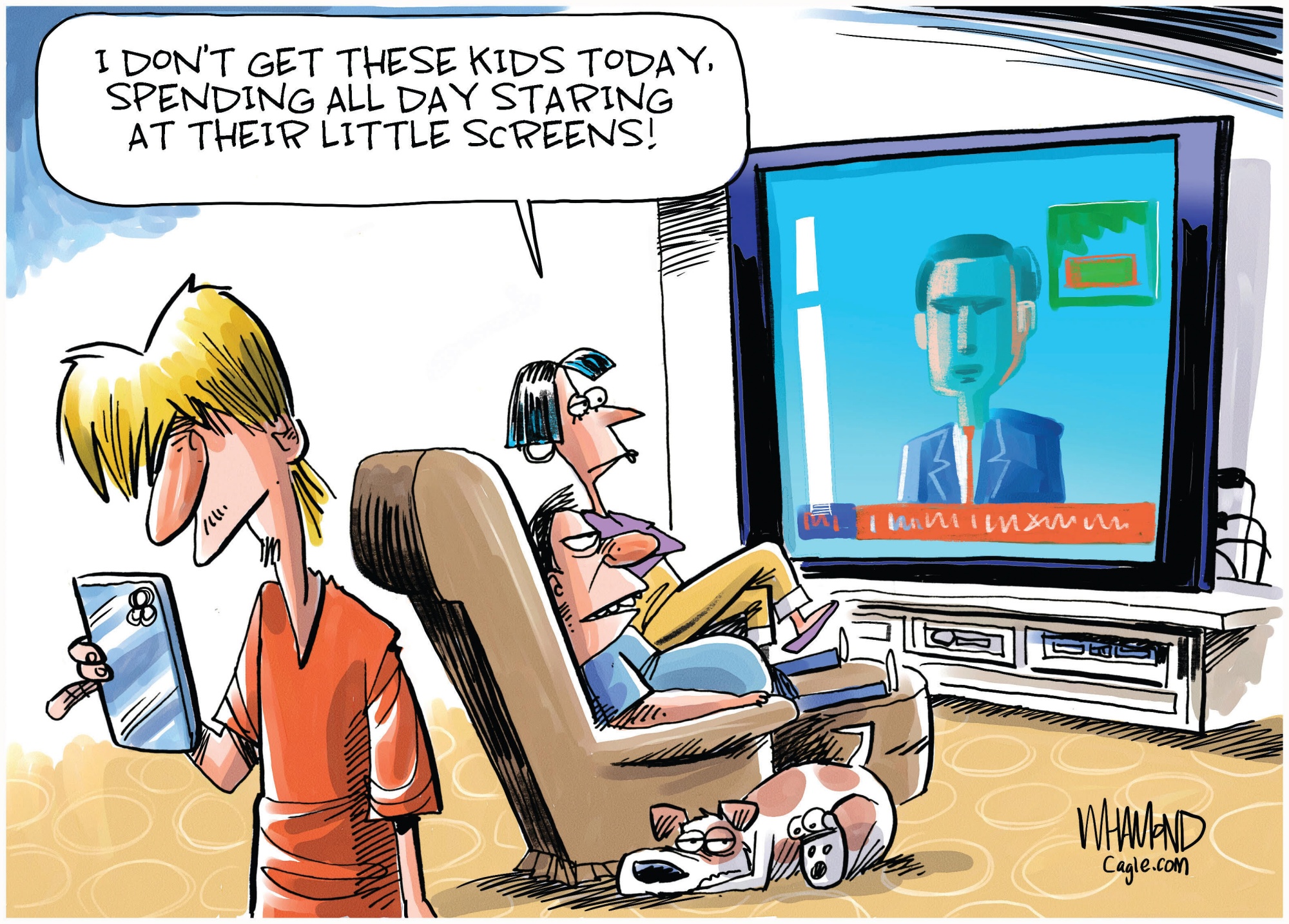
Illustration by Dave Whamond on Cagle Cartoons


Linking smartphones and social media to youth well-being distracts us and poor legislation eliminates important sources of information for vulnerable teenagers.
Sep 4, 2024 3:03 AM
Linking smartphones and social media to youth well-being distracts us and poor legislation eliminates important sources of information for vulnerable teenagers.
Gov. Gavin Newsom, school Superintendent Tony Thurmond, legislators, and school districts are vying to limit teenagers’ social media access, including restricting or banning students from having smartphones. “Excessive smartphone use among youth is linked to increased anxiety, depression, and other mental health issues,” the governor argues, while restrictions promote “enhanced social interactions.”
Principals glow with self-praise as they claim de-phoned teens actually socialize with each other instead of staring at screens. Politicians and experts break both arms patting themselves on the back.
Of course, a generation ago, adults panicked over teenagers socializing with each other, which authorities knew meant they were palming drugs and guns, contemplating pregnancies, plotting all sorts of evil peer physicalities. The real world was so dangerous that California authorities arrested tens of thousands of teens for curfews every year and banned them from public en masse to keep them away from it.
The Bill Clinton presidency pushed daytime and nighttime curfews so restrictive that teens could be in public only a few hours on a few days a year. Now, we champ to get them away from keypads and outdoors, where they’ll soon scare the elders even more.
Related stories
Are schools and other institutions right to forbid phone and social media use that is disruptive and distracting? Absolutely; nearly all already do. But selective enforcement is very different from officials’ latest one-size-fits-all, save-the-children stampede that combines the zeal, misinformation, and cost-free culture-war politics of past mistakes later research found ineffective or even harmful.
It doesn’t matter whether they work
A quarter century ago, California officials, the press, and Clinton feverishly hailed school uniforms as the magic cure-all for every ill plaguing schools. Long Beach officialdom crowed over the “amazing” improvements.
Then, massive studies of thousands of students and research reviews summarized by Virginia Tech sociology professor David Brunsma found exactly the opposite:
"School uniform policies do not significantly affect students' educational outcomes and, in some cases, they may be more harmful than previously thought… Uniform policies have no significant impact on measures of self-esteem in middle or high schools… no effect on psychological coping and do not help us understand behavioral problems at school."
Adults just felt better seeing kids all dressed alike.
Another wildly enthusiastic crusade greeted mandatory student drug testing. Later evaluations by University of Michigan surveyors found, “drug testing of students in schools does not deter drug use” and has predictably negative effects. The same bad results followed California’s ecstatically-ballyhooed 1998 teen driving law (later linked to more teen highway deaths) and periodic youth curfews.
California’s much-hyped but pointless 2016 ban on under-21 tobacco use (teens had already cut the habit by 60% on their own) was followed by the first survey in 15 years to show no reduction. Strangely, legislators, officials, professionals, and reporters who so eagerly campaigned to slap more restrictions to save teens’ sanity, health, and lives showed no concern when those restrictions later proved worthless or harmful – especially in jeopardizing young adults’ badly needed employment opportunities.
The panacea crusaders are back
Popular “save the children!” crusades have surrounded every new media and culture decade after decade, from dime novels, jazz, comics, voice telephones, rock’n’roll, video games, rap music, library computer terminals, etc., to social media, often bringing unintended consequences.
The emotional, one-sided campaign to ban and restrict teens from smartphones and social media (California’s major media with few exceptions simply refuse to report dissenting views) relies heavily on anecdotes and weak, outdated studies while ignoring the growing body of newer, better-designed research showing curbs are a bad idea.
New York University statistician Aaron Brown’s 2024 review of 476 studies cited by those who blame social media for harming teens found most are now 15 or more years out of date. Of the few valid studies, “the evidence not only doesn't support [their] claim about teen health and mental health; it undermines it.”.
Likewise, recent, large-scale reviews by Stetson University psychologist Christopher Ferguson and colleagues of dozens of studies of social media and teens found “screen media plays little role in mental health concerns” and desistance from screens brought no improvements.
The Centers for Disease Control’s detailed 2021 survey of 7,000 teens found students (especially girls and LGBTQ youth) who had been violently and/or emotionally abused by parents and household grownups were much more likely than non-abused teens to use screens. That is, teens who log more screen time are more depressed because more have been abused or have other problems, not because they’re online.
Similarly, University of California psychologist Candace Odgers and colleagues’ 2024 review of scores of studies found “not that social-media use predicts or causes depression, but that young people who already have mental-health problems use such platforms more often or in different ways from their healthy peers.”
As reviews expose flawed past research, recent, better-designed, long-term studies are revealing complexities.
The 2022 four-year Stanford Medicine and Data study tracking 250 seven-to-15-year-olds found no relationship between even younger teen’s online/phone use and “their well-being and adjustment outcomes.” The eight-year 2024 Trondheim study of 600 teens found, “increased social media use predicted more time with friends offline” and “no support for the assumption that social media use predicts declines in social skills.” That is, teens who socialize well online also socialize well elsewhere.
“Research does not definitively show that excessive screen time causes teen anxiety or depression,” a 2024 review in the prestigious journal Nature concluded. In fact, more restrictions on teens were “significantly associated with problematic internet use.”
A detailed, 2024 multi-institutional study of 2.4 million people worldwide over 15 years found “internet access and use predict well-being positively and independently” for all ages, including teens. Likewise, the 2024 National Academy of Sciences “committee’s review of the literature did not support the conclusion that social media causes changes in adolescent health at the population level,” although some individuals find heavy internet use troublesome.
A 2023 University of Manchester study of 12,000 teens found, “social media use is one of the least influential factors of adolescent mental health, with others (for example, bullying, lack of family support and school work dissatisfaction) exhibiting stronger associations.” That finding dovetails with U.S. CDC survey numbers showing abuses by household adults are by far the biggest predictor of teens’ depression.
Still, even if social media and smartphones don’t harm teens as previously thought, shouldn’t schools ban them as annoyances and distractions? Again, the latest research suggests caution.
The CDC survey showed teens (especially already depressed teens) who rarely use screen media are 1.4 times more likely to attempt suicide and 2.1 times more likely to harm themselves than teens who often use screen media. Pew Research’s 2022 study of 1,316 teens found large majorities reporting that social media help them feel “more accepted” and connects them to “people who can help them get through tough times.”
Teens “are embracing online mental health tools—from social media to therapy and mental health apps—as resources for seeking support and managing their own mental health and well-being” and are “careful to use trusted sources,” the conservative Common Sense Media’s 2024 study of 1,254 young people concluded.
“Linking smartphones and social media to youth well-being distracts us from the real difficulties faced by young people,” a 2024 report by Princeton University’s multi-university research team warned. “Poorly-formulated legislation will eliminate important sources of information for vulnerable teenagers and wipe out anonymity on the social web.”
That warning is apt, given the CDC’s 2021 finding of widespread domestic abuses of teens accompanying skyrocketing drug and alcohol abuse by grownups. Overdose deaths by ages 25-64 (teenagers’ parents, parents’ partners, relatives, etc.) soared by 200% in the nine-county Bay Area region, by 213% across California, and by 300% nationwide from 2010 to 2023 – exactly the period teens became more depressed.
Yet, the governor, legislators, and school and health officials remain silent on these major, very real threats to teens’ mental health. Instead, citing anecdotes and schools’ and institutions’ need to prevent disruptions, they push wholesale, widespread bans and controls on students’ screen use. Let’s not rush into yet another mistake.
Comments

Powered by RoundtableAn AI/DeFi-powered Enterprise Media Operating System. Learn more at Roundtable.io.© Roundtable 2026. By using this site you agree to the Terms of Use and Privacy Policy