
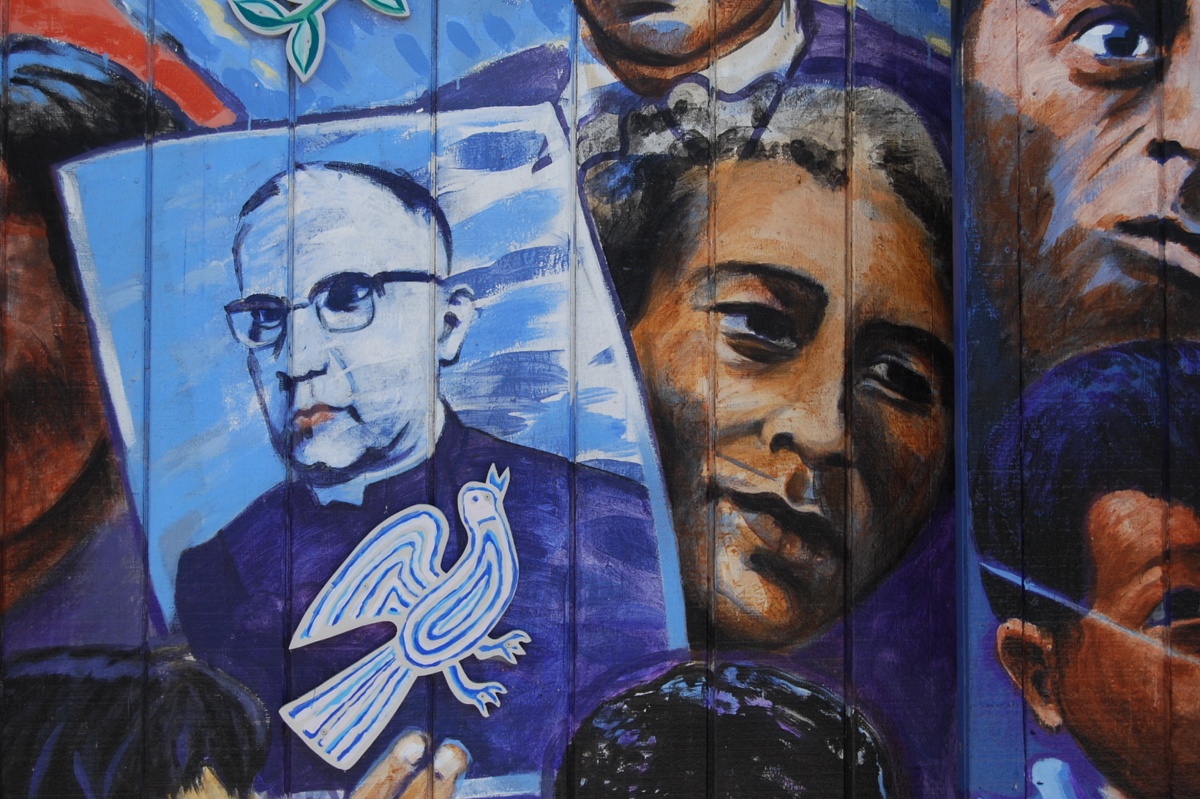
Eric E. Castro • CC BY 2.0 Flickr


oscar romero
Apr 11, 2025 3:15 PM
Updated Apr 11, 2025 6:59 PM
Liberation Theology, El Salvador and the Challenge of Saint Oscar Romero
They send them back in chains—sons of a shattered inheritance, where tattoos bloom like bruises across their bodies, testimonies etched in the language of survival, histories not chosen but endured—memories of violence pressed deep like fingerprints into the soul’s soft clay. They are called animals, threats, infestations, terrorists, words hurled like stones by those who refuse to see the image of God behind the ink, the divine breath behind the brokenness.
But peel back the layers, and you’ll find the wreckage of war. U.S.-backed civil war. Death squads trained in Georgia. U.S. army and CIA interrogation manuals translated into Spanish. Mass graves filled with peasant bodies. And in the midst of it all, a bishop — soft-spoken, bespectacled, unarmed.
Óscar Romero stood at the altar and named the beast. He dared to say: "The Church must speak out for those who have no voice." For this, they shot him mid-Mass — the body of Christ raised aloft in his hand, his own body broken — a sacrifice mirroring the very Christ he invoked.
And now?
Related stories
The same soil that drank Romero’s blood builds mega prisons. The same system that assassinated him now contracts with foreign powers to lock up the offspring of war — those who inherited trauma, exile, and desperation.
The children of the El Mozote massacre now fill the cells of Tecoluca. Many of the gang members the U.S. sends back to El Salvador are not only victims of the present carceral state, but the children of an unfinished war — a war Romero tried to stop with his body, his voice, and finally, with his blood.
Saint Óscar Romero was martyred for saying what empire could not abide: that the Gospel belongs to the poor, and that the Church must speak where there is silence, must cry out where there is injustice. He was canonized in Rome but crucified in San Salvador — and the very forces that silenced him are the ancestors of today’s incarceration regime.
What if Saint Romero’s canonization is not a closing benediction in a world gone mad but a trumpet blast? Not a wreath of flowers but a cry of fire? After all, his sainthood does not sanctify the past — it calls us to convert the present. Liberation theology is not dead. It sleeps beneath the concrete, waiting to rise once again.
The origins of liberation theology are deeply tied to both liturgical history and the lived realities of oppressed peoples, especially in Latin America during the mid-20th century. To understand how it began, we have to look at a few key movements and moments where theology shifted from the lofty heavens to the dusty roads of the poor.
In the beginning, the altar was distant.
For centuries, the Church's liturgy unfolded like a celestial drama, high above the heads of the faithful. The priest stood facing east, away from the people, speaking Latin — a language most could not understand. Incense filled the air, the bread that was transformed into the body of Christ was held reverentially aloft, and the chalice of Christ’s blood touched lips quivering in gratitude. Yet the mystery remained... mysterious. The sanctity of the Mass was holy, yes, but also far away. The poor filled the Church, genuflected, and left hungry.
Then came the winds of change — Vatican II (1962–1965).
The Second Vatican Council was the first tremor in the foundations. The Church turned around — literally. Priests began facing the people. Mass was said in the vernacular. The People of God were no longer passive spectators but active participants. The liturgy became a place where the burdens of daily life met God’s mystery, where the Word was proclaimed and heard. Hosana in the highest.
It was as if the Spirit whispered: "The altar belongs to all."
This renewal of the liturgy opened a door — not just to new rites, but to new sight. And through that door walked the powerless and the poor.
In the slums of São Paulo, the hills of El Salvador, and the favelas of Rio, the faithful gathered not just in churches but in Base Ecclesial Communities — small groups where scripture was read and pages gingerly turned with calloused hands, where the Exodus was not past history but hope for the future, where the Gospel was not a comfort but a call to fight death squads trained afar, in Fort Benning, Georgia.
The Eucharist — preserved in sacred ritual — became a revolutionary memory: a poor laborer from Nazareth, breaking bread with the rejected and the vulnerable, proclaiming a Kingdom where the last would be first.
And so theology descended from the ivory towers and was born again — in the margins, in villages where government death squads dragged peasants out of their homes and executed them for belonging to left wing guerilla movements.
It was both a quiet war and a bloody one. But always theological, always political, always aimed not just at silencing dissent but at crushing a vision of Christianity that placed the poor, the exploited, and the crucified at its center.
Noam Chomsky’s observation — that the U.S.-backed campaign against liberation theology was “first religious war of the 21st century” — is piercing. Because it wasn’t just a war of bullets and bayonets. It was a war of ideology, of hermeneutics, of Gospel versus empire. It was a war where the enemy was not just communism, but conscientization — Paulo Freire’s term for waking up the poor to their historical situation and giving them the tools to change it.
In Latin America, the U.S. feared priests more than guerrillas. A priest with a Bible preaching justice in a village was more dangerous than a guerrillero with a gun. Because the priest spoke to souls. Because the priest said: “God is not neutral. God is on your side.”
So the United States trained death squads. They funded dictators. They sent money, helicopters, and manuals. But also theologians — those who would neuter the Gospel, bleach it of its radical message and saving grace, and replace it with a gospel of personal morality, prosperity, and quiet obedience. A gospel that bows to Caesar and forgets Calvary. (Think of Paula Whites speaking in tongues and summoning angels from Africa and South America or Joel Osteen’s promises of riches for the faithful).
And in that war, El Salvador was ground zero.
Pope John Paul II, shaped by the brutal repression of communism in Poland, saw in liberation theology a dangerous flirtation with Marxist ideology. Reagan, leading the United States into its final crusade against the “evil empire,” saw in it an insurgency of the poor that threatened the hemispheric order. Together, they forged a strange concordat — altar and empire, crozier and cruise missile — to strangle a theology that dared to say God was not neutral.
They feared, or claimed to fear, that the Gospel was being politicized. But what is the Incarnation if not the politicization of God — God taking sides, becoming flesh, walking among the hungry and the tortured? Critics decried the theologians of liberation whom they believed were reading the Bible with Marxist lenses. But what terrified them more, perhaps, was that the poor were becoming literate enough to read the Bible for themselves — and finding themselves not cursed, but blessed.
Reagan’s war against liberation theology was not merely political; it was sacramental in its violence — a parody of holy war, where the enemy was not heresy but orthopraxis—right action for the poor. It was the inverse of Pentecost: tongues of fire not to inspire, but to incinerate.
What Chomsky recognized — and what so few in the American church dared to say — was that this war was a war of religion, of competing gods. On one side, the God of the Beatitudes, the God of exodus and resurrection, the God of Romero’s trembling voice at the altar. On the other, the gods of market, military, and manifest destiny — Moloch in a three-piece suit.
The U.S. strategy, like that of Rome centuries earlier, was to kill the body to silence the word. But, like in the catacombs of old, the blood of the martyrs became seed. The bodies buried in El Salvador's soil — in mass graves, in unmarked pits — did not decay quietly.
They preached.
The "preferential option for the poor" was not just a theological slogan; it was an act of war against empire. And empire responded in kind.
So perhaps what we’re seeing now — with mega-prisons in El Salvador turned into sites of MAGA’s retribution, with refugees branded as terrorists, with Christian language co-opted to bless oppression, with the Trump administration investigating peaceful protesters of genocide — is not just the aftermath. It is Rome, reborn. The coliseum has walls and cameras now. The cross wears a flag.
The Vatican silenced voices. The White House funded armies. Priests and nuns were disappeared. Universities were raided. And bishops, once servants of the oligarchs, began to return to their palaces.
But one archbishop did not. A new theology was being born, and he sensed it.
In 1971, the Peruvian priest Gustavo Gutierrez published A Theology of Liberation. It was not a theology about the poor, spoken from marble pulpits or penned in the quiet of ivy towers. No—it was a theology from below, rising like smoke from the huts of campesinos and the kitchens of widows. It was a theology of the poor, whispered through cracked lips in prayer and shouted from mountaintops in defiance. It was the Gospel with calloused hands and dirt under its nails, forged not in abstraction but in the crucible of hunger, exile, and blood.
This was not pity dressed up as doctrine. This was the Word made flesh again—this time in the broken bodies of the oppressed, in the voices of those the world tried to silence.
Gutierrez asked: What does the Gospel mean to those who live beneath the heel of empire, abandoned by both government and sometimes even the Church?
He wrote: "To know God is to do justice." In that sentence, liturgy and life met.
In liberation theology, the Mass is not just remembrance — it is resistance. The Cross is not only suffering — it is solidarity. And resurrection. Not only a promise of the afterlife, but a defiant hope for the here and now.
The altar is still sacred. But now it stands firmly on the earth, in the soil of struggle, among campesinos, factory workers, mothers of the disappeared, and children in tattered clothes with dust on their feet. Liberation theology rises like a cry from the margins, a fierce hymn of hope sung not from gilded pulpits but from the dust of memory of the forgotten. It is a theology forged in the fire of suffering, where God is not enthroned above the pain of the world but walks barefoot among the poor, wounded and weary, whispering liberation through broken chains.
At its heart is a sacred bias—the conviction that the Divine stands first and foremost with the oppressed. The poor are not passive recipients of charity, but the very pulse of God’s grace, the living texts through whom the Word speaks anew. In the suffering of the poor, theology finds its ground; in their struggle, its direction.
Liberation theology is not content with contemplation alone. It demands action—marches, movements, and radical transformation. It sees injustice not as a sad reality to be pitied, but a structural sin to be dismantled.
The gospel, in this light, is not only about saving souls but about healing systems, tearing down the walls of inequality brick by brick.
This theology reads Scripture not as a detached chronicle, but as a living document written in the blood and hope of the oppressed. Exodus becomes more than ancient history—it is the daily bread of the enslaved dreaming of freedom. The prophets roar again, and Christ, crucified by empire, rises as the revolutionary companion of all who resist.
Theory alone is not enough. Liberation theology insists on praxis—a dance of reflection and action, of kneeling in prayer and rising in protest. It is faith that rolls up its sleeves, that wades into struggle, that believes salvation begins wherever oppression ends.
This movement took root amid the poverty and dictatorship of 20th-century Latin America, where voices like Gustavo Gutiérrez called for a church not perched above the people, but embedded in their cry. From there, the fire spread.
Liberation theology is not one voice, but a chorus. It gave rise to Black liberation theology in the streets of the U.S., where faith became a shield against racial terror and a song of deliverance.
Feminist theology rose with it, calling out patriarchy within pews and scripture. And yes, priests read Karl Marx. Much of what is attributed to the outcome of Marx’s thought – forced labor camps under Stalin, mass starvation, totalitarian ideology and organizational system – is a flagrant violation of Marx’s own work and has occluded Marx’s fundamental emphasis on the self-emancipation of human beings from social relations of exploitation, alienation and oppression – in other words, it has either ignored or rejected his emphasis on humanism.
Marx’s humanism borrowed from Hegel’s philosophical humanism and emphasized the unity of theory and practice, as did Freire’s own work. Marx’s writings did not constitute a theory of everything, as in the Soviet Union’s dialectical materialism. It was a philosophical approach to understanding and transforming society rather than a scientific account of the whole of reality. It was a powerful insight into the political economy of capitalism.
The altar may still be wrapped in linen and lit by candles. But now, beside it, stand workers and weepers, migrants and mothers, prophets and poets. The liturgy still speaks of heaven — but it does so with its feet firmly planted in the dirt and the fire of the Word.
But not all have welcomed this fire. To some, it burned too hot—too much revolution in the pews, too much Marx in the margins. They saw in it a theology gone rogue, a betrayal of tradition. Liberation theology, they said, traded heaven for history, mystery for materialism. It lifted up the cries of the poor but, in their view, risked drowning out the voice of God.
And yet—for those with knees in the dirt and eyes toward justice—it remains a living hope.
Liberation theology still rises like a psalm from the margins, a fierce hymn not sung from cathedral choirs but whispered through cracked lips in prison cells, in protest chants, in kitchens where mothers stir soup with faith and fire. It is a theology of proximity—not to power, but to pain. God, it insists, does not dwell atop the towers of empire, but walks barefoot in the barrios and refugee camps, wounded and whispering through broken chains: You are not forgotten. You are not alone. Rise and break your chains.
At its center lies a sacred bias: a preferential option for the poor. Not a sentimental one, but a radical, theological conviction. The poor are not objects of pity; they are the locus of revelation. They are not burdens to be lifted, but prophets to be heard. In their hunger, theology finds its questions. In their struggle, it discovers its truth.
This is not a theology of passivity. It is praxis. It is a gospel that marches, that organizes, that refuses to make peace with injustice. It looks at systemic evil, at structural sin—not as a tragic accident, but as a dismantlable machine. It names racism, colonialism, patriarchy, and economic violence not just as sins, but as idols demanding to be toppled.
It reads Scripture not like a relic but like a roadmap. Exodus is not over. The prophets are not dead. The crucifixion is not just a historical event—it is a warning and a gift of God’s grace. The resurrection is not escapism—it is resistance. Jesus, crucified by the state, rises as the companion of every prisoner, every revolutionary, every weeping mother searching for her disappeared child.
Resistance is conceived as a form of remembering the past so as to create the conditions of possibility for redemption. As Da Siva and McLaren argue, ‘Redemptive remembrance contests social amnesia and challenges relations of domination. It recognizes that social life is radically decentered, and individuals inhabit a cultural terrain that is unevenly and unequally occupied by conflicting discourses. It is a mode of social dreaming that has a redemptive capacity in that it not only recognizes the partial, contingent, and uncertain character of all knowledge and the heterogeneity of social, cultural, and institutional life but seeks to transform knowledge in the interests of the power and powerless.’ There is an affinity here to the daydreaming of Ernst Bloch that sets out to rescue emancipatory moments from the ‘depravation of history.’ It is a dreaming that acknowledges that oppression is porous and that we should not dwell on the seamlessness of social sin. That is because hegemony leaks under the pressure of resistance. Redemptive remembering speaks to a critical engagement of and resistance to the hegemony of war-making, It challenges any society that creates among the poor and dispossessed a supplicatory attitude that is placatory toward regimes of domination.
But theory alone does not liberate. Praxis demands flesh and blood, the sinew of our being.
Enter José Porfirio Miranda, and his searing opus, Being and the Messiah.
José Porfirio Miranda’s Being and the Messiah deeply engages with the Gospel of Saint John, particularly in the context of his broader theological and political vision. Miranda's work connects the teachings of Jesus, especially in the Johannine Gospel, with the themes of liberation theology. For Miranda, the Gospel of John is not just a spiritual or theological text but also a revolutionary manifesto that challenges structures of power and calls for the liberation of the oppressed.
In Being and the Messiah, Miranda explores the figure of Jesus not merely as a religious figure but as the Messiah who stands in opposition to the political and social systems of oppression. He argues that Jesus' role as the Messiah is not only about spiritual salvation but also about the transformative, radical act of liberating the poor and marginalized. Miranda sees the Gospel of John, with its emphasis on the Word becoming flesh and its portrayal of Jesus as a direct challenge to the powers that be, as particularly suited to this political reading.
The central themes of the Gospel of John, such as the tension between light and darkness, truth and falsehood, and the intimate relationship between Jesus and the Father, are read through the lens of liberation. Miranda suggests that the message of John is about the establishment of a new kind of kingdom—a kingdom that opposes the powers of domination and exploitation. In this regard, it sounds much like the message of liberation found in the teachings of figures like Saint Óscar Romero and Paulo Freire.
In this light, the Messiah that John presents is not just a divine savior but a figure who embodies the call to justice, the demand for social change, and the radical invitation to follow him in the struggle for the dignity and freedom of the oppressed. Miranda’s interpretation of John is thus deeply political, framing the Gospel as both a theological and a revolutionary text.
Miranda does not write theology to soothe. He writes to unsettle, to unravel. His pen is a scalpel. He dismantles the Greek inheritance of static ontology—being as something self-contained, untouched by suffering. For Miranda, such metaphysics has long served power, legitimized hierarchies, and numbed the Church to the cries of the oppressed.
Miranda does not ask, What is suffering? He asks, Who is suffering? And why? And more urgently: Who responds?
For him, true being is not essence—it is ethical action. One does not exist in God’s light by contemplating ideals but by committing to justice. The Messiah is not a metaphysical puzzle. The Messiah is an ethical explosion in history, calling the powerful to account and lifting the lowly. Jesus does not preach neutrality—he embodies solidarity. Not in theory, but in worn sandals during long walks with his flock, in his healing of the sick.
The liturgy, then, becomes not just remembrance but revolution. Eucharist is protest. Prayer is protest. To kneel is not to surrender, but to prepare—to rise in defiant hope.
And across the hemisphere, another voice echoed following Gutierrez: James Cone, prophet of the American soil. Where Miranda dissected ontology, Cone set fire to theology soaked in whiteness. He asked: Can a theology that ignores Black suffering be Christian? His answer was clear: No. Any gospel that does not crucify racism is not the gospel of Christ. Any Jesus who is not Black—who does not stand with Black people, the poor, the brutalized—is a false messiah.
Cone and Miranda, though divided by language and landscape, marched together in spirit. Both rejected theology as a tool of empire. Both shattered the illusion of neutrality. Both made the scandalous claim that theology must choose a side—and that side is with the oppressed.
Where Miranda found revolution in the ethical demand of justice, Cone lit the flame of resistance in the Black church, its songs, its sermons, its suffering. Cone’s Jesus was not the polite white savior of stained glass, but the radical, lynched Lord of the oppressed. His was a Jesus who marched in Selma, who bled in Memphis, who burns in Ferguson.
Theology, for both, is not an escape from history—it is the demand to change it.
And still, the empire marches.
In the age of Trump—and what he represents beyond any single name—we saw the gospel of profit dressed in patriotism. We watched as white Christian nationalism crowned Caesar again, preaching salvation through strength, exclusion, and spectacle. We saw pulpits turned into platforms, communion traded for conspiracy, faith bent to serve the market, the border wall, the militarized state.
Liberation theology sees through it. It names it—not as politics, but as idolatry.
It declares: This is not Christ. This is empire resurrected.
Trump's messiahship—brash, vengeful, enthroned in gold—mirrors the very powers Jesus resisted. And when churches cheer it on, liberation theology says what must be said: This is theological heresy. This is betrayal in holy robes.
Because Christ is not a conqueror of nations. He is the suffering servant. He is found not in the White House, but in the tent cities. Not behind walls, but beside the exiled. He does not wield domination—he offers dignity. He does not protect the powerful—he overturns their tables.
In these days of fracture, it’s tempting to spiritualize pain, to silence rage with doctrine, to mistake neutrality for peace. But liberation theology refuses this retreat. As Miranda and Cone insist: neutrality is complicity. Silence is violence. To walk with Christ is to risk confrontation.
The fire that began in Latin America has become a global flame.
It burns now in the chants of Palestinians demanding dignity. In the sermons of queer pastors proclaiming that God is love beyond the binaries. In the resistance of Indigenous theologians reclaiming land and liturgy. In the courage of African theologians confronting extractive capitalism. In every place where theology puts on flesh—and walks into the struggle.
So yes—liberation theology is still alive.
It is dangerous. It is disruptive. It is beautiful.
It is the gospel with its work boots on. It is the Word made protest.
It is the Christ who still dares to turn over tables—in temples of greed, in halls of power, and even in the sanctuaries of comfort where justice has been too long denied.
And it asks of us still: Whose side are you on?
There was a time, not far behind us, when we believed the gospel slept soundly behind stone walls, nestled in velvet-lined pews, lulled by the cadence of clerical tongues. We thought it was a song sung in marble cathedrals, bound in leather tomes inked by distant hands, far above the dust and sweat of the streets. We searched for it in the polished words of preachers in bespoke suits, in the technicolor glow of stained glass dreams, in the crisp chill of sanctuaries refrigerated by comfort and wealth. It was the gospel of up—always up—toward power, toward prosperity, toward the sanitized altars of empire.
But then something cracked.
A figure descended—not from the heavens, but from a golden escalator, wrapped not in humility but in hubris. He did not speak with the tongue of prophets but with the bark of a broker. He came not to heal but to brand, not to kneel but to dominate. He was deemed “the Chosen One” by his followers who attacked the U.S. Capitol building in his name. His gospel was not good news but a bargain: safety for silence, power for allegiance, walls for worship. He offered no loaves and fishes, only tariffs and tweets. Yet still, many called it gospel.
They bowed to a Messiah made of mirrors and brass, who did not bleed but blustered, who did not feed the hungry but fed their fear. And in the hush of stained-glass echo chambers, some whispered amen.
But the Gospel has never lived in towers of gold. It was not born in palaces, but in a manger borrowed from beasts. It grew up under the boot of empire, spoke in the dialects of the dispossessed, and was executed between thieves. When it rose, it did not shed its scars. It wore them like a banner, like a wound that sings: you must go down to rise again.
If you wish to touch that gospel now, you must go downward—into the shadows. Down to the mothers still weeping at the edges of empires. Down to flooded fields, closed factories, and silent steel towns. Down to the food pantry, the refugee camp, the prison cell. For the poor are not an inconvenience to be managed—they are the burning bush where theology catches fire.
Liberation theology dares to say what polite pulpits will not: God is not neutral. God is not a silent monarch on a throne of clouds, blessing empires while children starve. God is not apolitical, and God is not polite. God takes sides. And the side God takes is always with the crushed, the forgotten, the enslaved.
This is not Marx dressed in vestments. This is Jesus of Nazareth, who healed when it was illegal, who broke bread with the unclean, who said Caesar is not Lord. This is Jesus who flipped tables in the temple when religion was used to fleece the poor. Who said greatness is service, and salvation is solidarity. Not a staircase to heaven, but a descent into the dirt, into the lives of those whose pain the powerful profit from.
And now, in the age of strongmen and charlatans, of manufactured messiahs draped in flags and gilded lies, we need that gospel more than ever—not as a concept, but as a cry. As a rebellion of tenderness.
It has been shouted and whispered, silenced and resurrected, from the blood-soaked soil of El Salvador to the back pews of Black churches in Mississippi. From the pens of José Porfirio Miranda and James Cone, from the lips of Óscar Romero to the chalk-stained hands of Paulo Freire. It is a gospel that rises from the ground—not from the clouds.
Let your theology bleed. Let it get dirt under its nails. Let it weep. Let it take sides. Not with those who hold the whip, but with those who bear its lash. Let it rise—not triumphant, but wounded. Tender. Resolute. For the gospel, in this era of spectacle and cruelty, is not safe. It is not clean. But it is real. And it is rising.
It rose in the voice of Archbishop Romero, who traded pietism for prophetic fire, who stood in the pulpit and called out the guns, who dared to say no to both Caesar and the Church’s complicity. They shot him for it—while he offered mass with trembling hands.
But the gospel lives where the blood soaks the ground. It lives where injustice grinds its heel and someone still sings. Romero knew this. He saw sin not as a smudge on the soul but a system, a machine, a history. He saw conversion not as personal purity but public rupture. He taught us that God’s will was not abstract—it had a location: with the poor.
And in the grand theater of contradictions that is the modern Church—where Romero is canonized beside patriarchs who bless war machines, and prosperity preachers weep for their golden idol—still, there is a glimmer of the gospel. Pope Francis wore the bloodstained rope belt that Oscar Romero had been wearing when he was assassinated in 1980 during the canonization of Romero and Pope Paul VI at the Vatican on October 14, 2018.
Meanwhile, in America, a false messiah preens before crowds who chant for crucifixions. They call him the Chosen One. They offer him worship in stadiums of flags and slogans. They compare him to kings and prophets. They forget he is a man who mocks the weak, boasts of assault, builds walls to keep love out. They kiss the ring of empire and call it holy.
But somewhere else—in classrooms of resistance, in refugee camps, in barrios and broken cities—the true Gospel is whispering still. Freire is there, teaching the unfinished to reclaim their humanity. He tells us that to teach is to resist, that to learn is to hope, that to read the word is to read the world. And to read the world rightly is to change it.
The Gospel is not a map—it is a path. And we make it by walking, hand in hand, heart to heart, through the blood and the dust.
The struggle for liberation, etched in the blood of martyrs and the cries of the oppressed, comes alive in the legacy of those like Archbishop Oscar Romero. The miliary death squad killed six Jesuit scholars at the Universidad Centroamericana: Ellacuría, Montes, Baró, Moreno, López, López y López—slain by soldiers for the heresy of hope. They killed Julia Elba and her daughter Celina. They raped and murdered nuns in cow pastures. They crucified the Gospel again and again, mistaking liberation for blasphemy.
Their deaths were not merely murders; they were brutal punctuations in a sentence that history could not ignore. Shot in the dead of night, their bodies became the ultimate act of defiance against the silent, suffocating grip of oppression. Among them were Ignacio Ellacuria, a theologian whose words carried the weight of truth, Segundo Montes, who spoke for the silenced masses, and Ignacio Martín Baro, whose work in psychology revealed the deep scars left by war. Their lives and their deaths formed a resonant chord, reverberating through the very fabric of Liberation Theology. They stood with the poor, and when they fell, the world heard the thundering silence of those left behind—the poor who still suffered beneath the boot of systemic violence.
Before them, the world had already witnessed the assassination of Oscar Romero, a man who had moved from the comfort of the ecclesiastical tower to the dusty streets of El Salvador, where the poor were not statistics, but flesh and blood. Romero’s martyrdom was a luminous point in the dark labyrinth of social sin. His theology, once defined by abstract sin and individual penitence, became a living, breathing testament to the need for a collective, historical redemption—a confrontation with sin not only in hearts but in the structures that perpetuate it. Romero’s cry was for change not in the distant future, but in the here and now. "We live in a situation of inequality, of injustice, of sin," he declared, and these words bled from his very being, drawing him closer to the broken world he sought to heal.
Romero’s canonization in 2018—amid the controversy and the ghosts of his accusers—was an act of contradiction. The Church, which had once shunned him as too radical, now embraced him as a saint. With Romero’s blood-stained rope belt held aloft in the Vatican, one might catch a glimpse of possibility, a flicker of hope in the labyrinth of contradictions.
The Church, like the world, is not without its fractures—its chasms and its glaring absences.
There is the spectacle of power in the rise of figures like Russia’s Patriarch Kirill, wrapped in the robes of authority, aligning with the Kremlin in the heart of an unjust war against Ukraine. There, too, is the rise of the prosperity gospel, as the figure of Donald Trump parades across the stage of American politics, draped in the robes of ‘Chosen One’ rhetoric. This is a spectacle not of the sacred, but of the profane, where the gospel of love is twisted into the gospel of conquest and domination. Yet, in the shadow of such hollow deifications, there stands another figure: Paulo Freire, whose pedagogy calls us not to kneel before false idols but to rise together in shared humanity.
And so, as we look to the horizon, with the winds of change stirring the dust of old paradigms, we must remember: liberation is not a final act, but a perpetual unfolding. It is not something to be granted by rulers or ideologies, but something to be claimed by the collective will of the people. We must walk forward, as Freire urged, and in walking, we ask questions. We must question the structures that bind us, and, in doing so, we begin to heal the world, piece by shattered piece. For just as the martyrdom of Romero and the Jesuits echoes in the hearts of the oppressed, so too does the call of liberation vibrate in the hearts of those willing to walk the path of revolutionary praxis, each step a declaration of hope in the face of despair.
We cannot look for salvation in the sermons of prosperity pastors, in the glow of stained glass, in the air-conditioned sanctuaries of the American dream.
In this age of strongmen and spectacles, of political messiahs who trade mercy for masculinity, we need liberation theology more than ever. Not as an academic exercise, but as a lifeline. A compass. A cry.
From José Porfirio Miranda to James Cone, from the highlands of El Salvador to the back pews of a Black church in Mississippi, this gospel has been whispered and shouted, hidden and resurrected. It has always been a gospel from the ground up—not the top down. It lives in the voices of those who suffer, in the songs of those who hope, in the hands of those who keep showing up even when justice is delayed again and again.
So here is the invitation: let your theology get dirty. Let it be bruised by love. Let it take sides. Let it walk—not with those who dominate—but with those who dwell in the shadows of power. Let it rise, not in triumph, but in tenderness, with eyes wide open to the cost of justice. Because the gospel, in this age, is not safe. It is not sanitized. But it is real. And it is rising.
There are no simple formulas for change; the path we walk is forged by the act of walking itself. Like the poet Antonio Machado’s reminds us: “traveler, there is no road—we make the road by walking. And in this walking, in this act of continuous questioning, we find the space to not only question the world around us but also to change it. It is through this reflective action, this praxis, that we encounter the potential for genuine transformation. For as the educator, Paulo Freire knew well, liberation is not a place to reach but a process—a journey without a definitive end, where each step both answers and opens up new questions.
Freire’s pedagogy, like the call to —the repairing of the world—reminds us that the work of human emancipation is not an abstract ideal but a tangible, everyday endeavor. It requires us to engage with the world as it is, to face the brokenness, the alienation, and the violence that mark our existence. It asks us to confront the weight of systemic injustices—those of race, class, gender, and empire—and to rebuild what has been shattered by centuries of oppression. This is no passive exercise but a collective effort to mend the world piece by piece, to challenge the forces that seek to divide and conquer, and to rebuild community where it has been eroded.
In the face of those who wield power with deceit and violence, who seek to rewrite history in the name of empire, Freire’s vision offers a stark contrast. The road to justice that we are invited to walk is one built on dialogue, solidarity, and humility. It is a road marked by moments of failure and growth, of stumbling and rising, of questioning and learning. There is no simple victory, no final triumph. As we walk this path, we will encounter countless obstacles—the same walls that have been erected by those who fear the truth, the same forces that seek to crush dissent and maintain their grip on power. And yet, we must continue, not with blind optimism, but with the hope born of praxis—knowing that each step taken in solidarity with the oppressed is a step toward a new world.
The battle is not for the faint of heart. It is a battle against those who would turn our collective humanity into a commodity, who would build walls to separate us, who would close our eyes to the suffering of others. Yet, in the struggle, we find our purpose—not in the triumph of one over another, but in the radical, unyielding belief that a different world is possible. A world where justice is not a privilege for a few but a right for all. A world where the dignity of every person is upheld, where the gospel of liberation calls us to stand with the poor, the marginalized, and the oppressed.
So, Mr. Trump, gird yourself for a battle of culture and conviction. Rally your legions of loyalists, your sycophants and stooges. Bind your forces with your relentless fabrications and your venomous assaults on the vulnerable, those immigrants who have dared to seek refuge. Keep accusing them of eating the pets of our ‘legacy’ citizens. You can keep sending your migrants to Guantanamo Bay or the infamous CECOT, formally known as the Terrorism Confinement Center, a maximum security prison in Tecoluca, El Salvador. But in doing so you will pay a price.
CELOT goes by the nickname, "La Esperanza" or "The Hope", which ironically highlights the hellish conditions within. There is still plenty of room, Mr. Trump, to send more undocumented immigrants and gang members there, along with a sizeable payment to President Nayib Bukele. But remember this, El Salvador is the land of Saint Oscar Romero.
On the evening of March 24, 1980, beneath the cracked ceiling of a humble chapel nestled within the Hospital of Divine Providence, a prophet of God held aloft the bread of salvation. Monsignor Óscar Arnulfo Romero y Galdámez—shepherd of a bleeding flock, fourth archbishop of San Salvador—stood at the altar, a chalice in his heart, his voice still echoing with the words of mercy. As he prepared the offerings, two shadows approached, faceless emissaries of empire. A single bullet, forged in the heart of the North and baptized by tyranny, tore through the sanctuary. It struck him mid-benediction. He fell among lilies and blood, the body of Christ shattered upon the altar.
He did not die as a priest alone. He died as a flame of Christ’s passion. As witness. As the trembling voice of the voiceless made flesh. His death thundered across mountains and sugarcane fields, the final homily of a man who had become the incarnation of El Salvador’s aching soul. For the poor, he was their Moses; for the powerful, their mirror—and in that reflection, they saw judgment.
Romero had not always been a man of singular defiance. Once, he walked cautiously among the hedges of polite theology, a guardian of respectability. But grief has its own liturgy. When his friend, Father Rutilio Grande, was gunned down like a dog on a country road for preaching justice with the peasants, something tore inside Romero. A veil lifted. The Word of God ceased to be a parchment in his hands—it became a sword, a light that did not merely warm, but seared.
“I do not believe in death without resurrection”, he said. “If they kill me I will rise again in the people of El Salvador.”
The people of El Salvador inherited a land where the soil was soaked not only with rain but with the blood of the poor. Where the fields whispered the names of campesinos strung from trees, children shot for singing freedom, and mothers whose only crime was to pray night and day with hands calloused from labor. The oligarchy—fourteen gilded families—sat atop their sugar kingdoms, sipping imported wine while death squads haunted the night like demons fed on dollars and doctrine.
They called it "anti-communism", but it was murder sanctified by lies. On January 22, 1979, as peasants marched with songs instead of weapons, snipers from the shadows rained down death—twenty-one lives snuffed out like candles, 120 bodies broken under the sunlit sky of downtown San Salvador. In the countryside, the murdered lay like scarecrows on the roadsides, left to rot as sermons to those who might dream of dignity.
Major Roberto D’Aubuisson—the butcher in a general’s garb, the founder of the right wing political party ARENA (Alianza Republicana Nacionalista), who anointed himself the “Führer of San Salvador”—oversaw these crimes with the calm of a bureaucrat from hell. His hands stirred the cauldron of torture, rape, and fire, while the courts and police—tamed dogs of the regime—gnawed the bones of justice and called it law.
And yet, Romero stood, defiant.
He stood not as a politician, nor as a rebel, but as something older and more dangerous—a man who had seen God in the faces of the broken and would not be silent. His voice rose from pulpits and radio waves like thunder before the flood: Stop the repression! Lay down your weapons! The church stands with the crucified people!
And so, they killed him.
But they did not silence him. For in Romero’s death, El Salvador gained a martyr, and the world heard a whisper that would become a roar: The blood of the prophet is the seed of the people’s resurrection.
It was the United States that trained Salvadorean death squads in School of the Americas that took the life of Saint Oscar Romero. He died as a martyr and a prophet, as the greatest source of hope for millions of oppressed and impoverished Salvadorans, and as the greatest threat to the greed and arrogance of the oligarchy of the 14 families that ruled El Salvador as if it were their own fiefdom.
Romero’s murder was the calculated conclusion of a liturgy of violence written in the ledgers of empire and sealed with a bullet forged in the foundries of foreign policy. He was slain at the altar, not merely by a man, but by machinery—the hydraulic press of militarism and greed, stamped with the seal of the School of the Americas.
The finger that pulled the trigger belonged to a nameless soldier. The order came from Major Roberto D’Aubuisson, a man so steeped in blood he might have confused it with baptismal water. D’Aubuisson was no madman acting alone. He was a pupil of Fort Benning, Georgia—a disciple of the School of the Americas, renamed The Western Hemisphere Institute for Security Cooperation (WHINSEC), where theology was replaced by thermodynamics, and the gospels were rewritten in the cold calculus of counterinsurgency.
There, in the belly of the eagle, they taught him how to break bodies and silence voices. Not with reason, not with truth, but with terror. And like many before and after him, D’Aubuisson returned to his homeland not with wisdom, but with a sword—and the knowledge of where to strike.
The United Nations Truth Commission, emerging years later from the ash and shadow of El Salvador’s war, left no ambiguity. “There is full evidence,” the report reads, “that Major Roberto D’Aubuisson gave the order to assassinate Archbishop Romero.” The meeting was held. The lot was cast. And the shot was fired.
But to understand Romero’s murder is to see beyond a single night in March of 1980. It is to see the long shadow of U.S. empire stretching across the isthmus, arming generals, advising torturers, funding death squads as if they were line items in a budget, not instruments of human agony. It is to understand that Romero was not killed for preaching violence, but for daring to proclaim peace in a nation that had made war its sacrament.
And yes—the U.S. knew the plans in advance.
Weeks before the assassination, Romero wrote to President Jimmy Carter, like a prophet pleading with Pharaoh: “Stop the military aid.” It was not a request—it was a warning. “These weapons,” Romero wrote, “will be used to kill the Salvadoran people.”
He was not wrong. Declassified U.S. cables, now yellowed and redacted but still reeking of complicity, show that American intelligence knew the nature of the beast they were feeding. They knew D’Aubuisson by name. They knew his hatred of Romero. They knew the Jesuits were being hunted, the peasants slaughtered, the students disappeared. Yet the aid flowed like oil down a priest’s beard—millions of dollars in guns, ammunition, surveillance, and training—each dollar a nail, each rifle a future ghost.
A cable dated November 19, 1980, confirms it plainly: a National Guard officer told the U.S. embassy that D’Aubuisson had held a meeting before Romero’s murder, where participants drew lots to decide who would pull the trigger. In another cable, the assassin is named—Walter “Musa” Antonio Álvarez—paid by D’Aubuisson to be the hand of death.
And still, nothing was done.
No warnings were issued. No military aid was suspended. No protection was offered. Only silence—and silence, as Romero knew too well, is a language that power speaks fluently.
This is not mere historical commentary. It is a trial. The question is not whether the United States pulled the trigger—but whether it built the gun, taught the method, trained the hand, and then turned away as the prophet was slain.
And so Romero fell—not as a lamb to the slaughter, but as a lion among jackals, as a voice that still speaks louder than bullets. He fell at the intersection of faith and empire, and his blood has not yet dried, for it continues to cry out from the soil of El Salvador, and from every country where the poor are made to kneel by men trained to kill in the name of “order.”
El Salvador was not the caricatured “shithole” country of Trump’s imperial tongue, but a wounded Eden, made desolate not by its own hand but by the steel boot of history, including a complicitous role played by the United States.
Long before the epithets of presidents or the threats of deportation, the land was cracked open by a different force. Not nature—but nation. Not earthquake—but empire.
In the dark heat of the 1980s, El Salvador became the altar of a terrible sacrifice. A small and desperate country turned battlefield, not by the will of its peasants or students or catechists—but by the cold logic of geopolitics. Reagan, prophet of neoliberal exorcism, saw demons in campesinos and communists in hungry children. And so he sent rivers of cash, arms, and iron to generals with cigars between their teeth and blood beneath their fingernails.
They called it aid.
The Atlacatl Battalion—trained in the crucible of Fort Benning, baptized in bullets and counterinsurgency—descended upon villages like horsemen of the apocalypse. In El Mozote, they came at dawn, dragging old men by their hair, separating mothers from children like wheat from chaff. Women were raped until their voices broke. Children were herded into convents and shot through windows. The average age was six.
This was not war. This was liturgy. The high mass of empire, where the sacrament is death and the incense is cordite.
The U.S. ambassador, cigar lit and conscience dim, looked upon the charred offerings and called it an unfortunate crossfire. Congress kept the money flowing, like Pontius Pilate with a pen. And so the machine turned.
The soil drank deeply of Salvadoran blood—75,000 dead. Most at the hands of the very military the U.S. cultivated like a poisonous flower. The leftists and unionists, the catechists and campesinos, they fell with their thumbs tied behind their backs, heads shattered and discarded along the roadside.
And when the war sputtered into uneasy silence, and the guns cooled, another chapter began.
The refugees came to the land of the free—scarred, scared, survivalists. Young men cast out of the battlefield, many whose parents or grandparents had been killed in the dirty war, were forged in the flames of a planned political orphanage, fluent in violence but denied all other tongues. They arrived in the U.S. with trembling hearts and were herded into ghettos, given no future, only memory. And when the state offered them neither home nor hope, they formed their own tribes—gangs of the diaspora, sons of chaos, MS-13 and Barrio 18. These gangs were not born in El Salvador, but in the exile America created for them.
Later, when the plates beneath the country shifted and the land groaned, a natural disaster consisting of two 2001 earthquakes in El Salvador gave many Salvadorans a rare legal shelter in the empire that once drowned them in bullets. Temporary Protected Status—it sounded like mercy. But even that, President Trump sought to undo, lifting his golden forked tongue to curse them, casting whole nations into the pit of slur and disdain.
He called El Salvador a shithole. But he did not see the bones beneath the flowers, or hear the voices that still wail through the smoke. He did not ask why so many fled their homeland, or who set the fire.
It was not just “bad leaders” or “natural disasters,” as the polished courtiers in Washington claimed. It was policy—deliberate and deadly. It was empire that lit the match. The United States was not simply nearby; it was the puppeteer, the banker, the arms dealer, and the amnesiac.
Now, in courtrooms decades later, old generals sit in the dock in San Salvador, their medals rusted, their lies unraveling. The ghosts of El Mozote watch in silence. Justice is slow, like molasses and truth. But it comes—eventually.
And still, the land burns.
Still, America debates whether to welcome the children of this fire or cast them out once more. Still, it cannot reckon with what it has done.
But El Salvador remembers. The soil remembers. The bones, broken and buried, remember.
And history—like the volcanoes that surround San Salvador—does not forget. It only sleeps.
And now, in the age of spectacle and surveillance, El Salvador is famous not for its poets or martyrs, not for Romero’s blood on the altar or the valiant resistance of peasants and their parish priests—but for its prisons.
A fortress of punishment rises from the bones of the poor like a new Tower of Babel, not to reach heaven, but to scrape the underbelly of hell. The crown jewel of Bukele’s security dream, CECOT—a concrete behemoth where education dies, where no child’s drawing will ever adorn a wall, where laughter is forbidden and visitation a myth—stands as both monument and mausoleum. Here, for a steep price tag, El Salvador is accepting back its youth, which had earlier sought refuge in the United States.
Six million in U.S. currency is the price tag on this latest ritual of sending Salvadorean youth to be warehoused in the world’s largest prison system. A bargain, really, for absolving history. Trump shakes hands with Bukele, two strongmen in tailored suits, trading lives like chips at a casino built on bones. The circle closes: the children of the war, now fathers, now prisoners. Once refugees, now refuse.
El Salvador, which once hemorrhaged its people through wounds opened by the U.S. empire, now cages them at the empire’s request. A reversal that feels almost mythic—like the Israelites building Pharaoh’s prisons after fleeing Pharaoh’s wrath.
But there is no Moses here. Only concrete. Cameras. Chains.
And silence.
So president Trump, go gather your January 6 MAGA soldiers, those whom you have given a blanket pardon, who found twisted solace in the shadows of gallows outside the Capitol, whose bloodlust called for the death of the Vice President, while clutching a distorted vision of ‘Christian’ America—a land where white Stetson-wearing gunslingers ‘stand their ground’ and dream of a final rest in Boot Hill.
Summon them to defend ‘our way of life’—which, let us be clear, means the life of America’s legacy citizenry—by suppressing the truth of our nation’s blood-soaked history (i.e., the history of ecocide, epistemicide, genocide, slavery and Jim Crow, Indian residential schools, and reinforcing a predatory capitalist system that enriches the few while demonizing the many).
Do as you wish, Mr. Trump, but know this: we will rise with a vision of liberation, and by that we do not mean creating ‘liberation days” where tariffs are weaponized to destabilize the countries of your enemies while destroying your citizens in the process. No, ours is a vision where freedom and justice are reborn, reshaped into something unrecognizable to the forces you serve.
We will build a world that is not tethered to your falsehoods, a world forged in the spirit of liberation—a liberation reflecting the teachings of others who have crossed our paths on the jagged road to justice. These paths, echoing the cries of ‘give me liberty or give me death’, ‘no taxation without representation’ and ‘these are the times that try men’s souls’ over the blasts of Brown Bess musket fire, are roads you cannot erase, no matter how hard you try. For these are roads that led to the dismantling of oppression, and the formation of a new nation based on democracy and the rule of law. We therefore refuse to rewrite history in service of a tyrannical vision that punishes our neighbors, beseeching them to come before us on their knees as supplicants eager to, as you so delicately put it, ‘kiss your ass’.
With Trump bragging about the power he holds over the rest of the world—"They are dying to make a deal. 'Please, please sir, make a deal. I’ll do anything sir'”—he reveals a Messiah complex that has hoodwinked his base, even in the face of his childish petulance.
Here we have a man crowned not with thorns but with gold, who mistakes desperation for devotion, and coercion for covenant. He plays Messiah, not in the image of the servant-king who rides into Jerusalem on a donkey, but as a grotesque Caesar, demanding genuflection before the altar of his ego. His “gospel” is one of dominance, not deliverance — a theology of deals and threats, not of grace and justice.
This is not the Jesus who weeps over Jerusalem, who feeds the multitude without demanding a sycophantic loyalty in return, who dies with arms outstretched between thieves. This is the anti-Gospel of humiliation — of bending the poor until they break, of building walls while preaching freedom, of asking others to crawl while calling themselves “blessed.”
When Trump crows that the world is prostrate before him, kissing his ample, quivering buttocks, it is not Christ’s humility he imitates — it is Pharaoh’s hunger for power.
Romero's canonization is a call for celebration. It is a call not for piety, but for praxis. We must refuse to let the theology of the comfortable eclipse the theology of the cross. Because the Christ who died at Golgotha walks again in shackled ankles, speaks again through gang tattoos, and waits again in a cell, whispering: “When I was in prison, did you visit me?”
Comments

Powered by RoundtableAn AI/DeFi-powered Enterprise Media Operating System. Learn more at Roundtable.io.© Roundtable 2026. By using this site you agree to the Terms of Use and Privacy Policy