
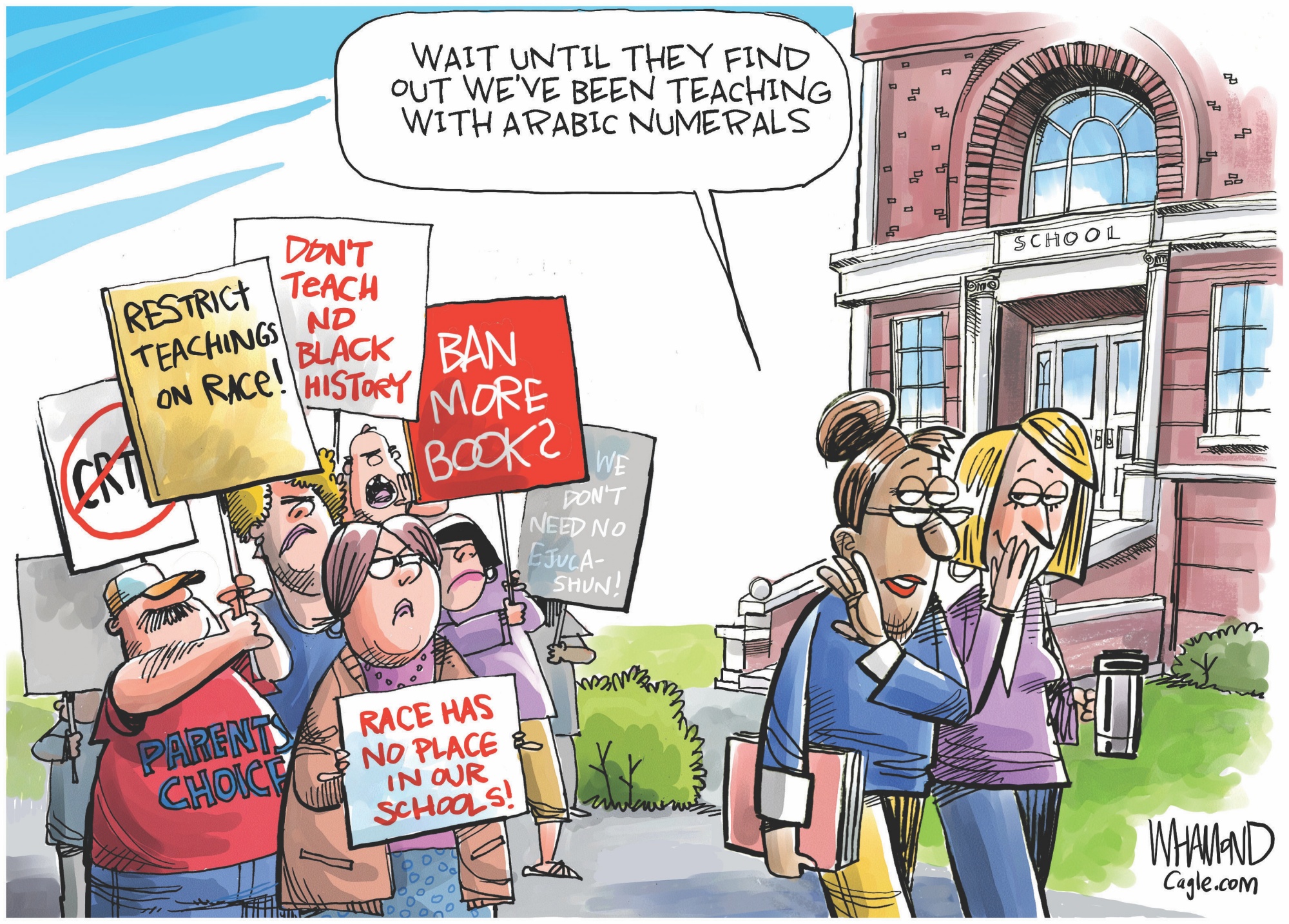
Illustration by Dave Whamond on CagleCartoons.com


If the current campaign against education succeeds, the truth will become whatever those in power tell us it is. We’re already a good distance down that road.
Oct 7, 2025 12:36 AM
Public education is the best way to minimize the risk of tyranny. Not only will students benefit from such an education; society at large will benefit too.
Why do we have free public education? Why should I pay taxes to educate someone else’s children when I have none of my own? Why should I pay teachers if I can’t guarantee they’re going to teach their students the right stuff, or worse, if they might teach the wrong stuff?
Thomas Jefferson addressed these questions in a 1779 proposal called “Bill for the More General Diffusion of Knowledge.” It’s worth a close look. Jefferson begins by naming the problem he hopes to solve:
Whereas it appeareth that however certain forms of government are better calculated than others to protect individuals in the free exercise of their natural rights, and are at the same time themselves better guarded against degeneracy, Experience hath shewn, that even under the best forms, those entrusted with power have, in time, and by slow operations, perverted it into tyranny...
Good government can serve to protect both the freedom and and the character of citizens, Jefferson asserts, but those with power will tend to abuse it, both to their advantage and to the disadvantage of those they govern. However:
Related stories
...it is believed that the most effectual means of preventing this would be, to illuminate, asfar as practicable, the minds of the people at large, and more especially to give them knowledge of those facts, which history exhibiteth, that, possessed thereby of the experience of other ages and countries, they may be enabled to know ambition under all its shapes, and prompt to exert their natural powers to defeat its purposes...
Does a good knowledge of history make it possible to recognize the abuse of power when it occurs and to suppress it? Jefferson thinks so, and he says education is the way to accomplish that:
...whence it becomes expedient for promoting the publick happiness that those persons, whom nature hath endowed with genius and virtue, should be rendered by liberal education worthy to receive, and able to guard the sacred deposit of the rights and liberties of their fellow citizens, and that they should be called to that charge without regard to wealth, birth or other accidental condition or circumstance....
Jefferson’s point is clear: public education is the best way to minimize the risk of tyranny. Education prepares people to keep themselves informed, to combine what they know with what they’ve experienced, and to use their insights to make thoughtful, responsible choices. Not only will students benefit from such an education; society at large will benefit too, especially if this education is available to all without distinction. In short, a society requires education to stay free.
Jefferson calls this education “liberal,” a term derived from the Latin word liber. The word means “book,” but it also means “free,” or “freedom,” and it serves as the root for words like “liberty,” “liberate,” and “liberal,” The education Jefferson had in mind had the primary purpose of equipping Americans to liberate themselves, and to keep themselves free, not only from the tyranny of others, but also from their own ignorance and prejudice. Education frees the mind, and helps to keep the body free too.
These days, unfortunately, many would want to challenge any sort of link between what they understand as “liberty” and what they think of neighbors whose values they consider “liberal.” We might even argue that the disintegration of American community has developed hand in hand with the steady deterioration of American schooling, caused by excessive procedural regulation, aggressive moral and political policing of curriculum, and widespread reluctance to fund schools and pay teachers at levels consistent with their critical importance.
Each year, teachers and schools are more constrained by watchdogs outside the system who want to control everything that goes on inside it. They want to dictate what students learn, and what they don’t.
Jefferson’s interest was less in what students learened than in whether. He would be dumbfounded today as those in charge betray his vision even as they profess to act in his name. History has shown repeatedly that totalitarianism cannot take root as long as those who would be its subjects remain able to find information and to process and organize it as a basis for thinking and acting. The dismantling of education at all levels going on in the country is casting a growing shadow that will engulf us unless we can find a way to halt its advance.
Jesus told his disciples that the truth would make them free, and Socrates famously claimed that the unexamined life is not worth living. If they’re right, then to lack the will to examine our lives is a tragic missed opportunity. But even more tragic would be to lose the ability to examine our lives, to seek the truth for ourselves.
If the current campaign against education succeeds, we stand to lose not only that ability, but also the freedom we cannot have without it, and the truth will become whatever those in power tell us it is. We’re already a good distance down that road.
Contrary to popular opinion, it’s not veterans like me who deserve thanks for protecting freedom. It’s the teachers, at all levels of our education system, who serve faithfully to give our children the knowledge and understanding they need to become free and productive citizens.
The price of freedom is not the courage to go to war. It’s the courage to teach. And it’s the courage to learn — go to school, to make the effort it takes to become educated enough to think clearly and make responsible choices. It’s a price each of us must pay, and it includes the the cost of building schools and paying teachers to work in them.
If you like your freedom, thank a teacher.
Comments

Powered by RoundtableAn AI/DeFi-powered Enterprise Media Operating System. Learn more at Roundtable.io.© Roundtable 2026. By using this site you agree to the Terms of Use and Privacy Policy