
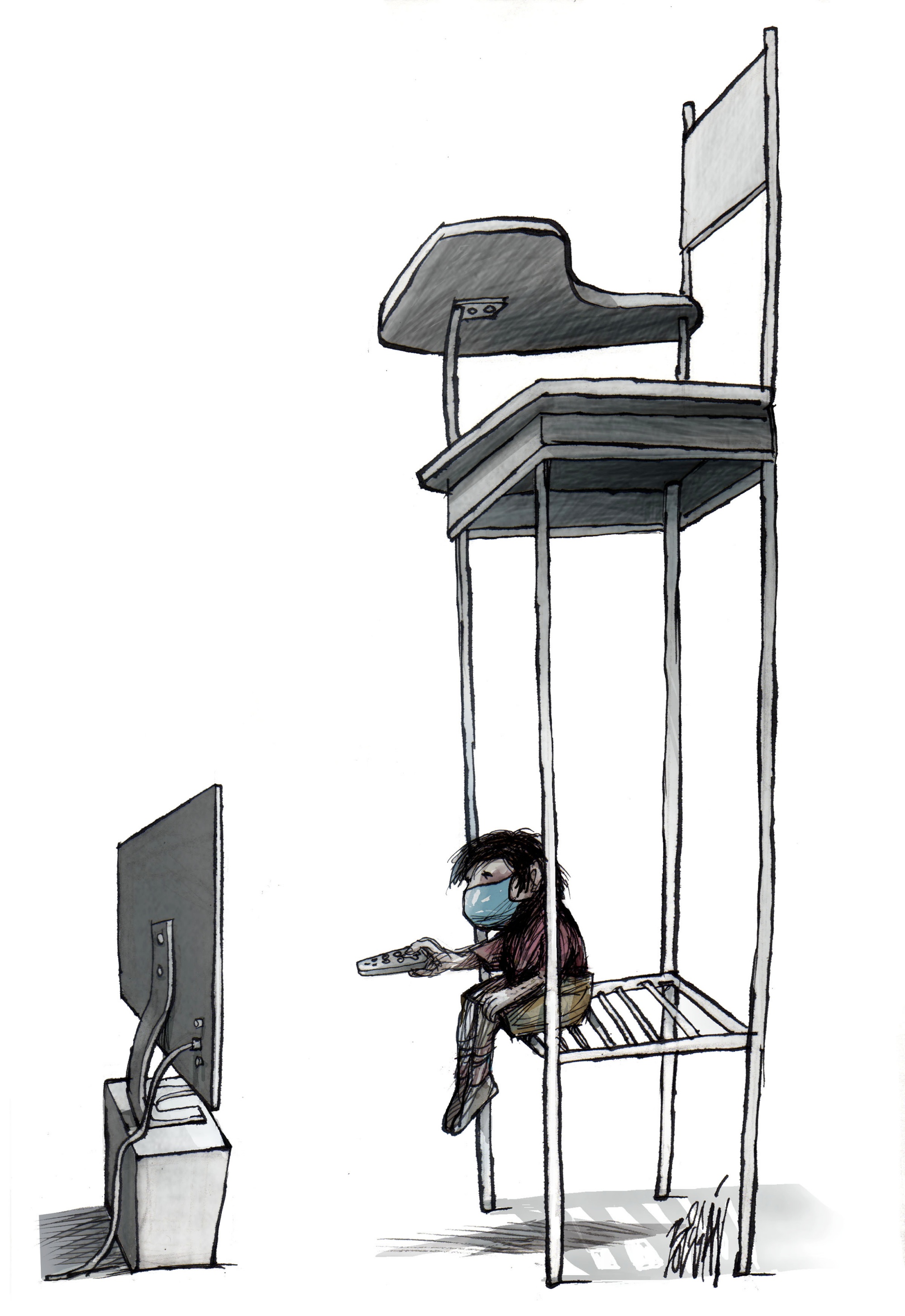
Illustration by Angel Boligan on Cagle Cartoons


Tapping in to the natural curiosity and critical nature of teenagers.
Oct 27, 2023 1:00 PM
Teaching only one point of view isn’t teaching, but indoctrination. Questions must stretch students’ minds to discover the complexity and magnitude of questions
Going to high school in the 1950’s was a different world than today, when there was more time to be human and academic standards were high. As time progressed, however, the country’s school systems, under federal and state laws, became more centralized, bureaucratized, and over-organized to a point where now they have become virtually unrecognizable from what past generations knew. But even in the past, high schools failed their students in one central way.
They never tried to teach students to think.
Adolescents have always been a skeptical lot. Anything and everything is fair game to them, and woe betide what is found wanting. Criticism comes easily to these professional critics who are taking the world’s measure and finding themselves. Yet, high schools waste this irreverence by failing to harness, exploit, and turn it to educational use.
By failing to tap into this abundant resource, they forgo their most precious asset — the intellectual restlessness of youth itself. By barring this critical spirit from the classroom, high schools teach that questioning is wrong and should play no part in one’s education. If one wants it, one must get it on one’s own — such is the lesson schools often convey.
Related stories
This is regrettable, for what could transform the classroom by encouraging students to think for themselves became one of life’s many what-might-have-beens. Students are naturally curious and want to hear all sides of a question; they welcome the clash, drama, and excitement of opposing opinions, and yet the schools deny them precisely what would capture their interest.
Schools, by being locked into State curricula, have marginalized many students to educational limbos, where many lose interest and, finally, dismiss schools are irrelevant.
It was with this in mind that, over the past several decades, I tried to bring this critical spirit of inquiry into the classroom by teaching against the grain of inherited student expectations by welcoming students’ questioning spirit. They learned how to detect fallacies in logical reasoning; dissect and refute faulty arguments; classify statements into their respective categories to determine which could and couldn’t be proven and why; in short, they learned not what to think, but how to think.
To be sure, a school must teach the factual, but if it imparts no more than that, it ultimately fails its students. It must also teach them how to think for themselves. Indeed, everything else is an educational frill!
If the purpose of education isn’t to train the mind to think critically and to instill the courage to do it, what then is its purpose? One would do better to leave school and educate oneself!
Why learn to read, if one isn’t also taught to judge the worth of what one is reading, lest one wind up brainwashing oneself?
Why learn to memorize, if one isn’t at the same time taught how to organize these facts into meaningful patterns which reveal the Big Picture? Or what one is memorizing isn't simply indoctrination? Seneca had it right when he said that it’s not for school that we learn, but for life!
Teaching courses in this way entails the responsibility to present all sides of a question. The point is not to make converts, but critical thinkers. The teacher must not take a stand, but simply argue, or better, have students argue, each position convincingly.
Teaching only one point of view isn’t teaching, but indoctrination. A teacher’s questions must stretch students’ minds to discover the complexity and magnitude of questions, and illuminate them from several perspectives.
These questions may be specific or open-ended; they may elaborate or imply; they may prompt introspection or conjecture; they may seem to affirm or deny; they may probe and dissect — but they must never resolve.
A teacher owes it to students to confound them, to have them feel the power of every position, to keep them in doubt as to which answer is right. A teacher must try to enter into students’ perceptions of truth to help them evaluate these perceptions critically. With some, the teacher plays the liberal; with others, the conservative; with all, the devil’s advocate.
Plato went to the heart of the matter: “Philosophy begins in wonder.” Wonder, not certainty, opens the mind. Certainty only closes it. A teacher’s role is to make students uncertain.
This kind of teaching stimulates not only thinking, but also feeling. It introduces students to a question’s emotional landscape. It explores, through empathy, how it feels to hold a particular viewpoint by exploring its emotional landscape — the emotional advantages and disadvantages of holding it; it seeks not to judge or condemn, but only to understand.
Teaching, like parenting, is an act of faith. One never knows what the future will bring. The harvest is always beyond our control. Yet one hopes to have opened young minds, to instill students with the confidence to use their own judgment, to think with courage and rational calm, to awaken a love for the romance of ideas, and to suggest that one’s education, like philosophy, not only begins in wonder, but may end there, too.
The first day of class, I enter the classroom, hold up our class text, Edith Hamilton’s The Greek Way, and announce, “Two ways of reading a book.” I then hold the book at arm’s length as if reading it. Then I kneel down, head reverently bowed over the text, as if reading a prayer book. I get up, slowly look around the class, and ask: ‘What was my point? What two states of mind are induced toward reading this book by adopting these two different postures?” A three-minute discussion follows, the question unresolved, with no one sure where it’s all heading.
“Truth! How do we know when we have it?” Pause. “If we’re absolutely sure that we have it, more sure than of the fact we exist, does that mean we have truth? Does overpowering certainty prove that something is true?”
Several answers, as I tell students to simply speak up, without raising their hand. “If you’re certain you’re right, but inner certainty doesn’t prove that you are, does that mean that you’re wrong?”
Students venture a few answers, and others nod in agreement. “If being certain you’re right doesn’t mean that you’re right or you’re wrong, what, then, does it mean?” Students try to sort themselves out.
“Is something moral, if your society says it’s moral?” Pause. “Or does society say it’s moral because it is right?” An extremely long pause, and a student replies that it’s right if your society says it’s right, and gives a few reasons why this is the case.
“Fine, now argue the converse.” Taken aback, the class makes a case for the opposite view.
I pause a few seconds and ask, “Now, how would you refute what’s just been said?”
Students, warming to the subject, mount a spirited rebuttal. I continue, “What would the opposition say in response?” And, again, a good counter-rebuttal is made.
“Now, given the fact that we’ve made two good cases for both sides, with good rebuttals, how would we know which answer is correct?” Dead silence.
I wait 30 seconds, leisurely pacing around the room, then sit in one of the empty desks. Still no response. I move on to the next question.
“Let me make the question even more interesting, now that we’ve solved that one. [general laughter] Is it possible that many of the things you’ve been taught in school or at home could be wrong? Everything your parents, teachers, and everyone you usually look to for answers, even in this class, that all of them might have been wrong? Sincere though they were, but wrong?” A few students slowly nod their assent, while others keep silent.
“Would this matter as long as everyone thought it was true and was happy believing it?” Different answers are given, once again, without my commenting on whatever is said, showing neither approval nor disapproval, but simply encouraging students to speak up, conveying more by manner than by word that they are free to say whatever they wish. I slightly alter the question.
“As long as everyone thought that they had the right answers, were content and happy believing in them, would that be okay even if everything they believed in was wrong?” Students, getting their second wind, begin to give more nuanced responses.
“Let’s bring it a little closer to home. What if much of what we were taught, say, as a society, a nation, or culture, were an illusion, but it all seemed true because that’s all we knew, and everyone we knew also believed the same thing and was happy believing it. Would it then be okay to keep on believing in it?” Students offer various answers.
“Let’s get a little more real. Would it be foolish to question these ideas if you doubted they were true, even though everyone else thought they were true, but you didn’t, but knew, if you did spoke up, you wouldn’t be popular anymore, might lose friends, even be punished, lose your job, be put in prison, or executed?” Students are unsure how to respond, but make valiant attempts, while many stay silent.
“What if you didn’t go public with your doubts, but decided it was better to play it safe and not create waves, and only shared them with a few close friends. Would this be prudent or cowardly? Would your silence eat away at you?” There being no response, I deepen the question.
“Would you have a moral obligation to speak out, a responsibility to let your voice be heard, because you felt you were right? Or would this be suicidal?” A variety of answers are given, and I ask students to elaborate on a few, so that others can hear their reasoning. As always, the question ends without resolution.
A three-paragraph aside. I’ve begun this article “in medias res” to convey from the outset a sense of how the course was conducted for almost 30 years. Naturally, my reason for asking these questions wasn’t only to elicit answers, but to accustom college-prep and advanced placement seniors to think in a sustained and systematic philosophical way that rarely ever occurs in American high schools.
This nine-week introduction to the Greeks set the stage for the rest of the year in a number of ways, but primarily in giving students the critical-thinking skills needed to do well in college. In learning the critical method of philosophical discourse, how the mind comes at issues from several different angles at once, bobbing and weaving, thrusting and parrying, detecting fallacies, classifying statements, testing assumptions, dissecting arguments, analyzing evidence, and arguing all sides of a question in a disciplined and methodical way, 17-year-olds learned an ensemble of technical skills that, again, are rarely taught in American high schools for a number of reasons.
There was no such thing as heresy in the course. Students could say whatever they wished, provided they were willing to support it and, hopefully, say it in good English. For my part, I taught students not what to think, but how to think and, by so doing, tried to open for them the immensity of these timely and timeless questions raised by the Greeks, so that students could understand, by doing. that philosophy is nothing else but asking an endless series of “whys” in an eternal romance with questions, that ‘‘the love of wisdom grows out of wonder,” and that the best way of teaching is the lived experience of wrestling with questions.
“Okay, now that we’ve solved those questions [muffled laughter], let’s move on to some difficult ones. What happens when one group is absolutely certain that it possesses the truth and encounters another which dismisses that view as nonsense?” Students give a range of opinions, while neither agreeing nor disagreeing with them.
I summarize the gist of what has been said: that the one group might pity and feel sorry for the other, think it stubborn or the victims of brainwashing, and try to show why it was wrong to help free its members from error, while the other group thinks the same about them.
“Would one group ever convince the other?” A long silence ensues, and students give a range of thoughtful replies.
“I want to reframe the question. We have two persons, each of whom is sure that he has the truth. One of them actually does have the truth, while the other one doesn’t, although he thinks he does. Now, if both think they’re right, but only one of them is, what would be the difference in the subjective states of mind between these two persons? ” A few answers are given, although it becomes clear that a few students don’t understand the question, so I repeat it.
Then someone says, “There would be no difference! They’d both have the same state of mind. They’d both think they were right, but only one of them would be.” A brief pause ensues.
I ask students to think about what’s just been said and then ask, “That being the case, if both states of mind are identical, what would that say about the state of being certain?” Long pause, with no student response.
I continue, “Let’s now take these same two persons, and tell them that only one of them is actually right, and the other one wrong. How would they know which one was which, without being told?” Students are unsure.
“What if they were told, and the person who was wrong was told he was wrong. Would he believe it?” One student says, “It would all depend on what it was. If they could prove it by showing him the facts, he probably would accept it.” Many agree.
Then someone says, “But what if there’s no concrete evidence you couldn’t point to, but has to do with what he believes, something you can’t really prove one way or the other, but just feel it so deeply that you know that you’re right? I don’t think he would accept it. He’d probably even think that the people who told him were wrong.” Some students agree, while others aren’t sure.
“What’s the difference between being absolutely certain and being closed-minded?” Students are silent and then give various answers, but, again, no conclusion is reached.
“What’s the difference between a person with rock-bottom principles and someone else who is closed-minded?” Students again offer different opinions.
A third question. “What the difference between principles and prejudices?” No responses.
I then say, “Several years ago, one student said that there wasn’t any difference, that they’re one and the same thing, that principles are prejudices, and prejudices are principles, and that the only difference is the word which is used. What I’d like you to do is to argue this both ways — that they are and aren’t the same thing.” Students then attempt to make a case for both sides with varying degrees of success.
“Is it morally wrong to question things? Or are there things that should never be questioned, off-the-table, non-negotiable items that, in questioning them, some might feel that they’d come undone as persons?” A long pause.
“Or should everything be questioned?” Various answers come trickling in and, again, some students are asked to repeat what they’ve said to underscore an unusual point.
“Are some people hard-wired to question? It’s simply their nature? They can’t help themselves? Not to question would make them depressed?” Silence.
I continue: “Are there others who are hard-wired not to question, but simply accept? It’s better for them if others just tell them what to believe? That they’d come undone if they did question? That they should even be protected from questions for their own good and self-preservation?” Many opinions are offered.
“All the answers you’ve thought were true to the many questions we’ve been considering so far, how do you know that they’re the answers you really believe in and not simply what you want to believe, or what you were raised to believe are the true answers, and these may be the real reasons why you believe as you do?” Long pause, with no one responding.
“A somewhat larger question. Every culture has its own unique way of viewing the world, its system of beliefs and values, the things it considers true and false, right and wrong, important and unimportant. Let’s call this its ‘reality,’ its conceptual and emotional prism or grid through which each culture views human existence, and that every culture has its own ‘reality,’ which differs from the ‘realities’ of other cultures.” I pause to let the idea slowly sink in. I then repeat this again, and students become intensely focused.
“Now let’s flesh this out a bit. Let’s say we have six different cultures, with six different ‘realities,’ and that each of these ‘realities’ seems true to everyone within each culture because that’s all the people in that particular culture know and grew up with. No one in each of these cultures has ever left their culture, their ‘reality,’ or has ever met anyone from another culture.” Another long pause.
“Now, what if one of these cultures began to send out ships to establish colonies and farm fertile land in various places around the entire Mediterranean basin because there wasn’t enough land to sustain its ever-growing population. Over the centuries, dozens of these colonies trade with the native populations, and get to know these peoples, their religions, beliefs, general outlook, their ‘realities.’ They also send back word to their homeland the news about all these strange cultures with their different beliefs and customs. Question: how would these colonists react to all these different peoples with their different ‘realities’?”
Student reactions range from the colonists being surprised or shocked that these other cultures differ so markedly from that of their own, wondering about how they could possibly believe in such preposterous notions, feeling sorry for them because they hadn’t had the good fortune to be born in the colonists’ culture. A few students say that people of the other cultures might also be thinking the same thing about the colonists.
“This experience of being taken aback and disoriented in the face of a strange world is called ‘culture shock’ and is a feeling that is intensified if one must cope with this new culture on a daily basis. What do you think would be some of the positives of having to deal with ‘culture shock’?”
One student responds, “Well, life would certainly never be boring. [general laughter] It would also be interesting and exciting in having to rethink all one’s beliefs and entire outlook on life, which would keep one from becoming intolerant and closed-minded toward other people and ideas.”
“It could also be very threatening,” says another student, “because one would now have to rethink everything one had ever been brought up to believe, and it would take a very strong person to be able and willing to do this, since most people would be terrified at having their world turned upside down.”
“So how do you think our colonists would react when coming upon these different cultures and ‘realities’?” “I think they’d be in denial,” says a student. “They’d simply say that these people didn’t know any better, were superstitious, brainwashed, or crazy. They probably would also want to change the minds of these peoples so they wouldn’t feel threatened.”
Another student says, “Well, it wouldn’t have to be because they felt threatened, but because they sincerely wanted to help these people, enlighten them, because they felt they were wrong.”
“But that’s just it, isn’t it,” interjects another. “While saying they wanted to help these people, they might at the same time feel so threatened that they’d convince themselves that they simply wanted to help these people out of the goodness of their heart, whereas what they might really be doing is wanting to silence their own doubts by convincing them they were wrong.” A long, thoughtful silence descends on the class.
“It could be either one,” says another, “although I really don’t see how you could know, since there’s no way you could actually prove it one way or another.”
Another student adds, “I suppose you could even hate this other group because they would threaten you by their mere existence, especially if they seem to be decent people. So you might be tempted to disparage them in some way by looking down on them, calling them names, making up all manner of things about them just so you wouldn’t have to take them seriously.”
“But aren’t we forgetting something?” says somebody else. “There’s another kind of reaction to all of this. Isn’t it possible to think that all of these different ‘realities’ could be right?”
“But how’s that possible,” asks another, “since you’d then have several contradictory ways of viewing the world, so how could they all be correct? I’m not saying that all these groups couldn’t have different beliefs and think that only theirs was right and all the others were wrong, but that they all couldn’t be objectively right! This desk I’m sitting in either exists or it doesn’t. It’s either here or it’s not. So if you have two cultures, and they both look at the world differently, only one of them can be right and the other one wrong, since they can’t both be right. And if you’re talking about more than two cultures, then it’s even more impossible that they could all be correct, when only one of them can?”
“Well, let me put it another way,” the other replies. “Say there’s 20 of us here in this room, and we all come from different parts of the world, from different cultures, with different religions and ways of viewing the world. Everybody would have a different outlook on life, a different ‘reality,’ which we’d all think was right. Why? Because all of these outlooks have worked for us and the cultures we come from. All these different ‘realities’ make sense within each of our cultures. So that, getting back to the colonists and the cultures they encounter, we’d have the same situation — everything makes sense within each of those cultures, but not within the other cultures. Of course, those other worldviews would seem wrong to foreigners, but only because they hadn’t been raised in those cultures, but if they had, those other ‘realities’ would begin to make sense.”
“I see what you’re talking about,” says the other student, “but that still doesn’t address the question of which culture is objectively right . . . ,” at which point, the bell rings for the end of class, and the students turn to me. I hold up the text of The Greek Way and say, “Welcome to the Greeks!"
Comments

Powered by RoundtableAn AI/DeFi-powered Enterprise Media Operating System. Learn more at Roundtable.io.© Roundtable 2026. By using this site you agree to the Terms of Use and Privacy Policy