
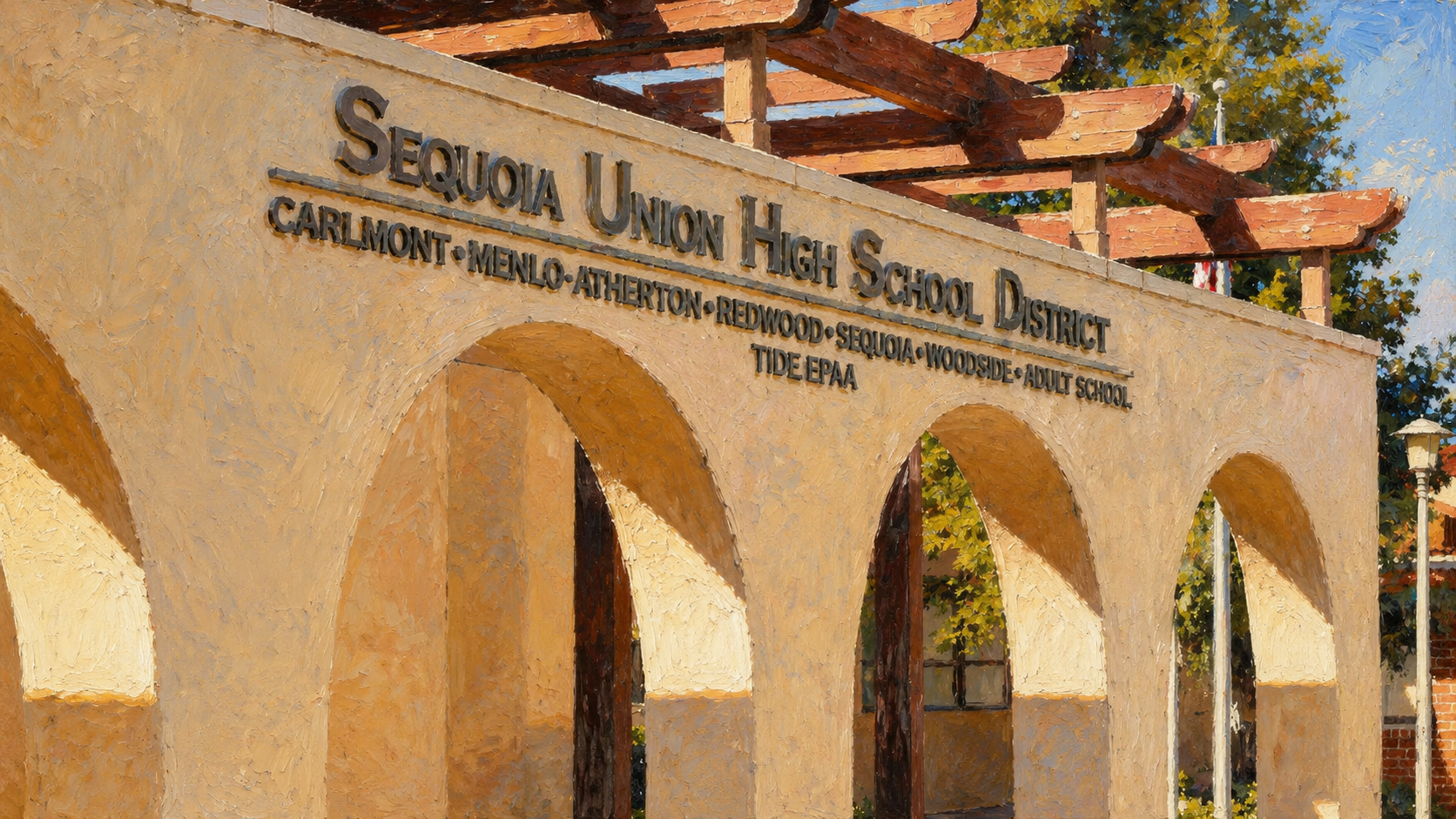
The SUHSD main office in Redwood City. (Ardenmachro via Wikimedia Commons, CC BY 4.0)


Aug 21, 2026 5:25 PM
The Sequoia Union settlement blurs the line between protecting students from harassment and policing political ideas in the classroom.
This story was originally published at J. the Jewish News of Northern California.
A dangerous new trend is undermining freedom of speech and academic freedom in the name of combating antisemitism.
Public schools accused of antisemitism are signing private legal settlements that impose intrusive policies and curriculum changes without public scrutiny. Judges are not being given the opportunity to assess whether they comply with constitutional requirements, while school districts are surrendering their autonomy and capitulating to far-reaching policy changes beyond what courts can legally impose.
The recent settlement in a lawsuit brought by seven Jewish families against the Sequoia Union High School District is an ominous example. One of the plaintiffs’ attorneys told J. she anticipates that “the relief we’ve obtained here will be a model in litigation we and others are pursuing in antisemitic discrimination cases across the country.” In February 2025, the Santa Ana Unified School District settled a similar lawsuit brought by Jewish families who alleged its ethnic studies courses contained antisemitic content.
Related stories
In April, a Jewish student at San Leandro High School filed a similar lawsuit. In March, the Brandeis Center for Human Rights Under Law (not affiliated with Brandeis University) sued the State of California and more than a dozen school districts, alleging a systemic failure to protect Jewish students.
I practiced civil rights law for almost 50 years. During law school I converted to Judaism largely because of its commandment, “justice, justice shall you pursue” (Deuteronomy 16:20). I firmly believe people have the right to present their claims — backed by evidence and valid legal arguments — to judges and juries in public trials and appeals. That is why these new private settlements, negotiated behind closed doors — yet binding on thousands of students and teachers — offend my sense of justice.
Sequoia Union operates four different high schools near San Francisco, serving nearly 9,000 students. Seven Jewish families accused the district of failing to adequately investigate allegations of antisemitism. They alleged that a classmate told a Jewish student he hoped the boy and his entire family “burn in hell, and that Hamas kills us all;” that a Jewish student was told, “Go back to where you came from;” that a teaching assistant told a Jewish student to conceal her Star of David necklace or she would “get what she deserved;” and that another teacher asked a student if she was Jewish, saying he could tell by her nose.
But the lawsuit expanded the definition of antisemitism beyond these ugly slurs to include how teachers taught the conflict in the Middle East, including claims that a world history teacher urged students to draw a moral equivalence between Israel and Hamas and falsely told them that Palestine has been a U.N.-recognized state since 1947.
These allegations will never be tested in open court because the district settled.
That’s in sharp contrast to what happened at MIT last year when the pro-Israel group StandWithUs and two Jewish students filed a similar lawsuit. MIT forcefully asserted its First Amendment rights and won; the complaint was dismissed last October by an appellate court that held “requiring MIT to restrict students’ expression merely because those students opposed Israel and favored the Palestinian cause would infringe upon MIT’s freedom to encourage, rather than suppress, a vigorous exchange of ideas.”
Instead of defending its autonomy and academic freedom, Sequoia Union capitulated. On May 23, it agreed to pay the plaintiffs $325,000, and it signed a 50-page settlement agreement imposing a straightjacket on what teachers can teach.
Now, due to this settlement, the district must delegate its educational authority to an outside person (ironically called “a Neutral”) to be chosen jointly by the plaintiffs and the district. This powerful new educational decision-maker will approve (or disapprove) all “Supplementary Instructional Materials” referencing “the Israel-Palestine Conflict.”
The settlement also requires the district to adopt a particular definition of “antisemitism,” a vaguely worded seven-paragraph policy that requires the district to accept as “examples of antisemitism” such illustrations as “the denial of the Jewish people’s right to self-defense or self-determination, e.g., by claiming that the State of Israel is a racist endeavor, and/or applying double standards by requiring of the State of Israel a behavior not expected or demanded of any other democratic nation.”
These are the very same highly debatable political claims that the appellate court in the MIT case held could not be imposed on an educational institution.
The settlement also requires all administrators, teachers and employees who work directly with students to take “mandatory Antisemitism training,” using the definition of antisemitism mandated by the settlement. And it requires each world history class to include at least one lesson on antisemitism, using lesson materials selected by the seven Jewish families and the district. If they can’t agree, the materials will be chosen unilaterally by the outside Neutral.
How have we leaped from investigating deplorable antisemitic taunts to drastically transforming the policies and curricula of an entire public school district with 9,000 students?
With two grandchildren in the California public school system, I want them and their classmates to learn in an environment that encourages critical thinking by examining all viewpoints unrestrained by outside political agendas.
Comments

Powered by RoundtableAn AI/DeFi-powered Enterprise Media Operating System. Learn more at Roundtable.io.© Roundtable 2026. By using this site you agree to the Terms of Use and Privacy Policy