

Tom Emens, CC BY-SA 4.0, via Wikimedia Commons


California’s three-tiered system of higher education focused on educating our best and brightest. Now its focus is profits and tax write offs for investors and donors.
May 28, 2025 4:10 AM
California’s three-tiered system of higher education focused on educating our best and brightest. Now its focus is profits and tax write offs for investors and donors.
California’s system of higher education consists of:
- 116 community colleges
- 23 California State University campuses
- 10 University of California campuses
Today, they are financially in the red, forced to cut classes and lay off faculty and staff. In 1960, the state’s “Master Plan,” driven by Cold War competition with the Soviet Union, called for free education for all Californians. But beginning in the 1970s, student loan debt, tuition and “student activity fees” were gradually instituted and increase annually.
The “Master Plan,” created a system of free higher education, but with the rise of neo-liberalism and the breakup of the Soviet Union, California’s system of higher education shifted to a neo-liberal model focused on tax shelters, bloated salaries for administrators, and profit generation. As a result, tuitions were routinely increased, and free higher education has given way to tuition increases, tax write-offs, and the sale of tax-free bonds.
Related stories
Beginning with the 1990-1991 Recession, decline in state revenues resulted in cuts to the state’s system of higher education. While the state’s economy quickly recovered, revenues to higher education did not, and the state’s contribution to higher education continued to decline.
Revenue cuts justified increases in tuition, fees, and even parking. In 1996, for example, five years after the collapse of the Soviet Union, the state’s contribution to higher education, once at 100%, declined to only 10% of the total cost.
Given that California is the wealthiest state in the wealthiest nation in the world, how could a budget crisis even exist?
By 2025, the State’s Domestic Product of $4.1 trillion surpassed Japan’s Gross Domestic Product of $4 trillion, making California the fourth largest economy in the world. In addition, California’s per-capita income (Gross Domestic Product/population) is higher than the US, China, Germany, and Japan!
California’s economy is far wealthier today than in 1970, when, for example, the state’s Gross State Product (GSP) was $112 million. Adjusted for inflation California’s SDP would be $935 million in current dollars. Today, the state’s SDP is now over $4 trillion!
Yet, the CSU system alone reports a $1 billion short fall, which justifies increases in tuition, student activity fees, parking as well as the low salaries for faculty and staff. The same logic does not apply to administrators, however, where campus presidents earn $400,000 to $500,000 annually. At the top is the CSU chancellor, who earns $891,000 in salary and housing subsidy. By comparison, few faculty in the CSU system, including tenured faculty with 20 years of service, earn even $100,000 a year.
CSU’s chancellor appoints the Board of Trustees, most of whom have extensive corporate experience. Trustee Jack McGrory, for example, is the CEO of La Jolla MJ Management, LLC, a real estate investment company, while trustee Leslie Gilbert-Lurie is a former NBC Television executive who worked for the law firm Manatt, Phelps, Rothenberg and Tunney. A review of the remaining Board members reveals similar resumes.
Administrators of California’s three-tiered system are committed to a neo-liberal approach known as “New Public Management,” which seeks to operate public entities as private corporations. New Public Management’s guiding principles include:
- strict financial control by administrators
- greater power for senior management
- increase role for non-public entities
- curbing and/or eliminating unions
- shifting power from the academicians to management
- encouraging entrepreneurship
- building a corporate structure
First initiated in the 1980s, the principals of New Public Management have resulted in increases in tuition, student activity and parking fees, cuts in salaries and benefits, and the implementation of tax write-offs through bond sales and donations, as well as increases in administrative salaries. The results of New Public Management are reflected in the charts below:
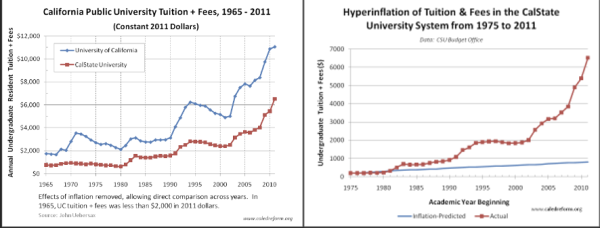
The UC system first began to charge tuition in 1970, while by 1981 tuition was charged within the CSU and community college systems. Since then, tuition and fees have increased regularly, effectively ending the goal of the state’s Master Plan to provide free education. At CSU Channel Islands, for example, tuition and fees for the Fall, 2024 semester include:
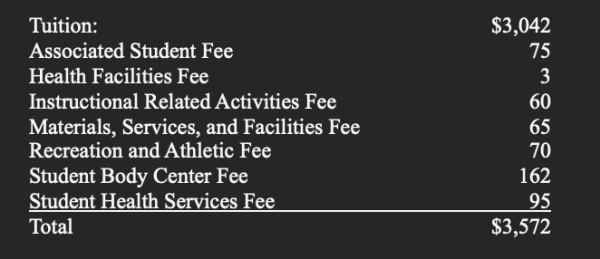
In addition, students are charged $195 per semester for parking, while faculty and staff employed by the CSU are charged $98.45. Student housing begins at $1,339 a month, while campus prices are well-above those found at the local 7-11. In addition, at the CSUCI campus vending machines charge an additional ten cents for using a debit or credit card.
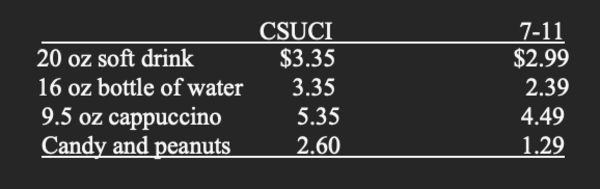
Thus, while faculty and staff salaries and benefits have failed to keep up with inflation, charges to the students have sky-rocketed.
As state revenue for higher education declined, private money from bond sales, corporate and individual donations, and increases in tuition and fees made up the shortfall. At the same time, administrators fight any pay increases for faculty and staff, who, following New Public Management, are regarded as employees just as the Ford Motor Company considers its assembly line workers employees.
Thus, while faculty and staff salaries and benefits have failed to keep up with inflation, charges to the students have sky-rocketed.
By increasing revenue through tuition and fee increases and bond sales while minimizing salaries for faculty and staff, the CSU management acts like any private employer and service provider. Since CSU’s student body in in fact a captive consumer, there is every incentive to raise education costs.
Bond sales fund construction projects, which, while impressive to the visiting parent or tourist, do nothing to improve the salaries of its workforce or the learning environment of the students. Among state leaders, there is a consensus that higher education will continue to increase tuition, parking, and fees, while administrators will fight to reduce salaries and benefits. In sum, New Public Management will continue—regardless of its negative impact on California’s system of higher education.
The union for the CSU, the California Faculty Association, has played a crucial role in salary and benefit reductions for faculty and staff. During contract negotiations, for example, the CFA typically agrees to salary increases that do not keep up with inflation—which means the purchasing power of faculty and staff is eroded with each new contract.
The collective bargaining agreement for 2014-2021, for example, allowed for an annual 1.6% general salary increase, or 8% over the life of the contract. But inflation during those years was 19%, so the contract agreed to by the CFA negotiating team resulted in a decrease in faculty salaries of around 11% over the life of the contract.
Similarly, for the 2022-2025 collective bargaining agreement, the general salary increase was 5%, while inflation over that time was 7%. Again, the CFA bargaining team agreed to a salary increase that did not keep up with inflation.
With a docile union like the CFA, there is no reason for the CSU to change its tactic of aggressive contract negotiations to keep salary increases below the inflation rate while reducing benefits.
Before 2024 the CFA had never gone on strike. By the Winter of 2024, however, angry union members demanded the CFA call a strike, the first in its history. The strike showed remarkable solidarity and all 23 campuses were shut down. In less than 24 hours, however, the CFA bargaining team closed down the strike.
While the strike illustrated overwhelming solidarity within the union, the CFA failed to utilize its remarkably strong hand: the 23 campuses in the CSU system cannot be moved to China, and the 25,000 CFA members, all highly skilled, could not be replaced. Instead, the CFA carried through their previous commitment to end the strike if the CSU agreed to the strikers’ demands.
Months after this successful strike, CSU management instituted massive cutbacks in classes and hiring. Faculty and staff have been dismissed or forced into retirement while class availability (which determines how quickly a student can graduate) continues to fall. With the CFA’s failure to take advantage of its very strong position, union leaders have, once again, grabbed defeat from the jaws of victory.
In conclusion, from Sputnik to the collapse of the Soviet Union, California’s three-tiered system of higher education, the “Master Plan,” focused on educating California’s best and brightest. Today, however, California’s three-tiered system of higher education is focused on generating profits and tax write offs for investors and donors, pork barrel construction projects for contractors, and bloated salaries for administrators.
Guided by the principals of New Public Management, the state’s system of higher education has failed in its charge to educate California’s college-age students free of debt. At the same time, however, California’s system of higher education has seen great success in enriching the wealthiest in the state and the country.
Comments

Powered by RoundtableAn AI/DeFi-powered Enterprise Media Operating System. Learn more at Roundtable.io.© Roundtable 2026. By using this site you agree to the Terms of Use and Privacy Policy