
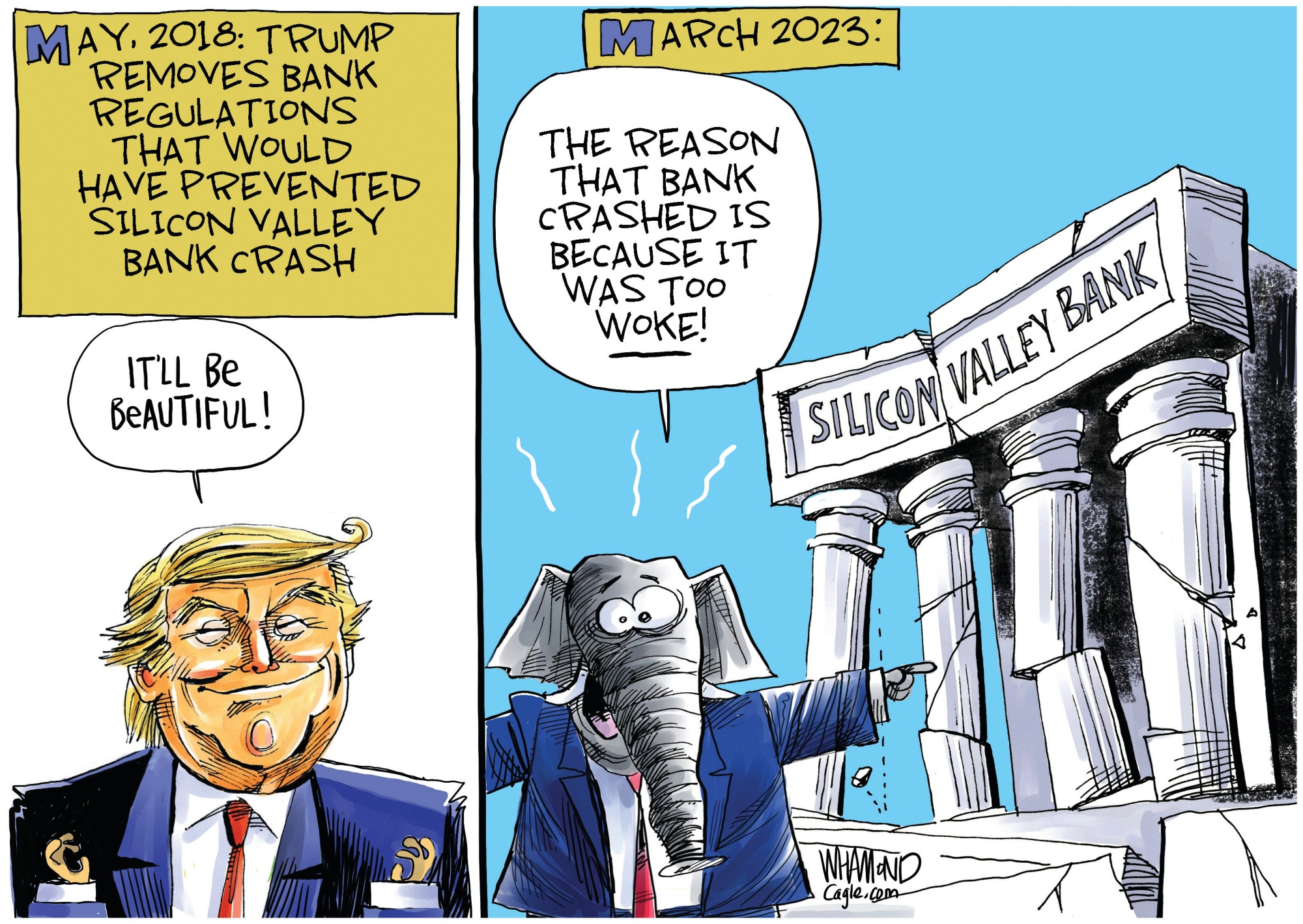
Illustration by Dave Whamond on Cagle Cartoons


Mar 29, 2023 6:00 PM
Deregulation meant the SVB bank didn’t keep a sufficient reserve to meet demands for withdrawals. A reserve would have curtailed profits and Executive bonuses.
The lesson supposedly learned from the 2008 crisis is that the banks needed larger reserves of capital (net assets) to weather the usual downturns in the business cycle, but also to have sufficient cash on hand to meet all demands for withdrawals immediately.
Canadian banks did not need a bail out and no Canadian bank failed in 2008. One of the main reasons was that Canadian banks, large and small, kept their capital reserves at 9% while American banks often kept a reserve of only 2% — and that reserve to the knowledge of the bankers was in junk mortgages.
The Same Old Problem
Banks do not hold depositors’ money in trust, but are permitted to use it however the bank executives wish. Most understand that banks lend out depositors’ money at a higher interest rate than paid to the depositors. Thus, banks make their profit on loans.
But, they can also invest it for bigger profits that result in bigger executive bonuses — and that’s exactly what they do. Notice the inherent conflict in keeping the bank secure and the executives’ desire for bigger executive bonuses.
Related stories
As long ago as 1914, Louis Brandeis warned of this conflict in his book: Other Peoples’ Money and How Bankers Use It.
Prior to 2008, as exemplified in the movie, The Big Short, retail bankers bet multi-billions of depositor money with the equity/hedge funds that the housing market would continue to rise. This was pure gambling with no benefit to depositor or country, only a possible benefit to better executive pay. When the bankers lost, the equity hedge funds could seize all the banks’ assets, including deposits, to satisfy the multi-billion dollar debt.
In 2008, the bankers didn’t have sufficient reserve capital to both pay their losses to the equity/ hedge funds and continue to function as a bank, because they didn’t even have 2% reserve capital. Perhaps they could have barely survived, but they could not have made new loans or met depositor requests for withdrawals — nor continue to pay themselves sky high bonuses.
The Unique Aspect of Banking
All businesses know that careful risk management planning requires a rainy day fund because of the recurring fat and lien years of the business cycle that we have known of since biblical times. But banks have an additional concern, and that is to keep confidence in the banking system and the money system. They must have adequate liquid assets, those that can be immediately converted into cash.
What if a customer comes to a teller and asks to withdraw $100 and the teller says, “Don’t worry, we can’t give you that money today, but if you come back in a month, we will definitely have it because we have some really big investments coming due.”
Until the crash of 2008 the bank deregulation fans, who are usually called neoliberal, held sway. They believe, Reagan-like, that regulation is the problem, and the fewer regulations the better. We can trust the markets to regulate themselves. Greed against greed will somehow produce a benefit for the common good.
While that theory was blown apart in 2008, most influential economists, and a number of politicians on both sides, were still true believers in deregulation and itched to start deregulating banks again.
Dodd Frank increased the capital reserve more in line with the Canadian Bank limits and added some other tests (liquidity ratio, stress test) to ensure the banks’ liquidity, i.e., their ability to convert sufficient assets to cash immediately to meet debts, including withdrawals. This was all supervised by a regulator on a monthly basis to ensure the banks were keeping sufficient liquidity.
However, the deregulation fans, with the support of both Republicans and Democrats, convinced Congress to deregulate what they called the smaller banks whose failure would supposedly not affect the banking system as a whole. In 2018, this legislation, promoted by Senator Mike Crapo, was passed as the Economic Growth, Regulatory Relief, and Consumer Protection Act’’.
Note the ‘Regulatory Relief’ middle term.
Now these midsize banks had no required cushion for depositor withdrawals, the executives were again free to try and earn as much profit for their pay as possible. And no nosy regulator was looking over their shoulder to see if the bank’s financial position was safe on a monthly basis.
Some commentators warned of this exact danger of this deregulation. My warning here.
Many analysts say that the SVB failure was due to trying for greater profits by a risky lending model to venture funds; others say that it was due to taking long-term bonds that were devalued because of the rising interest rates set by the Federal Reserve. It doesn’t matter which of those, or even both, are accurate.
The SVB bank did not keep a sufficient reserve to meet demands for withdrawals. That reserve would have curtailed profits — and bonuses. And, it didn’t have to do so thanks to the Crapo legislation.
It is hard to say if the stricter requirements for reserve capital and supervision by a financial regulator could have fully prevented the SVB failure. Likely, though, the problem would have been identified much earlier.
However, SVB was not a normal bank. As Nathan Vardi of Market Watch points out, most of its customers were venture capitalists who borrowed to re-lend to startups. Only 20% of the depositors were startups. Vardi explains how SVB’s somewhat unique arrangement for the loans to venture capitalists proved beneficial to the venture capitalists, but unprofitble to the bank, and gives an excellent analysis of the other factors at play.
However, it is now undeniable that midsize banks can be a threat to the financial system and for that reason should be subject to enhanced capital requirements, and careful supervision.
Will There Be More Teflon Bank Executives?
CNBC News reported that in the two years leading up to the failure, SVB executives sold $84 million of shares. CEO Greg Becker’s sale accounted for $30 million of those. Shortly before SVB announced its difficulty, Becker reported sales of $3.5 million to the SEC on February 27, 2023. Remember that SVB revealed its problem on March 8.
Even worse, Forbes disclosed that Moodys had told SVB in mid February that it was going to downgrade its rating. Additionally, Pam and Russ Martens report that CEO Berger made $10 million in pay in the year preceding the failure. Will any of that be clawed back?
Media Manipulation
You won’t see many media focussing on the deregulation factor suggesting that, as part of the cleanup, these midsize banks should again be subject to the same restrictions on the use of depositor monies for executive gains as larger banks. According to the New York Times, Trump appointee, committed deregulator, and head of the Fed, Jerome Powell, “blocked efforts to include a phrase mentioning regulatory failures in the joint statement” on the SVB crash that was published jointly by the Fed, Treasury, and FDIC.
Now the question is: Will we learn from history or will history continue to repeat itself in the banking sector?
Comments

Powered by RoundtableAn AI/DeFi-powered Enterprise Media Operating System. Learn more at Roundtable.io.© Roundtable 2026. By using this site you agree to the Terms of Use and Privacy Policy