
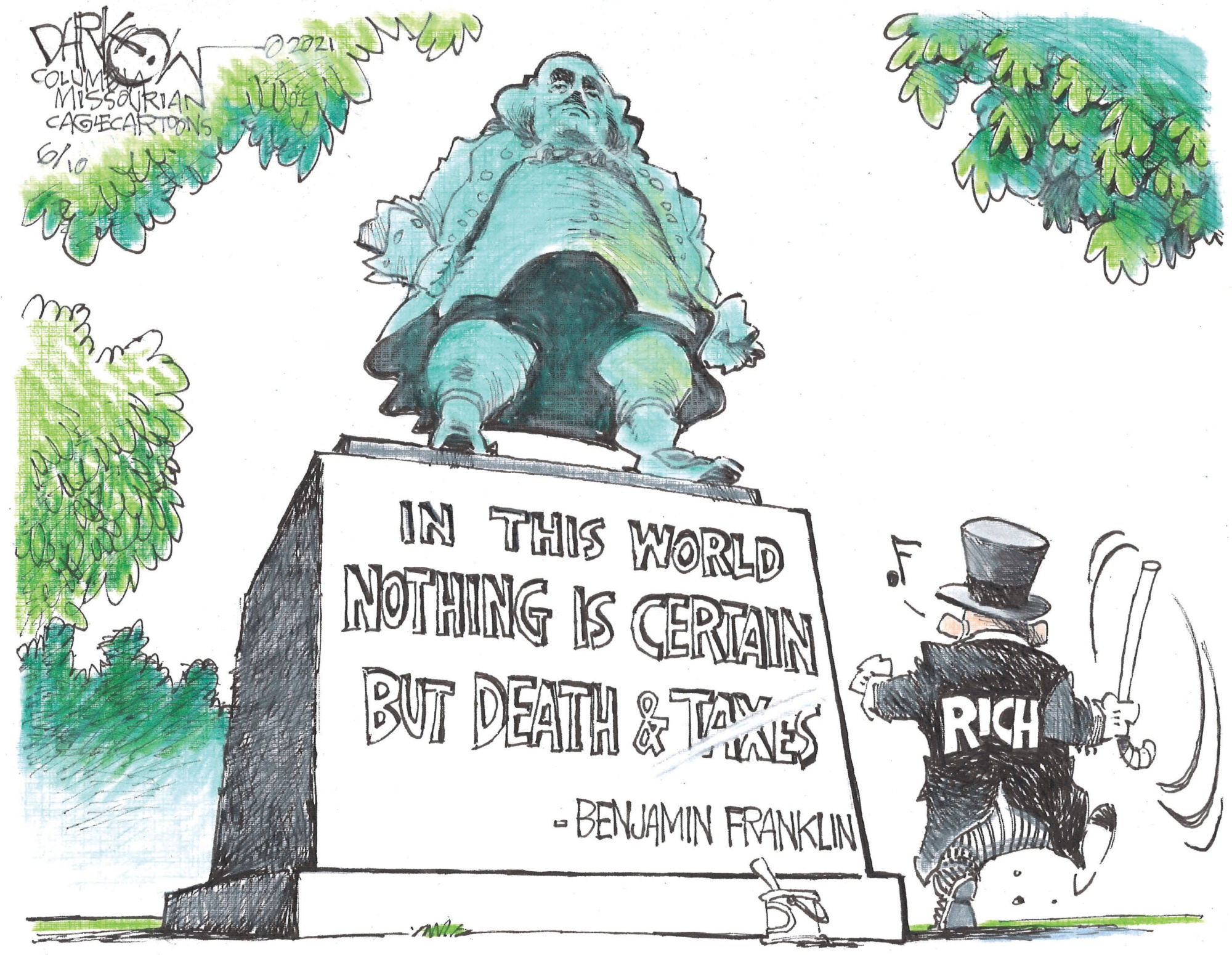
Illustration by John Darkow on Cagle Cartoons


Tax the Rich
Dec 17, 2023 2:00 PM
If we want a functioning society, we must fund it, and the funds can only come from those who have it.
If we think it’s morally wrong to take money from the rich to pay for society’s infrastructure, it’s quite possible we’re right.
I wonder, though, why if taking money from someone rich through taxation is wrong, it’s somehow morally right to take it from the poor and middle class. Either way, we’re taking money away from people who have earned it. Why is it morally right to take it from the poorer folks but sinful to take it from richer ones? What makes the rich morally exempt from proportional responsibility?
In the end, I’m not sure it matters what’s morally right regarding taxation. The reality is that infrastructure costs money. Taxation is a matter of practicality, not a method of moral instruction. If we want a functioning society, we must fund it, and the funds can only come from those who have it.
If you want to bottle water, do you set up your bottling plant in a region with lakes, springs, and aquifers, or do you move to the desert?
Related stories
It may be a morally superior decision to tax people with less money so that those with more can “invest” and “create jobs,” but it’s not a fiscally sound one. Morality won’t get us a functioning society. Poorer folks are simply unable to fund one, no matter how much we or they or anyone may want them to.
If a mugger demands your money but you aren’t carrying your wallet, no amount of coercion will make that wallet magically appear, no amount of willingness to cooperate will produce a billfold out of thin air.
If we want funds to develop and sustain a functioning infrastructure, should we fine homeless folks or should we tax people who have money?
If poor people are responsible for their poverty, if homeless people are weak, morally bankrupt losers who deserve to be treated with disdain, if working class folks struggling to pay their bills should have forced themselves to develop more skills and gotten better jobs, fine. We can judge these “losers” all we want. But judging them, punishing them, being repulsed by them, ignoring them—none of that changes their account balances. They still don’t have the funds to build roads, pay police and firefighter salaries, or do any of the other things that will prevent our cities from falling into ruin.
You don’t get a blood donation from someone who’s bleeding out.
You don’t get a blood donation from someone who’s bleeding out.
Locals in Seattle don’t stroll through Pike Place Market anymore. They don’t shop in Pioneer Square or in the downtown corridor. When they come out of the light rail station on 3rd Avenue, they see dozens of homeless people camped out across the street. Businesses are boarded up.
In Columbia City, in Mount Baker, in neighborhood after neighborhood, store windows are bashed in, there’s graffiti everywhere, trash wherever we walk, tents and RVs and vans where people make their homes next to burned out, abandoned stores.
And all this takes place while high rise after high rise is constructed throughout the city, beautiful new buildings next door to homeless encampments and lots filled with “tiny houses.”
Income inequality, income disparity, the wealth gap—whatever we want to call it—has created not only a tale of two cities but a tale of two nations. And when one nation preys on another, when there’s an effectual apartheid, the inevitable outcome is always disastrous.
“No Justice, No Peace” isn’t a threat. It’s a statement of fact.
If you want to relax, do you go to a park filled with flowers and trees or do you go to a park filled with homeless encampments?
If you want misery, where do you go?
The “where” is policy. If we want to live in a safe, beautiful city and a safe, beautiful country, we need to enact policies that will get us there.
“Let’s crack down on crime!”
We already conduct homeless sweeps. We already bust unions. We’ve already built more and larger prisons. We’ve already given tax refunds to the wealthiest among us. We’ve already given tax breaks to corporations. We already subsidize many of the richest corporations.
Where has that gotten us?
To dystopia.
Insanity is doing the same thing over and over and expecting different results.
Some feel that spending cuts and “tightening our belts” is the solution. Some want to defund public transit, defund public schools, defund public libraries. Making everyone fend for themselves, they insist, will save the city, state, and nation money while simultaneously forcing people to improve their moral character.
But we don’t have to guess at the outcome. This isn’t a theoretical question. We’ve seen the results of such actions again and again. Every act of austerity only exacerbates the problem.
Now we have folks who can’t get to work in a timely manner. They lose their jobs. They end up receiving unemployment.
If we defund unemployment programs, these folks simply become homeless. We haven’t resolved any problems. We’re only worsened the dystopia. We see it happening right before our eyes.
Where will we go if we bust more unions, build more prisons, give more tax breaks to the wealthy? Will that somehow create water in the desert?
Will it magically force the poorest among us to produce the funds necessary to create a functioning infrastructure, like a mugger demanding a wallet we don’t have? Even a professional magician can’t really pull a rabbit out of a hat unless that rabbit is already there.
Income inequality isn’t alchemy.
For those who demand “reform” of capitalism, the same questions apply. If we want justice and equity, do we keep promoting the system that creates these problems, that pits groups against one another, that depends on these problems to survive?
Or do we go somewhere else?
We worry that if our city demands corporations and the wealthy pay their fair share of taxes then those businesses or residents will move outside city limits.
We worry that if our state demands corporations and the wealthy pay their fair share of taxes, those businesses and wealthy residents will move out of state.
We worry that if our nation demands corporations and the wealthy pay their fair share of taxes, those businesses and wealthy citizens will move out of the country.
But what we’re really acknowledging is that capitalism is blackmail and by its very nature can never provide an adequate infrastructure for the people of a city, state, or nation, no matter how rich that nation is.
Under capitalism, a handful of wealthy people will always hoard money at the expense of others. It’s the principal feature of capitalism, not a bug.
This inequity is propped up by the belief that those with more money are morally, intellectually, and spiritually superior to those with less.
And so what if that’s true?
It doesn’t matter if the superiority we feel is for our ethnicity, our religion, our education, our intelligence, our political ideology, or anything else. Our being superior still doesn’t alter economic reality.
We can only get money to keep our society functioning—and have that society be a place we’d actually want to live—from those who have the money. That’s true no matter how desperately we wish it were otherwise, no matter how superior we may be.
A functioning society isn’t free.
Justice and equity aren’t free.
Even freedom isn’t free.
But just as a drug addict will keep using while his marriage and friendships crumble, as her performance at work deteriorates, as his whole world collapses around him, so we keep supporting politicians who funnel money to those at the top, even as our society falls apart.
When an alcoholic hits rock bottom, he may end up on skid row.
What happens when a nation hits rock bottom?
That’s not a theoretical question, either. We’ve seen what happens when income disparity becomes too great.
But there is a solution.
We peasants learn to accept our moral inferiority and continue to allow the wealthiest among us to hoard their money, and everything will turn out just fine.
Comments

Powered by RoundtableAn AI/DeFi-powered Enterprise Media Operating System. Learn more at Roundtable.io.© Roundtable 2026. By using this site you agree to the Terms of Use and Privacy Policy