


Jul 6, 2026 9:14 PM
Updated Jul 7, 2026 5:04 PM
From supply chains to employment, artificial intelligence may make possible forms of planning that once failed under Soviet bureaucracy.
Dramatic technological changes always bring major social changes, and artificial intelligence (AI) is clearly a major technological change.
Among other things, AI might cause us to reevaluate the practicality of a planned economy.
To date, markets have been the only practical way to organize a modern economy. In market economies, everybody is free to enter into voluntary associations in which inducements are exchanged or transferred by mutual consent.
Decisions about what and how much to produce are guided by prices, mostly set by the interaction of supply and demand. (An exception would be prices charged by regulated utilities.)
Related stories
In the Soviet Union, all decisions about what and how much of each commodity to produce were made, instead, by Gosplan, the state planning bureacracy. Gosplan also determined all prices.
Bureaucracy was not up to this complicated job, so the Soviet economy was plagued by massive imbalances between supply and demand.
In a market economy, shortages of something drive up its price, discouraging people from buying it and encouraging people to produce more of it.
At the market-clearing price, determined experimentally, the quantity of each good or service that can sell at that price equals the quantity that will be produced. There are no permanent surpluses or shortages in a market economy.
The Soviet economy with its arbitrarily fixed prices did not have this tendency to correct itself.
Of course market economies have their own disadvantages. But Adam Smith's famous “invisible hand” produces results that look as if they were intelligently planned, whereas the “planned economies” looked like no one in their right mind would plan.
Before AI, central planning was therefore a terrible idea. But AI might be able to handle planning an economy so that it runs as smoothly as a market economy.
For example, if planners decide to increase production of cars, they must also either increase production of metal, rubber (for tires), and other materials needed to make each car, or else reduce allocation of these things to other producers. If more of these things are needed, the inputs required to produce them would also need to be increased. And so forth!
The Soviet bureaucracy was unable to pull this complicated task off, which may be why people wanting to buy a car had to wait many years unless they had political “pull.”
The fact that human bureaucrats couldn't cope with so much complexity does not mean that an AI system could not handle it.
Currently two of the biggest boo-words in the American political vocabulary are“socialism” or “communism.” Since people associate these terms with central planning, and since central planning historically produced an economic shambles, calling proposed policies socialistic or communistic has been an effective way to prevent them from serious consideration.
With the advent of AI, “socialistic” and “communistic” may no longer be useful political epithets.
If AI is about to force a realignment of political forces in the United States, the increasing willingness of some would-be leaders to label themselves democratic socialists could be well-timed.
We need not assume that an economy must be entirely a market one or entirely centrally planned. If we move towards planning, it will probably be gradual, and our system will probably become a hybrid combining planning for some purposes and markets for other purposes.
It is hard to imagine, for example, how a planned economy could allow rapid development of new industries, such as the production of personal computers a generation ago or solar panels more recently.
But employment is one sector where market economies—plagued with unemployment and increasing economic inequality—have not produced outstanding results.
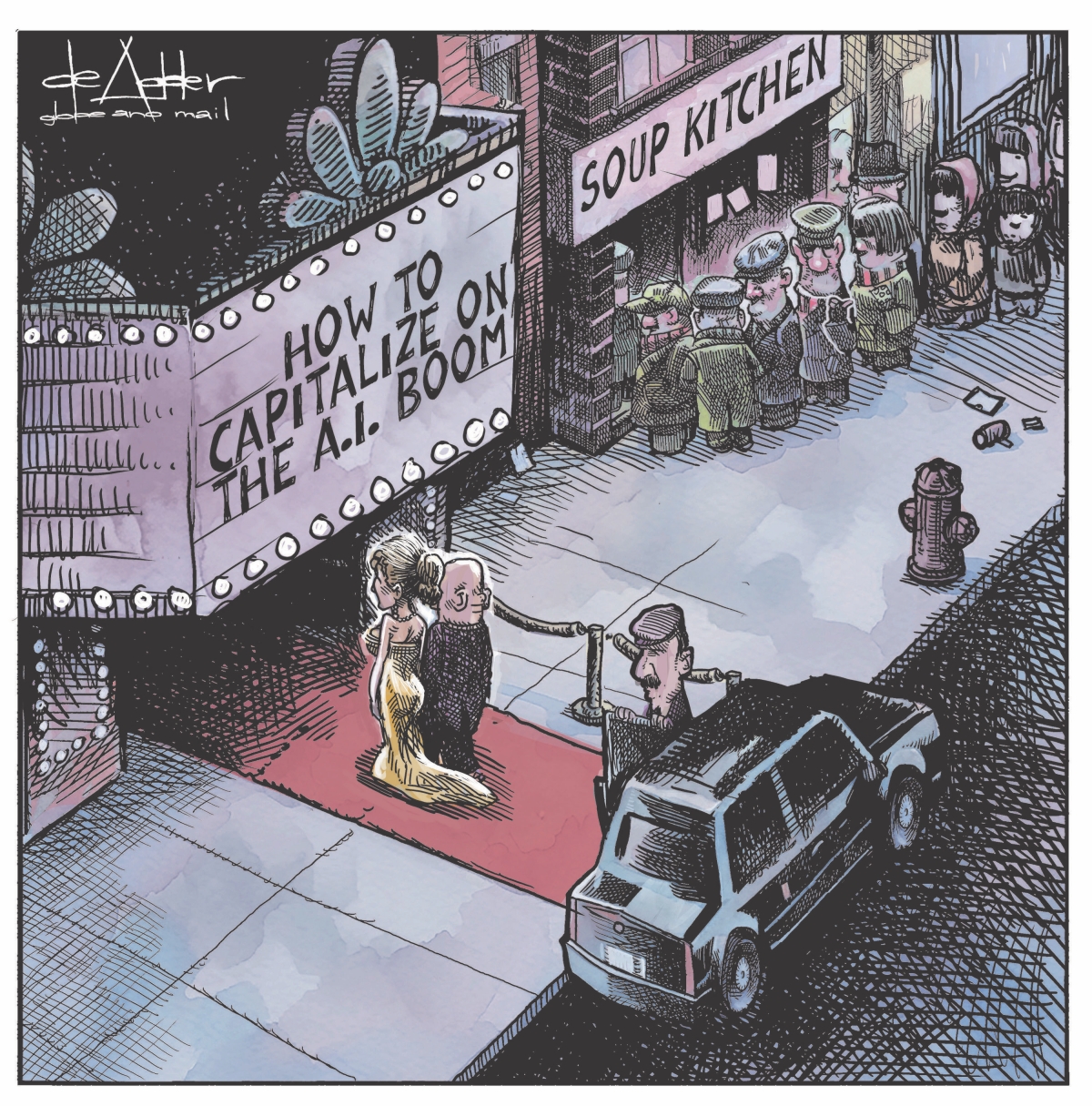
Given the possibility that AI could drive millions more Americans into unemployment, it will be particularly interesting to see whether AI itself might provide a remedy by replacing the current market for labor with a planned employment system.
AI might provide a universal employment agency that could match interested job-seekers with employers. Perhaps it could eliminate unemployment with greatly shortened work weeks for everybody. As my grandmother used to say, “Many hands make light work.”
Getting from here to there (wherever “there” is) will be a major challenge. It will be interesting to see how all this plays out.
Comments

Powered by RoundtableAn AI/DeFi-powered Enterprise Media Operating System. Learn more at Roundtable.io.© Roundtable 2026. By using this site you agree to the Terms of Use and Privacy Policy