


Feb 17, 2026 5:43 AM
Updated Feb 17, 2026 11:40 PM
From racialized foreclosure and eviction to policing and containment, Skid Row reveals how “planned precarity” shapes who falls into homelessness—and who benefits from keeping it that way.
Fifteen years ago, Dick and I drove six and a half miles from our home to a nonprofit meeting in Skid Row. In Los Angeles, that’s a short trip. But proximity isn’t awareness.
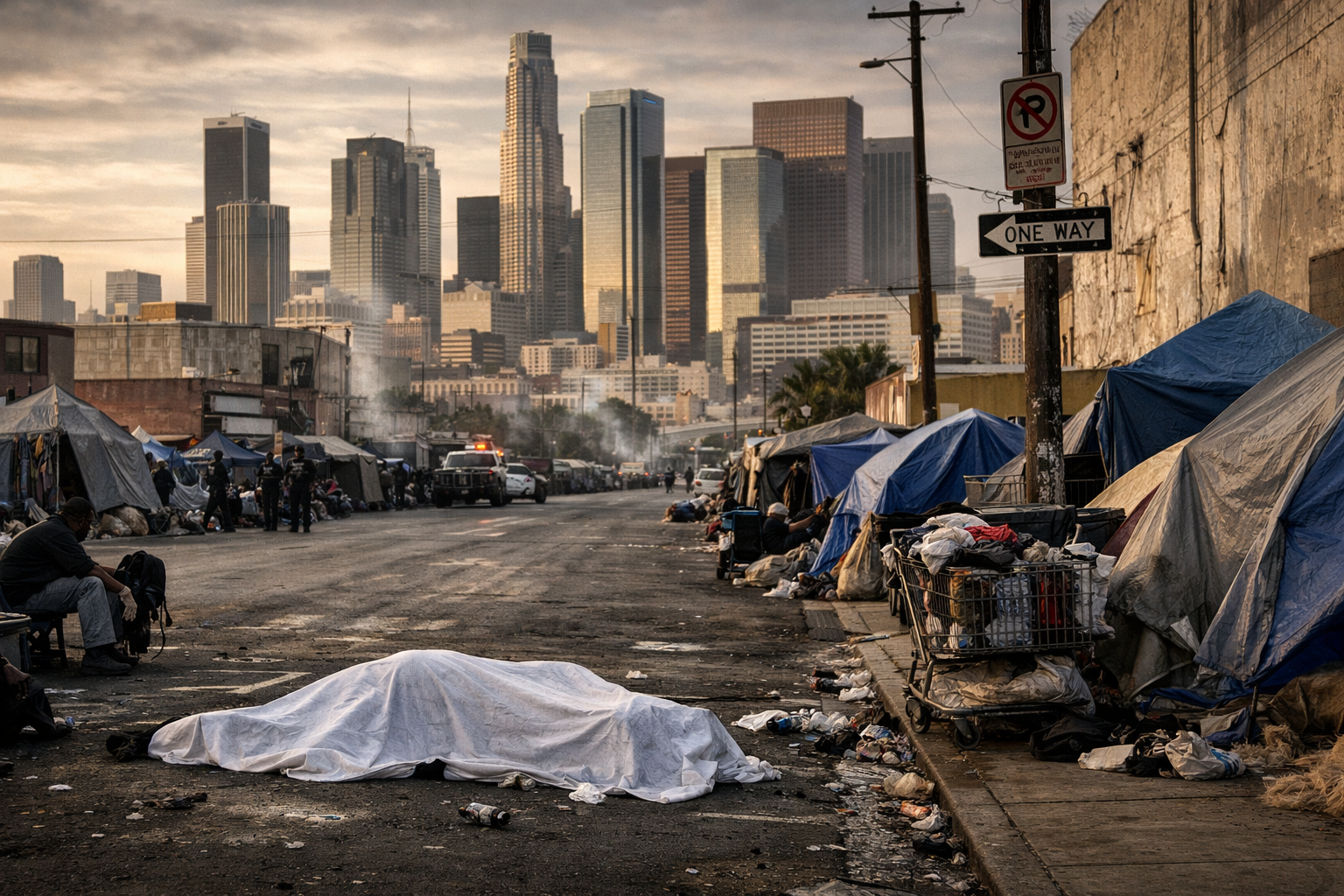
When we passed 6th Street, something in me gave way. Tents stretched for blocks. People were visibly sick. Exhausted. Forgotten. Most were Black.
This was not a famine zone. Not a failed state. This was one of the wealthiest metropolitan regions on earth.
Today we mark the passing of Rev. Jesse Jackson — a giant in the fight for human and civil rights. In one of his most enduring lines, he declared, “I was born in the slum, but the slum wasn’t born in me.” Born in 1941 in South Carolina, he devoted his life to confronting the moral stain of poverty and racial exclusion.
Related stories
He will be remembered. He will be honored. And he should be.
But standing on 6th Street that day, I was not witnessing individual failure. I was witnessing design.
An American who spent most of his adult life in East Germany, Victor Grossman, offered a stark comparison in his memoir -- a book I am currently reading. Grossman passed away eight weeks ago after living in Germany for decades. Reflecting on life in the former German Democratic Republic, he wrote:
“No-one slept in the streets or went begging.”
He wasn’t claiming perfection. He was describing policy. Jobs were guaranteed. Rents were low. Evictions were forbidden. Housing was treated as a social obligation, not a speculative commodity.
Grossman explained why that mattered to him personally:
“These things meant a lot to me because I was raised feeling for people who were down and out, the underdog, people who were in trouble.”
That line hits hard.
Because what I saw in Skid Row was a city — and a nation — that has normalized people sleeping in the streets. Begging. Deteriorating in plain sight.
This is not about charity. It is not about individual resilience. It is not even about inspiration.
It is about structure.
What I call planned precarity is not random hardship. It is instability engineered into the system — housing treated as an asset class, wages detached from living costs, public capacity hollowed out — while stability is carefully protected for those already secure.
If Rev. Jackson taught us that dignity can survive the slum, our era forces a harder truth: in modern America, the slum itself is administered.
Los Angeles does not have one of the largest concentrated homeless populations in the nation because it cannot solve homelessness.
It has it because we have accepted homelessness as a management strategy. Housing is more fundamental than roads, highways, hospitals, or airports — because without shelter, none of those systems matter — yet we govern it as if it were a “nice to have” instead of the core public infrastructure that it is.
Skid Row is not a failure of resources.
It is a revelation of priorities.
And that should unsettle everyone
The answer is not only moral. It is structural.
Skid Row is not just a neighborhood. It is a diagnostic tool. It reveals how power, race, and economic design intersect. And what it reveals should concern anyone who cares about democracy, markets, or basic social stability.
Skid Row Is Not an Accident
Homelessness is often dismissed as the unavoidable result of:
- Mental illness
- Addiction
- Personal failure
- A tight housing market
But Skid Row is not simply the tragic collision of those forces.
There are structural reasons people without housing are not distributed evenly across Los Angeles. Instead, they are concentrated in a highly visible zone of extreme instability. That concentration is not incidental. It shapes how risk is absorbed, how responsibility is assigned, and how urgency is managed within the city’s political economy.
In my Democracy Project work, I call this planned precarity — not because someone sits in a back room designing suffering, but because systems tolerate instability under specific conditions: when it is isolated and when that isolation stabilizes the broader order.
Planned precarity is simple: instability is allowed to persist because, in some way, it benefits someone or protects something more powerful than the people experiencing it.
Precarity means survival is unreliable. It appears as instability in:
- housing
- income
- health access
- legal security
- mortality risk
When that instability is concentrated, normalized, and politically sustained rather than eliminated, it becomes structural.
That is where Foothold Theory enters.
A foothold forms when concentrated precarity becomes stable enough to support the broader system. It is a zone where instability is:
- concentrated,
- familiar,
- tolerated,
- bounded from triggering systemic reform,
- and useful to entrenched interests.
Footholds matter because once a society accepts concentrated instability in one place, it gains leverage to preserve broader hierarchies while reducing the urgency to build the capacity that would make survival reliable for everyone.
A Lesson from The Godfather
In the movie, The Godfather, crime bosses debate entering the drug trade. One objects: drugs will poison society. Another reassures him — they will only sell in the colored neighborhoods.
The logic is chilling.
If harm can be confined to a group already treated as marginal - as less than, the moral cost feels lower. The damage appears controlled, quarantined, manageable.
But the drugs do not stay contained. Addiction spreads. Violence escalates. Policing expands. The architecture built to manage “their” crisis reshapes the entire society.
What began as a targeted decision becomes a systemic condition.
Skid Row operates under a similar illusion.
If extreme instability is “over there,” the broader public tolerates it longer. Property markets continue. Political pressure diffuses. The system feels stable.
But containment is not cure.
And instability never stays politely where we assign it.
Why Everyone Should Care
Containment Creates a False Sense of Security
Skid Row concentrates crisis. Tents are clustered downtown rather than dispersed into affluent neighborhoods.
When crisis is concentrated:
- Other districts feel protected.
- Property markets feel insulated.
- Political urgency weakens.
Containment reduces feedback. If homelessness reached wealthier districts at scale, reform would accelerate.
Containment is not resolution. It is postponement.
And postponement compounds cost.
Precarity Shapes Behavior
Skid Row may be geographically avoidable, but it is culturally visible — in news cycles, campaigns, and public debate.
It sends a message:
“This is what falling out looks like.”
Fear of downward mobility influences behavior:
- Accept unstable work.
- Tolerate rising rents.
- Avoid risk.
- Support punitive “order” policies.
The visible edge disciplines the slope above it.
Racial Inequality Determines Who Falls First
Skid Row is not racially neutral.
Black residents are roughly 8–9% of Los Angeles County’s population but account for about one-third of its unhoused residents. They are four to five times more likely to experience homelessness than white residents.
These disparities reflect decades of:
- Segregation
- Employment discrimination
- Subprime lending
- Higher eviction rates
- Intergenerational wealth gaps
When housing tightens, those with the least inherited cushion fall first.
Racial hierarchy lowers the political cost of concentrated instability.
That weakens democratic equality.
Enforcement Expands Faster Than Housing
Governments facing instability can build capacity — or expand enforcement.
It is faster to increase policing than to build housing at scale.
Los Angeles has oscillated for decades:
- Invest in housing.
- Grow impatient.
- Lean into enforcement.
- Repeat.
Once enforcement tools normalize, they rarely remain confined.
Instability Is Contagious
The 2007–2008 foreclosure crisis stripped wealth disproportionately from Black homeowners. Evictions cascaded. Those with family assets doubled up. Those without fell further.
Instability moves:
- Through rental markets.
- Through healthcare systems.
- Through labor markets.
- Through mortality rates.
No modern city is insulated from systemic fragility.
Skid Row Tests Governance
During COVID-19, Project Roomkey moved thousands of unhoused residents into hotel rooms within weeks.
That proved something critical:
Capacity exists.
And that realization is what led me to write this piece.
If one of the richest cities in the world can mobilize housing at scale during an emergency, it has the material capacity to house its population.
So why doesn’t it?
Because:
- Housing construction moves slower than market displacement.
- Zoning battles and neighborhood opposition block scale.
- Financing supportive housing is complex and layered.
- Enforcement is administratively simpler than redesign.
- Property markets reward scarcity.
- Public urgency fades after crisis moments.
- Racialized instability lowers the political cost of delay.
Building capacity requires sustained commitment across election cycles.
Managing precarity requires far less.
So the city oscillates.
Capacity is possible.
Full activation is political.
The Real Answer
So why should everyone care that Los Angeles has one of the largest Skid Row communities in the nation?
Because Skid Row is not only about homelessness.
- It is about how risk is distributed.
- How protection is allocated.
- Who receives stability.
- Who absorbs instability.
In The Godfather, harm was imagined as containable. It was not.
Skid Row poses the same test.
If extreme precarity can persist in one of the wealthiest regions in the world, then security anywhere is more fragile than we admit.
Containment can slow feedback.
It cannot eliminate interdependence.
And that is what came back to me on 6th Street — the recognition that what I was seeing was not separate from the rest of the city, but structurally connected to it.
We have built systems that protect prosperity with extraordinary efficiency. But in doing so, we risk building two tracks of justice: one that cushions those with wealth, influence, or institutional protection, and another that falls hardest on the poor and the publicly visible.
In some communities, surveillance expands and Fourth Amendment protections feel thinner. In others, power can insulate misconduct from meaningful consequence. When enforcement and protection diverge along lines of race, class and influence, democracy strains.
The question is not whether Los Angeles has the capacity to solve this problem. We have already proven that it does.
The question is what we are willing to tolerate.
Rev. Jesse Jackson insisted that the slum did not have to define the human spirit. He believed dignity could outlive deprivation. But what happens when deprivation is no longer accidental? What happens when the slum is not inherited — but administered?
In The Godfather, the crime bosses convinced themselves that harm could be contained — that it could be sold “over there,” to people already treated as disposable. They believed containment meant control.
They were wrong.
The harm spread. The violence expanded. The tools built to manage one neighborhood reshaped the whole society.
Skid Row operates on the same illusion.
If instability can be concentrated downtown — in a place tourists avoid and property markets route around — the rest of the city feels safe. But containment is not cure. It is a delay tactic.
And delay is not neutral.
The day I drove past 6th Street, what broke in me was not just sorrow. It was recognition.
Recognition that what I was seeing was not separate from the rest of Los Angeles — it was foundational to it.
We have built a system that protects prosperity with precision. But protection for some, built on tolerated collapse for others, is not stability. It is imbalance disguised as order.
Skid Row is not an anomaly.
It is a mirror.
It reflects who absorbs risk.
Who receives insulation.
Who is policed.
Who is protected.
Who is allowed to fall.
Rev. Jackson said the slum was not born in him.
But if we continue to administer instability — if we continue to treat housing as optional, enforcement as primary, and racialized precarity as politically manageable — then the slum will not stay contained.
It will define us.
And that is the real democratic test.
Comments

Powered by RoundtableAn AI/DeFi-powered Enterprise Media Operating System. Learn more at Roundtable.io.© Roundtable 2026. By using this site you agree to the Terms of Use and Privacy Policy