


Apr 24, 2026 5:54 PM
The world is in fact on the brink of a new era in which the United States can no longer exercise hegemony.
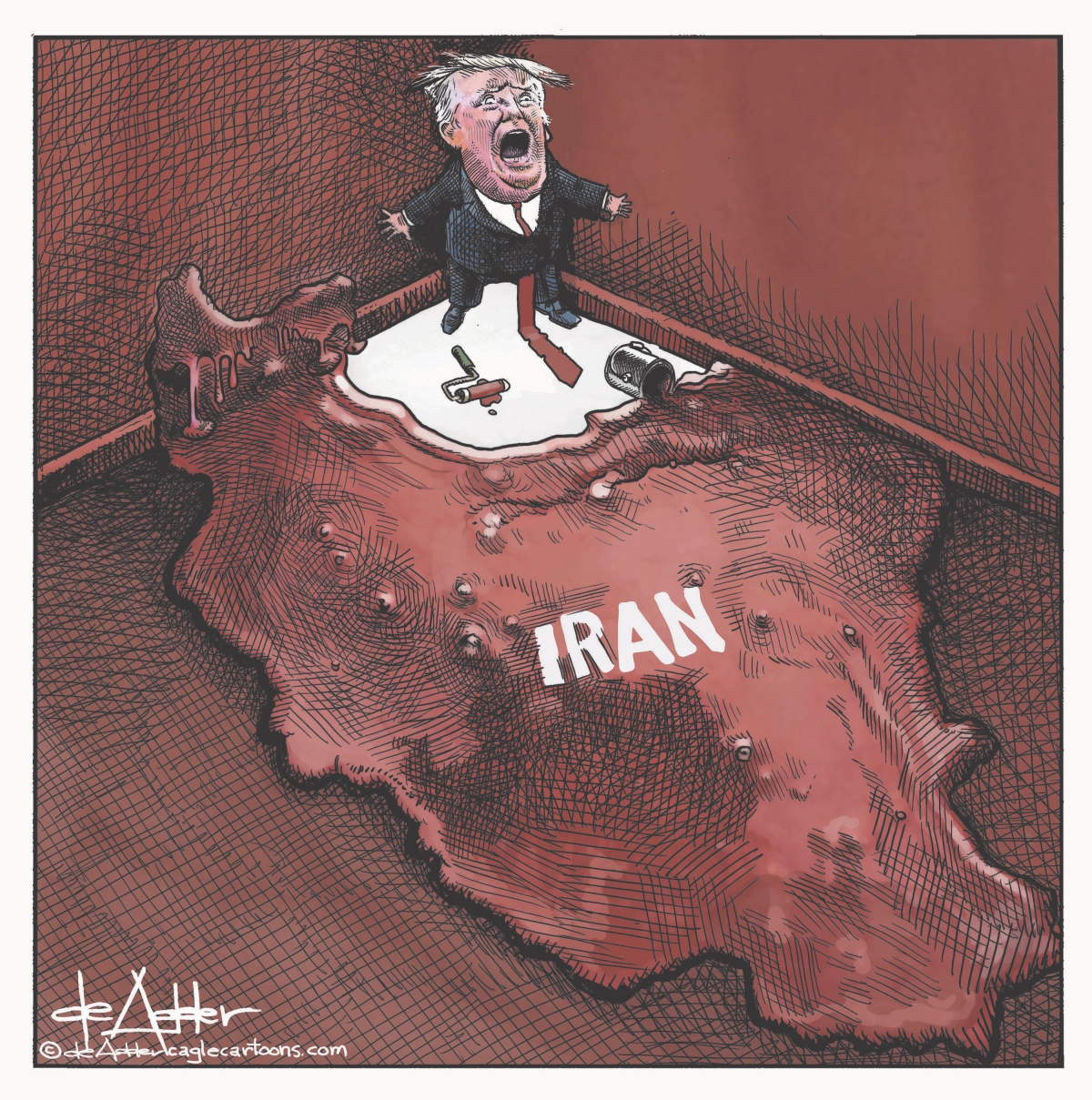
The apocalyptic threats to “destroy a whole civilization” in Iran and bring “epic darkness” to Lebanon backfired after the first weeks of war in West Asia. Instead of collapsing under the ferocious “shock and awe” attacks from the U.S. and Israel, Iran delivered some awesome shocks of its own. Iranian drones and missiles damaged or destroyed 13 U.S. military bases in the Persian Gulf, and hit oil refineries and nuclear facilities in Israel. They disabled critical infrastructure in the Gulf monarchies. And they established control over the Strait of Hormuz, an essential passageway for at least 20 percent of the world’s oil, natural gas and fertilizer.
U.S. war ships had to be deployed hundreds of miles away from the Strait to avoid Iranian drone and missile attacks. That rendered Trump’s “blockade” porous at best. “Our ships are moving in and out of the waters of the Strait of Hormuz,” declared China’s Minister of Defense Admiral Dong Jun. This made the regional conflict a global standoff. Both China and Russia support Iran.
Boisterous blustering from Trump and “war secretary” Hegseth about U.S. military achievements rang hollow despite “success” killing Iranian leadership and more than 160 schoolgirls, as well as destroying civilian infrastructure ― all war crimes. Following a suspended first round of ceasefire negotiations, Trump conducted a free style series of social media posts and impromptu media chats, often self-contradictory and consistently denied by Iran’s top negotiator. A New York Times report said “The president has often made overly optimistic claims about the war.”
Both Trump and “war secretary” Hegseth claimed “victory” and threatened to attack more if they don’t get “a deal” limiting Iran’s nuclear potential ― even demanding that Iran give all its nuclear material to the U.S. Unlike Israel, Iran does not possess nuclear weapons. Iran’s Supreme Leader, Ali Khamenei, who was killed in the first U.S.-Israeli bomb attacks, had a long-standing, publicized religious decree (fatwa) forbidding the production, stockpiling, and use of nuclear weapons, calling them haram (forbidden). Trump’s focus on the nuclear issue is a red herring, a propaganda ploy.
Related stories
Iran’s new supreme leader Mojtaba Khamenei issued a statement after the suspended first round of negotiations saying “We were absolutely certain that you requested a ceasefire to replenish your ships and weapons after your air defense stockpiles ran out… We tell you that the stockpiles you will bring in within two weeks will be depleted in just two days, because we possess a stockpile of missiles and drones that you cannot exhaust for at least 10 years...”
The Iranian leader added: “We promise you that we will have the upper hand in the resumption of the war. We will not wait for you to arrive; we will begin striking Tel Aviv with all our might, and we will leave no energy center operational there…” Israel’s continued assaults on Lebanon following the ceasefire killed hundreds of villagers, injuring thousands more and destroying their homes.
Iran’s President Pezeshkian sent a “letter to the American people” on April 1, saying “The Iranian people harbor no enmity toward other nations, including the people of America, Europe, or neighboring countries. Even in the face of repeated foreign interventions and pressures throughout their proud history, Iranians have consistently drawn a clear distinction between governments and the people they govern. This is a deeply rooted principle in Iranian culture and collective consciousness — not a temporary political stance.”
Pezeshkian suggested that “America has entered this aggression as a proxy for Israel, influenced and manipulated by that regime.” He said “Israel, by manufacturing an Iranian threat, seeks to divert global attention away from its crimes toward the Palestinians,” adding that “Israel now aims to fight Iran to the last American soldier and the last American taxpayer dollar — shifting the burden of its delusions onto Iran, the region, and the United States itself in pursuit of illegitimate interests.”
How long the war will continue following the ineffectual ceasefire and inconclusive negotiations is unpredictable. During the U.S.-Vietnam war, negotiations began in 1968, culminating in 1973 with a peace agreement through which most U.S. troops left. The war then continued with U.S. support and direction of Vietnamese puppet troops for another two years until final U.S. withdrawal in 1975.
VIPs Issue “Open Letter” Condemning U.S. Doctrine of “Absolute Predation”
In mid-April a group of nearly 200 VIPs from 30 countries issued a blistering open letter condemning the U.S.-Israeli war on Iran. The former UN officials, career diplomats, former ministers, parliamentarians, military professionals, scholars and others described the current U.S. posture as “an expansionist strategy aimed at dominating global resources” — a “demonic creed of ‘everything for us, nothing for others’.” It says “U.S. policy now fixates on Iran because the country possesses over seven percent of the world’s mineral and energy wealth. The war on Iran,” the letter says, is “another sign of the moral collapse of the U.S.-led West which finds its nadir in the genocide in Gaza and is embodied in the vulgar figure of President Trump.” It calls for “a new international order centered on sovereignty and resistance to Western domination.”
The open letter says that “For 249 years — spanning the entirety of its existence since 1776 — the United States built a record of atrocity that belonged to a darker, pre-civilized age; the predatory empire erected on the corpses of nations; from the genocide of nearly five million Indigenous peoples, to the brutal enslavement of over four million Africans, to the lynching of more than 4,000 Black citizens under Jim Crow.”
“With shameless rapacity,” the letter says, the U.S. “claims the resources of the world — whether the oil of Venezuela, the mineral wealth of Greenland, or the energy reserves of Canada — as objects of strategic entitlement. And now, that gluttonous eye fixates on Iran, because Iran, possessing over seven percent of the world’s mineral and energy wealth, is seen as the final frontier of plunder.”
The Role of Resistance in the United States
On March 28, exactly a month after the U.S. and Israel attacked Iran, more than five million people mobilized across the country in hundreds of cities and towns. “Stop This War” was not an official slogan, but it roared from the tens of thousands of protesters in Minneapolis-St. Paul, along with calls to end ICE killings and brutalization of both migrants and citizens alike, which culminated in a general strike there in January. There were also many “Tax Day” protests on April 15, protesting the use of tax dollars to fund wars, genocide and immigration enforcement.
Calls for soldiers to refuse illegal orders have mushroomed among both the rank-and-file and officers. The huge aircraft carrier USS Ford was marooned in a Greek harbor after being disabled either by Iranian fire or internal sabotage, or both. A group of top commanders from the Iraq war produced a video in 2025 telling military personnel it is “their right and their duty” to disobey illegal orders. Trump condemned this as “sedition,” meriting the death penalty.
Retired Lieutenant General Mark Hertling, who commanded the 1st Armored Division in Iraq in 2007 and the U.S. Army-Europe during the Obama administration, said U.S. top officers are feeling tensions between their loyalty to the U.S. Constitution, to superior officers and to soldiers they command. He said this at the same time Trump declared the U.S. would “bomb Iran back to the Stone Ages” by destroying essential infrastructure — itself a war crime. It’s notable that Trump agreed to a ceasefire the same night he had promised the “Stone Age” bombing, which followed the loss of numerous U.S. aircraft and personnel in a botched landing which had the goal of capturing Iran’s uranium supply. Senior officers had advised against that adventure.
In the fall of 2025 Admiral Alvin Holsey, head of U.S. Southern Command in the Caribbean Sea (which was blowing up civilian motorboats, killing the anonymous crews) resigned only a year into his command. War secretary Pete Hegseth not only accepted Holsey’s resignation but lectured hundreds of top officers on his new fascist military doctrine, openly calling on them to commit war crimes. On April 2 he forced out Army Chief of Staff General Randy George, and has fired a dozen other top officers, giving no reason, including Joint Chiefs Chairman General CQ Brown, the second African American to hold the job, and Admiral Lisa Franchetti, the first woman to hold the Navy’s top uniformed job.
For rank-and-file soldiers, a 24-hour GI Rights Hotline informs service members of their options for military discharge. Hotline coordinator Steve Woolford told Veterans For Peace “Our phones are busier than ever, with the biggest increase in calls coming from military members who are opposed to the ways the US military is currently being used.”
Mike Prysner, an Iraq War combat veteran and now director of the Center on Conscience and War, said, “The number one thing cited by our callers as a breaking point for them was the U.S. bombing of the Minab girls’ elementary school That was the moment they realized, ‘I’m not going to take part in the killing of children’.”
He added “When the U.S. and Israel launched the war against Iran there was a shift. We used to get a handful of calls a week; now it’s three or four a day…people with really accomplished careers, in very elite jobs like Special Forces, Top Gun fighter pilots, physicians, surgeons. … Our highest-ranking CO client right now is a major in the military.”
Veterans For Peace is also reaching out to active-duty troops, publicizing the troops’ right to disobey illegal orders. VFP has launched an billboard campaign:
These billboards are posted near military bases, including Fort Benning, GA, Fort Drum, NY, Norfolk Naval Station, VA, Travis AFB, CA, 29 Palms Marine Base, CA, Great Lakes Naval Base, IL, Wright Patterson AFB, OH, Fort Campbell, KY, U.S. drone base in Aguadilla, Puerto Rico, as well as New Orleans, Tucson, San Diego, and Portland, OR.
U.S. Army Colonel Lawrence Wilkerson (Retired), said in support of the VFP campaign, “No officer, warrant officer, non-commissioned officer or enlisted man or woman should carry out an order they know is illegal. Instead, they should carry their objection to the next higher person in the chain of command — and continue doing so until they get to an individual in that chain who will support them — even if they have to go all the way to the Commander-in-Chief.”
VFP President Susan Schnall recalled that “Many soldiers refused orders in Vietnam, Iraq, Afghanistan and most recently to protest U.S. support of Israel’s genocide in Gaza.” The former Navy nurse was featured in the documentary “Sir, No Sir!” for disobeying orders and protesting the war in Vietnam. “We know it takes courage. We also know we have to live with ourselves and our consciences long after military service.”
On April 20, some 150 veterans and military members occupied the capitol rotunda in Washington, demanding that Congress force an end to the war on Iran.
The group About Face: Veterans Against the War issued a statement: “For nearly two months the Trump administration has driven an illegal, catastrophic war on Iran which has murdered thousands of Iranians, destroyed critical civilian infrastructure, and threatened total annihilation of Iran’s civilization. They have sent thousands of our brothers, sisters, and family members to fight and die for the sake of American domination of Iran and the region. It is time for Congress to end this war. The cost is too high.”
Historical Comparisons
As the Soviet Union began to collapse in 1990, Francis Fukuyama called it “the end of history,” and George H.W. Bush announced a “new world order” with the United States as global hegemon. His first move was to launch “Desert Storm” against Iraq, in a bid to exert total U.S. control over the region’s petroleum resources. A decade later George W. Bush “junior” not only ordered a full-scale invasion and war on Iraq, but also launched a new Cold War against Russia, renewing U.S. efforts to dismember the world’s geographically largest country and seize its resources. That effort morphed into the largest European war since World War II, as U.S. Presidents Bush, Obama, Biden and Trump all pressed on with aggressive efforts to expand NATO to Russia’s borders and revive Ukrainian fascists to fight a proxy war against Russia.
Now the world could be entering a new era. The global economy faces severe strain caused by shortages of oil, gas and fertilizers. Gasoline prices are as high or higher in the U.S. and elsewhere than they were during the catastrophic energy crisis of the 1970s. Recession or depression loom for the U.S., its G7 allies and much of the Global South. Notable exceptions are China, Russia, and their BRICS allies, including Iran. The almighty dollar — or the Petrodollar instituted back in 1973 — is losing its dominant status for international trade. That alone is an existential threat to the Western capitalist economies, but a boon to countries that have been strangled with debt caused by the need to pay for fuel, fertilizer and food imports in dollars.
Can Losing a War End an Empire?
Losing a war does not necessarily lead to the end of an empire. It didn’t when the U.S. withdrew from Afghanistan in a pell-mell retreat in 2021. It didn’t when the U.S. withdrew from Vietnam in 1975, after two decades of war that caused millions of Vietnamese deaths and tens of thousands of U.S. casualties. It didn’t when the U.S.-Korean War ended in a truce in 1953 that was not a final peace treaty, meaning the U.S. and the South and North Koreans are still in a state of war today.
In these two Asian wars the U.S. was also threatening China, which helped both its allies. Now, after nearly a half century of uncertain peace and economic cooperation between the U.S. and China, there is a constant push for war against China, often focused on a fight over Taiwan. Since 1971 the U.S. has officially recognized Taiwan as part of China, while at the same time arming it to the teeth and advocating for its “independence.” Recent developments are confused, as Trump continues efforts to sustain essential trade with China while at the same time half a million U.S. troops surround China, armed with missiles, war ships, aircraft and nuclear submarines. Few observers believe the U.S. could win a war against China, but U.S. leaders remain determined to stop China’s rise. It’s a fool’s errand.
In 2021 China signed a 25-year “Comprehensive Strategic Partnership” with Iran, committing to invest hundreds of millions in the country’s petroleum industry, transportation and manufacturing infrastructure, in exchange for commitments to import large amounts of oil from Iran. The deal helped Iran import Chinese satellite and communications technology, which became strategic assets for its air defenses and for targeting its drones and missiles.
In the case of Iraq, U.S. forces were officially withdrawn in 2011, but returned in 2014, only to be bogged down in endless war with no clear outcome other than continued resistance. Now Iraqi popular forces form part of the Axis of Resistance in alliance with Iran, Hezbollah in Lebanon, the Palestinian resistance forces led by Hamas and Islamic Jihad, and Ansar Allah in Yemen.
The outcome of the current conflict threatens to be dramatically different. As the open letter cited above says, “the United States has made a fatal miscalculation. What stands before it is not merely a nation, but a civilization…” with “ancient organizational genius fused with 21st-century scientific sovereignty… a global pole of power that dictates the terms of engagement, forcing strategic retreat by rewriting the very rules of active defense… Iran’s all-encompassing defense and active deterrence represent a golden opportunity to end global hegemony.”
Loss of control of the Strait of Hormuz, along with damage to the Gulf oil monarchies, has brought the world economy to the brink of collapse. Oil and natural gas are essential to all countries. Their scarcity is bringing crisis to the entire world. Nearly all these countries are seeking solutions outside the grip of the U.S. empire. The BRICS countries, led by China, Russia and Iran, are trading among themselves in local currencies and increasingly using the Chinese yuan.
The world is in fact on the brink of a new era in which the United States can no longer exercise hegemony. That is indeed truly a new world order, perhaps an era of peace and common prosperity.
Comments

Powered by RoundtableAn AI/DeFi-powered Enterprise Media Operating System. Learn more at Roundtable.io.© Roundtable 2026. By using this site you agree to the Terms of Use and Privacy Policy