
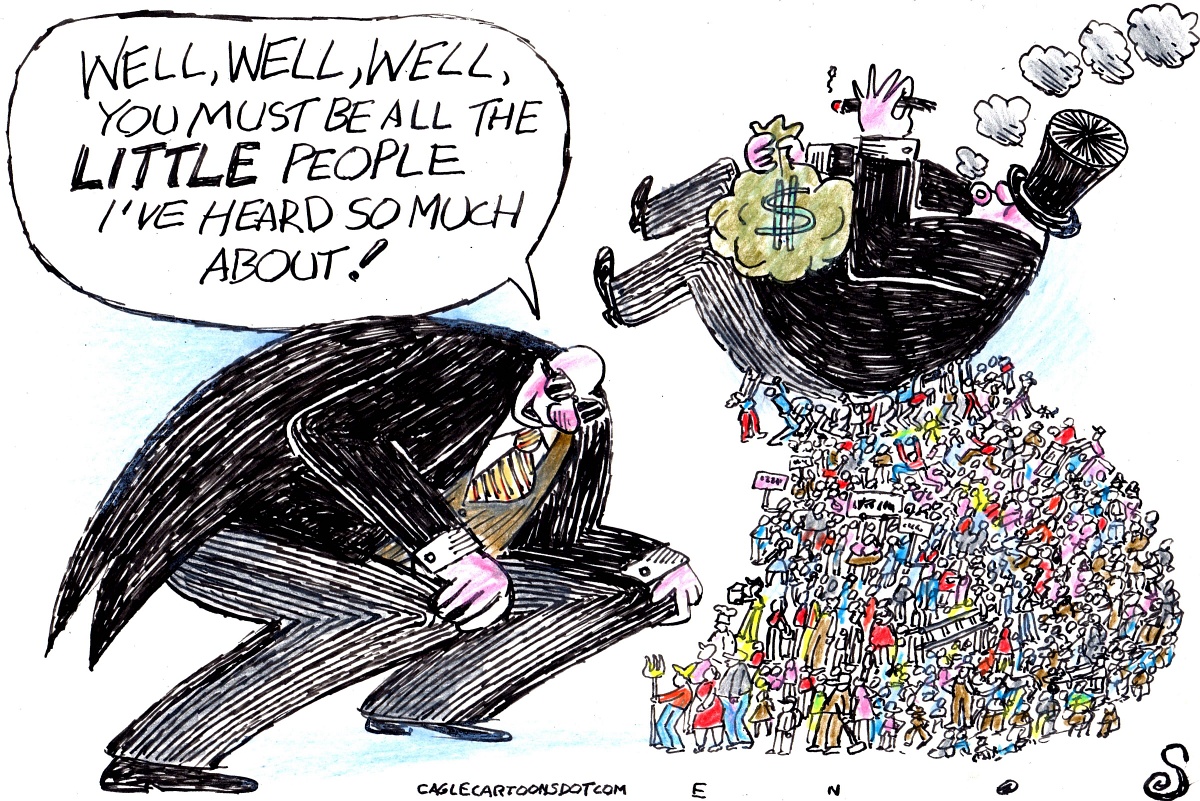
Cagle Cartoons: Randall Enos


Seeking Profits
Sep 20, 2024 2:23 PM
The main problem with having profits dominate our economic thinking is that such a single-minded pursuit can kill us, destroy our environment, or allow vast discrepancies in wealth.
Conservative capitalist economist Milton Friedman once wrote, “The social responsibility of business is to increase its profits.” Was he right? Let’s look at the case of Steward Health Care.
Earlier this month (of September) the PBS News Hour featured a segment on it. In it host William Brangham interviewed The Boston Globe's Mark Arsenault, who was part of the paper’s team that investigated the company’s 30 plus hospitals. Here is part of what Arsenault revealed.
“Steward Health Care was founded in Boston in 2010, when a private equity firm known as Cerberus Capital Management bought six hospitals.” Steward then bought up more properties and in 2016 made a deal with a “a real estate investment trust from Alabama.” According to the agreement, Steward sold much of the property on which the hospitals sat “and then leased them back, which generated a bunch of money for Steward, more than a billion dollars, most of which went to dividends, not into hospital reinvestment, but also straddled these community hospitals with significant rent lease payments.”
Arsenault went on to indicate that Steward failed its patients in two ways, shortages of staff—including nurses, doctors, and specialists—and “oftentimes routine equipment, supplies, maintenance on machines and even maintenance on buildings.” The shortages often meant that needed procedures were delayed. The investigative team found 15 cases where a person died because “Steward hospital that did not meet professionally accepted standards due to a lack of staff or a lack of supplies and equipment.”
Related stories
One shortage case that Arsenault mentioned was that of a 31-years-old man whom the doctors indicated “needed one-on-one monitoring continuously.” But the Steward hospital, short of staff, could not provide it. “So when his heart stopped, there was nobody there. . . . to resuscitate him, nobody there to raise an alarm.” And he died.
While Steward suffered from shortages, its CEO did not. The Boston Globe reported that Ralph De la Torre often used the company’s jet and his own yacht for private pleasure trips in the Caribbean and Europe. “Passengers included . . . [his] fishing friends, a luxury yacht salesman, and high-profile horse trainers. . . . In many, if not all, instances, the private jet excursions were paid for by Steward . . . the funds pulled directly from the coffers of one of the nation’s largest . . . for-profit, private hospital chains.”
At about the same time as the above interview, a new book appeared by Thomas Piketty, who a decade ago had written the influential Capital in the Twenty-First Century. This French economist’s new book is entitled Nature, Culture and Inequality: A Comparative Historical Perspective. In an essay/interview about it, New York Times reporter Manuela Andreoni stated that “many countries, Piketty argues, were largely successful in expanding access to health care and education by taking these parts of the economy out of purely capitalist frameworks.
She then asked Piketty if he was suggesting that climate change should also “be taking out of the profit logic system because it’s a public good?” To which he responded, “Yes, exactly. At some point we have to replace market valuation by a sort of political valuation . . . to try to decide what’s valuable for us.”
Replacing the profit motive (or “market valuation”) by common-good considerations could apply to other areas besides climate, education, and health care, but instead we often see areas go in the opposite direction. Take, for example, for-profit prisons or an email I recently received (from Action Network) that began, “Louisiana, with its nine immigrant detention centers, eight of them run by for-profit corporations, has become a modern-day hell for migrants. These centers are designed to generate profit, not to provide care.”
Piketty’s response above suggests that Friedman was wrong when he wrote, “The social responsibility of business is to increase its profits.” Part of the social obligation of business is to recognize that to further the common good some areas have to witness (as Piketty pointed out) that profit and market valuation have to be replaced by political considerations. And the main purpose of politics—Pope Francis and many others have believed (see here and here)—is to further the common good.
For over a century, some critics of capitalism have recognized that the common good must come before profits. Take, for example, the U. S. Progressives of the 1890-1914 period. As one historian described it, their movement desired “to limit the socially destructive effects of morally unhindered capitalism, to extract from those [capitalist] markets the tasks they had demonstrably bungled, to counterbalance the markets’ atomizing social effects with a countercalculus of the public weal [well-being].” It wanted to constrain capitalism so that it served the common good.
A few decades later, President Franklin Roosevelt perceived himself as following in the tradition of earlier Progressives. And about three decades after FDR’s death, the British economist and environmentalist E. F. Schumacher (1911-1977) wrote, “Out of the large number of aspects which in real life have to be seen and judged together . . . [Western] economics supplies only one—whether a thing yields a money profit. . . . It does not even generally ask ‘whether an activity carried on by a group within society yields a profit to society as a whole.’” A half century before Piketty, Schumacher was also concerned about the environment. Western economics, he thought, failed to adequately consider “the availability of basic resources and, alternatively or additionally, the capacity of the environment to cope with the degree of interference implied.” By advertising and marketing, it also encouraged a “frenzy of greed and . . . an orgy of envy.” His conclusion? Humans were in danger of building up “a monster economy, which destroys the world.”
Decades after Schumacher wrote these words, writer Wendell Berry expressed sentiments similar to his and Piketty’s when speaking about his own grandfather and James B. Duke (1856-1925) and his American Tobacco Company:
Corporate industrialism has exposed the falsehood that . . . it ever has given precedence to the common good. . . . Among its characteristic signs are destroyed communities, neighborhoods, families, small businesses, and small farms. It has failed just as conspicuously and more dangerously to conserve the wealth and health of nature. No amount of fiddling with capitalism to regulate and humanize it, no pointless rhetoric on the virtues of capitalism or socialism . . . can for long disguise this failure. The evidences of it are everywhere: eroded, wasted, or degraded soils; damaged or destroyed ecosystems; extinction of species; whole landscapes defaced, gouged, flooded, or blown up; pollution of the whole atmosphere and of the water cycle; “dead zones” in the coastal waters; thoughtless squandering of fossil fuels and fossil waters, of mineable minerals and ores; natural health and beauty replaced by a heartless and sickening ugliness.
Just a year after Berry’s statement (in 2013) Pope Francis wrote that capitalism is a: “system, which tends to devour everything which stands in the way of increased profits, whatever is fragile, like the environment, is defenseless before the interests of a deified market, which become the only rule.”
Yet, despite all the reminders about seeking the common good, gaining a profit often rules our minds, or at least those of capitalist corporations, overwhelming any concern for public welfare. Time and again we see this demonstrated.
Why is this so? What prevents the USA, as Piketty suggests, from having common-good considerations prioritized over profitability ones when it comes to areas like health, education, and the environment? I would suggest—FEAR. Fear of “big government.” Fear of socialism. When FDR introduced Social Security, some opponents cried, “Socialism.” When Lyndon Johnson pushed for Medicare, the same opposition cry was heard.
For various reasons many of our citizens, especially older ones, have come to believe that socialism is bad and capitalism good. (In early 2019, President Donald Trump warned that socialism “promises unity, but it delivers hatred and it delivers division. Socialism promises a better future, but it always returns to the darkest chapters of the past. That never fails. It always happens. Socialism is a sad and discredited ideology rooted in the total ignorance of history and human nature.”) Such hostility partly explains why in his debate with Vice President Harris, Trump said, “She’s a Marxist. Everybody knows she’s a Marxist.” Moreover, many people do not distinguish between communist socialism, as existed in the USSR, and democratic socialism, which has existed in many Scandinavian countries and been embraced by U. S. Senator Bernie Sanders.
Socialism has also been linked with “big government,” which many of our fellow citizens fear more than corporate profit prioritizing—when asked at the end of the twentieth century whether he would keep or eliminate fourteen U. S. cabinet departments, economist Friedman (who once advised President Reagan) responded he would eliminate most of them, including those overseeing commerce, education, energy, and labor. Such opposition also stems from “big government” being associated with higher taxes. (In his interview Pikittey praised Sweden for bringing health and education under common-good rather than profit criteria, but also recognized that people had to pay higher taxes to do so.)
The main problem with having profits dominate our economic thinking is that such a single-minded pursuit can kill us, destroy our environment, or allow vast discrepancies in wealth. Three years ago on this LAP site some of these evils were emphasized in "Is Capitalism Killing Our Planet and Our Concern for the Common Good?”
The essay mentioned Purdue Pharma’s marketing of the opioid OxyContin and how that corporation “put profits first. Before any ethical considerations. Before the interests of people. Even if it killed them.” Many of which it did. The article also referred to Boeing (profits before safety), Pacific Gas & Electric (guilty of starting California wildfires), and Facebook as companies that put (in the words of a Facebook whistle-blower) “astronomical profits before people.”
Regarding our vast “discrepancies in wealth,” Piketty’s new book argues that reducing the great wealth gap is essential to grappling with our climate crisis. And he furnishes such statistics as the following: “The top 10 percent of the richest people in the world account for almost half of global emissions.” (See also Nobel-Prize-winning economist Joseph Stiglitz’s The Price of Inequality for earlier reflections on the harm of widening economic discrepancies.)
In the U. S. especially, the gap in recent decades has been growing worse. As Sen. Bernie Sanders emphasized a little over a year ago, “the richest three billionaires [are now] owning more wealth than the bottom half of our society—165 million people. Today, the top 1 percent owns more wealth than the bottom 92 percent and the CEOs of major corporations earn four hundred times what their employees make.”
Although Sanders considers himself a democratic socialist, he operates politically more like an updated FDR, especially of the 1944 kind who told Congress that “freedom cannot exist without economic security and independence.” In 2001, in order to clarify the type of economy the U. S. had, the State Department declared that though we are “often described as a ‘capitalist’ economy,” we are “perhaps better described as a ‘mixed’ economy, with government playing an important role along with private enterprise.” Whatever we call our economy, we want it to be fair and moral. And it can only be that if it puts the common good first, not profit-making.
Comments

Powered by RoundtableAn AI/DeFi-powered Enterprise Media Operating System. Learn more at Roundtable.io.© Roundtable 2026. By using this site you agree to the Terms of Use and Privacy Policy